

U.S. Senators Ed Markey and Richard Blumenthal asked the National Highway Traffic Safety Administration on June 16, 2026, to scrutinize Tesla’s public Full Self-Driving safety claims after reporting challenged the math behind the company’s crash-rate comparisons. The request is not just another round in Washington’s long argument with Elon Musk’s car company. It is a test of whether software-defined transportation can keep grading itself while its code is already operating on public roads. If Tesla wants Full Self-Driving to be treated like infrastructure, the numbers behind it have to survive infrastructure-grade scrutiny.
Tesla has long sold autonomy as a story about scale. The company’s core argument is that millions of vehicles, millions of miles, and constant telemetry give it a safety-learning loop that rivals cannot easily copy. Full Self-Driving, now branded as Full Self-Driving (Supervised), sits at the center of that claim: a system that is not legally autonomous for consumer use, but is marketed as a path toward autonomy and measured by Tesla as if it can already prove a safety advantage.
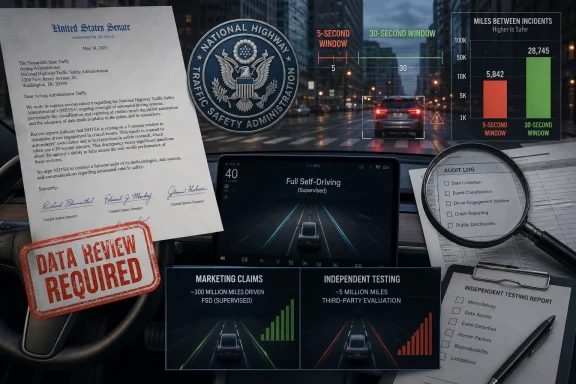
The disputed claim is blunt enough to travel well in investor decks and social media posts: Tesla says FSD can be several times safer than human driving, with the company pointing to roughly 5.5 million miles between major collisions compared with about 660,000 miles for the U.S. average. That kind of comparison has obvious rhetorical power. It suggests that hesitation about wider deployment is not caution but irrational resistance to a safer technology.
Markey and Blumenthal are attacking the hinge of that argument. Their letter presses NHTSA to determine whether Tesla’s public statistics are statistically valid, methodologically sound, and grounded in data that regulators can independently evaluate. The senators are not merely asking whether Tesla’s software crashes; they are asking whether Tesla’s public safety narrative is itself becoming a safety risk.
That distinction matters. A flawed chart in an investor presentation is one thing. A flawed chart that convinces drivers to trust a supervised system as if it were unsupervised is another. In automated driving, the marketing layer is part of the control system, because it shapes how the human behind the wheel behaves.
The senators want to know whether NHTSA has examined the underlying data, assumptions, crash definitions, exposure metrics, and methodology Tesla uses to generate its public FSD statistics. That is the right place to look, because a crash-rate comparison can be technically true and still deeply misleading. If one side of the comparison counts only severe collisions while the other includes a broader class of crashes, the resulting ratio may say more about the accounting than the technology.
The timing window is especially important. Tesla says that, for its safety report, it counts a collision as FSD-engaged if FSD was active at any point within five seconds before the collision event. The senators contrast that with NHTSA’s Standing General Order reporting framework, which uses a broader 30-second window for certain crashes involving advanced driver-assistance or automated-driving systems. A five-second window can exclude cases in which the system disengaged shortly before impact, precisely when the handoff between automation and human driver may be most consequential.
Tesla supporters will argue that the shorter window avoids blaming FSD for crashes after a driver has retaken control. That is not an absurd point. But it is also exactly why regulators need to see the data rather than accept the marketing. If disengagements cluster just outside the reporting window, the safety claim becomes less a measure of real-world risk than a product of where the stopwatch starts.
Telemetry introduces another ambiguity. Tesla’s fleet can collect enormous amounts of operational data, but the senators ask whether reliance on automated telemetry could omit crashes or safety incidents when connectivity is unavailable or communication systems are damaged. Again, the issue is not whether Tesla has data. It is whether the data are complete enough, comparable enough, and auditable enough to support public claims that drivers, regulators, and lawmakers are likely to treat as evidence.
That compromise has always been unstable. The phrase Full Self-Driving invites the driver to imagine a system that drives itself; the word Supervised pulls the driver back into legal responsibility. The result is a product name that contains its own contradiction, and a user experience that depends on the driver understanding which half of the phrase matters in a given moment.
California’s recent action against Tesla’s driver-assistance branding shows why regulators are no longer willing to treat names as cosmetic. The California DMV found Tesla’s use of Autopilot and Full Self-Driving language misleading, and Tesla avoided a threatened sales suspension by changing its marketing in the state. That was not a mere semantic dispute. It was an official recognition that overpromising vehicle capability can alter consumer behavior in ways that have safety consequences.
For WindowsForum readers, the software analogy is obvious. We do not let a backup tool call itself disaster recovery if it silently excludes half the system drive. We do not accept an endpoint agent’s dashboard as proof of protection if its detection logic is opaque and its false-negative rate is untested. When software touches safety-critical systems, naming, telemetry, and auditability stop being marketing concerns and become operational controls.
Tesla’s challenge is that it wants consumer software iteration speed in a domain that still requires aviation-style accountability. Over-the-air updates are genuinely powerful; they can patch defects, add capability, and standardize improvements across a fleet faster than the old recall model ever could. But rapid iteration does not eliminate the need for independent validation. It increases it, because the product being evaluated may change faster than the public can understand it.
The senators’ new pressure adds another layer. They are not only asking whether the system has defects. They are asking whether Tesla’s public claims may obscure defects by presenting an overly clean safety picture. That is a subtler but potentially broader regulatory question.
If NHTSA accepts self-published safety ratios without auditing the inputs, it risks letting companies define their own safety baseline. If it challenges those ratios too aggressively without clear standards, it risks creating a regulatory gray zone where every public comparison becomes legally hazardous. The answer is not for regulators to ban safety claims. The answer is for safety claims about semi-automated driving to be reproducible.
That means common definitions for crash severity, consistent treatment of disengagements, transparent exposure metrics, and some mechanism for verifying whether the dataset captures incidents that matter. A company should be free to say its system is improving. But if it says the system is seven or ten times safer than human driving, regulators should be able to ask: safer by which measure, against which population, under which conditions, and with which exclusions?
This is the kind of regulatory plumbing that rarely makes headlines but determines whether a technology scales responsibly. The automated-driving industry has spent years arguing that miles alone are a crude measure of maturity. That is true. But once companies choose to make miles-between-crashes claims, they cannot then treat the details as proprietary decoration.
That European thread is important, but it does not settle the argument. In fact, it reinforces the senators’ central point. The strongest defense of FSD approval in the Netherlands is not that Tesla’s chart was persuasive; it is that the regulator did its own work. Independent testing, defined operating conditions, and local-road evaluation are exactly what distinguish a public-safety assessment from a vendor sales pitch.
The U.S. problem is messier because deployment is fragmented. Federal regulators oversee vehicle safety defects and reporting requirements, while states control many operational rules for testing and commercial deployment. Texas can create a permissive environment for robotaxi expansion while New Jersey considers tighter limits and California polices marketing language. The result is not a single national autonomy policy but a patchwork of incentives.
Tesla thrives in that patchwork. The company can point to Texas as proof that driverless deployment is real, California as proof that regulators are hostile to innovation, and Europe as proof that independent authorities can validate the system. Each argument contains a piece of truth. None eliminates the need for a common evidentiary standard for public safety claims.
The question is not whether FSD can perform impressively in some environments. It plainly can. The question is whether Tesla’s broad safety claims fairly represent the range of environments, driver behaviors, disengagement patterns, and failure modes that define public-road risk.
There is force to that critique. Badly written state rules can freeze technology around today’s assumptions and protect incumbents under the banner of safety. A law that treats every autonomous system as identical, or demands compliance mechanisms unrelated to actual risk, can slow useful deployment without making roads safer.
But Tesla’s problem is that it keeps asking regulators to trust performance while resisting the level of transparency that would make performance the governing metric. If the company wants rules based on real-world safety rather than checklists, it should welcome rigorous third-party evaluation of its real-world safety claims. The alternative is a trust-us model dressed up as data-driven policy.
New Jersey also exposes the politics of autonomy. Local lawmakers do not want to explain after a crash why they deferred to a company’s internal statistics. Companies do not want fifty different state regimes telling them how to deploy one software stack. Federal regulators are caught between those pressures, trying to evaluate defects and reporting practices without becoming the de facto national licensing board for autonomous operations.
This is why the senators’ letter matters beyond Tesla. It asks whether federal reporting rules are strong enough for a market where driver-assistance and driverless systems are converging in public perception even when they remain legally distinct. If NHTSA cannot verify the claims companies use to justify deployment, state lawmakers will fill the vacuum with their own restrictions.
That argument is too tidy. Human factors are not an afterthought in automated driving; they are the battlefield. If a system performs well enough to lull drivers into confidence but not reliably enough to handle rare edge cases, the design has created a predictable supervision problem. The better the system gets, the harder that problem becomes, because human attention is notoriously poor at monitoring highly reliable automation for sudden exceptions.
This is why safety claims have operational consequences. A driver who believes FSD is many times safer than human driving may supervise differently from a driver who believes it is a beta-like assistance feature with known limitations. The difference may be subtle: a longer glance at a phone, a slower reaction to a confusing maneuver, a tendency to let the car “figure it out” for another second. In a moving vehicle, another second is not trivial.
The term supervised autonomy is itself a warning sign. It describes a system that can appear autonomous most of the time but still depends on a human fallback who may be least prepared at the moment intervention is needed. That does not mean the technology is doomed. It means the safety case cannot rest on aggregate miles alone.
A mature safety case would separate driving domains, weather conditions, road types, driver-attention states, software versions, and crash severities. It would acknowledge uncertainty rather than flatten it into a single “X times safer” number. Tesla’s talent is making complex technology feel simple. Regulators are now asking whether that simplicity has become misleading.
Automotive safety is harsher because the failures are physical. A bad Windows update may brick a laptop fleet and ruin an administrator’s week. A bad vehicle automation assumption can put pedestrians, passengers, and other drivers in the blast radius. The comparison is not meant to trivialize either domain; it is meant to highlight that software governance patterns are now migrating into transportation.
Tesla pioneered the car as a rolling software platform. That achievement is real. The company made over-the-air updates normal, turned vehicles into data-generating endpoints, and forced legacy automakers to move faster. But the same architecture that lets Tesla improve quickly also lets it define, measure, and narrate performance from inside a closed loop.
That closed loop is what lawmakers are challenging. They are not asking Tesla to stop collecting data. They are asking NHTSA to verify whether the data support the public claims Tesla makes. In any other safety-critical software domain, that would be an ordinary governance expectation.
For sysadmins and security professionals, the lesson is familiar: self-attestation is not assurance. It may be useful, but it is not enough when the stakes are high and the incentives are obvious. Vendors can be sincere and still choose flattering metrics. Engineers can be brilliant and still build dashboards that omit ugly edge cases. Leaders can believe in the mission and still oversell the maturity of the product.
This is a harder test than a viral demo. It requires stable definitions and ugly disclosures. It requires saying where the system performs poorly, not just where it performs brilliantly. It requires distinguishing between consumer FSD, supervised operation, and robotaxi deployments that may use related software under different operating rules.
Tesla’s Texas robotaxi expansion sharpens the issue. Once a company operates uncrewed rides commercially, the distinction between driver assistance and autonomy becomes more than a label. If similar branding, software heritage, or public claims connect those systems in consumers’ minds, regulators will examine the whole ecosystem rather than each product page in isolation.
The company can still win this argument. If its data are sound, independent review could strengthen Tesla’s position and weaken efforts to impose blunt restrictions. A credible audit showing strong performance under defined conditions would be more persuasive than another safety ratio floating through social media. The risk for Tesla is that independent scrutiny reveals not catastrophic failure but methodological overreach: a gap between a promising technology and the grand claims made on its behalf.
That gap is where regulators live. It is also where public trust goes to die if companies refuse to narrow it.
 Tesla’s Safety Pitch Has Become a Regulatory Problem
Tesla has long sold autonomy as a story about scale. The company’s core argument is that millions of vehicles, millions of miles, and constant telemetry give it a safety-learning loop that rivals cannot easily copy. Full Self-Driving, now branded as Full Self-Driving (Supervised), sits at the center of that claim: a system that is not legally autonomous for consumer use, but is marketed as a path toward autonomy and measured by Tesla as if it can already prove a safety advantage.The disputed claim is blunt enough to travel well in investor decks and social media posts: Tesla says FSD can be several times safer than human driving, with the company pointing to roughly 5.5 million miles between major collisions compared with about 660,000 miles for the U.S. average. That kind of comparison has obvious rhetorical power. It suggests that hesitation about wider deployment is not caution but irrational resistance to a safer technology.
Markey and Blumenthal are attacking the hinge of that argument. Their letter presses NHTSA to determine whether Tesla’s public statistics are statistically valid, methodologically sound, and grounded in data that regulators can independently evaluate. The senators are not merely asking whether Tesla’s software crashes; they are asking whether Tesla’s public safety narrative is itself becoming a safety risk.
That distinction matters. A flawed chart in an investor presentation is one thing. A flawed chart that convinces drivers to trust a supervised system as if it were unsupervised is another. In automated driving, the marketing layer is part of the control system, because it shapes how the human behind the wheel behaves.
The Fight Is About Denominators, Not Just Driver Behavior
The public debate around Tesla’s driver-assistance systems often collapses into anecdotes: one driver says FSD handled a complex intersection beautifully, another posts a clip of a near miss, and everyone retreats to their priors. Regulators, however, live in the less glamorous world of denominators, definitions, and reporting windows. That is where Tesla’s safety claims become vulnerable.The senators want to know whether NHTSA has examined the underlying data, assumptions, crash definitions, exposure metrics, and methodology Tesla uses to generate its public FSD statistics. That is the right place to look, because a crash-rate comparison can be technically true and still deeply misleading. If one side of the comparison counts only severe collisions while the other includes a broader class of crashes, the resulting ratio may say more about the accounting than the technology.
The timing window is especially important. Tesla says that, for its safety report, it counts a collision as FSD-engaged if FSD was active at any point within five seconds before the collision event. The senators contrast that with NHTSA’s Standing General Order reporting framework, which uses a broader 30-second window for certain crashes involving advanced driver-assistance or automated-driving systems. A five-second window can exclude cases in which the system disengaged shortly before impact, precisely when the handoff between automation and human driver may be most consequential.
Tesla supporters will argue that the shorter window avoids blaming FSD for crashes after a driver has retaken control. That is not an absurd point. But it is also exactly why regulators need to see the data rather than accept the marketing. If disengagements cluster just outside the reporting window, the safety claim becomes less a measure of real-world risk than a product of where the stopwatch starts.
Telemetry introduces another ambiguity. Tesla’s fleet can collect enormous amounts of operational data, but the senators ask whether reliance on automated telemetry could omit crashes or safety incidents when connectivity is unavailable or communication systems are damaged. Again, the issue is not whether Tesla has data. It is whether the data are complete enough, comparable enough, and auditable enough to support public claims that drivers, regulators, and lawmakers are likely to treat as evidence.
“Supervised” Is Doing More Work Than It Should
Tesla’s current naming convention is doing a lot of legal and rhetorical labor. Full Self-Driving (Supervised) tells drivers that the car may perform much of the driving task, but that a human must remain responsible. It is a compromise label, one that tries to preserve the ambition of the old brand while acknowledging the operational reality.That compromise has always been unstable. The phrase Full Self-Driving invites the driver to imagine a system that drives itself; the word Supervised pulls the driver back into legal responsibility. The result is a product name that contains its own contradiction, and a user experience that depends on the driver understanding which half of the phrase matters in a given moment.
California’s recent action against Tesla’s driver-assistance branding shows why regulators are no longer willing to treat names as cosmetic. The California DMV found Tesla’s use of Autopilot and Full Self-Driving language misleading, and Tesla avoided a threatened sales suspension by changing its marketing in the state. That was not a mere semantic dispute. It was an official recognition that overpromising vehicle capability can alter consumer behavior in ways that have safety consequences.
For WindowsForum readers, the software analogy is obvious. We do not let a backup tool call itself disaster recovery if it silently excludes half the system drive. We do not accept an endpoint agent’s dashboard as proof of protection if its detection logic is opaque and its false-negative rate is untested. When software touches safety-critical systems, naming, telemetry, and auditability stop being marketing concerns and become operational controls.
Tesla’s challenge is that it wants consumer software iteration speed in a domain that still requires aviation-style accountability. Over-the-air updates are genuinely powerful; they can patch defects, add capability, and standardize improvements across a fleet faster than the old recall model ever could. But rapid iteration does not eliminate the need for independent validation. It increases it, because the product being evaluated may change faster than the public can understand it.
NHTSA Is Being Asked to Audit the Story, Not Just the System
NHTSA is already investigating aspects of Tesla’s FSD performance, including how the system behaves in reduced-visibility conditions. That probe was escalated earlier this year to a more serious engineering analysis, a step that usually indicates regulators have moved beyond preliminary concern and are gathering deeper technical evidence. The agency has been looking at crashes where FSD allegedly failed to detect degraded roadway visibility or did not provide sufficient warning to the driver.The senators’ new pressure adds another layer. They are not only asking whether the system has defects. They are asking whether Tesla’s public claims may obscure defects by presenting an overly clean safety picture. That is a subtler but potentially broader regulatory question.
If NHTSA accepts self-published safety ratios without auditing the inputs, it risks letting companies define their own safety baseline. If it challenges those ratios too aggressively without clear standards, it risks creating a regulatory gray zone where every public comparison becomes legally hazardous. The answer is not for regulators to ban safety claims. The answer is for safety claims about semi-automated driving to be reproducible.
That means common definitions for crash severity, consistent treatment of disengagements, transparent exposure metrics, and some mechanism for verifying whether the dataset captures incidents that matter. A company should be free to say its system is improving. But if it says the system is seven or ten times safer than human driving, regulators should be able to ask: safer by which measure, against which population, under which conditions, and with which exclusions?
This is the kind of regulatory plumbing that rarely makes headlines but determines whether a technology scales responsibly. The automated-driving industry has spent years arguing that miles alone are a crude measure of maturity. That is true. But once companies choose to make miles-between-crashes claims, they cannot then treat the details as proprietary decoration.
Europe’s “Yes” Does Not End the U.S. Argument
Tesla allies have pointed to the Netherlands as evidence that U.S. skepticism is political rather than technical. Dutch authorities have approved FSD under their own framework, and officials have emphasized that their decision was based on independent RDW testing rather than Tesla’s self-published marketing statistics. Vehicles operating locally have reportedly accumulated millions of kilometers without noteworthy incidents, giving Tesla supporters a ready-made counterpoint to Washington’s suspicion.That European thread is important, but it does not settle the argument. In fact, it reinforces the senators’ central point. The strongest defense of FSD approval in the Netherlands is not that Tesla’s chart was persuasive; it is that the regulator did its own work. Independent testing, defined operating conditions, and local-road evaluation are exactly what distinguish a public-safety assessment from a vendor sales pitch.
The U.S. problem is messier because deployment is fragmented. Federal regulators oversee vehicle safety defects and reporting requirements, while states control many operational rules for testing and commercial deployment. Texas can create a permissive environment for robotaxi expansion while New Jersey considers tighter limits and California polices marketing language. The result is not a single national autonomy policy but a patchwork of incentives.
Tesla thrives in that patchwork. The company can point to Texas as proof that driverless deployment is real, California as proof that regulators are hostile to innovation, and Europe as proof that independent authorities can validate the system. Each argument contains a piece of truth. None eliminates the need for a common evidentiary standard for public safety claims.
The question is not whether FSD can perform impressively in some environments. It plainly can. The question is whether Tesla’s broad safety claims fairly represent the range of environments, driver behaviors, disengagement patterns, and failure modes that define public-road risk.
New Jersey Shows the Next Battlefield Is State Power
The federal request arrives as Tesla is fighting state-level restrictions in New Jersey, where proposed bills would impose tighter rules on autonomous vehicle testing and operation. Tesla has framed the measures as overly rigid and anti-competitive, warning owners that the rules could make true driverless deployment effectively illegal in the state. That is a familiar industry argument: performance should matter more than prescriptive process.There is force to that critique. Badly written state rules can freeze technology around today’s assumptions and protect incumbents under the banner of safety. A law that treats every autonomous system as identical, or demands compliance mechanisms unrelated to actual risk, can slow useful deployment without making roads safer.
But Tesla’s problem is that it keeps asking regulators to trust performance while resisting the level of transparency that would make performance the governing metric. If the company wants rules based on real-world safety rather than checklists, it should welcome rigorous third-party evaluation of its real-world safety claims. The alternative is a trust-us model dressed up as data-driven policy.
New Jersey also exposes the politics of autonomy. Local lawmakers do not want to explain after a crash why they deferred to a company’s internal statistics. Companies do not want fifty different state regimes telling them how to deploy one software stack. Federal regulators are caught between those pressures, trying to evaluate defects and reporting practices without becoming the de facto national licensing board for autonomous operations.
This is why the senators’ letter matters beyond Tesla. It asks whether federal reporting rules are strong enough for a market where driver-assistance and driverless systems are converging in public perception even when they remain legally distinct. If NHTSA cannot verify the claims companies use to justify deployment, state lawmakers will fill the vacuum with their own restrictions.
Tesla’s Real Risk Is Over-Reliance Masquerading as Adoption
Tesla’s defenders often treat driver over-reliance as user error. The company tells drivers to supervise FSD. The vehicle monitors attention. The warnings are there. If someone treats the system as autonomous when it is not, the argument goes, that is misuse.That argument is too tidy. Human factors are not an afterthought in automated driving; they are the battlefield. If a system performs well enough to lull drivers into confidence but not reliably enough to handle rare edge cases, the design has created a predictable supervision problem. The better the system gets, the harder that problem becomes, because human attention is notoriously poor at monitoring highly reliable automation for sudden exceptions.
This is why safety claims have operational consequences. A driver who believes FSD is many times safer than human driving may supervise differently from a driver who believes it is a beta-like assistance feature with known limitations. The difference may be subtle: a longer glance at a phone, a slower reaction to a confusing maneuver, a tendency to let the car “figure it out” for another second. In a moving vehicle, another second is not trivial.
The term supervised autonomy is itself a warning sign. It describes a system that can appear autonomous most of the time but still depends on a human fallback who may be least prepared at the moment intervention is needed. That does not mean the technology is doomed. It means the safety case cannot rest on aggregate miles alone.
A mature safety case would separate driving domains, weather conditions, road types, driver-attention states, software versions, and crash severities. It would acknowledge uncertainty rather than flatten it into a single “X times safer” number. Tesla’s talent is making complex technology feel simple. Regulators are now asking whether that simplicity has become misleading.
The Software Industry Has Seen This Movie Before
The Windows world has spent decades learning that telemetry can illuminate a system and conceal it at the same time. Crash dumps, endpoint signals, update success rates, and threat detections are invaluable, but every metric is shaped by collection logic. If a machine cannot phone home, if a sensor is disabled, if a crash happens outside the logging window, the dashboard becomes a partial map mistaken for the territory.Automotive safety is harsher because the failures are physical. A bad Windows update may brick a laptop fleet and ruin an administrator’s week. A bad vehicle automation assumption can put pedestrians, passengers, and other drivers in the blast radius. The comparison is not meant to trivialize either domain; it is meant to highlight that software governance patterns are now migrating into transportation.
Tesla pioneered the car as a rolling software platform. That achievement is real. The company made over-the-air updates normal, turned vehicles into data-generating endpoints, and forced legacy automakers to move faster. But the same architecture that lets Tesla improve quickly also lets it define, measure, and narrate performance from inside a closed loop.
That closed loop is what lawmakers are challenging. They are not asking Tesla to stop collecting data. They are asking NHTSA to verify whether the data support the public claims Tesla makes. In any other safety-critical software domain, that would be an ordinary governance expectation.
For sysadmins and security professionals, the lesson is familiar: self-attestation is not assurance. It may be useful, but it is not enough when the stakes are high and the incentives are obvious. Vendors can be sincere and still choose flattering metrics. Engineers can be brilliant and still build dashboards that omit ugly edge cases. Leaders can believe in the mission and still oversell the maturity of the product.
The Autonomy Debate Is Moving From Capability to Accountability
For years, the central question about Tesla FSD was whether the software could drive well enough. That question has not disappeared, but it is no longer sufficient. The better question is whether Tesla can prove safety in a way that regulators, courts, insurers, and the public can trust.This is a harder test than a viral demo. It requires stable definitions and ugly disclosures. It requires saying where the system performs poorly, not just where it performs brilliantly. It requires distinguishing between consumer FSD, supervised operation, and robotaxi deployments that may use related software under different operating rules.
Tesla’s Texas robotaxi expansion sharpens the issue. Once a company operates uncrewed rides commercially, the distinction between driver assistance and autonomy becomes more than a label. If similar branding, software heritage, or public claims connect those systems in consumers’ minds, regulators will examine the whole ecosystem rather than each product page in isolation.
The company can still win this argument. If its data are sound, independent review could strengthen Tesla’s position and weaken efforts to impose blunt restrictions. A credible audit showing strong performance under defined conditions would be more persuasive than another safety ratio floating through social media. The risk for Tesla is that independent scrutiny reveals not catastrophic failure but methodological overreach: a gap between a promising technology and the grand claims made on its behalf.
That gap is where regulators live. It is also where public trust goes to die if companies refuse to narrow it.
The Numbers Tesla Needs to Defend Are Now the Product
The practical stakes are clearer than the rhetoric around them. Tesla is not facing a single fight over a single chart; it is facing a convergence of federal oversight, state restrictions, marketing enforcement, and international validation regimes that will decide how fast its autonomy strategy can scale.- Tesla’s claim that FSD is several times safer than human driving depends on crash definitions, exposure metrics, and reporting windows that regulators are now being asked to inspect.
- The five-second FSD engagement window is a central methodological dispute because it may exclude crashes where automation disengaged shortly before impact.
- NHTSA’s existing FSD investigations focus on real-world failure modes, including reduced-visibility scenarios, while the senators’ letter focuses on whether Tesla’s public safety narrative is itself reliable.
- California’s action against Tesla’s Autopilot and Full Self-Driving branding shows that regulators increasingly view marketing language as part of the safety environment.
- European approval in the Netherlands helps Tesla only to the extent that it demonstrates independent testing, not reliance on Tesla’s own promotional statistics.
- State battles such as New Jersey’s proposed restrictions will intensify if federal regulators cannot create trusted, comparable reporting standards for automated-driving claims.
References
- Primary source: Not a Tesla App
Published: Tue, 16 Jun 2026 21:12:00 GMT
Lawmakers Urge NHTSA to Investigate Tesla's FSD Safety Claims - Not a Tesla App
U.S. lawmakers have once again set their sights on Tesla's Full Self-Driving (Supervised) system, this time targeting safety claims regarding the softwarewww.notateslaapp.com - Related coverage: bloomberg.com
- Related coverage: eenews.net
NHTSA expands probe of Tesla’s ‘full self-driving’ mode - E&E News by POLITICO
More than 3 million Teslas would be affected by the inquiry, including the Model S and Cybertruck.www.eenews.net - Related coverage: autoblog.com
- Related coverage: autosafety.org
2026 Tesla Model 3 Recalls, Complaints and Investigations - The Center for Auto Safety
2026 Tesla Model 3 is it safe? Read all complaints, recalls and other safety issues for 2026 Tesla Model 3www.autosafety.org - Related coverage: markey.senate.gov
NHTSA Opens Investigation into Tesla’s Full-Self Driving System After Letter from Senators Markey and Blumenthal
Washington (October 9, 2025) - Senator Edward J. Markey (D-Mass.), a member of the Commerce,... www.markey.senate.gov
- Related coverage: tesla.com
- Related coverage: arstechnica.com
Feds give Tesla another five weeks to respond to FSD probe - Ars Technica
Regulators want to know why Tesla's system ignores red lights and runs into traffic.arstechnica.com - Related coverage: blumenthal.senate.gov
[2025-09-30] Senators Blumenthal & Markey Push Trump Administration to...
[Hartford, CT] — Today, U.S. Senator Richard Blumenthal (D-Conn.) and U.S. Senator Edward J. Markey (D-Mass.) wrote to Jonathan Morrison,...www.blumenthal.senate.gov
- Related coverage: nhtsa.gov
- Related coverage: automotivesafetycouncil.org
- Related coverage: ir.tesla.com
- Related coverage: latimes.com
DMV decides not to suspend Tesla sales in California over deceptive marketing
California regulators determined this week that Tesla is no longer using deceptive marketing to advertise its supervised self-driving features.www.latimes.com - Related coverage: theguardian.com
Tesla avoids California sales ban by removing ‘autopilot’ from marketing | Tesla | The Guardian
State regulators walk back suspension threat and say Tesla has stopped misleading drivers about the safety of its carswww.theguardian.com - Related coverage: techcrunch.com
Tesla brings its robotaxi service to Dallas and Houston | TechCrunch
The company now offers robotaxi service in three cities, all of them in Texas, after launching in Austin last year and starting to offer rides without safety drivers in January 2026.techcrunch.com - Related coverage: teslanorth.com
Tesla Launches Unsupervised Robotaxi Service in Dallas and Houston | TeslaNorth.com
Tesla has officially expanded its unsupervised Robotaxi service to Dallas and Houston, marking a significant step in the company's autonomous driving ambitions. The rollout uses Model Y vehicles equipped with the latest Full Self-Driving software to navigate city streets without a safety... teslanorth.com
- Related coverage: caranddriver.com
Tesla Drops "Autopilot" Name After Legal Pressure from California
After the California DMV threatened to strip Tesla of its dealer license, the automaker changed the way it markets its driver assistance features.www.caranddriver.com
- Related coverage: electrek.co
Tesla avoids 30-day California sales suspension after dropping misleading 'Autopilot' marketing | Electrek
Tesla has avoided a 30-day suspension of its dealer and manufacturer licenses in California after complying with a DMV order... electrek.co
- Related coverage: evwire.com
Tesla rolls out robotaxi service in Dallas and Houston, without safety operators. Here's all you need to know
Tesla launches fully unsupervised robotaxi service in Dallas and Houston. Model Y vehicles operate without safety drivers, offering rides ~56% cheaper than Waymo competitors.evwire.com - Related coverage: sourcedwire.com
Tesla Expands Unsupervised Robotaxi Service to Dallas and Houston | Sourced Wire
Tesla announced on April 18 that its unsupervised Robotaxi service is now operating in Dallas and Houston, bringing the total to three US cities after Austin's launch in mid-2025. The initial Dallas service covers eight neighborhoods; Houston is limited to two.sourcedwire.com - Related coverage: vfuturemedia.com
Tesla Robotaxi Goes Fully Driverless in Dallas & Houston: Autonomous Era Begins
Tesla launches fully driverless Robotaxi in Dallas and Houston. Explore how FSD autonomy is scaling, safety concerns, and what it means for urban mobility.vfuturemedia.com - Related coverage: gearmusk.com
Tesla Robotaxi Launches Unsupervised Rides in Dallas and Houston — Expansion Incoming - Gear Musk
Tesla's Robotaxi is now live in Dallas and Houston with zero safety drivers. See which cities are next — and what it means for Cybercab.gearmusk.com
- Related coverage: teslaoracle.com
Tesla expands Unsupervised Robotaxi service to two new cities in Texas, and it's cheaper than Waymo - Tesla Oracle
Tesla (TSLA) expands its Robotaxi service in two more cities in Texas. Users share videos and cost of the service compared to Waymo, more. www.teslaoracle.com
- Related coverage: creativebloq.com
Tesla ordered to rebrand Autopilot amid false advertising claims | Creative Bloq
The company could face a sales ban in California.www.creativebloq.com
