

Rivian CEO RJ Scaringe said in June 2026 that Rivian plans to bring supervised, Tesla FSD-like point-to-point driving to its Gen 2 vehicles this year, followed by eyes-off autonomy in 2027 and a longer-term push toward driverless robotaxi operation through its Uber partnership. The statement turns Rivian’s autonomy roadmap from a speculative investor slide into a dated product promise. It also puts the company into the same uncomfortable arena Tesla has occupied for years: selling cars today on the credibility of software that must arrive tomorrow.
Rivian is not merely saying that driver-assistance features will improve. It is saying that the R2, the company’s mass-market SUV hope, is being born into a business model where personal transport, fleet economics, and artificial intelligence are supposed to converge. That is a big swing for a company still proving it can manufacture at scale, service customers at scale, and survive the capital demands of the electric vehicle market.
The most important word in Scaringe’s latest autonomy pitch is not robotaxi. It is this year. Tesla has spent nearly a decade training the market to hear autonomy promises as a rolling forecast rather than a delivery schedule, but Rivian does not yet have Tesla’s tolerance cushion with buyers, regulators, or investors.
Scaringe’s description of a supervised point-to-point system puts Rivian directly in the Full Self-Driving comparison lane, even if the company will inevitably use its own branding and caveats. In plain English, the promise is that the vehicle will be able to navigate from one destination to another while the driver remains responsible for supervision. That is not driverless operation, and it is not the car taking legal responsibility for the drive.
The next phase is the more provocative one. Eyes-off driving implies a move beyond the familiar Level 2 bargain, where the system helps but the human remains constantly responsible. If Rivian reaches that stage in 2027, it will be moving into a category where driver attention, operational boundaries, insurance liability, and state-by-state rules matter as much as model performance.
That distinction should matter to buyers. A supervised system can be impressive and still be legally and practically conservative. An eyes-off system asks the customer to trust not only the software but the entire stack behind it: sensors, compute, redundancy, mapping assumptions, driver monitoring, failover logic, and the company’s willingness to say “not here” when conditions are outside the design domain.
That could be a disadvantage. Tesla has mountains of real-world driving data and millions of vehicles providing training signal, interventions, and edge cases. Rivian cannot simply wish that gap away with a slick neural network architecture or a more modern compute platform.
But Tesla’s history is also a warning label. Autonomy roadmaps can become a credibility tax when dates slip, capabilities are renamed, or marketing language outruns driver experience. Rivian has the advantage of having watched another company discover every pothole in this road: overpromising, underexplaining, and letting enthusiasts blur the line between assisted driving and self-driving.
Scaringe’s challenge is therefore rhetorical as much as technical. Rivian needs to persuade buyers that its system is ambitious without making them think the vehicle is more capable than it is. The company has to borrow Tesla’s excitement without inheriting Tesla’s semantic mess.
That is why autonomy matters so much here. If the R2 is merely a smaller, cheaper Rivian, it competes in a crowded field of electric crossovers where price, range, service access, charging, and incentives dominate. If the R2 arrives as a rolling autonomy platform, Rivian can argue that it is not just selling a vehicle but selling an upgrade path.
There is obvious appeal in that framing. A customer who buys an R2 in 2026 may be told that the same hardware foundation could support supervised driving soon, eyes-off driving later, and eventually a world in which the vehicle can do more work on its own. That is the kind of future-facing pitch that can move reservation holders from curiosity to purchase.
It is also the kind of pitch that can create resentment if the roadmap becomes vapor. EV buyers have already learned to distinguish between shipped capability, paid unlocks, software promises, and “hardware ready” optimism. Rivian’s customers are likely to be enthusiastic, but they are not immune to the fatigue that follows when expensive vehicles become vessels for unfinished software narratives.
For Rivian, Normal is the place where the company’s software ambitions meet the cold arithmetic of manufacturing. Autonomy announcements can be made on podcasts; vehicles have to come off lines repeatedly, profitably, and with quality levels that keep service centers from drowning. The R2 ramp is therefore the real test of whether Rivian can support a more ambitious future.
This is especially true because autonomy features do not reduce operational complexity. They add it. Sensors need calibration, compute modules need thermal headroom, wiring harnesses need consistency, and software validation must account for hardware variance. A misbuilt adventure trim is one problem; a miscalibrated autonomy platform is a different category of risk.
Pritzker’s reservation is a useful political symbol, but the more important constituency is not elected officials. It is the first wave of R2 owners who will discover whether Rivian’s manufacturing system can deliver a vehicle sturdy enough for daily life and sophisticated enough for the autonomy roadmap being attached to it.
On paper, that division of labor is sensible. Automakers have historically struggled to become software marketplaces, and platform companies have struggled to build vehicles. A partnership lets each side pretend it can avoid the other’s hardest problem.
But robotaxis are unforgiving because the hardest problem is shared. If the car fails, the rider does not care whether the fault belongs to Rivian’s autonomy stack, Uber’s fleet operations, a maintenance contractor, or a city’s confusing curb rules. The experience collapses into one brand event.
This is why the Rivian-Uber plan should be understood less as an immediate robotaxi breakthrough and more as a long-dated option. It gives Rivian a plausible commercial endpoint for autonomy and gives Uber another supplier in its increasingly diversified autonomous vehicle strategy. It does not prove that Rivian can safely operate driverless vehicles at scale in messy cities.
The words matter. “Hands-free” can still require eyes on the road. “Eyes-off” implies that the vehicle, not the driver’s constant attention, is carrying the immediate operational burden. Even if Rivian restricts such use to certain roads, speeds, weather conditions, or geofenced areas, the feature will need to be explained with painful clarity.
This is where automakers often discover that engineering capability and consumer comprehension are not the same thing. A system can be safe within an operational design domain and dangerous when drivers misunderstand that domain. The manual can be technically correct while the marketing creates the wrong expectation.
For IT pros and security-minded readers, this should sound familiar. Access control systems fail when users misunderstand trust boundaries. Cloud misconfigurations happen when defaults imply more protection than they provide. Vehicle autonomy has a similar interface problem: the danger is not only what the system cannot do, but what the user thinks it can do.
A sensor-rich system can offer redundancy and complementary perception, particularly in poor visibility or complex environments. Radar and lidar can provide forms of spatial awareness that cameras alone must infer. For a company aiming at eyes-off and driverless operation, that redundancy is not just a technical preference; it is part of the safety argument.
The tradeoff is cost and complexity. More sensors mean more parts, more calibration, more failure modes, and more manufacturing discipline. They can strengthen the autonomy case while making the vehicle harder to build cheaply.
That is the central R2 tension. Rivian needs the R2 to be affordable enough to matter and sophisticated enough to justify its autonomy narrative. If the company cannot keep that balance, it risks building either a great EV that cannot support the story or an impressive technology platform that is too expensive to scale.
That sequence is attractive because it lets Rivian develop capability across a growing fleet before asking the public to accept empty vehicles operating for hire. Consumer miles become learning opportunities. Commercial ambitions become a future monetization layer rather than a separate moonshot.
But shared destiny cuts both ways. If consumer autonomy disappoints, the robotaxi story looks premature. If robotaxi testing encounters high-profile failures, consumer confidence in the same underlying platform may suffer. Rivian cannot neatly compartmentalize the two narratives once it has publicly linked them.
The company must also avoid the temptation to treat consumer vehicles as a beta pool in the pejorative sense. Drivers may accept iterative software improvement; they are less forgiving when the improvement process feels like unpaid safety validation. Rivian’s brand has been built around trust, capability, and considered design. Autonomy will test whether that brand can survive more ambiguous software behavior.
Rivian, however, should be careful about becoming “Tesla, but outdoorsy.” Its strongest argument is not that it can mimic Tesla feature for feature. It is that it can build a different kind of EV company: one with stronger design restraint, a more traditional safety posture, and an ownership experience that feels less like participation in a public experiment.
Autonomy complicates that identity. Once Rivian starts promising FSD-like capability, it invites the same social media demo culture, the same edge-case videos, and the same binary fan wars over whether the car “drove itself.” The company may want the valuation benefits of being seen as an AI mobility platform, but it also inherits the attention economy that comes with that label.
That is why Rivian’s messaging over the next year will matter almost as much as the feature itself. If the company describes the system conservatively and ships meaningful capability, it can look disciplined. If it lets the robotaxi halo dominate the ownership pitch, it risks sounding like every other autonomy company that discovered the future is always eighteen months away.
A modern EV is already a rolling endpoint. It has operating systems, update channels, telemetry, identity, certificates, radios, cameras, local inference, remote services, and vendor-controlled feature flags. Autonomy raises the stakes because software failure is no longer a convenience bug or infotainment glitch; it can become a physical-world event.
This is where automakers are being forced into the same disciplines enterprise IT has spent decades learning. Secure update pipelines matter. Rollback strategies matter. Observability matters. Incident response matters. So does the uncomfortable question of who controls the device after the customer buys it.
Rivian’s autonomy roadmap will depend on all of that invisible plumbing. The public will focus on whether the R2 changes lanes smoothly or handles a difficult intersection. The harder technical story is whether Rivian can operate a safety-critical software platform across consumer and commercial fleets without losing control of quality, security, or trust.
That makes the Uber deal strategically useful. It provides a route to external capital, fleet demand, and a commercial story Wall Street can model. Investors like optionality, and robotaxis are one of the biggest optionality narratives in transportation.
Still, optionality is not cash flow. Rivian has to sell vehicles profitably before it can rely on autonomy economics to transform the business. The R2’s near-term success will be measured in deliveries, margins, service performance, and customer satisfaction, not only in neural network benchmarks.
The autonomy roadmap may help Rivian justify investment and differentiate the product. It may also raise expectations faster than the company can meet them. In a market that has already punished EV startups for confusing aspiration with execution, that is a dangerous line to walk.
There is also a reckless way. It can let comparisons to Tesla’s FSD do too much marketing work, let robotaxi economics dominate product discussion, and allow buyers to assume that a 2026 R2 is one software update away from being a revenue-generating autonomous asset. That path may excite investors briefly, but it would put Rivian’s credibility at risk.
The best version of this story is not Rivian beating Tesla at Tesla’s own game. It is Rivian learning from Tesla’s mistakes while still moving quickly enough to matter. That means plain language, cautious rollout, and a willingness to disappoint hype merchants before disappointing customers.
If Rivian can do that, the R2 could become something more consequential than another electric crossover. It could be the first real test of whether a newer EV company can combine mainstream production, serious autonomy hardware, and a less chaotic software culture. That is a much harder goal than winning a podcast quote cycle, but it is also the only one that matters.
Rivian is not merely saying that driver-assistance features will improve. It is saying that the R2, the company’s mass-market SUV hope, is being born into a business model where personal transport, fleet economics, and artificial intelligence are supposed to converge. That is a big swing for a company still proving it can manufacture at scale, service customers at scale, and survive the capital demands of the electric vehicle market.
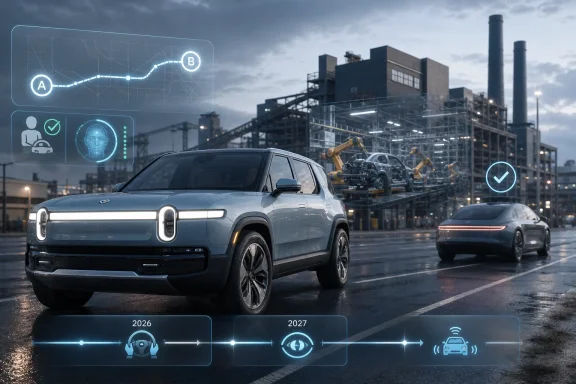 Rivian Is Selling a Timeline, Not Just a Car
The most important word in Scaringe’s latest autonomy pitch is not robotaxi. It is this year. Tesla has spent nearly a decade training the market to hear autonomy promises as a rolling forecast rather than a delivery schedule, but Rivian does not yet have Tesla’s tolerance cushion with buyers, regulators, or investors.Scaringe’s description of a supervised point-to-point system puts Rivian directly in the Full Self-Driving comparison lane, even if the company will inevitably use its own branding and caveats. In plain English, the promise is that the vehicle will be able to navigate from one destination to another while the driver remains responsible for supervision. That is not driverless operation, and it is not the car taking legal responsibility for the drive.
The next phase is the more provocative one. Eyes-off driving implies a move beyond the familiar Level 2 bargain, where the system helps but the human remains constantly responsible. If Rivian reaches that stage in 2027, it will be moving into a category where driver attention, operational boundaries, insurance liability, and state-by-state rules matter as much as model performance.
That distinction should matter to buyers. A supervised system can be impressive and still be legally and practically conservative. An eyes-off system asks the customer to trust not only the software but the entire stack behind it: sensors, compute, redundancy, mapping assumptions, driver monitoring, failover logic, and the company’s willingness to say “not here” when conditions are outside the design domain.
The Tesla Comparison Is Useful, but It Is Also a Trap
Calling Rivian’s system “Tesla FSD-like” is understandable shorthand, but it risks flattening the most important differences between the companies. Tesla’s autonomy strategy has been shaped by enormous fleet scale, camera-first ideology, aggressive public beta culture, and years of regulatory scrutiny. Rivian is entering the conversation with a smaller fleet, a different customer base, and a brand that has so far leaned more toward adventure utility than software bravado.That could be a disadvantage. Tesla has mountains of real-world driving data and millions of vehicles providing training signal, interventions, and edge cases. Rivian cannot simply wish that gap away with a slick neural network architecture or a more modern compute platform.
But Tesla’s history is also a warning label. Autonomy roadmaps can become a credibility tax when dates slip, capabilities are renamed, or marketing language outruns driver experience. Rivian has the advantage of having watched another company discover every pothole in this road: overpromising, underexplaining, and letting enthusiasts blur the line between assisted driving and self-driving.
Scaringe’s challenge is therefore rhetorical as much as technical. Rivian needs to persuade buyers that its system is ambitious without making them think the vehicle is more capable than it is. The company has to borrow Tesla’s excitement without inheriting Tesla’s semantic mess.
The R2 Turns Autonomy From Feature Creep Into Company Strategy
The timing is not accidental. Rivian’s R2 is the vehicle that is supposed to move the company from premium EV curiosity into mainstream relevance. The R1T and R1S gave Rivian credibility; the R2 has to give it volume.That is why autonomy matters so much here. If the R2 is merely a smaller, cheaper Rivian, it competes in a crowded field of electric crossovers where price, range, service access, charging, and incentives dominate. If the R2 arrives as a rolling autonomy platform, Rivian can argue that it is not just selling a vehicle but selling an upgrade path.
There is obvious appeal in that framing. A customer who buys an R2 in 2026 may be told that the same hardware foundation could support supervised driving soon, eyes-off driving later, and eventually a world in which the vehicle can do more work on its own. That is the kind of future-facing pitch that can move reservation holders from curiosity to purchase.
It is also the kind of pitch that can create resentment if the roadmap becomes vapor. EV buyers have already learned to distinguish between shipped capability, paid unlocks, software promises, and “hardware ready” optimism. Rivian’s customers are likely to be enthusiastic, but they are not immune to the fatigue that follows when expensive vehicles become vessels for unfinished software narratives.
Normal, Illinois Becomes the Center of a Much Bigger Bet
The Illinois angle is more than a feel-good manufacturing sidebar. Governor J.B. Pritzker’s public celebration of the R2 ramp in Normal reflects the political and economic importance of Rivian turning an old Mitsubishi site into a modern EV production hub. For central Illinois, the R2 is jobs, supplier activity, and proof that the post-industrial factory story can still be rewritten.For Rivian, Normal is the place where the company’s software ambitions meet the cold arithmetic of manufacturing. Autonomy announcements can be made on podcasts; vehicles have to come off lines repeatedly, profitably, and with quality levels that keep service centers from drowning. The R2 ramp is therefore the real test of whether Rivian can support a more ambitious future.
This is especially true because autonomy features do not reduce operational complexity. They add it. Sensors need calibration, compute modules need thermal headroom, wiring harnesses need consistency, and software validation must account for hardware variance. A misbuilt adventure trim is one problem; a miscalibrated autonomy platform is a different category of risk.
Pritzker’s reservation is a useful political symbol, but the more important constituency is not elected officials. It is the first wave of R2 owners who will discover whether Rivian’s manufacturing system can deliver a vehicle sturdy enough for daily life and sophisticated enough for the autonomy roadmap being attached to it.
Uber Gives Rivian Distribution, but Not a Shortcut Through Reality
The Uber partnership is the strategic hinge in Rivian’s robotaxi story. Rivian does not have to build a consumer ride-hailing network from scratch if Uber can provide demand, routing, marketplace liquidity, and operational reach. That lets Rivian focus on the vehicle and autonomy platform while Uber does what Uber does best: match riders with cars at scale.On paper, that division of labor is sensible. Automakers have historically struggled to become software marketplaces, and platform companies have struggled to build vehicles. A partnership lets each side pretend it can avoid the other’s hardest problem.
But robotaxis are unforgiving because the hardest problem is shared. If the car fails, the rider does not care whether the fault belongs to Rivian’s autonomy stack, Uber’s fleet operations, a maintenance contractor, or a city’s confusing curb rules. The experience collapses into one brand event.
This is why the Rivian-Uber plan should be understood less as an immediate robotaxi breakthrough and more as a long-dated option. It gives Rivian a plausible commercial endpoint for autonomy and gives Uber another supplier in its increasingly diversified autonomous vehicle strategy. It does not prove that Rivian can safely operate driverless vehicles at scale in messy cities.
Eyes-Off Driving Is Where the Legal Story Starts Getting Serious
Supervised autonomy lives in a familiar legal framework: the human driver remains responsible. Eyes-off autonomy changes the conversation because it suggests the system can handle the driving task under defined conditions while the human is temporarily relieved from continuous monitoring. That is a radically different consumer promise.The words matter. “Hands-free” can still require eyes on the road. “Eyes-off” implies that the vehicle, not the driver’s constant attention, is carrying the immediate operational burden. Even if Rivian restricts such use to certain roads, speeds, weather conditions, or geofenced areas, the feature will need to be explained with painful clarity.
This is where automakers often discover that engineering capability and consumer comprehension are not the same thing. A system can be safe within an operational design domain and dangerous when drivers misunderstand that domain. The manual can be technically correct while the marketing creates the wrong expectation.
For IT pros and security-minded readers, this should sound familiar. Access control systems fail when users misunderstand trust boundaries. Cloud misconfigurations happen when defaults imply more protection than they provide. Vehicle autonomy has a similar interface problem: the danger is not only what the system cannot do, but what the user thinks it can do.
Rivian’s Sensor Strategy May Be Its Quiet Rebuttal to Tesla
Rivian’s autonomy work has been framed around a more sensor-rich approach than Tesla’s camera-centric philosophy. That difference matters because it suggests Rivian is not simply cloning Tesla’s strategy under another badge. It is trying to build a platform that can support consumer assistance and, eventually, commercial driverless use.A sensor-rich system can offer redundancy and complementary perception, particularly in poor visibility or complex environments. Radar and lidar can provide forms of spatial awareness that cameras alone must infer. For a company aiming at eyes-off and driverless operation, that redundancy is not just a technical preference; it is part of the safety argument.
The tradeoff is cost and complexity. More sensors mean more parts, more calibration, more failure modes, and more manufacturing discipline. They can strengthen the autonomy case while making the vehicle harder to build cheaply.
That is the central R2 tension. Rivian needs the R2 to be affordable enough to matter and sophisticated enough to justify its autonomy narrative. If the company cannot keep that balance, it risks building either a great EV that cannot support the story or an impressive technology platform that is too expensive to scale.
The Consumer Car and the Robotaxi Are Now Sharing a Destiny
Rivian’s roadmap makes personal vehicles and robotaxis part of the same continuum. The supervised system comes first to consumer vehicles. The eyes-off phase follows. The eventual driverless system becomes the foundation for commercial deployment.That sequence is attractive because it lets Rivian develop capability across a growing fleet before asking the public to accept empty vehicles operating for hire. Consumer miles become learning opportunities. Commercial ambitions become a future monetization layer rather than a separate moonshot.
But shared destiny cuts both ways. If consumer autonomy disappoints, the robotaxi story looks premature. If robotaxi testing encounters high-profile failures, consumer confidence in the same underlying platform may suffer. Rivian cannot neatly compartmentalize the two narratives once it has publicly linked them.
The company must also avoid the temptation to treat consumer vehicles as a beta pool in the pejorative sense. Drivers may accept iterative software improvement; they are less forgiving when the improvement process feels like unpaid safety validation. Rivian’s brand has been built around trust, capability, and considered design. Autonomy will test whether that brand can survive more ambiguous software behavior.
The Market Wants a Tesla Rival, but Rivian Needs a Rivian Answer
The R2 has already drawn comparisons to Tesla’s Model Y, and those comparisons are inevitable. The Model Y became the default electric crossover because it combined range, charging access, software familiarity, and production scale. Any serious electric SUV entering the mainstream market is measured against that baseline.Rivian, however, should be careful about becoming “Tesla, but outdoorsy.” Its strongest argument is not that it can mimic Tesla feature for feature. It is that it can build a different kind of EV company: one with stronger design restraint, a more traditional safety posture, and an ownership experience that feels less like participation in a public experiment.
Autonomy complicates that identity. Once Rivian starts promising FSD-like capability, it invites the same social media demo culture, the same edge-case videos, and the same binary fan wars over whether the car “drove itself.” The company may want the valuation benefits of being seen as an AI mobility platform, but it also inherits the attention economy that comes with that label.
That is why Rivian’s messaging over the next year will matter almost as much as the feature itself. If the company describes the system conservatively and ships meaningful capability, it can look disciplined. If it lets the robotaxi halo dominate the ownership pitch, it risks sounding like every other autonomy company that discovered the future is always eighteen months away.
Software-Defined Vehicles Are Becoming the New PC Platform War
For WindowsForum readers, the deeper story is not simply about cars. It is about the transformation of vehicles into networked computing platforms whose capabilities are revised after purchase, whose safety depends on software supply chains, and whose business models increasingly resemble cloud services.A modern EV is already a rolling endpoint. It has operating systems, update channels, telemetry, identity, certificates, radios, cameras, local inference, remote services, and vendor-controlled feature flags. Autonomy raises the stakes because software failure is no longer a convenience bug or infotainment glitch; it can become a physical-world event.
This is where automakers are being forced into the same disciplines enterprise IT has spent decades learning. Secure update pipelines matter. Rollback strategies matter. Observability matters. Incident response matters. So does the uncomfortable question of who controls the device after the customer buys it.
Rivian’s autonomy roadmap will depend on all of that invisible plumbing. The public will focus on whether the R2 changes lanes smoothly or handles a difficult intersection. The harder technical story is whether Rivian can operate a safety-critical software platform across consumer and commercial fleets without losing control of quality, security, or trust.
The Autonomy Race Is Becoming a Capital Allocation Test
Autonomy is expensive in a way that punishes half-measures. It requires hardware investment, AI talent, simulation, real-world data collection, validation infrastructure, safety operations, regulatory engagement, and customer support. Rivian is pursuing this while also ramping a critical vehicle, expanding manufacturing capacity, and competing in an EV market where price pressure is brutal.That makes the Uber deal strategically useful. It provides a route to external capital, fleet demand, and a commercial story Wall Street can model. Investors like optionality, and robotaxis are one of the biggest optionality narratives in transportation.
Still, optionality is not cash flow. Rivian has to sell vehicles profitably before it can rely on autonomy economics to transform the business. The R2’s near-term success will be measured in deliveries, margins, service performance, and customer satisfaction, not only in neural network benchmarks.
The autonomy roadmap may help Rivian justify investment and differentiate the product. It may also raise expectations faster than the company can meet them. In a market that has already punished EV startups for confusing aspiration with execution, that is a dangerous line to walk.
The Real Test Is Whether Rivian Can Underpromise in Public
There is a disciplined way for Rivian to execute this. It can ship supervised point-to-point driving with clear limits, expand coverage gradually, publish conservative guidance, and resist the urge to imply that eyes-off means go-anywhere autonomy. It can make the R2 feel better every quarter without asking customers to become evangelists for unfinished capability.There is also a reckless way. It can let comparisons to Tesla’s FSD do too much marketing work, let robotaxi economics dominate product discussion, and allow buyers to assume that a 2026 R2 is one software update away from being a revenue-generating autonomous asset. That path may excite investors briefly, but it would put Rivian’s credibility at risk.
The best version of this story is not Rivian beating Tesla at Tesla’s own game. It is Rivian learning from Tesla’s mistakes while still moving quickly enough to matter. That means plain language, cautious rollout, and a willingness to disappoint hype merchants before disappointing customers.
If Rivian can do that, the R2 could become something more consequential than another electric crossover. It could be the first real test of whether a newer EV company can combine mainstream production, serious autonomy hardware, and a less chaotic software culture. That is a much harder goal than winning a podcast quote cycle, but it is also the only one that matters.
The R2 Autonomy Promise Now Has Receipts to Produce
Rivian has moved from general ambition to calendar-bound claims, and that changes how the company should be judged. The next eighteen months will show whether Scaringe’s autonomy timeline is a credible execution plan or another entry in the industry’s long archive of self-driving optimism.- Rivian says supervised point-to-point driving is planned for Gen 2 vehicles in 2026, including the R2.
- The company is aiming for eyes-off driving in 2027, a step that would require much clearer operational boundaries than today’s driver-assistance systems.
- The Uber partnership gives Rivian a distribution channel for future robotaxis, but it does not remove the technical, regulatory, or safety burden of driverless operation.
- The R2 production ramp in Normal, Illinois is now tied to both Rivian’s consumer growth story and its autonomy credibility.
- Rivian’s biggest risk is not that it trails Tesla in hype, but that it lets Tesla’s language define customer expectations before Rivian has earned them.
References
- Primary source: Benzinga
Published: Sun, 14 Jun 2026 06:33:56 GMT
Rivian CEO Says Tesla FSD-Like Driving Is Coming This Year — And Eyes-Off Driving Next Year - Rivian Auto - Benzinga
Rivian CEO RJ Scaringe announces plans for unsupervised driving in 2022, with longer-term goal of true driverless operation.www.benzinga.com - Related coverage: investor.uber.com
Uber Technologies, Inc. - Uber and Rivian Partner to Deploy up to 50,000 Fully Autonomous Robotaxis
Uber to invest up to $1.25 billion in Rivian through 2031, subject to the achievement of autonomous performance milestones Uber, or its fleet partners, expected to purchase 10,000 fully autonomous R2 robotaxis with the option to purchase up to 40,000 more in 2030 Initial commercial deployments...investor.uber.com
- Related coverage: kbb.com
Uber Plans Fleet of Autonomous Rivian R2 SUVs - Kelley Blue Book
Rivian and Uber are partnering to enter the robotaxi autonomous-vehicle market. Expect to see these R2 robotaxis around 2028.www.kbb.com - Related coverage: techcrunch.com
Uber taps Rivian to build robotaxis in deal worth up to $1.25B | TechCrunch
Uber is kicking off the partnership with an initial $300 million investment, while Rivian will provide as many as 50,000 autonomous R2 SUVs.techcrunch.com - Related coverage: riviantrackr.com
Rivian Point-to-Point This Year, Eyes Off Next, Says RJ Scaringe
RJ Scaringe went on Masters of Scale and put fresh dates on Rivian's autonomy rollout, with supervised Point-to-Point arriving this year and eyes off driving next year. Here is what he confirmed on the VW deal, Uber robotaxis, and Mind Robotics, plus where I land on whether the timeline...riviantrackr.com - Related coverage: rivianwave.com
Rivian Confirms R2 Deliveries Start Next Month - Rivian Wave
Rivian has officially confirmed on X that initial customer deliveries for the highly anticipated R2 electric SUV will begin next month.www.rivianwave.com
- Related coverage: techspot.com
Uber commits up to $1.25 billion in Rivian to deploy 10,000 robotaxis | TechSpot
The deal provides both companies with strategic advantages. For Uber, access to a dedicated robotaxi fleet supports its broader push to integrate multiple self-driving partners across its...www.techspot.com - Related coverage: powertrainchronicle.com
Rivian Confirms R2 Deliveries 'By June' as Validation Builds Begin | The Powertrain Chronicle
Rivian told WGLT it plans to begin R2 deliveries by June 2026. The statement narrows the window, but key ramp details remain undisclosed.powertrainchronicle.com - Related coverage: electrek.co
Rivian opens R2 configurator: here are all the options and pricing | Electrek
Rivian has opened the online configurator for the R2, its critical mid-size electric SUV, giving reservation holders their first chance...electrek.co - Related coverage: latimes.com
Uber and Rivian plan to bring robotaxis to California
Uber plans to invest up to $1.25 billion in Rivian through 2031 to bring robotaxis to San Francisco and other cities.www.latimes.com - Related coverage: axios.com
Uber to invest up to $1.25 billion in Rivian for robotaxi push
The companies expect to deploy 10,000 Rivian robotaxis on Uber's rideshare network in the first phase of their partnership.www.axios.com
- Related coverage: thomasnet.com
- Related coverage: tomshardware.com
Rivian unveils its own in-house RAP1 AI chip and ACM3 self-driving platform—automaker one-ups Tesla with LiDAR support | Tom's Hardware
"Cameras are enough," it was once said.www.tomshardware.com - Related coverage: techradar.com
Rivian boss says Level 4 autonomous driving is 'much closer than people think', but Tesla is struggling to convince its own employees that the technology is reliable | TechRadar
Tesla staffers claim the company isn't close to safely delivering autonomous vehicles at scalewww.techradar.com - Related coverage: chicagofed.org
