

Chinese Tesla drivers have reportedly been using tiny plastic doll heads mounted near the rearview mirror to trick cabin-camera driver-monitoring safeguards, according to reports published in mid-June 2026 by WIRED and Digital Trends. The hack is ridiculous in form and serious in implication. It turns a safety system meant to verify human attention into a prop-comedy test of whether modern driver assistance can distinguish supervision from theater. The lesson is not that Tesla owners are unusually mischievous; it is that Level 2 automation still depends on a fragile social contract between software, sensors, marketing language, and human boredom.
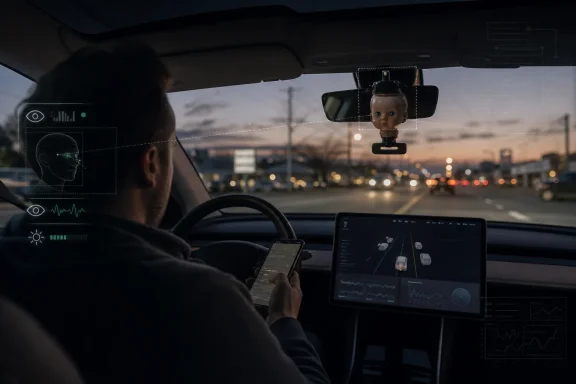
The image is almost too neat: a “smart” car, a neural-network worldview, and a ping-pong-ball-sized plastic face defeating a camera that is supposed to know whether a driver is watching the road. It sounds like the sort of thing a safety researcher would stage for a conference demo, except the reports describe drivers sharing the trick as practical advice. That distinction matters. A vulnerability in a lab is a warning; a workaround circulating among owners is evidence of a market behavior.
Tesla’s driver-monitoring problem has never been purely technical. The company sells cars whose most famous software features invite users to imagine a future in which the vehicle does more and the driver does less, while the legal and safety regime still requires the driver to remain responsible at every moment. The cabin camera is supposed to close that gap by watching for attention. The doll head is a crude reminder that attention is not a visual artifact; it is a human state.
What makes the story so potent is its asymmetry. Tesla has spent years arguing that cameras and software can do more than rivals believe, both outside the car and inside it. The bypass described here does not require adversarial machine-learning expertise, code injection, sensor spoofing, or a disciplined test lab. It requires a toy.
That does not mean every Tesla cabin camera can always be defeated this way, or that every configuration behaves identically across markets, software versions, and vehicle generations. It means something narrower and more uncomfortable: if drivers perceive the monitoring system as an obstacle to be gamed rather than a boundary to be respected, the safety case has already moved from engineering into culture.
Tesla’s manuals and in-car warnings are explicit that drivers must keep their hands on the wheel, watch the road, and be ready to take over. In recent years, Tesla has leaned more heavily on cabin-camera monitoring, especially as regulators and safety investigators pushed the company to strengthen driver engagement checks. Earlier versions of the “nag” relied heavily on steering-wheel torque, which produced its own cottage industry of defeat devices. The camera was supposed to be the smarter answer.
The doll-head workaround attacks the newer bargain. If the system is looking for a face, eyes, or head-like geometry, a fake head suggests that the detection problem may be narrower than the human-attention problem it represents. The car does not need to be fooled into believing the driver is awake, competent, sober, scanning mirrors, anticipating hazards, or ready to grab the wheel. It only needs to be sufficiently satisfied that its monitoring criteria are being met.
That is the deep weakness of many driver-monitoring systems, not just Tesla’s. They translate a continuous human obligation into a handful of measurable signals. Eyes forward, hands available, head oriented, cabin camera unobstructed: these are useful proxies, but they are still proxies. A proxy can be improved, fused with other signals, and made harder to fool. It cannot become the thing itself.
That creates a strange bind for Tesla. In the United States, Tesla’s identity has long been tied to the idea that it is a software company on wheels, moving faster than regulators and legacy automakers. In China, it faces local companies that have learned to compete on both electrification and software experience, often with dense feature sets tuned to Chinese roads and consumer expectations. The result is a market where Tesla needs to show technological leadership while avoiding regulatory tripwires around “self-driving” claims.
Reports around Tesla’s China software rollout have also been muddy in the way global Tesla stories often are. Tesla has promoted broader availability of Full Self-Driving (Supervised), while Chinese state-linked and industry outlets have at times described local capabilities as more limited than the phrase might suggest. That ambiguity is part of the problem. When consumers hear “Full Self-Driving,” even with “Supervised” attached, they hear a promise the product must then spend every mile walking back.
The doll-head workaround lands directly in that gap. It is a user behavior born from the desire to make a supervised system feel less supervised. It is also a market signal: some drivers are not just misunderstanding the limits of the system; they are actively negotiating against them.
This is the irony of automation in one plastic face. Driver-assistance systems are most useful when they reduce workload, but they still depend on the driver to intervene during the rare moments when workload suddenly spikes. Humans are bad at that handoff. A driver who has been demoted to supervisor can become slower, less situationally aware, and more trusting precisely because the system is working well most of the time.
Tesla’s particular version of this problem is amplified by branding. “Autopilot” is an aviation term, and “Full Self-Driving” is an enormous phrase even after “Supervised” was bolted onto it. Tesla defenders correctly note that the company issues warnings, requires driver responsibility, and does not legally claim unsupervised autonomy for consumer vehicles in ordinary use. Critics correctly note that names, demos, CEO statements, and years of futurist positioning shape how customers behave.
Both can be true, and that is why the issue persists. A warning screen can clarify legal responsibility without undoing the emotional meaning of a product name. A manual can say “pay attention” while the interface encourages the driver to experience the car as doing the driving. A camera can monitor the cabin while owners on social platforms swap tips for making that monitoring less annoying.
The doll head is not merely a bypass; it is user feedback in its most perverse form. It says that some drivers experience the safeguard as friction, not protection. Once safety becomes a UX annoyance, the product team has lost more than a sensor battle.
Those improvements are worth doing. Driver monitoring should be robust against low-effort spoofing, and automakers should assume that some users will try to cheat. The modern car is already a rolling adversarial environment: owners install defeat devices, hackers probe interfaces, thieves relay key fobs, and influencers test boundaries for content. If a safety feature can be bypassed by consumer clutter, it needs redesign.
But better monitoring also has limits. The driver-facing camera can become stricter, but stricter systems create false positives that irritate attentive drivers. Add too much sensitivity and the car becomes a scold; add too little and it becomes permissive. The target is not simply “detect a face.” It is “maintain enough driver engagement to preserve the safety case without making normal driving miserable.”
This is why some competitors have chosen narrower operational domains for hands-free systems. A system that works only on mapped highways, under certain conditions, with robust driver monitoring and clear handoff rules may sound less futuristic than a general-purpose promise. It may also be easier to explain, regulate, and trust. Tesla has preferred scale, data, and generality. The doll-head story is a reminder that generality in the driving task does not eliminate the need for hard boundaries in the human task.
China’s regulators have their own reasons to be cautious. The country wants leadership in intelligent vehicles, but it also wants public order, data control, and clear responsibility after crashes. Recent moves against misleading assisted-driving terminology show that Beijing understands the public-safety risk in letting marketing outrun capability. A tiny fake head on a windshield is not just a consumer hack; it is an argument for stricter enforcement.
The United States and Europe face similar questions, though through different legal and political machinery. How much driver monitoring is enough? Should systems be allowed to operate outside conditions where they can reliably detect misuse? Should automakers be punished for foreseeable workarounds if those workarounds spread through owner communities? And how should regulators handle software features whose behavior changes monthly?
The hardest question is whether a company should be judged by intended use or predictable use. Tesla intends supervised use. The manuals demand supervised use. But if a meaningful subset of drivers predictably tries to remove themselves from supervision, the design cannot pretend that behavior is an unforeseeable edge case. Mature safety engineering treats misuse as part of the environment.
That makes the human-machine interface the central product. The car has to drive well enough to help, but not so confidently that it lulls the driver into abdication. It has to warn often enough to maintain attention, but not so often that the owner treats warnings as noise. It has to promise capability without implying autonomy. That is a brutally narrow path.
The doll-head story shows what happens when the path is missed. A driver who tapes or mounts a fake face to the cabin-monitoring field is not just violating instructions. The driver is converting the car’s safety model into a puzzle game. The objective becomes not safe travel, but uninterrupted automation.
This is where the story should worry sysadmins and security-minded readers even if they never plan to buy a Tesla. The pattern is familiar from enterprise IT. A control that users find obstructive gets routed around. A policy that depends on user discipline becomes theater. A monitoring system that checks for compliance artifacts rather than underlying risk invites spoofing. The car is different because the failure mode involves kinetic energy, but the governance problem is the same.
But camera-first thinking creates a particular vulnerability to visual ambiguity. The outside world contains reflections, unusual signs, occlusions, weather, damaged lane markings, and objects that look like other objects. The inside world contains sunglasses, hats, masks, phone screens, passengers, shadows, and now apparently tiny doll heads. Vision systems can become extremely capable, but they still see the world through patterns, probabilities, and training data.
A human instantly understands that a plastic toy head is not a responsible driver. A camera model may need to infer that from motion, depth, context, body alignment, and other signals. This is not a condemnation of AI; it is a description of the kind of problem AI systems face when they are asked to operationalize common sense. The stranger the edge case, the more important the fallback rules become.
Tesla’s defenders may reasonably argue that every safety system can be defeated by deliberate abuse. Seatbelt chimes can be silenced with buckles. Alcohol interlocks can be tricked. Speed limiters can be hacked. That is true as far as it goes. But driver assistance is unusual because the system’s safe operation depends continuously on the very person who may be motivated to defeat it.
Yet an update would address the symptom more than the disease. If not doll heads, then printed faces. If not printed faces, then reflective tricks, camera placement hacks, or behavioral routines that satisfy the monitor while attention drifts elsewhere. The point is not that Tesla cannot improve. The point is that a system designed around reluctant supervision will always have to fight the user at the boundary.
This is the uncomfortable product-management lesson. If the driver wants the system to do more than it is allowed to do, the safeguard becomes adversarial. If the driver understands the system as assistance, the safeguard becomes cooperative. The same chime, camera, and steering prompt can feel like either a seatbelt or a speed bump depending on the story the product has told.
Tesla has spent years telling the most ambitious story in the industry. That story built loyalty, valuation, and a data advantage. It also trained some owners to view present-day limitations as temporary annoyances on the way to autonomy. The doll head is what happens when tomorrow’s promise sits in today’s cup holder.
The next breakthrough may not be a model that handles one more unprotected left turn or a neural net that reads one more ambiguous lane marking. It may be a product boundary that ordinary people actually respect. That could mean stricter monitoring, narrower operating domains, clearer names, harsher lockouts, or a more candid separation between driver assistance and driver replacement. Until then, the tiny plastic head belongs in the same file as steering-wheel weights and seatbelt defeat clips: ridiculous objects that reveal serious design truths.
Tesla’s great challenge is that it is trying to ship the future through cars owned by impatient humans in the present. Software can improve, cameras can get smarter, and regulators can tighten the vocabulary around autonomy. But as long as the safety case depends on a person who would rather be eating sunflower seeds, filming a video, or pretending a toy is watching the road, the real test of Autopilot is not whether it can see. It is whether it can make the driver care enough to look.
 The Toy Head Is Funny Until You Remember What It Is Bypassing
The image is almost too neat: a “smart” car, a neural-network worldview, and a ping-pong-ball-sized plastic face defeating a camera that is supposed to know whether a driver is watching the road. It sounds like the sort of thing a safety researcher would stage for a conference demo, except the reports describe drivers sharing the trick as practical advice. That distinction matters. A vulnerability in a lab is a warning; a workaround circulating among owners is evidence of a market behavior.Tesla’s driver-monitoring problem has never been purely technical. The company sells cars whose most famous software features invite users to imagine a future in which the vehicle does more and the driver does less, while the legal and safety regime still requires the driver to remain responsible at every moment. The cabin camera is supposed to close that gap by watching for attention. The doll head is a crude reminder that attention is not a visual artifact; it is a human state.
What makes the story so potent is its asymmetry. Tesla has spent years arguing that cameras and software can do more than rivals believe, both outside the car and inside it. The bypass described here does not require adversarial machine-learning expertise, code injection, sensor spoofing, or a disciplined test lab. It requires a toy.
That does not mean every Tesla cabin camera can always be defeated this way, or that every configuration behaves identically across markets, software versions, and vehicle generations. It means something narrower and more uncomfortable: if drivers perceive the monitoring system as an obstacle to be gamed rather than a boundary to be respected, the safety case has already moved from engineering into culture.
Tesla’s Safety Net Is Built Around the Same Human It Is Trying to Discipline
Autopilot and Full Self-Driving (Supervised) are not autonomous driving systems in the everyday sense most consumers attach to that phrase. They are advanced driver-assistance systems that can steer, accelerate, brake, change lanes, and navigate in certain circumstances, but they still require a human driver to supervise. That supervision requirement is not a footnote. It is the liability hinge on which the whole product category turns.Tesla’s manuals and in-car warnings are explicit that drivers must keep their hands on the wheel, watch the road, and be ready to take over. In recent years, Tesla has leaned more heavily on cabin-camera monitoring, especially as regulators and safety investigators pushed the company to strengthen driver engagement checks. Earlier versions of the “nag” relied heavily on steering-wheel torque, which produced its own cottage industry of defeat devices. The camera was supposed to be the smarter answer.
The doll-head workaround attacks the newer bargain. If the system is looking for a face, eyes, or head-like geometry, a fake head suggests that the detection problem may be narrower than the human-attention problem it represents. The car does not need to be fooled into believing the driver is awake, competent, sober, scanning mirrors, anticipating hazards, or ready to grab the wheel. It only needs to be sufficiently satisfied that its monitoring criteria are being met.
That is the deep weakness of many driver-monitoring systems, not just Tesla’s. They translate a continuous human obligation into a handful of measurable signals. Eyes forward, hands available, head oriented, cabin camera unobstructed: these are useful proxies, but they are still proxies. A proxy can be improved, fused with other signals, and made harder to fool. It cannot become the thing itself.
China Turns the Autopilot Debate Into a Stress Test
The China angle is not incidental. China is both one of Tesla’s most important markets and one of the world’s most aggressive proving grounds for assisted-driving features. Domestic automakers have been pushing navigation-assisted driving, urban driver assistance, and cockpit intelligence at a pace that makes Western product cycles look cautious. Consumers are sophisticated, competitors are relentless, and regulators have become increasingly sensitive to language that suggests cars can do more than they legally or safely can.That creates a strange bind for Tesla. In the United States, Tesla’s identity has long been tied to the idea that it is a software company on wheels, moving faster than regulators and legacy automakers. In China, it faces local companies that have learned to compete on both electrification and software experience, often with dense feature sets tuned to Chinese roads and consumer expectations. The result is a market where Tesla needs to show technological leadership while avoiding regulatory tripwires around “self-driving” claims.
Reports around Tesla’s China software rollout have also been muddy in the way global Tesla stories often are. Tesla has promoted broader availability of Full Self-Driving (Supervised), while Chinese state-linked and industry outlets have at times described local capabilities as more limited than the phrase might suggest. That ambiguity is part of the problem. When consumers hear “Full Self-Driving,” even with “Supervised” attached, they hear a promise the product must then spend every mile walking back.
The doll-head workaround lands directly in that gap. It is a user behavior born from the desire to make a supervised system feel less supervised. It is also a market signal: some drivers are not just misunderstanding the limits of the system; they are actively negotiating against them.
The Joke Is Really About Level 2 Automation
The auto industry’s most dangerous magic trick is making Level 2 automation feel like more than Level 2 automation. At Level 2, the system can control steering and speed at the same time, but the driver remains responsible for monitoring the environment. The better the system gets, the more boring the human role becomes. The more boring the human role becomes, the less reliable the human becomes.This is the irony of automation in one plastic face. Driver-assistance systems are most useful when they reduce workload, but they still depend on the driver to intervene during the rare moments when workload suddenly spikes. Humans are bad at that handoff. A driver who has been demoted to supervisor can become slower, less situationally aware, and more trusting precisely because the system is working well most of the time.
Tesla’s particular version of this problem is amplified by branding. “Autopilot” is an aviation term, and “Full Self-Driving” is an enormous phrase even after “Supervised” was bolted onto it. Tesla defenders correctly note that the company issues warnings, requires driver responsibility, and does not legally claim unsupervised autonomy for consumer vehicles in ordinary use. Critics correctly note that names, demos, CEO statements, and years of futurist positioning shape how customers behave.
Both can be true, and that is why the issue persists. A warning screen can clarify legal responsibility without undoing the emotional meaning of a product name. A manual can say “pay attention” while the interface encourages the driver to experience the car as doing the driving. A camera can monitor the cabin while owners on social platforms swap tips for making that monitoring less annoying.
The doll head is not merely a bypass; it is user feedback in its most perverse form. It says that some drivers experience the safeguard as friction, not protection. Once safety becomes a UX annoyance, the product team has lost more than a sensor battle.
Better Monitoring Is Necessary, but It Is Not the Whole Fix
The obvious response is to make the cabin camera harder to fool. Tesla can update its models, detect static props, require liveness cues, correlate gaze with road events, fuse steering-wheel input with head pose, and look for inconsistencies between the driver’s body and the apparent face. The software can ask whether the thing being tracked behaves like a human over time. It can penalize occlusion, suspicious stillness, or geometry that does not match an actual seated driver.Those improvements are worth doing. Driver monitoring should be robust against low-effort spoofing, and automakers should assume that some users will try to cheat. The modern car is already a rolling adversarial environment: owners install defeat devices, hackers probe interfaces, thieves relay key fobs, and influencers test boundaries for content. If a safety feature can be bypassed by consumer clutter, it needs redesign.
But better monitoring also has limits. The driver-facing camera can become stricter, but stricter systems create false positives that irritate attentive drivers. Add too much sensitivity and the car becomes a scold; add too little and it becomes permissive. The target is not simply “detect a face.” It is “maintain enough driver engagement to preserve the safety case without making normal driving miserable.”
This is why some competitors have chosen narrower operational domains for hands-free systems. A system that works only on mapped highways, under certain conditions, with robust driver monitoring and clear handoff rules may sound less futuristic than a general-purpose promise. It may also be easier to explain, regulate, and trust. Tesla has preferred scale, data, and generality. The doll-head story is a reminder that generality in the driving task does not eliminate the need for hard boundaries in the human task.
Regulators Are Watching the Gap Between Words and Behavior
Regulators tend not to care about brand philosophy until it shows up in crash data, consumer complaints, or viral misuse. Tesla has already faced regulatory scrutiny over Autopilot and Full Self-Driving, including investigations and recalls tied to driver engagement and system safeguards. The company’s over-the-air update model gives it a powerful way to respond quickly, but it also means regulators can treat software behavior as an ongoing compliance surface rather than a fixed vehicle attribute.China’s regulators have their own reasons to be cautious. The country wants leadership in intelligent vehicles, but it also wants public order, data control, and clear responsibility after crashes. Recent moves against misleading assisted-driving terminology show that Beijing understands the public-safety risk in letting marketing outrun capability. A tiny fake head on a windshield is not just a consumer hack; it is an argument for stricter enforcement.
The United States and Europe face similar questions, though through different legal and political machinery. How much driver monitoring is enough? Should systems be allowed to operate outside conditions where they can reliably detect misuse? Should automakers be punished for foreseeable workarounds if those workarounds spread through owner communities? And how should regulators handle software features whose behavior changes monthly?
The hardest question is whether a company should be judged by intended use or predictable use. Tesla intends supervised use. The manuals demand supervised use. But if a meaningful subset of drivers predictably tries to remove themselves from supervision, the design cannot pretend that behavior is an unforeseeable edge case. Mature safety engineering treats misuse as part of the environment.
The Real Rival Is Not Waymo; It Is Human Complacency
Every Tesla autonomy story eventually gets dragged into a comparison with Waymo, Cruise, Chinese robotaxi pilots, or whichever company currently carries the “real self-driving” banner. Those comparisons can be useful, but they can also obscure the immediate issue. Tesla’s consumer fleet is not operating like a geofenced robotaxi service with remote assistance, fleet monitoring, and no expectation that a private owner will supervise from behind the wheel. It is operating as a mass-market Level 2 system sold to ordinary drivers.That makes the human-machine interface the central product. The car has to drive well enough to help, but not so confidently that it lulls the driver into abdication. It has to warn often enough to maintain attention, but not so often that the owner treats warnings as noise. It has to promise capability without implying autonomy. That is a brutally narrow path.
The doll-head story shows what happens when the path is missed. A driver who tapes or mounts a fake face to the cabin-monitoring field is not just violating instructions. The driver is converting the car’s safety model into a puzzle game. The objective becomes not safe travel, but uninterrupted automation.
This is where the story should worry sysadmins and security-minded readers even if they never plan to buy a Tesla. The pattern is familiar from enterprise IT. A control that users find obstructive gets routed around. A policy that depends on user discipline becomes theater. A monitoring system that checks for compliance artifacts rather than underlying risk invites spoofing. The car is different because the failure mode involves kinetic energy, but the governance problem is the same.
Tesla’s Camera-First Philosophy Meets the Physical World
Tesla’s broader bet has long been that cameras, data, and neural networks can solve driving at scale without the more sensor-heavy stacks favored by some rivals. That approach has obvious advantages if it works. Cameras are cheap, ubiquitous, and closer to the way humans visually interpret roads. A camera-first system can be deployed across a huge fleet, improved through software, and manufactured without the cost and complexity of lidar-heavy architectures.But camera-first thinking creates a particular vulnerability to visual ambiguity. The outside world contains reflections, unusual signs, occlusions, weather, damaged lane markings, and objects that look like other objects. The inside world contains sunglasses, hats, masks, phone screens, passengers, shadows, and now apparently tiny doll heads. Vision systems can become extremely capable, but they still see the world through patterns, probabilities, and training data.
A human instantly understands that a plastic toy head is not a responsible driver. A camera model may need to infer that from motion, depth, context, body alignment, and other signals. This is not a condemnation of AI; it is a description of the kind of problem AI systems face when they are asked to operationalize common sense. The stranger the edge case, the more important the fallback rules become.
Tesla’s defenders may reasonably argue that every safety system can be defeated by deliberate abuse. Seatbelt chimes can be silenced with buckles. Alcohol interlocks can be tricked. Speed limiters can be hacked. That is true as far as it goes. But driver assistance is unusual because the system’s safe operation depends continuously on the very person who may be motivated to defeat it.
The Software Update Will Not End the Argument
It would be surprising if Tesla did not respond, directly or indirectly, through a future software update. The company can retrain the cabin-monitoring system, adjust thresholds, add anti-spoofing checks, and increase penalties for suspicious camera input. Tesla’s fleet-learning advantage is real in scenarios like this: once a workaround becomes known, the company can look for patterns and push mitigations faster than traditional recall processes would allow.Yet an update would address the symptom more than the disease. If not doll heads, then printed faces. If not printed faces, then reflective tricks, camera placement hacks, or behavioral routines that satisfy the monitor while attention drifts elsewhere. The point is not that Tesla cannot improve. The point is that a system designed around reluctant supervision will always have to fight the user at the boundary.
This is the uncomfortable product-management lesson. If the driver wants the system to do more than it is allowed to do, the safeguard becomes adversarial. If the driver understands the system as assistance, the safeguard becomes cooperative. The same chime, camera, and steering prompt can feel like either a seatbelt or a speed bump depending on the story the product has told.
Tesla has spent years telling the most ambitious story in the industry. That story built loyalty, valuation, and a data advantage. It also trained some owners to view present-day limitations as temporary annoyances on the way to autonomy. The doll head is what happens when tomorrow’s promise sits in today’s cup holder.
The Plastic Face Exposes the Parts of Autopilot That Matter Now
The immediate lesson is not that Tesla vehicles are uniquely unsafe or that driver assistance should be abandoned. The better lesson is that the industry has reached the stage where misuse is no longer hypothetical. Users are experimenting with the boundaries of semi-automation in public, and the safeguards must be judged against that reality.- Tesla’s reported doll-head workaround is best understood as a driver-monitoring failure mode, not as proof that the driving stack itself has been defeated.
- The episode underscores that Autopilot and Full Self-Driving (Supervised) remain supervised driver-assistance systems, even when their branding and behavior make them feel more capable.
- China is an especially important setting because Tesla faces intense local competition, fast-moving consumer expectations, and regulators increasingly wary of misleading assisted-driving claims.
- Stronger cabin-camera anti-spoofing is necessary, but it will not solve the deeper problem of drivers who experience safety prompts as obstacles to hands-off use.
- The industry’s next safety fight will be less about whether cars can steer themselves for longer stretches and more about whether humans can be kept honestly engaged when they are still legally required to supervise.
The Next Autonomy Breakthrough May Be a More Honest Boundary
There is a temptation to treat this as a clownish footnote in the long march toward self-driving cars. It is more than that. It is a small, absurd, very human rebellion against a machine that asks to be trusted but not too much, obeyed but not ignored, supervised but not interrupted. That contradiction defines the current era of consumer autonomy.The next breakthrough may not be a model that handles one more unprotected left turn or a neural net that reads one more ambiguous lane marking. It may be a product boundary that ordinary people actually respect. That could mean stricter monitoring, narrower operating domains, clearer names, harsher lockouts, or a more candid separation between driver assistance and driver replacement. Until then, the tiny plastic head belongs in the same file as steering-wheel weights and seatbelt defeat clips: ridiculous objects that reveal serious design truths.
Tesla’s great challenge is that it is trying to ship the future through cars owned by impatient humans in the present. Software can improve, cameras can get smarter, and regulators can tighten the vocabulary around autonomy. But as long as the safety case depends on a person who would rather be eating sunflower seeds, filming a video, or pretending a toy is watching the road, the real test of Autopilot is not whether it can see. It is whether it can make the driver care enough to look.
References
- Primary source: Digital Trends
Published: Sat, 13 Jun 2026 05:58:24 GMT
Chinese drivers have figured out a silly way to fool Tesla Autopilot and it involves doll heads - Digital Trends
Chinese Tesla owners are reportedly using miniature doll heads, photos, and blinking screens to trick Autopilot’s driver-monitoring cameras into thinking they are paying attention.www.digitaltrends.com - Independent coverage: WIRED
Published: Fri, 12 Jun 2026 17:57:00 GMT
Chinese Drivers Are Using Tiny Plastic Heads to Fool Tesla’s Autopilot Safeguards | WIRED
A cottage industry of celebrity figurines, blinking screens, and other DIY gadgets is helping drivers bypass Tesla's distracted-driving controls.www.wired.com - Related coverage: motortrend.com
Tesla’s Autopilot Driver-Assist System Tricked By Ghostly Projections
A recent study shows a projected image on a roadway can easily trick Tesla's Autopilot and Mobileye's driver-assist systems into incorrect decision-making.www.motortrend.com - Related coverage: eng.pressbee.net
- Related coverage: techbuzz.ai
Tesla Autopilot Bypassed by Plastic Heads in China | The Tech Buzz
Chinese drivers use celebrity figurines and DIY gadgets to fool Tesla's safety systemswww.techbuzz.ai - Related coverage: techspot.com
Autopilot exploit lets researchers trick Tesla vehicle into driving toward oncoming traffic lane | TechSpot
You may think they did this by hacking into the car's software or drastically altering the way Autopilot functions, but the reality is much simpler.www.techspot.com
- Related coverage: phys.org
- Related coverage: keenlab.tencent.com
- Related coverage: thewirechina.com
- Related coverage: tesla.com
- Related coverage: techmymoney.com
Tesla FSD China: Full Self-Driving Finally Launches
Tesla FSD China goes live May 21, 2026 — supervised Full Self-Driving costs 64,000 yuan ($9,410) for Model 3, now available across 10 countries. techmymoney.com
- Related coverage: livemint.com
Tesla announces rollout of fully self-driving tech in China | Mint
In a post on X, Tesla said that its full self-driving driving system—or FSD Supervised—is now available in several countries, including China.www.livemint.com - Related coverage: globalchinaev.com
Tesla officially confirms FSD Supervised is available in China
Tesla has officially announced FSD Supervised is available in China across 10 markets, following Trump's state visit — but full regulatory approval is still pending, with a Q3 2026 target.www.globalchinaev.com - Related coverage: techtimes.com
Tesla Brings Full Self-Driving Tech to China For Eligible EVs to Use With Supervision
Tesla’s Full Self-Driving technology is now available in China, which has required the company to make sure it is supervised.www.techtimes.com - Related coverage: tesla.cn
- Related coverage: carnewschina.com
Tesla officially confirms FSD (Supervised) support for China market
Tesla announces FSD (Supervised) support for China.carnewschina.com
- Related coverage: creativebloq.com
Tesla ordered to rebrand Autopilot amid false advertising claims | Creative Bloq
The company could face a sales ban in California.www.creativebloq.com - Related coverage: techradar.com
Tesla just switched to a Netflix-style subscription model for Full Self-Driving – here's why | TechRadar
Yet another service you have to subscribe towww.techradar.com - Related coverage: as.com
Tesla “liquida” Autopilot entre problemas judiciales y un cambio de foco al robotaxi y las suscripciones - Meristation
Tesla elimina Autopilot y refuerza Full Self-Driving por suscripción, con Austin como vitrina tecnológica y California apretando por publicidad engañosa.as.com - Related coverage: lemonde.fr
Tesla struggles in China as market share collapses
By focusing on design and performance, the American manufacturer was a pioneer in getting Chinese motorists to adopt electric cars. Although 40% of its sales are now in China, Tesla has become a minor player, constantly forced to adapt.www.lemonde.fr
