

Tesla is encouraging employees to use SpaceXAI’s Grok 4.5 whenever practical, after imposing a $200 weekly AI-spending limit, because Elon Musk says the model’s lower token costs can reduce Tesla’s reliance on pricier third-party tools without banning rivals that perform better. The directive turns the electric vehicle and energy company into both customer and proving ground for another Musk-led technology business. More importantly, it exposes the question now confronting every large enterprise experimenting with generative AI: once employees become accustomed to premium models, who decides when their higher performance is worth the bill?
The answer emerging at Tesla is neither unrestricted choice nor a conventional single-vendor mandate. It is a cost-driven routing policy, expressed through spending limits, executive pressure, beta testing, and a performance exception that leaves engineers free to use competing models when Grok falls short.
The Information first reported that Musk told Tesla staff to move toward Grok 4.5 when possible, citing its lower token costs compared with competing models. TipRanks subsequently framed the shift as an effort to reduce third-party AI spending, arriving days after Tesla introduced the $200 weekly limit for employee AI use.
That sequence matters. Tesla is not introducing Grok into an organization that has never used generative AI; it is trying to redirect an existing pattern of paid consumption. The company has apparently reached the stage at which employee experimentation is no longer a novelty expense and model usage must be treated as an operating cost.
Token-based billing makes that cost unusually easy to generate and unusually difficult to predict. A conventional software license is generally visible before an employee begins working. An AI-assisted coding session, by contrast, can expand through repeated prompts, large context windows, automated tool calls, retries, code analysis, and long-running agentic tasks.
A weekly employee limit is a blunt response, but it has an obvious advantage: everyone can understand it. It gives finance a ceiling, managers a reason to question costly workflows, and employees an incentive to consider whether a task really needs the most expensive available model.
The risk is that a simple ceiling can confuse spending reduction with efficiency. An engineer who uses a more expensive model to solve a difficult problem in one attempt may be more productive than a colleague who spends less while cycling through repeated failures. Token cost is measurable; the value of the resulting work is not nearly as tidy.
That is why Musk’s exception for better-performing rival models is the most significant part of the policy. According to The Information, he later said Tesla employees should continue using other AI models if those models outperform Grok. The company is therefore applying price pressure without pretending that every model is interchangeable.
That distinction separates Tesla’s approach from a pure lock-in strategy. Grok receives a structural advantage because its token costs are reportedly lower, its developers can work directly with Tesla staff, and Musk can personally request feedback. Rival tools retain a place when their performance justifies the additional expense.
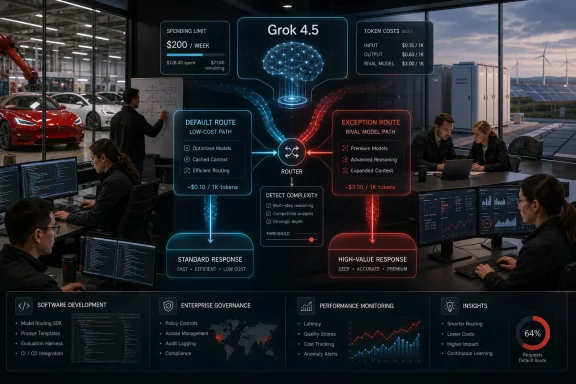
The table reveals a more sophisticated policy than the headline suggests. Tesla is not choosing between Grok and every competing model in the abstract. It is creating a default path and an exception path: use the cheaper affiliated model for routine work, but escalate to an alternative when quality requires it.
This resembles the way enterprises route cloud workloads among service tiers. Not every task needs maximum capability, just as not every application needs the most expensive compute instance. Basic office work, routine code generation, documentation, summarization, and low-risk engineering assistance may be suitable for a cheaper default model, while difficult debugging or specialized analysis may justify a premium alternative.
The challenge is defining “outperform” before it becomes a loophole or a source of internal friction. Engineers may judge a model by correctness, latency, context handling, tool use, coding style, or the amount of supervision required. Finance may judge the same session by tokens and dollars.
Without shared criteria, every expensive model request risks becoming an argument between people measuring different things. Tesla’s policy acknowledges that performance matters, but the available reporting does not indicate how the company will measure it or who will arbitrate close calls.
That omission is not unusual. Enterprise AI adoption has moved faster than the systems needed to evaluate it. Many organizations can identify how much they spent on a model but cannot say whether the output reduced development time, prevented a defect, accelerated a release, or simply generated more text for employees to review.
The Information reported that Andrew Milich, a SpaceXAI product lead, worked with Tesla staff to resolve technical issues. Musk also asked engineers to send him direct feedback on the model, creating a short feedback loop between the people building Grok and the employees expected to use it.
For an AI developer, that arrangement is valuable. Software engineers working inside a large manufacturing, energy, and vehicle company can expose a model to practical tasks that benchmarks may not capture: understanding established codebases, navigating internal conventions, handling incomplete documentation, assisting with repetitive office work, and maintaining coherence over long technical sessions.
Tesla, in return, gets influence over the product’s development. If engineers encounter recurring failures, the problems can be raised directly with SpaceXAI rather than disappearing into ordinary customer-support channels. Grok’s roadmap can be informed by real internal workloads rather than polished demonstrations.
This is the hidden advantage of the Musk ecosystem. The companies do not need to behave like unrelated vendors and customers negotiating at arm’s length. Product leads can troubleshoot with Tesla staff, engineers can test beta versions, and Musk can transmit priorities across organizational boundaries.
But the same closeness complicates evaluation. A normal enterprise can assess AI vendors primarily on capability, security, reliability, support, and price. Tesla must do that while the preferred model comes from an organization closely associated with its own leader.
The practical question is not whether that relationship automatically makes Grok a bad choice. It is whether Tesla’s internal process can distinguish a genuinely cost-effective tool from one that receives adoption advantages because of its place in Musk’s corporate orbit.
The performance exception provides one safeguard. If employees can continue using rival models when those systems produce better results, Tesla preserves a form of internal competition. That competition is meaningful only if employees can invoke the exception without unnecessary delay or pressure.
A nominal right to use another model is less useful when approval processes are slow, budgets are exhausted, or teams believe that choosing a rival will be interpreted as resistance. The policy’s success will therefore depend less on the wording of Musk’s message than on the behavior of managers and the design of Tesla’s internal AI platform.
Days before the Grok directive — Tesla introduced a $200 weekly limit on employee AI spending, establishing a financial incentive to reduce reliance on third-party models.
Friday — Tesla encouraged staff to use Grok 4.5 when possible, Musk preserved the option to use better-performing rivals, and TSLA shares rose mildly to close at $407.76.
A coding-only model can be evaluated against a relatively narrow set of tasks. A broader workplace model must handle far more variation, from source-code changes and technical explanations to document drafting, analysis, and administrative requests. Each additional category increases the possible usage volume—and the number of ways the model can fail.
Cursor’s involvement strengthens the engineering proposition because developers increasingly encounter AI through coding environments rather than standalone chat windows. The model is no longer merely answering questions. It may be asked to inspect repositories, propose coordinated edits, explain unfamiliar components, diagnose errors, or continue working through a multi-step task.
Those workflows can consume substantially more tokens than a short chat. The model must often ingest large amounts of context before producing anything useful, and agentic tools can generate repeated calls as they inspect files, execute actions, evaluate results, and try again.
This helps explain why lower token costs would be attractive to Tesla even if Grok 4.5 were only comparable—not superior—to every rival. Small differences in the cost of one request become consequential when multiplied across a large engineering workforce and repeated throughout the working week.
The cheapest model, however, can become expensive if it requires more retries. A model that charges less per token but generates longer answers, misreads a codebase, or forces engineers to repeat instructions may produce a higher total cost for the completed task.
That is the metric Tesla ultimately needs: cost per useful outcome, not cost per token in isolation. The weekly limit can constrain the budget, but it cannot reveal whether Grok actually improves the economics of engineering work.
The beta-testing period gives Tesla an opportunity to answer that question. Teams can compare how often Grok resolves tasks successfully, how much review its output requires, how frequently engineers switch to another model, and whether those switches cluster around particular languages, repositories, or forms of analysis.
If Tesla uses that evidence to route work intelligently, Grok 4.5 could become the inexpensive default without becoming an artificial bottleneck. If the company focuses primarily on raw token consumption, it may optimize a number that has only a loose relationship with productivity.
A developer using AI to investigate a safety-critical defect should not necessarily operate under the same practical constraints as an employee generating routine text. Likewise, a team preparing a time-sensitive software release may need temporary capacity that would look excessive when judged only against an individual weekly allowance.
The limit can also encourage counterproductive behavior. Employees may postpone useful work until a budget resets, split tasks across accounts or tools, use cheaper models for unsuitable jobs, or spend time seeking approvals that cost the company more in labor than the disputed tokens.
A more mature policy would classify workloads rather than merely users. Low-risk office tasks could route automatically to the preferred economical model. High-value engineering work could receive a larger allowance, while sensitive or safety-relevant tasks could require models and review processes selected for reliability rather than price.
Tesla’s performance exception points in that direction, but an exception is not the same as a routing system. Employees need to know when a rival model is justified, how to access it, whether approval is required, and what evidence should be recorded when one model consistently beats another.
The company also needs safeguards against model shopping driven by personal preference. Engineers develop strong opinions about AI tools, often based on genuine experience but sometimes based on familiarity, interface design, or isolated successes. A fair comparison requires repeated tests on representative work.
The goal should not be to force every team to reach the same conclusion. Different models may be best for different codebases, languages, context sizes, and styles of work. The purpose of governance is to make those differences visible and financially manageable, not to erase them.
AI tools now appear inside browsers, office suites, coding environments, command-line utilities, internal portals, and desktop applications. Blocking one website does not control the category, while approving a single subscription does not account for API use, embedded assistants, or automated agents.
The most effective control point is increasingly the enterprise gateway. A gateway can authenticate employees, record usage, apply spending policies, restrict sensitive data, and route requests to different models. It can also give the organization leverage to change providers without forcing every employee to rebuild a workflow.
Tesla’s reported approach appears to combine policy with preferential access: cap external spending and encourage an affiliated model that can be tested and supported closely. Other enterprises are unlikely to have their own Musk-linked AI provider, but they can reproduce the underlying strategy by selecting an economical default and preserving controlled access to alternatives.
That architecture prevents a false choice between chaos and monopoly. Unrestricted access creates unpredictable spending, fragmented data handling, and duplicated contracts. A rigid single-model mandate can leave employees trapped when the approved system performs badly on an important task.
Multi-model access with routing and observability is harder to implement, but it reflects how the technology actually behaves. Models differ, their relative quality changes, and the best option for a routine summary may not be the best option for debugging a complex application.
Windows shops must also account for the endpoint. When an AI tool can read local files, inspect repositories, issue commands, or interact with development environments, it is no longer just a web service. It becomes part of the software supply chain and must be evaluated accordingly.
Administrators need visibility into which extensions and desktop clients are installed, what permissions they possess, and whether employees can bypass centralized controls by signing into personal accounts. Spending policy, identity management, endpoint security, and data governance can no longer be handled as separate conversations.
Tesla’s experience is instructive precisely because the company appears to have started with adoption and then confronted cost. Many enterprises follow the same path: encourage experimentation, discover that usage is uneven and bills are growing, and only then introduce restrictions.
The better sequence is to design measurement and routing before use becomes entrenched. Once employees build daily habits around a particular model or coding environment, changing the economic policy can feel like removing a productivity tool—even when the organization has never established whether the tool produces enough value to justify its cost.
For software development, plausible measures include task completion, test results, accepted code changes, defects introduced, time to resolution, and the amount of human correction required. None is perfect, but all are more informative than counting prompts or tokens alone.
Basic office work is harder to score. A polished document may still contain errors; a concise summary may omit the most important point; an analysis can look persuasive while resting on unsupported assumptions. Human review remains part of the cost, even when it does not appear on the AI invoice.
Tesla must therefore avoid shifting expenses rather than reducing them. A cheaper model that creates more review work transfers cost from the model provider to Tesla’s employees. Because labor time and token spending appear in different budgets, the transfer may initially look like a saving.
The direct feedback requested by Musk could help identify these failures quickly. Engineers who encounter recurring problems can describe where Grok loses context, misunderstands a task, or requires a competing model to finish the job.
Direct executive feedback can also distort reporting if employees feel pressure to provide favorable results or avoid repetitive criticism. A scalable evaluation system needs structured data in addition to email: success rates, failure categories, model-switching patterns, latency, cost, and user corrections.
SpaceXAI’s close troubleshooting relationship with Tesla is potentially a major advantage here. The product team can respond to concrete failures and use them to improve the model. But Tesla should still preserve independent measurement, because the developer’s interest in proving the model and the customer’s interest in selecting the best tool are not identical.
The strongest outcome would be a genuinely competitive internal market. Grok handles the work where its price and capability produce the best overall result; other models handle tasks where they remain stronger; and the routing changes as each system improves.
The weakest outcome would be symbolic competition in which rivals are technically allowed but practically discouraged. In that case, Tesla could save on visible AI invoices while accumulating slower engineering work, frustrated employees, and less reliable output.
That creates a circular advantage. Tesla supplies demanding users and detailed feedback; SpaceXAI improves the product; the improved model becomes more useful to Tesla; and both organizations can point to the deployment as evidence that Grok works in a serious engineering environment.
If Grok performs well, the relationship could reduce Tesla’s external AI costs and give SpaceXAI a flagship internal customer. The model could mature against real production requirements rather than carefully selected demonstrations.
If it performs poorly, Tesla bears part of the cost. Engineers may spend time testing, troubleshooting, reporting failures, and switching to alternatives. The company would remain dependent on competitors while also contributing labor to the preferred model’s development.
That tradeoff deserves more scrutiny than an ordinary software purchase. Tesla shareholders may benefit indirectly if collaboration among Musk-led companies creates better technology, but Tesla employees and resources should still be deployed for Tesla’s own operational advantage.
The Information’s reporting makes the immediate rationale explicit: lower token costs. That is a testable claim, but only when cost includes the entire workflow. Tesla should be able to determine whether the model reduces spending after accounting for retries, employee time, failures, and the continued use of competing systems.
Investors should not expect the policy alone to transform Tesla’s financial results. TipRanks correctly characterized the immediate financial impact as likely limited. Even substantial savings on employee AI tools would be small compared with the economics of manufacturing, vehicle deliveries, energy products, and the company’s broader technology ambitions.
The strategic impact could be more important than the direct savings. A successful deployment would show that Grok can support intensive engineering work inside a major industrial company and that Tesla can use the wider Musk ecosystem to lower internal technology costs.
That outcome is not guaranteed by a memo. It will be earned task by task, as employees decide whether Grok can finish the work or whether they need to invoke the exception and return to a competing model.
The analyst picture remains divided. Among 29 analysts issuing ratings during the past three months, 10 rated Tesla a Buy, 16 assigned a Hold, and three rated it a Sell, producing an overall Hold consensus.
The average TSLA price target stood at $400.59, implying 1.76% downside from the current price cited by TipRanks. Those figures show that Wall Street is not treating every AI-related move as sufficient reason to expand Tesla’s valuation.
The Grok deployment sits inside the longstanding disagreement over what Tesla is. The cautious interpretation sees an electric vehicle and energy company trying to control software expenses by favoring a tool associated with its chief executive. The bullish interpretation sees a technology platform using its workforce, products, and engineering operations to accelerate an integrated AI ecosystem.
Both readings can be true. Tesla can save money on third-party models while also becoming a development partner and showcase for Grok. The unanswered question is whether the arrangement creates measurable value for Tesla itself.
That is why investors should watch operational evidence rather than launch language. Relevant signals would include broader adoption, fewer switches to rivals, documented productivity improvements, and continued expansion of the tasks assigned to Grok.
Failure will also leave traces. If employees routinely use their budgets on competitors, if exceptions become the normal workflow, or if Tesla must repeatedly adjust the policy to accommodate Grok’s limitations, the deployment will look less like vertical integration and more like subsidized product development.
The answer emerging at Tesla is neither unrestricted choice nor a conventional single-vendor mandate. It is a cost-driven routing policy, expressed through spending limits, executive pressure, beta testing, and a performance exception that leaves engineers free to use competing models when Grok falls short.
 Tesla’s AI Push Has Reached the Finance Department
The Information first reported that Musk told Tesla staff to move toward Grok 4.5 when possible, citing its lower token costs compared with competing models. TipRanks subsequently framed the shift as an effort to reduce third-party AI spending, arriving days after Tesla introduced the $200 weekly limit for employee AI use.That sequence matters. Tesla is not introducing Grok into an organization that has never used generative AI; it is trying to redirect an existing pattern of paid consumption. The company has apparently reached the stage at which employee experimentation is no longer a novelty expense and model usage must be treated as an operating cost.
Token-based billing makes that cost unusually easy to generate and unusually difficult to predict. A conventional software license is generally visible before an employee begins working. An AI-assisted coding session, by contrast, can expand through repeated prompts, large context windows, automated tool calls, retries, code analysis, and long-running agentic tasks.
A weekly employee limit is a blunt response, but it has an obvious advantage: everyone can understand it. It gives finance a ceiling, managers a reason to question costly workflows, and employees an incentive to consider whether a task really needs the most expensive available model.
The risk is that a simple ceiling can confuse spending reduction with efficiency. An engineer who uses a more expensive model to solve a difficult problem in one attempt may be more productive than a colleague who spends less while cycling through repeated failures. Token cost is measurable; the value of the resulting work is not nearly as tidy.
That is why Musk’s exception for better-performing rival models is the most significant part of the policy. According to The Information, he later said Tesla employees should continue using other AI models if those models outperform Grok. The company is therefore applying price pressure without pretending that every model is interchangeable.
Grok Gets Preferred Status, Not an Exclusive Contract
It would be easy to describe Tesla’s directive as a ban on competing AI systems, but the reporting does not support that conclusion. Employees are being encouraged to use Grok 4.5 when possible, not ordered to use it regardless of the result.That distinction separates Tesla’s approach from a pure lock-in strategy. Grok receives a structural advantage because its token costs are reportedly lower, its developers can work directly with Tesla staff, and Musk can personally request feedback. Rival tools retain a place when their performance justifies the additional expense.
| Decision factor | Grok 4.5 | Rival AI models |
|---|---|---|
| Default policy position | Encouraged when possible | Still permitted |
| Cost rationale | Musk says token costs are lower | Treated as higher-cost third-party tools |
| Performance rule | Preferred when capable of the task | Should remain in use when they outperform Grok |
| Reported Tesla experience | Beta-tested for several months | Already part of employee AI usage |
| Stated work focus | Engineering, software development, and basic office tasks | Used where task-specific performance is stronger |
This resembles the way enterprises route cloud workloads among service tiers. Not every task needs maximum capability, just as not every application needs the most expensive compute instance. Basic office work, routine code generation, documentation, summarization, and low-risk engineering assistance may be suitable for a cheaper default model, while difficult debugging or specialized analysis may justify a premium alternative.
The challenge is defining “outperform” before it becomes a loophole or a source of internal friction. Engineers may judge a model by correctness, latency, context handling, tool use, coding style, or the amount of supervision required. Finance may judge the same session by tokens and dollars.
Without shared criteria, every expensive model request risks becoming an argument between people measuring different things. Tesla’s policy acknowledges that performance matters, but the available reporting does not indicate how the company will measure it or who will arbitrate close calls.
That omission is not unusual. Enterprise AI adoption has moved faster than the systems needed to evaluate it. Many organizations can identify how much they spent on a model but cannot say whether the output reduced development time, prevented a defect, accelerated a release, or simply generated more text for employees to review.
Tesla Is Becoming Grok’s Most Demanding Beta Customer
The cost story is only half the picture. Tesla employees have reportedly tested beta versions of Grok for several months, making the company an operational proving ground rather than merely another account on a vendor dashboard.The Information reported that Andrew Milich, a SpaceXAI product lead, worked with Tesla staff to resolve technical issues. Musk also asked engineers to send him direct feedback on the model, creating a short feedback loop between the people building Grok and the employees expected to use it.
For an AI developer, that arrangement is valuable. Software engineers working inside a large manufacturing, energy, and vehicle company can expose a model to practical tasks that benchmarks may not capture: understanding established codebases, navigating internal conventions, handling incomplete documentation, assisting with repetitive office work, and maintaining coherence over long technical sessions.
Tesla, in return, gets influence over the product’s development. If engineers encounter recurring failures, the problems can be raised directly with SpaceXAI rather than disappearing into ordinary customer-support channels. Grok’s roadmap can be informed by real internal workloads rather than polished demonstrations.
This is the hidden advantage of the Musk ecosystem. The companies do not need to behave like unrelated vendors and customers negotiating at arm’s length. Product leads can troubleshoot with Tesla staff, engineers can test beta versions, and Musk can transmit priorities across organizational boundaries.
But the same closeness complicates evaluation. A normal enterprise can assess AI vendors primarily on capability, security, reliability, support, and price. Tesla must do that while the preferred model comes from an organization closely associated with its own leader.
The practical question is not whether that relationship automatically makes Grok a bad choice. It is whether Tesla’s internal process can distinguish a genuinely cost-effective tool from one that receives adoption advantages because of its place in Musk’s corporate orbit.
The performance exception provides one safeguard. If employees can continue using rival models when those systems produce better results, Tesla preserves a form of internal competition. That competition is meaningful only if employees can invoke the exception without unnecessary delay or pressure.
A nominal right to use another model is less useful when approval processes are slow, budgets are exhausted, or teams believe that choosing a rival will be interpreted as resistance. The policy’s success will therefore depend less on the wording of Musk’s message than on the behavior of managers and the design of Tesla’s internal AI platform.
Timeline
Several months before the shift — Tesla employees reportedly began testing beta versions of Grok, while SpaceXAI product lead Andrew Milich worked with Tesla staff to troubleshoot technical issues.Days before the Grok directive — Tesla introduced a $200 weekly limit on employee AI spending, establishing a financial incentive to reduce reliance on third-party models.
Friday — Tesla encouraged staff to use Grok 4.5 when possible, Musk preserved the option to use better-performing rivals, and TSLA shares rose mildly to close at $407.76.
Grok 4.5 Arrives With an Enterprise Job Description
SpaceXAI launched Grok 4.5 alongside the coding platform Cursor, positioning the model for engineering work, software development, and basic office tasks. That range is deliberate: the economic case for an enterprise model becomes stronger when the same system can cover both specialized development work and ordinary knowledge work.A coding-only model can be evaluated against a relatively narrow set of tasks. A broader workplace model must handle far more variation, from source-code changes and technical explanations to document drafting, analysis, and administrative requests. Each additional category increases the possible usage volume—and the number of ways the model can fail.
Cursor’s involvement strengthens the engineering proposition because developers increasingly encounter AI through coding environments rather than standalone chat windows. The model is no longer merely answering questions. It may be asked to inspect repositories, propose coordinated edits, explain unfamiliar components, diagnose errors, or continue working through a multi-step task.
Those workflows can consume substantially more tokens than a short chat. The model must often ingest large amounts of context before producing anything useful, and agentic tools can generate repeated calls as they inspect files, execute actions, evaluate results, and try again.
This helps explain why lower token costs would be attractive to Tesla even if Grok 4.5 were only comparable—not superior—to every rival. Small differences in the cost of one request become consequential when multiplied across a large engineering workforce and repeated throughout the working week.
The cheapest model, however, can become expensive if it requires more retries. A model that charges less per token but generates longer answers, misreads a codebase, or forces engineers to repeat instructions may produce a higher total cost for the completed task.
That is the metric Tesla ultimately needs: cost per useful outcome, not cost per token in isolation. The weekly limit can constrain the budget, but it cannot reveal whether Grok actually improves the economics of engineering work.
The beta-testing period gives Tesla an opportunity to answer that question. Teams can compare how often Grok resolves tasks successfully, how much review its output requires, how frequently engineers switch to another model, and whether those switches cluster around particular languages, repositories, or forms of analysis.
If Tesla uses that evidence to route work intelligently, Grok 4.5 could become the inexpensive default without becoming an artificial bottleneck. If the company focuses primarily on raw token consumption, it may optimize a number that has only a loose relationship with productivity.
The Weekly Cap Is a Policy Signal, Not a Complete Control System
A per-employee spending limit is an understandable first control, but it is a poor substitute for workload-aware governance. Two employees can generate identical bills while producing radically different value.A developer using AI to investigate a safety-critical defect should not necessarily operate under the same practical constraints as an employee generating routine text. Likewise, a team preparing a time-sensitive software release may need temporary capacity that would look excessive when judged only against an individual weekly allowance.
The limit can also encourage counterproductive behavior. Employees may postpone useful work until a budget resets, split tasks across accounts or tools, use cheaper models for unsuitable jobs, or spend time seeking approvals that cost the company more in labor than the disputed tokens.
A more mature policy would classify workloads rather than merely users. Low-risk office tasks could route automatically to the preferred economical model. High-value engineering work could receive a larger allowance, while sensitive or safety-relevant tasks could require models and review processes selected for reliability rather than price.
Tesla’s performance exception points in that direction, but an exception is not the same as a routing system. Employees need to know when a rival model is justified, how to access it, whether approval is required, and what evidence should be recorded when one model consistently beats another.
The company also needs safeguards against model shopping driven by personal preference. Engineers develop strong opinions about AI tools, often based on genuine experience but sometimes based on familiarity, interface design, or isolated successes. A fair comparison requires repeated tests on representative work.
The goal should not be to force every team to reach the same conclusion. Different models may be best for different codebases, languages, context sizes, and styles of work. The purpose of governance is to make those differences visible and financially manageable, not to erase them.
Action checklist for admins
- Inventory every approved AI model, coding assistant, internal gateway, subscription, and reimbursement path currently used by employees.
- Measure spending by model, team, workload, and completed task rather than relying only on total token consumption.
- Establish a lower-cost default model while documenting clear performance, security, and reliability grounds for using alternatives.
- Create a fast exception process so engineers do not lose more time seeking approval than the organization saves on tokens.
- Log model failures, retries, human rework, and switches to competing tools to identify where the default model is creating hidden costs.
- Review what company data each tool can receive, how prompts and outputs are retained, and whether beta services meet internal security requirements.
- Reassess limits regularly as model quality, pricing, and employee workflows change.
Model Choice Has Become an IT Architecture Decision
For Windows administrators and enterprise IT teams, the Tesla story is not mainly about which chatbot wins a benchmark. It is about the rapid transformation of generative AI from an employee-selected application into a governed layer of workplace infrastructure.AI tools now appear inside browsers, office suites, coding environments, command-line utilities, internal portals, and desktop applications. Blocking one website does not control the category, while approving a single subscription does not account for API use, embedded assistants, or automated agents.
The most effective control point is increasingly the enterprise gateway. A gateway can authenticate employees, record usage, apply spending policies, restrict sensitive data, and route requests to different models. It can also give the organization leverage to change providers without forcing every employee to rebuild a workflow.
Tesla’s reported approach appears to combine policy with preferential access: cap external spending and encourage an affiliated model that can be tested and supported closely. Other enterprises are unlikely to have their own Musk-linked AI provider, but they can reproduce the underlying strategy by selecting an economical default and preserving controlled access to alternatives.
That architecture prevents a false choice between chaos and monopoly. Unrestricted access creates unpredictable spending, fragmented data handling, and duplicated contracts. A rigid single-model mandate can leave employees trapped when the approved system performs badly on an important task.
Multi-model access with routing and observability is harder to implement, but it reflects how the technology actually behaves. Models differ, their relative quality changes, and the best option for a routine summary may not be the best option for debugging a complex application.
Windows shops must also account for the endpoint. When an AI tool can read local files, inspect repositories, issue commands, or interact with development environments, it is no longer just a web service. It becomes part of the software supply chain and must be evaluated accordingly.
Administrators need visibility into which extensions and desktop clients are installed, what permissions they possess, and whether employees can bypass centralized controls by signing into personal accounts. Spending policy, identity management, endpoint security, and data governance can no longer be handled as separate conversations.
Tesla’s experience is instructive precisely because the company appears to have started with adoption and then confronted cost. Many enterprises follow the same path: encourage experimentation, discover that usage is uneven and bills are growing, and only then introduce restrictions.
The better sequence is to design measurement and routing before use becomes entrenched. Once employees build daily habits around a particular model or coding environment, changing the economic policy can feel like removing a productivity tool—even when the organization has never established whether the tool produces enough value to justify its cost.
The Performance Exception Will Decide Whether the Policy Works
Musk’s instruction to keep using other models when they outperform Grok prevents the directive from becoming a claim that one model is universally best. It also creates the policy’s largest unresolved problem: performance must be demonstrated somehow.For software development, plausible measures include task completion, test results, accepted code changes, defects introduced, time to resolution, and the amount of human correction required. None is perfect, but all are more informative than counting prompts or tokens alone.
Basic office work is harder to score. A polished document may still contain errors; a concise summary may omit the most important point; an analysis can look persuasive while resting on unsupported assumptions. Human review remains part of the cost, even when it does not appear on the AI invoice.
Tesla must therefore avoid shifting expenses rather than reducing them. A cheaper model that creates more review work transfers cost from the model provider to Tesla’s employees. Because labor time and token spending appear in different budgets, the transfer may initially look like a saving.
The direct feedback requested by Musk could help identify these failures quickly. Engineers who encounter recurring problems can describe where Grok loses context, misunderstands a task, or requires a competing model to finish the job.
Direct executive feedback can also distort reporting if employees feel pressure to provide favorable results or avoid repetitive criticism. A scalable evaluation system needs structured data in addition to email: success rates, failure categories, model-switching patterns, latency, cost, and user corrections.
SpaceXAI’s close troubleshooting relationship with Tesla is potentially a major advantage here. The product team can respond to concrete failures and use them to improve the model. But Tesla should still preserve independent measurement, because the developer’s interest in proving the model and the customer’s interest in selecting the best tool are not identical.
The strongest outcome would be a genuinely competitive internal market. Grok handles the work where its price and capability produce the best overall result; other models handle tasks where they remain stronger; and the routing changes as each system improves.
The weakest outcome would be symbolic competition in which rivals are technically allowed but practically discouraged. In that case, Tesla could save on visible AI invoices while accumulating slower engineering work, frustrated employees, and less reliable output.
Tesla’s Corporate Ecosystem Turns Procurement Into Strategy
The adoption push has implications beyond software expenses because Tesla is not dealing with an unrelated supplier. Grok belongs to a Musk-led ecosystem, and Tesla’s use of the model can improve its capabilities, demonstrate enterprise demand, and accelerate adoption elsewhere.That creates a circular advantage. Tesla supplies demanding users and detailed feedback; SpaceXAI improves the product; the improved model becomes more useful to Tesla; and both organizations can point to the deployment as evidence that Grok works in a serious engineering environment.
If Grok performs well, the relationship could reduce Tesla’s external AI costs and give SpaceXAI a flagship internal customer. The model could mature against real production requirements rather than carefully selected demonstrations.
If it performs poorly, Tesla bears part of the cost. Engineers may spend time testing, troubleshooting, reporting failures, and switching to alternatives. The company would remain dependent on competitors while also contributing labor to the preferred model’s development.
That tradeoff deserves more scrutiny than an ordinary software purchase. Tesla shareholders may benefit indirectly if collaboration among Musk-led companies creates better technology, but Tesla employees and resources should still be deployed for Tesla’s own operational advantage.
The Information’s reporting makes the immediate rationale explicit: lower token costs. That is a testable claim, but only when cost includes the entire workflow. Tesla should be able to determine whether the model reduces spending after accounting for retries, employee time, failures, and the continued use of competing systems.
Investors should not expect the policy alone to transform Tesla’s financial results. TipRanks correctly characterized the immediate financial impact as likely limited. Even substantial savings on employee AI tools would be small compared with the economics of manufacturing, vehicle deliveries, energy products, and the company’s broader technology ambitions.
The strategic impact could be more important than the direct savings. A successful deployment would show that Grok can support intensive engineering work inside a major industrial company and that Tesla can use the wider Musk ecosystem to lower internal technology costs.
That outcome is not guaranteed by a memo. It will be earned task by task, as employees decide whether Grok can finish the work or whether they need to invoke the exception and return to a competing model.
Wall Street Is Watching a Larger Argument About Tesla
TSLA shares rose mildly on Friday to close at $407.76, according to TipRanks. The muted movement is appropriate for a development that is strategically suggestive but financially difficult to quantify.The analyst picture remains divided. Among 29 analysts issuing ratings during the past three months, 10 rated Tesla a Buy, 16 assigned a Hold, and three rated it a Sell, producing an overall Hold consensus.
The average TSLA price target stood at $400.59, implying 1.76% downside from the current price cited by TipRanks. Those figures show that Wall Street is not treating every AI-related move as sufficient reason to expand Tesla’s valuation.
The Grok deployment sits inside the longstanding disagreement over what Tesla is. The cautious interpretation sees an electric vehicle and energy company trying to control software expenses by favoring a tool associated with its chief executive. The bullish interpretation sees a technology platform using its workforce, products, and engineering operations to accelerate an integrated AI ecosystem.
Both readings can be true. Tesla can save money on third-party models while also becoming a development partner and showcase for Grok. The unanswered question is whether the arrangement creates measurable value for Tesla itself.
That is why investors should watch operational evidence rather than launch language. Relevant signals would include broader adoption, fewer switches to rivals, documented productivity improvements, and continued expansion of the tasks assigned to Grok.
Failure will also leave traces. If employees routinely use their budgets on competitors, if exceptions become the normal workflow, or if Tesla must repeatedly adjust the policy to accommodate Grok’s limitations, the deployment will look less like vertical integration and more like subsidized product development.
What Tesla’s Experiment Already Makes Clear
Tesla’s policy does not settle which AI model is best, but it demonstrates how quickly enterprise AI has become a question of budgets, routing, governance, and organizational power. The important details are the ones that keep the policy from being reduced to “Musk tells employees to use Grok.”- Tesla is encouraging Grok 4.5 use primarily to reduce third-party AI spending.
- The shift followed the introduction of a $200 weekly employee AI-spending limit.
- Rival models remain permitted when they outperform Grok.
- Tesla staff have reportedly beta-tested Grok for several months and worked directly with SpaceXAI product lead Andrew Milich on technical issues.
- SpaceXAI is positioning Grok 4.5 for engineering, software development, and basic office work.
- The immediate financial impact on Tesla is likely limited; the larger test is whether Grok can become an economical production tool across Musk-led companies.
References
- Primary source: TipRanks
Published: Sun, 12 Jul 2026 12:02:17 GMT
- Related coverage: axios.com
SpaceXAI launches new model, Grok 4.5
It's the first major model release from the company since going public.www.axios.com
- Related coverage: cursor.com
Introducing Grok 4.5 · Cursor
Our most intelligent model and the first we've built for more than software engineering.cursor.com - Related coverage: electrek.co
Tesla caps employee AI spending at $200/week except for Grok | Electrek
Tesla is capping employee AI spending at $200 per week from July 6 after engineers burned thousands in tokens weekly, joining Uber, Meta, and Walmart.electrek.co - Related coverage: theinformation.com
Exclusive: Elon Musk Asks Tesla Staff to Move to Using Grok — The Information
Tesla CEO Elon Musk told staff at the carmaker to move to using Grok, the AI model from SpaceXAI, according to a memo sent to staff on Friday. Musk told staff that they should make the change when possible given Grok 4.5’s lower token costs as compared to competitors, the memo said. Musk also...www.theinformation.com - Related coverage: x.ai
Introducing Grok 4.5 | SpaceXAI
Grok 4.5 is SpaceXAI's smartest model built for coding, agentic tasks, and knowledge work.x.ai
- Related coverage: linkedin.com
Tesla staff can't spend more than $200 per week on AI | LinkedIn
Before the mandate, the company's software engineers were spending significantly more, The Information reports, citing anonymous sources.www.linkedin.com
- Related coverage: easternherald.com
Tesla AI Spending Cap Exempts Grok, Musk's Own Tool
Tesla caps employee AI spending at $200/week starting July 6, but Grok from Musk's xAI is exempt. Engineers reportedly prefer Claude.easternherald.com - Related coverage: investing.com
Tesla sets $200 weekly cap on staff AI spending starting July 6 - Information By Investing.com
Tesla sets $200 weekly cap on staff AI spending starting July 6 - Informationwww.investing.com - Related coverage: newsbytesapp.com
Tesla limits employee AI spending to $200 per week
Tesla has set a weekly cap of ₹19,000 ($200) on employee spending for AI tools starting July 6, signaling a shift in managing generative AI expenses.www.newsbytesapp.com - Related coverage: the-decoder.com
Tesla caps employee AI spending at $200 per week
Tesla caps employee AI spending at $200 per week, according to an internal memo reported by The Information.the-decoder.com - Related coverage: docs.x.ai
Welcome to Grok | SpaceXAI Docs
A quick overview of Grok on grok.com and the iOS and Android apps — what you can do and where to go next.docs.x.ai - Related coverage: ir.tesla.com
- Related coverage: omni.se
X AI byter namn och släpper ny Grok-modell
Elon Musks Space XAI har lanserat en ny AI‑modell, Grok 4.5, rapporterar Bloomberg. Modellen är det första gemensamma AI-projektet mellan Space XAI och startupbolaget Cursor.omni.se - Related coverage: thedailybeast.com
Elon Musk Puts His AI Company’s Employees Under Surveillance
Musk’s xAI employees received a deadline to install a productivity tracking software on their personal computers.www.thedailybeast.com
- Related coverage: tesla.com
- Related coverage: sec.gov
- Related coverage: techcrunch.com
Tesla to invest $2B in Elon Musk's xAI | TechCrunch
Elon Musk's AI company xAI disclosed earlier this month it had raised $20 billion.techcrunch.com - Related coverage: itpro.com
‘What we’re seeing right now is just rapid escalation in AI token spend’: Accenture tells staff to stop using AI for unnecessary tasks amid surging costs | IT Pro
Accenture has told some staff to roll back the use of AI for basic tasks while the consultancy grapples with surging AI token costs.www.itpro.com - Related coverage: lemonde.fr
Elon Musk's life after Washington, from Tesla to robots and tunnels
Since parting ways with Trump in June, the world's richest man has refocused on his companies, delighting his investors.www.lemonde.fr
