

Berlin Becomes Tesla’s European Stress Test
For years, Tesla’s European strategy could be summarized in a sentence: ship cars, open Superchargers, let the brand do the work. That was enough when the Model 3 and Model Y felt radically ahead of the mainstream market, when software polish and charging access made legacy rivals look like they were selling compliance projects. Giga Berlin was supposed to turn that advantage into a local industrial base.
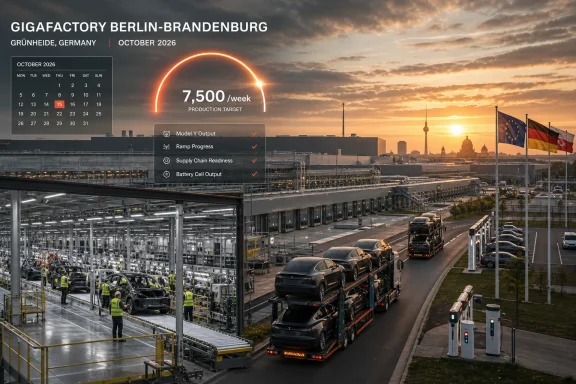
The latest ramp changes the tone. A move to 7,500 vehicles per week puts the German plant back in the neighborhood of its listed annual capacity of roughly 375,000 vehicles, assuming sustained output and normal downtime. That matters because the plant reportedly produced just over 200,000 vehicles in 2025, a number that looked soft next to the size of the facility and the political capital Tesla spent to build it.
Tesla’s statement is therefore doing two jobs at once. It tells customers and investors that demand has returned. It also tells German officials, unions, suppliers, and local communities that the factory remains a serious industrial project rather than an overbuilt monument to pandemic-era EV optimism.
That distinction is not cosmetic. Factories are not apps. You cannot simply ship a new version, watch telemetry, and roll back if the market complains. Adding shifts, hiring workers, training teams, securing parts, scheduling logistics, and smoothing quality at higher volumes all require confidence that demand will remain there after the headline fades.
The Rebound Is Real, But It Is Also Uneven
Tesla’s European recovery in 2026 has produced the kind of numbers supporters were waiting for. The Model Y’s March surge was dramatic, with European registrations reportedly more than doubling year over year and the vehicle returning to the top of the regional sales charts. Germany also showed a sharp reversal, with Tesla registrations said to have quadrupled in March compared with the prior year.
Those figures are the foundation for the Berlin ramp. If the Model Y is moving again in Europe, local production reduces shipping exposure, shortens delivery cycles, and helps Tesla respond faster to market-by-market pricing changes. The Model Y is also the product Berlin knows best; ramping a familiar vehicle is less risky than adding a new model, even if higher output still stresses every part of the operation.
But this is where the triumphant version of the story gets too easy. A rebound from a weak comparison year can look spectacular without fully restoring a company’s prior position. Tesla’s 2025 performance in Europe was hit by product-cycle timing, tougher competition, brand turbulence, pricing pressure, and a buyer base that suddenly had many credible alternatives.
The March rebound does not erase those problems. It says Tesla found demand when the refreshed Model Y and end-of-quarter delivery machinery lined up. The harder question is whether that demand is stable enough to support a factory running at materially higher weekly volume through the rest of 2026 and into 2027.
The Model Y Still Carries Too Much of the Company
There is a familiar genius to Tesla’s manufacturing strategy: simplify the product, repeat the process, drive cost down, and let software and scale do the rest. Berlin is a Model Y factory in spirit even if the larger corporate narrative talks about autonomy, AI, robotaxis, and the future of transport. The plant’s near-term fate is still tied to a family crossover.
That is both a strength and a constraint. The Model Y remains one of the most compelling EV packages in Europe because it combines range, charging access, practicality, software integration, and price flexibility. When Tesla chooses to push, it can use financing, trims, inventory management, and software packages to keep the vehicle moving without redesigning the business.
The constraint is that Europe is no longer waiting for Tesla to define the category. Volkswagen, Hyundai, Kia, Renault, BMW, Mercedes-Benz, Volvo, BYD, and other brands are fighting across price bands that used to feel safely below or above Tesla’s core. Some are better at local market tailoring. Some have denser dealer networks. Some have political and emotional advantages with buyers who want a European badge or a non-Musk purchase.
This is why the Berlin ramp is less a victory lap than a wager. Tesla is betting that the Model Y’s refreshed appeal, local production economics, and still-formidable brand can absorb another 20 percent increase in output. If that bet works, Berlin becomes a source of margin and market share. If it misses, Tesla will be back in the familiar posture of using price cuts to solve what is partly a product breadth problem.
Europe Is No Longer Tesla’s Easy Mode
Tesla’s early European advantage was built on the failures of incumbents. Legacy automakers treated software like an accessory, infotainment like a procurement exercise, and charging like someone else’s problem. Tesla arrived with a vertically integrated experience and made the competition look institutionally slow.
That gap has narrowed. It has not disappeared, and anyone who has used enough legacy car software knows how much cruft remains. But the question for many buyers is no longer “Tesla or a compromised EV?” It is “Tesla or a credible electric Renault, Hyundai, Volkswagen, BMW, Volvo, Kia, BYD, or Mercedes?”
This is a profound change in market psychology. In the first phase of European EV adoption, Tesla benefited from being the default technologically serious choice. In the second phase, it must compete as one option among many, and often as a politically loaded one.
The company’s strengths still matter. The Supercharger network remains a major asset, even as access opens more widely. Tesla’s software update model remains more coherent than most rivals’. Its powertrain efficiency and packaging are still excellent. But Europe’s buyers are not just buying specs; they are buying trust, service access, brand identity, resale confidence, and increasingly, a view of whether they want to be associated with the company’s public image.
Grünheide’s 1,000 New Jobs Are a Message to Germany
The plan to hire about 1,000 additional employees is more than an operational footnote. In Germany, industrial employment carries symbolic weight. Car factories are not merely production sites; they are political institutions, regional employers, supplier anchors, and bargaining arenas.
Tesla has had a complicated relationship with that environment. Giga Berlin brought investment, jobs, and industrial prestige to Brandenburg, but it also brought scrutiny over water use, labor practices, environmental permits, expansion plans, and the culture clash between Silicon Valley speed and German administrative process. Every ramp at Grünheide is therefore watched not only as a business move but as a test of whether Tesla can integrate into Europe’s most demanding manufacturing ecosystem.
Hiring gives Tesla local leverage. It strengthens the argument that the plant is contributing to Germany’s economic transition rather than merely extracting subsidies, permits, and goodwill. It also gives the company a louder voice in debates about energy costs, permitting, infrastructure, and industrial policy.
But more workers also mean more accountability. A larger workforce makes Tesla more exposed to labor organization, workplace expectations, and German norms around consultation and stability. The company may prefer the language of agility, but in Germany, a factory that employs thousands becomes part of the social fabric. That fabric does not move at startup speed.
The Capacity Number Matters Because Investors Remember the Gap
Tesla’s stated capacity for Berlin has often been treated as a promise hiding in plain sight. A factory capable of 375,000 vehicles a year but producing far below that level invites uncomfortable questions. Was demand too weak? Were logistics constrained? Was staffing short? Was the production system less efficient than planned? Was Tesla simply unwilling to fill Europe with cars at lower margins?
The new weekly target offers a partial answer. At 7,500 vehicles per week, the plant would be operating at an annualized level roughly aligned with that 375,000-unit capacity figure before downtime and seasonal variation. That does not mean Berlin will actually deliver 375,000 vehicles in a calendar year, but it gives Tesla a credible operational path toward using the asset it built.
That is important because underused capacity is expensive in ways that do not always show up cleanly in fan debates. Equipment depreciates. Fixed costs sit under fewer vehicles. Suppliers lose rhythm. Workers churn. Local governments grow skeptical. A factory designed for scale wants to be fed.
The ramp also comes at a time when Tesla’s global story is under pressure to prove that vehicle growth is not merely yesterday’s narrative. The company increasingly sells investors on autonomy and AI, but its cash generation still depends heavily on selling cars. Berlin is a reminder that the future may be software-defined, but the present still has stamping presses, paint shops, battery packs, loading docks, and takt time.
The Software Company Still Needs the Hardware Flywheel
Tesla has always blurred the line between automaker and software platform. Over-the-air updates, driver-assistance features, app integration, and data collection made the car feel less like a finished object and more like a device. That framing helped Tesla earn a valuation and fan base unlike any traditional automaker.
Yet the Berlin production boost underscores a less glamorous truth: software leverage depends on hardware distribution. Full Self-Driving subscriptions, premium connectivity, service revenue, fleet data, charging utilization, and future autonomy ambitions all require vehicles in customers’ hands. A stalled factory is not just a manufacturing problem; it is a platform-growth problem.
This is where WindowsForum readers may recognize the pattern. The technology industry loves to talk about platforms, ecosystems, and AI layers, but the real leverage usually appears only after distribution is secured. Microsoft needed PCs everywhere before Windows became the default application platform. Apple needed iPhones everywhere before services became a growth engine. Tesla needs vehicles everywhere before its software ambitions can compound.
That does not mean Tesla’s autonomy claims should be accepted at face value. They should not. The company has repeatedly stretched timelines and encouraged investors to price in futures that regulators, engineers, and customers have not yet fully validated. But it does mean that a production ramp in Germany is not separate from the software story. It is the machinery underneath it.
Europe’s EV War Is Becoming a Price-And-Policy War
The European EV market is not developing as a clean technology adoption curve. It is being shaped by subsidies, taxation, emissions rules, electricity prices, charging availability, tariffs, fleet purchasing, and national politics. Tesla’s Berlin ramp lands in the middle of that mess.
Local production gives Tesla some protection. Building Model Ys in Germany helps the company avoid the optics and logistics of relying solely on imports, and it positions Tesla better if trade tensions rise around Chinese-built EVs. It also gives the company a European industrial footprint at a moment when policymakers increasingly care where batteries and vehicles are made.
But competitors are adapting quickly. Chinese brands are using price, features, and rapid product cycles to pressure the market. European incumbents are using regulation, brand loyalty, financing arms, and local employment arguments to defend their turf. Tesla sits awkwardly between those groups: not European in identity, not Chinese in cost structure, but locally built enough to claim a place in Germany’s industrial future.
This is why higher Berlin output is strategically useful. It gives Tesla more room to maneuver on price without depending entirely on imports. It allows the company to serve Europe with a vehicle tuned to European demand. It also gives Tesla an answer when critics portray it as an American disruptor detached from local economic consequences.
Still, production is only one part of the fight. Europe’s next EV phase will reward companies that can manage affordability, charging confidence, service convenience, fleet relationships, and regulatory compliance simultaneously. Tesla is strong in some of those categories and weaker in others.
The 2025 Slump Left a Scar Tesla Cannot Hand-Wave Away
Tesla bulls will point to the rebound and say the market overreacted. They have a case. Product transitions often create temporary weakness, and the refreshed Model Y clearly helped change the sales trajectory. A bad year does not automatically mean structural decline.
But skeptics also have a case. Tesla’s 2025 difficulties in Europe were not caused by one variable. The company faced intensified competition, public backlash tied to Elon Musk’s politics and behavior, aging product cadence, pressure from lower-cost Chinese EVs, and a European market that no longer treated Tesla as the inevitable winner. Those are not problems that disappear after one strong month.
The most honest reading is that Tesla recovered momentum but not invulnerability. That is still meaningful. Many companies never recover once a growth market begins questioning their default status. Tesla has shown that the Model Y remains capable of pulling customers back when the product, price, and delivery timing align.
The scar matters because it changes how every future number will be interpreted. If Berlin hits 7,500 vehicles per week and sales remain strong, the rebound narrative hardens. If inventories rise or discounts deepen, the ramp will be read as overconfidence. Tesla has less benefit of the doubt in Europe than it once did.
A Factory Ramp Is Also a Quality Test
Higher production is not automatically better production. Automotive history is full of ramps that delivered volume at the expense of fit, finish, logistics, worker safety, and customer satisfaction. Tesla knows this better than most; its earlier manufacturing pushes often came with visible quality complaints and service strain.
Giga Berlin has generally been viewed as one of Tesla’s more important quality plays because it serves demanding European buyers from inside Europe. A German-built Model Y carries expectations that are different from an imported vehicle arriving into a still-maturing EV market. Buyers comparing Tesla to BMW, Mercedes-Benz, Audi, Volvo, or Volkswagen will not grade on a startup curve forever.
Adding 1,000 workers can help if the ramp is deliberate and training is strong. It can hurt if Tesla treats headcount as a shortcut to output. Manufacturing culture is built through repetition, supervision, process discipline, and feedback loops. At 7,500 vehicles per week, small defects scale quickly.
Tesla’s advantage is that its production system is highly instrumented and vertically coordinated compared with many rivals. Its disadvantage is that the company’s internal culture often prizes speed and heroic execution. Europe will reward the former more than the latter.
The Competition Will Not Wait for Tesla to Enjoy the Moment
The timing of Tesla’s Berlin announcement is not accidental in a broader market sense. Europe’s automakers are under pressure, but they are not standing still. Renault’s electric push, Volkswagen’s platform work, Hyundai and Kia’s increasingly polished EVs, Volvo’s electric lineup, BMW’s premium execution, and BYD’s aggressive expansion all create a market where Tesla cannot simply rely on being Tesla.
The Model Y’s return to the top of the charts in March is therefore important but not definitive. Monthly registration data can be noisy, especially for a company known for quarter-end delivery waves. Fleet timing, incentives, shipping, refreshed-model availability, and national registration quirks can make one month look more decisive than it really is.
The broader trend is the thing to watch. If Tesla keeps gaining across multiple European markets through the second half of 2026, Berlin’s ramp will look prescient. If the company spikes in quarter-end months and softens between them, the production increase may create a new round of pricing pressure.
Tesla’s rivals will study the same data. If Berlin’s higher output leads to lower prices, they will decide whether to defend margins or chase volume. If Tesla holds pricing while increasing deliveries, competitors will have to accept that the refreshed Model Y has more life than they hoped. Either way, the ramp forces the market to react.
The Labor Math Is Easier Than the Demand Math
Hiring 1,000 people is operationally hard, but it is conceptually straightforward. Tesla needs more hands, more trained teams, and more shift capacity to support higher output. Germany has a deep manufacturing labor base, and the prestige of EV production still helps recruitment even amid controversy.
Demand is harder. It depends on customer sentiment, financing conditions, electricity prices, policy incentives, rival launches, charging confidence, and Tesla’s own pricing choices. It also depends on whether the Model Y refresh has enough staying power once early adopters and delayed buyers have been served.
That is why the October timing matters. A ramp beginning in October gives Tesla time to prepare staffing and production systems, but it also points toward a crucial late-year test. The company will be entering the final quarter with higher European output capacity and a market that will reveal whether the spring rebound was durable or partly seasonal.
If Tesla manages the transition well, Berlin can become a stabilizing force. It can supply Europe at scale, support local employment, and reinforce the Model Y as the default electric crossover for buyers who want a mature EV without drifting into premium German pricing. If Tesla misreads demand, the same plant becomes a pressure valve releasing discounts into an already competitive market.
The Signal From Grünheide Is Confidence, Not Certainty
The cleanest takeaway from the announcement is that Tesla management believes European demand is strong enough to justify another push. Companies do not add 1,000 workers and raise a major plant’s output target by 20 percent as a publicity stunt alone. They may be wrong, but the decision itself reveals conviction.
That conviction rests on visible evidence. The Model Y rebounded sharply in March. Germany improved dramatically. Other European markets showed stronger Tesla registrations after a bruising prior year. Berlin has already demonstrated that it can build the Model Y at serious scale.
But confidence is not certainty, and Tesla’s recent history argues for discipline. The company has often been right about the direction of travel and wrong about timing, smoothness, and regulatory complexity. Europe is especially unforgiving because consumers, governments, competitors, and labor institutions all have strong opinions about how the EV transition should proceed.
That is what makes this production boost more interesting than a routine plant update. It is a calculated bet that Tesla’s European story has moved from retreat to recovery. The next six to twelve months will determine whether that recovery becomes a new growth chapter or merely a bounce inside a more crowded market.
The Numbers That Will Decide Whether Berlin’s Bet Pays Off
Tesla’s Grünheide ramp gives the market a concrete scoreboard. The company can talk about autonomy, AI, and future mobility as much as it wants, but this decision will be judged by factory output, registrations, inventories, pricing, and quality. For now, the practical read is clear:
- Tesla plans to lift Giga Berlin production to 7,500 vehicles per week from October 2026, a roughly 20 percent increase from the current run rate.
- The company says it will hire about 1,000 additional workers to support the higher output at the German plant.
- The ramp follows a sharp 2026 rebound for the Model Y in Europe after a difficult 2025 for Tesla registrations and factory utilization.
- The move brings Berlin closer to the annualized level implied by Tesla’s stated 375,000-vehicle capacity for the site.
- The biggest risk is not whether Tesla can build more Model Ys, but whether European demand remains strong enough to absorb them without margin-eroding discounts.
- The announcement strengthens Tesla’s claim to be a serious European manufacturer, but it also deepens its exposure to German labor, regulatory, and quality expectations.
Tesla’s Berlin ramp is a reminder that the EV transition is entering its industrial phase, where brand mythology and software ambition have to survive contact with labor markets, factory utilization, regional politics, and monthly registration data. If the Model Y’s rebound holds, Grünheide may look like the asset Tesla always promised Europe it would be. If it falters, the same factory will expose the limits of a company still asking one crossover to carry a continental strategy.