
Westminster City Council says its Microsoft-based AI contact centre, launched after discovery work in mid-2025 and put into service in September 2025, is now handling thousands of resident queries while cutting call wrap-up time and reducing repeat explanations for residents. The claim is not that a chatbot has reinvented local government. It is that one of the UK’s most visible boroughs has found a practical place for AI: not replacing judgment, but moving context through a bureaucracy without dropping it on the floor.
The most revealing detail in Westminster City Council’s Microsoft case study is not the 89.5 percent chatbot resolution rate, impressive though that sounds. It is Nadia Ali’s blunt description of what angers residents most: having to repeat themselves when the council already has the basics.
That is the kind of failure every resident recognises. You call about a repair, explain the problem, wait, explain it again, and then discover that the person sent to fix it has received only a flattened version of the story. In the private sector this is bad customer service. In local government, where calls often involve housing, vulnerability, debt, licensing, or safeguarding, it can become something heavier.
Westminster is a peculiar test bed for this problem. The borough contains Parliament, Big Ben, Westminster Abbey, global tourist flows, major employers, and extreme wealth. It also contains residents living with housing pressure, health inequality, and deprivation. A contact centre serving that mix is not a helpdesk bolted onto government; it is one of the places where public authority becomes tangible.
Microsoft’s telling of the story understandably foregrounds Copilot Studio and Dynamics 365 Contact Centre. But the more important lesson is organisational: Westminster began with discovery work, listened to residents, reviewed more than 3,000 call recordings, and mapped the messy handoffs behind its front door before it tried to automate them.
Those numbers matter, but the architectural shift matters more. The council built chatbots in Microsoft Copilot Studio for initial inquiries and connected them to Dynamics 365 Contact Centre so information from web activity, calls, and case notes could be brought into a more coherent customer record. In plain English: the machine is meant to collect the thread before the human picks it up.
That distinction is crucial for IT leaders. A bot that answers simple questions is a website with better manners. A bot that captures usable context and passes it into the case-handling workflow is closer to a service redesign. It changes not only how residents ask for help, but how staff inherit the problem.
The Westminster example also shows why omnichannel has so often been a hollow promise. Public-sector organisations have spent years adding digital forms, portals, phone systems, email inboxes, and chat widgets. But if those systems do not tell one story, the burden of integration falls back onto the resident.
This is where the AI debate becomes less abstract. Public-sector AI is often sold in sweeping language: transformation, modernisation, reinvention. Westminster’s most credible claim is narrower and therefore stronger. It saved one minute after a call.
That minute matters because contact centres are machines for aggregating small frictions. A few seconds of searching, a minute of note-taking, a duplicated explanation, an incorrectly routed case: each one is trivial in isolation and expensive at scale. The same arithmetic works in reverse. Reduce a repetitive task slightly and the recovered time can become meaningful.
Ali’s argument is that this reclaimed capacity can be shifted toward residents who need more support, including vulnerable people dealing with housing repairs. That is the morally serious version of the productivity story. The point is not merely to answer more easy questions with fewer humans. It is to reserve human attention for the cases where ambiguity, empathy, and persistence matter.
In service environments, badly deployed AI often creates a new kind of alienation. Residents can be pushed through automated menus, forced to adapt their problem to the system’s categories, or trapped in loops when the machine cannot recognise urgency. Westminster’s project is interesting because its stated goal is not to keep humans away from residents at all costs.
The council’s “right channel for the right conversation” line is doing a lot of work here. It rejects two familiar mistakes: digital-by-default ideology, which assumes online service is inherently better, and channel nostalgia, which treats the phone as the only humane option. Some questions should be answered instantly by a bot at midnight. Others should move quickly to a trained person.
That division is especially important in a borough with inequality behind the postcard scenery. The residents most likely to need patient, human help are often the least well served by brittle automation. AI earns its place only if it clears the path to that help rather than obscuring it.
The story also arrives at a useful time. The enterprise AI market is no longer impressed by generic demos of summarised meetings and drafted emails. Customers want measurable outcomes, and “one minute per call” is a more digestible metric than vague promises of reinvention.
Still, Microsoft’s involvement cuts both ways. The company benefits from public-sector credibility when a council reports high containment rates and staff time savings. But public bodies also need to avoid becoming marketing collateral for vendor roadmaps they do not control.
That means asking dull but essential questions. How are prompts governed? How are answers tested? How are hallucinations detected? How are residents told when they are interacting with automation? How are vulnerable cases escalated? How are records audited when an AI-generated summary becomes part of the operational truth?
Westminster says it has put controls in place against jailbreak-style prompts and trained the chatbot to respond neutrally in sensitive scenarios. That is encouraging, but safeguards are not a one-off configuration. They are an operating discipline.
That finding should be familiar to any sysadmin or IT manager who has inherited a sprawling public-sector stack. The hardest part of these projects is rarely spinning up the bot. It is understanding which systems hold which fragments of truth, which teams trust which records, and where the handoff breaks down.
AI can make that mess worse if it is layered on top without repair. It can confidently summarise incomplete information, route cases based on bad assumptions, or create a polished interface over unresolved organisational dysfunction. A smoother front end is not the same as a better service.
Westminster’s reported approach works because it treats AI as part of a service map rather than a magic portal. The project listened to calls, followed enquiries, and identified where residents were forced to compensate for institutional fragmentation. Only then did the automation become useful.
That is not automatically a better job. AI summaries can reduce drudgery, but they can also create pressure to handle more contacts, trust machine-generated records, or accept new surveillance of performance. Any serious assessment has to watch both sides of the ledger.
The better version of this future is one in which contact centre workers become higher-value navigators of complex services. Westminster hints at that when it talks about training staff on Copilot and Copilot Studio, potentially turning contact centre talent into future AI engineers and software developers. That is an ambitious claim, and it should be judged by whether staff actually gain mobility, skills, and influence over the tools they use.
The worse version is one in which AI captures the easy work, intensifies the hard work, and leaves humans with only the emotionally complex cases under tighter time pressure. Westminster’s one-minute saving is promising precisely because the council frames it as capacity for advocacy rather than simply throughput.
Ali’s comment that the council used to “misrepresent the customer” is unusually candid. It captures a common failure in case management: the person is translated into a note, the note becomes a task, the task becomes a work order, and the original context evaporates. By the time someone arrives at the door, the resident is no longer dealing with one council but with several disconnected interpretations of the same problem.
AI-generated summaries can help, but they also introduce a new risk. If the summary is wrong, too compressed, or stripped of nuance, the error may travel faster and look more authoritative. The neatness of machine-written text can disguise uncertainty.
That is why auditability matters. Staff need to see the underlying conversation when the summary looks suspicious. Residents need routes to correct the record. Managers need to know whether the system is improving outcomes, not merely producing cleaner notes.
A successful AI contact centre is not one where the chatbot wins every exchange. It is one where the organisation knows when the machine is out of its depth.
That agenda is less glamorous than the industry’s agentic AI rhetoric, but it is more plausible. Local government is full of repeatable interactions that are frustrating not because they require genius, but because they require continuity. Residents do not want to understand departmental structures. They want the council to remember what it has already been told.
The risk is that impressive resolution rates become the wrong scoreboard. A chatbot resolving 89.5 percent of queries sounds excellent, but the unresolved 10.5 percent may include the cases where harm is most likely if escalation fails. The correct metric is not containment alone; it is containment plus correctness, fairness, accessibility, and recovery when the system gets it wrong.
Westminster appears to understand at least part of that. Its focus on vulnerable residents, neutral responses in sensitive contexts, and advocacy capacity suggests a more grounded model than the usual “AI will replace the call queue” pitch.
 Westminster’s AI Bet Starts With a Very Old Civic Failure
The most revealing detail in Westminster City Council’s Microsoft case study is not the 89.5 percent chatbot resolution rate, impressive though that sounds. It is Nadia Ali’s blunt description of what angers residents most: having to repeat themselves when the council already has the basics.That is the kind of failure every resident recognises. You call about a repair, explain the problem, wait, explain it again, and then discover that the person sent to fix it has received only a flattened version of the story. In the private sector this is bad customer service. In local government, where calls often involve housing, vulnerability, debt, licensing, or safeguarding, it can become something heavier.
Westminster is a peculiar test bed for this problem. The borough contains Parliament, Big Ben, Westminster Abbey, global tourist flows, major employers, and extreme wealth. It also contains residents living with housing pressure, health inequality, and deprivation. A contact centre serving that mix is not a helpdesk bolted onto government; it is one of the places where public authority becomes tangible.
Microsoft’s telling of the story understandably foregrounds Copilot Studio and Dynamics 365 Contact Centre. But the more important lesson is organisational: Westminster began with discovery work, listened to residents, reviewed more than 3,000 call recordings, and mapped the messy handoffs behind its front door before it tried to automate them.
The Chatbot Is the Least Interesting Part of the Story
It would be easy to reduce this project to “council installs AI chatbot.” That framing misses the point. Westminster already had a chatbot before the latest system, and it reportedly handled around 300 queries a month. After the September 2025 launch, the council says the new system handled 33,400 queries and resolved 89.5 percent without referral to a human agent.Those numbers matter, but the architectural shift matters more. The council built chatbots in Microsoft Copilot Studio for initial inquiries and connected them to Dynamics 365 Contact Centre so information from web activity, calls, and case notes could be brought into a more coherent customer record. In plain English: the machine is meant to collect the thread before the human picks it up.
That distinction is crucial for IT leaders. A bot that answers simple questions is a website with better manners. A bot that captures usable context and passes it into the case-handling workflow is closer to a service redesign. It changes not only how residents ask for help, but how staff inherit the problem.
The Westminster example also shows why omnichannel has so often been a hollow promise. Public-sector organisations have spent years adding digital forms, portals, phone systems, email inboxes, and chat widgets. But if those systems do not tell one story, the burden of integration falls back onto the resident.
One Minute Per Call Is a Political Number
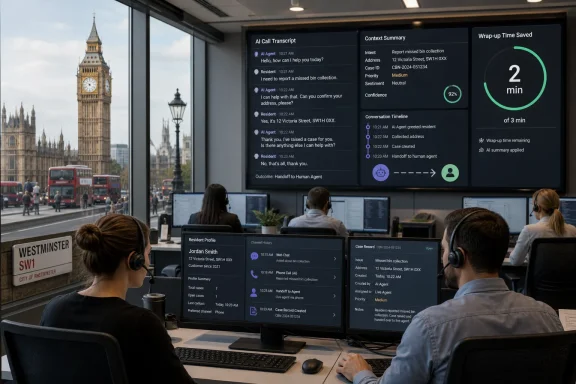
Westminster says AI-generated summaries and real-time transcription have cut average wrap-up time from three minutes to two. That sounds like a minor operational improvement until it is multiplied across roughly 500,000 annual enquiries. The council calculates the saving at about 500,000 minutes a year, or roughly 8,300 hours.This is where the AI debate becomes less abstract. Public-sector AI is often sold in sweeping language: transformation, modernisation, reinvention. Westminster’s most credible claim is narrower and therefore stronger. It saved one minute after a call.
That minute matters because contact centres are machines for aggregating small frictions. A few seconds of searching, a minute of note-taking, a duplicated explanation, an incorrectly routed case: each one is trivial in isolation and expensive at scale. The same arithmetic works in reverse. Reduce a repetitive task slightly and the recovered time can become meaningful.
Ali’s argument is that this reclaimed capacity can be shifted toward residents who need more support, including vulnerable people dealing with housing repairs. That is the morally serious version of the productivity story. The point is not merely to answer more easy questions with fewer humans. It is to reserve human attention for the cases where ambiguity, empathy, and persistence matter.
AI Helps When It Carries Context, Not When It Pretends to Care
The strongest part of Westminster’s case is that it does not pretend the chatbot is empathetic. The council’s emphasis is on removing friction, producing clearer records, and helping staff “focus on the person rather than the keyboard.” That is a better ambition than trying to make a bot sound compassionate.In service environments, badly deployed AI often creates a new kind of alienation. Residents can be pushed through automated menus, forced to adapt their problem to the system’s categories, or trapped in loops when the machine cannot recognise urgency. Westminster’s project is interesting because its stated goal is not to keep humans away from residents at all costs.
The council’s “right channel for the right conversation” line is doing a lot of work here. It rejects two familiar mistakes: digital-by-default ideology, which assumes online service is inherently better, and channel nostalgia, which treats the phone as the only humane option. Some questions should be answered instantly by a bot at midnight. Others should move quickly to a trained person.
That division is especially important in a borough with inequality behind the postcard scenery. The residents most likely to need patient, human help are often the least well served by brittle automation. AI earns its place only if it clears the path to that help rather than obscuring it.
Microsoft Gets a Useful Public-Sector Showcase
For Microsoft, Westminster is a tidy demonstration of a strategy it has been pushing across business applications: Copilot is not just a writing assistant, but a layer across customer service, case management, knowledge retrieval, and workflow. Dynamics 365 Contact Centre gives Microsoft a stronger claim in the contact-centre-as-a-service market, while Copilot Studio lets organisations build custom agents without starting from scratch.The story also arrives at a useful time. The enterprise AI market is no longer impressed by generic demos of summarised meetings and drafted emails. Customers want measurable outcomes, and “one minute per call” is a more digestible metric than vague promises of reinvention.
Still, Microsoft’s involvement cuts both ways. The company benefits from public-sector credibility when a council reports high containment rates and staff time savings. But public bodies also need to avoid becoming marketing collateral for vendor roadmaps they do not control.
That means asking dull but essential questions. How are prompts governed? How are answers tested? How are hallucinations detected? How are residents told when they are interacting with automation? How are vulnerable cases escalated? How are records audited when an AI-generated summary becomes part of the operational truth?
Westminster says it has put controls in place against jailbreak-style prompts and trained the chatbot to respond neutrally in sensitive scenarios. That is encouraging, but safeguards are not a one-off configuration. They are an operating discipline.
The Discovery Phase Was the Real Procurement
Ali’s advice to other organisations is not to rush discovery and not to buy technology for its own sake. That may sound like standard transformation-speak, but in this case it is the core of the project. The council’s discovery work found that data was “all over the place” and that channels were not producing a single view of the resident journey.That finding should be familiar to any sysadmin or IT manager who has inherited a sprawling public-sector stack. The hardest part of these projects is rarely spinning up the bot. It is understanding which systems hold which fragments of truth, which teams trust which records, and where the handoff breaks down.
AI can make that mess worse if it is layered on top without repair. It can confidently summarise incomplete information, route cases based on bad assumptions, or create a polished interface over unresolved organisational dysfunction. A smoother front end is not the same as a better service.
Westminster’s reported approach works because it treats AI as part of a service map rather than a magic portal. The project listened to calls, followed enquiries, and identified where residents were forced to compensate for institutional fragmentation. Only then did the automation become useful.
The Human Job Changes Before It Disappears
The usual anxiety around AI in contact centres is job replacement. Westminster’s account points to a subtler and more immediate shift: the work changes. Staff spend less time typing notes during calls and more time listening, interpreting, and following through.That is not automatically a better job. AI summaries can reduce drudgery, but they can also create pressure to handle more contacts, trust machine-generated records, or accept new surveillance of performance. Any serious assessment has to watch both sides of the ledger.
The better version of this future is one in which contact centre workers become higher-value navigators of complex services. Westminster hints at that when it talks about training staff on Copilot and Copilot Studio, potentially turning contact centre talent into future AI engineers and software developers. That is an ambitious claim, and it should be judged by whether staff actually gain mobility, skills, and influence over the tools they use.
The worse version is one in which AI captures the easy work, intensifies the hard work, and leaves humans with only the emotionally complex cases under tighter time pressure. Westminster’s one-minute saving is promising precisely because the council frames it as capacity for advocacy rather than simply throughput.
Public Trust Will Be Won in the Handoff
For residents, the visible part of the system is simple: did I get the right answer, and did I have to repeat myself? For administrators, the harder test is whether the handoff from bot to human to field team preserves meaning.Ali’s comment that the council used to “misrepresent the customer” is unusually candid. It captures a common failure in case management: the person is translated into a note, the note becomes a task, the task becomes a work order, and the original context evaporates. By the time someone arrives at the door, the resident is no longer dealing with one council but with several disconnected interpretations of the same problem.
AI-generated summaries can help, but they also introduce a new risk. If the summary is wrong, too compressed, or stripped of nuance, the error may travel faster and look more authoritative. The neatness of machine-written text can disguise uncertainty.
That is why auditability matters. Staff need to see the underlying conversation when the summary looks suspicious. Residents need routes to correct the record. Managers need to know whether the system is improving outcomes, not merely producing cleaner notes.
A successful AI contact centre is not one where the chatbot wins every exchange. It is one where the organisation knows when the machine is out of its depth.
Westminster’s Numbers Point to a Narrower, Better AI Agenda
The most concrete lesson from Westminster is that useful public-sector AI may look boring from the outside. It does not need to be a sentient council officer or a universal civic assistant. It needs to shave minutes from repetitive work, preserve context between teams, answer routine questions out of hours, and escalate the rest cleanly.That agenda is less glamorous than the industry’s agentic AI rhetoric, but it is more plausible. Local government is full of repeatable interactions that are frustrating not because they require genius, but because they require continuity. Residents do not want to understand departmental structures. They want the council to remember what it has already been told.
The risk is that impressive resolution rates become the wrong scoreboard. A chatbot resolving 89.5 percent of queries sounds excellent, but the unresolved 10.5 percent may include the cases where harm is most likely if escalation fails. The correct metric is not containment alone; it is containment plus correctness, fairness, accessibility, and recovery when the system gets it wrong.
Westminster appears to understand at least part of that. Its focus on vulnerable residents, neutral responses in sensitive contexts, and advocacy capacity suggests a more grounded model than the usual “AI will replace the call queue” pitch.
The Westminster Test Is Whether Residents Notice Less Government in the Way
The practical conclusions are refreshingly concrete. Westminster’s deployment is not proof that AI can fix local government, but it is evidence that carefully scoped automation can reduce some of the friction residents experience when systems fail to share context.- Westminster’s most important improvement is not the chatbot itself, but the attempt to connect web, phone, and case information into a more consistent resident record.
- The reported reduction in wrap-up time from three minutes to two matters because small savings compound across roughly 500,000 annual enquiries.
- The council’s claimed 89.5 percent chatbot resolution rate is promising, but it should be measured alongside escalation quality and outcomes for complex cases.
- AI-generated summaries are useful only if staff can verify, correct, and challenge them when nuance is lost.
- Other councils should copy the discovery-first approach before copying the technology stack.
References
- Primary source: Microsoft UK Stories
Published: Thu, 18 Jun 2026 06:55:31 GMT
How AI is helping Westminster City Council offer a better service to residents
Westminster City Council is using AI to give residents more accurate and relevant answers to queries faster. This is freeing up time for staff to spend on more complex cases that require more support.ukstories.microsoft.com - Official source: microsoft.com
Manchester City Council harnesses Microsoft 365 Copilot with Copilot Studio to drive greater service for citizens | Microsoft Customer Stories
Manchester City Council is embracing agentic AI, empowering employees and driving greater value for citizens.www.microsoft.com
- Related coverage: executivebiz.com
Microsoft Brings AI-Powered Dynamics 365 Contact Center to Government Community Cloud - ExecutiveBiz
Microsoft's launch of Dynamics 365 Contact Center on GCC gives agencies access to a unified voice and digital engagement tool. www.executivebiz.com
- Official source: techcommunity.microsoft.com
Empowering.Cloud Community Update – September 2025 | Microsoft Community Hub
The latest Microsoft Teams and Microsoft 365 expert community briefings, podcasts and upcoming community events for September 2025. Expert Briefings Copilot... techcommunity.microsoft.com
- Official source: adoption.microsoft.com
Agent transformation stories – Microsoft Adoption
Real customer stories. Real agent impact. Discover how organizations across industries are transforming their business with agents and find inspiration for your own AI journey.adoption.microsoft.com - Related coverage: cnbc.com
Microsoft adds Anthropic AI model to Copilot assistant, diversifying from OpenAI
Microsoft is taking another step toward diversification away from OpenAI, which it considers a strategic partner.www.cnbc.com
- Official source: info.microsoft.com
Microsoft Discovery Hour: Let’s Talk AI for Service
info.microsoft.com
- Related coverage: uk.marketscreener.com
- Related coverage: techbriefly.com
UK study: Microsoft 365 Copilot boosts satisfaction, not productivity - TechBriefly
A recent UK government pilot program evaluating Microsoft 365 Copilot revealed high levels of user satisfaction but failed to demonstrate any tangible gains in productivity. The Department for Business and Trade conducted the study, which spanned from October to December 2024. The initiative...techbriefly.com - Related coverage: computerworld.com
Microsoft prompts Teams AI agents to collaborate with humans – Computerworld
Microsoft is launching a range of AI agents to save workers time in its Teams, SharePoint and Viva Engage apps. www.computerworld.com
- Official source: pulse.microsoft.com
- Official source: cdn-dynmedia-1.microsoft.com