
Microsoft’s Security Update Guide entry for CVE-2026-25681, published after the Go project’s May 2026 x/net security update, tracks a medium-severity cross-site scripting flaw in
The oddity of this advisory is that Microsoft is not warning about a flaw in Windows itself. CVE-2026-25681 lives in the Go ecosystem, specifically in the
That distinction is easy to miss. A Windows administrator scanning advisory feeds may see “Microsoft Knowledge Base,” “MSRC,” and a CVE, then assume another operating system patch is required. In this case, the right response is not to wait for Windows Update, but to inventory Go dependencies, identify software that parses and re-renders untrusted HTML, and rebuild anything pinned below
The vulnerability was disclosed as part of a broader Go security update for
The word that should draw attention is not “DOCTYPE.” It is XSS. Cross-site scripting is not glamorous in the way remote code execution is glamorous, but it remains one of the most durable ways to turn a small parser disagreement into account compromise, session theft, malicious workflow changes, or data exposure inside a web application that otherwise appears to be doing the responsible thing.
The affected package can parse arbitrary HTML and then render it using the Go HTML renderer. Under vulnerable versions, character references inside DOCTYPE nodes are mishandled. That can lead to an unexpected HTML tree, meaning the structure produced and later emitted does not line up with what the application intended to permit.
This is the uncomfortable zone where parsers, renderers, sanitizers, and browsers all have to agree. When they do not, attackers look for a seam. A sanitizer may strip script tags, remove dangerous attributes, or enforce a restricted markup policy, only for a parser edge case to transform apparently harmless input into something the browser treats differently after rendering.
That is why this class of bug is more than a library footnote. Many applications do not display raw user input directly; they run it through a cleaning pipeline first. Forums, comment systems, Markdown-to-HTML renderers, documentation portals, ticketing systems, email viewers, knowledge bases, and admin dashboards all live in the space where “safe HTML” is a business requirement rather than an abstract exercise.
If those systems are written in Go, or if a Go service handles their sanitization path,
But attackers do not care whether the vulnerable syntax looks modern. They care whether it changes parser state, output structure, or browser interpretation. Security history is full of bugs that hid in dusty corners of a grammar because everyone assumed the interesting attacks lived in obvious tags and attributes.
The Go advisory says the problem can be leveraged to execute XSS in applications that attempt to sanitize input HTML before rendering it. That sentence carries an important implication: the most exposed applications are not necessarily the careless ones that dump user input straight into pages. They may be applications whose authors attempted to do the right thing but relied on a parser that made a subtly wrong promise.
This is especially relevant for WindowsForum readers because enterprise Windows environments are rarely pure Windows environments anymore. A help desk portal may run on Windows Server but ship as a Go executable. A security appliance management UI may be maintained by a vendor using Go. A developer platform installed on Windows may include Go-based services behind a reverse proxy. The vulnerable component’s name may never appear in the UI, the installer, or the admin guide.
That is the supply-chain lesson: a bug in a parser package can matter even when no one in the operations team believes they “run Go.”
But “official” does not mean “immune.” The
This is where Go’s strengths complicate remediation. Go’s module system makes it relatively straightforward for developers to update a dependency and rebuild. Go’s static binaries make deployment simple and predictable. Yet those same static binaries mean administrators cannot always fix a vulnerable library by updating a shared system package.
On Linux, this problem is already familiar to teams that manage container images and language ecosystems. On Windows, it is more uneven. Some organizations still think in MSI packages, Windows Update rings, and vendor patch bundles. Those tools remain essential, but they do not fully cover the modern software estate, especially when internal developers ship self-contained services or vendors deliver opaque executables.
A vulnerable Go module is not remediated by good intentions. It is remediated when the affected application is rebuilt against a fixed version, tested, signed, and redeployed. If the vulnerable code is inside third-party software, the customer has to wait for the vendor or apply compensating controls.
Still, “medium” is not a synonym for “ignore.” XSS impact depends heavily on where the vulnerable behavior exists. A flaw in a public comment widget is one thing; a flaw in an internal admin console used by privileged operators is another.
The classic XSS chain does not need to own the server to hurt the organization. It can steal session tokens where protections are weak, induce a privileged user to perform an action, alter displayed content, pivot through single sign-on flows, or exfiltrate data visible in the browser. In a modern enterprise portal, the browser is often the control plane.
User interaction also deserves a more skeptical reading. Many security teams see “user interaction required” and mentally downgrade the issue. But browser attacks are built around interaction. A crafted link, uploaded document, malicious comment, shared ticket, or poisoned profile field can be enough if the application later renders content in a privileged user’s session.
The key operational question is not whether every Go application is vulnerable in practice. Most are not. The question is whether any application accepts attacker-controlled or low-trust HTML, parses it with the affected package, sanitizes or transforms it, and renders it back into a page viewed by someone whose browser session matters.
For internal development teams, the search begins with
For operations teams, the problem is less elegant. A compiled Go binary does not always advertise its module graph in a way that a Windows admin can casually inspect. Some build pipelines preserve version metadata; others strip or obscure it. Some vendors publish SBOMs; others respond to CVE inquiries with delays, generic statements, or patched builds that do not clearly name the fixed component.
This is where software bills of materials stop being a procurement checkbox and become a practical incident-response tool. If a vendor can tell you whether its Windows agent, appliance controller, or web console includes
The most mature organizations will handle CVE-2026-25681 through dependency scanning, build attestation, and vendor questionnaires. Less mature organizations will wait until a scanner flags a binary or a security team asks why an internal tool has not been rebuilt in six months. The vulnerability itself is narrow; the process gap it exposes is broad.
That nuance matters. Overstating the issue leads to noisy emergency work. Understating it leads to silent exposure in the few places where the bug genuinely matters. Security teams need to separate “component present” from “component reachable” from “component exploitable in context.”
The highest-interest applications are those that implement HTML sanitization, preview generation, rich-text editing, email or message rendering, documentation ingestion, web scraping with re-publication, content management, or template-like transformations of user-provided markup. In those systems, the parser is part of a trust boundary.
There is a further wrinkle: some applications may rely on a separate sanitizer but still use Go’s parser or renderer in the pipeline. The vulnerable behavior may sit before or after the library the team normally thinks of as “the sanitizer.” That makes code review more useful than package inventory alone.
For sysadmins managing Windows-hosted applications, the practical path is to identify services that expose web UIs and accept rich content, then map ownership. Is it an in-house Go service? Ask for the module version and rebuild status. Is it a vendor product? Ask whether CVE-2026-25681 affects any shipped component. Is it containerized on Windows or managed through Kubernetes? Check image rebuild dates and dependency scan results rather than assuming the host patch state tells the whole story.
That is not a criticism of Microsoft. It is a description of the modern dependency model. Vulnerability intelligence has become centralized, while remediation remains distributed across maintainers, vendors, internal teams, managed service providers, and customers.
The same advisory can mean different things to different readers. For a developer, it means updating a module and validating parser-dependent tests. For a security engineer, it means checking reachability and exposure. For a Windows administrator, it means resisting the instinct to look only at Windows Update compliance. For procurement, it means asking why a vendor cannot answer basic dependency questions within a reasonable time.
This division of labor is uncomfortable because no single dashboard can close the loop. A vulnerability may appear in MSRC, NVD, Go’s vulnerability database, GitHub advisories, Snyk, GitLab, and scanner feeds. Those systems can agree on the CVE and still leave the customer with the hardest question: which running applications in my environment actually contain and expose this code?
But version bumps are rarely risk-free in large environments. Updating
For many applications, the security fix will be uneventful. For systems that compare serialized HTML output, enforce strict tests around parser trees, or depend on quirks in older behavior, the update may surface compatibility changes. That is not a reason to delay indefinitely, but it is a reason to treat the change as an application release rather than a blind library swap.
The more difficult verification problem is third-party software. If a vendor ships a patched build, administrators need a way to confirm it. Release notes should name the CVE or the fixed module version. SBOMs should show
The old mental model of XSS as website defacement is obsolete. In a corporate environment, a successful script injection can ride on the authority of whoever views the page. If that person is a help desk technician, developer, tenant administrator, or security analyst, the browser session may have access to secrets, configuration changes, deployment controls, or sensitive records.
This is why parser vulnerabilities matter even when they look academically narrow. The exploit payload may be small, but the trust context can be large. A single rich-text field in a privileged console can become a route to actions the attacker could never perform directly.
Defenses such as Content Security Policy, HTTP-only cookies, same-site protections, output encoding, and strict sanitization still matter. But they are defense-in-depth, not permission to ignore a parser bug. If the application’s safety depends on parsing and re-rendering hostile HTML, the parser has to be trustworthy.
golang.org/x/net/html before v0.55.0, where malformed DOCTYPE character references can produce an unsafe rendered HTML tree. The bug is not a Windows kernel problem, not a browser zero-day, and not a Patch Tuesday headline in the usual sense. Its importance is quieter and more familiar: modern Windows estates are full of Go-built services, agents, portals, scanners, dashboards, and internal tools whose risk is often hidden several layers below the application name on the change ticket.
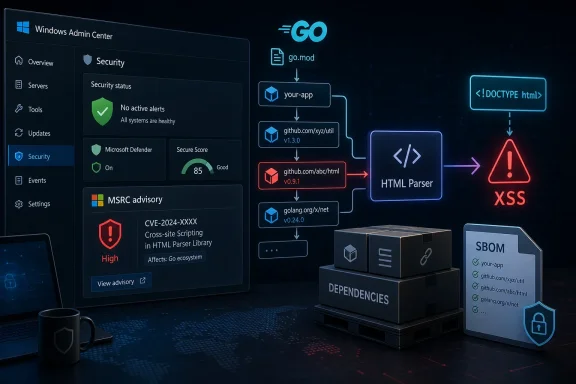 Microsoft’s Advisory Is Really a Supply-Chain Warning
The oddity of this advisory is that Microsoft is not warning about a flaw in Windows itself. CVE-2026-25681 lives in the Go ecosystem, specifically in the golang.org/x/net/html parser, a package many developers treat as dependable infrastructure because it comes from the Go project’s extended library family. Microsoft’s listing matters because MSRC has become a broad vulnerability clearinghouse for products and components that flow into Microsoft’s own software world, customer environments, and cloud-adjacent development practices.That distinction is easy to miss. A Windows administrator scanning advisory feeds may see “Microsoft Knowledge Base,” “MSRC,” and a CVE, then assume another operating system patch is required. In this case, the right response is not to wait for Windows Update, but to inventory Go dependencies, identify software that parses and re-renders untrusted HTML, and rebuild anything pinned below
golang.org/x/net v0.55.0.The vulnerability was disclosed as part of a broader Go security update for
x/net in May 2026. That update fixed several HTML parser issues, including cases where parsed content could be rendered differently from what a sanitizer or filtering layer believed it had allowed. CVE-2026-25681 is one member of that cluster, and its narrow description—incorrect handling of character references in DOCTYPE nodes—makes it sound less consequential than the exploit class it supports.The word that should draw attention is not “DOCTYPE.” It is XSS. Cross-site scripting is not glamorous in the way remote code execution is glamorous, but it remains one of the most durable ways to turn a small parser disagreement into account compromise, session theft, malicious workflow changes, or data exposure inside a web application that otherwise appears to be doing the responsible thing.
A Parser Bug Becomes Dangerous When Sanitizers Trust It
HTML security bugs often emerge from a deceptively simple assumption: if a program parses input, sanitizes the resulting structure, and renders it back out, the browser will interpret the final output in the same way the sanitizer did. CVE-2026-25681 is about what happens when that assumption fails.The affected package can parse arbitrary HTML and then render it using the Go HTML renderer. Under vulnerable versions, character references inside DOCTYPE nodes are mishandled. That can lead to an unexpected HTML tree, meaning the structure produced and later emitted does not line up with what the application intended to permit.
This is the uncomfortable zone where parsers, renderers, sanitizers, and browsers all have to agree. When they do not, attackers look for a seam. A sanitizer may strip script tags, remove dangerous attributes, or enforce a restricted markup policy, only for a parser edge case to transform apparently harmless input into something the browser treats differently after rendering.
That is why this class of bug is more than a library footnote. Many applications do not display raw user input directly; they run it through a cleaning pipeline first. Forums, comment systems, Markdown-to-HTML renderers, documentation portals, ticketing systems, email viewers, knowledge bases, and admin dashboards all live in the space where “safe HTML” is a business requirement rather than an abstract exercise.
If those systems are written in Go, or if a Go service handles their sanitization path,
golang.org/x/net/html may be somewhere in the chain. And because Go binaries are commonly statically compiled, the vulnerable code may be inside an executable with no obvious external DLL or system package to update.The DOCTYPE Detail Is a Red Herring for Defenders
DOCTYPE handling sounds like ancient web plumbing. For many developers, it evokes compatibility modes, legacy browsers, and the ceremonial line that appears at the top of an HTML document before anyone gets to the real page. That makes the bug easy to under-prioritize.But attackers do not care whether the vulnerable syntax looks modern. They care whether it changes parser state, output structure, or browser interpretation. Security history is full of bugs that hid in dusty corners of a grammar because everyone assumed the interesting attacks lived in obvious tags and attributes.
The Go advisory says the problem can be leveraged to execute XSS in applications that attempt to sanitize input HTML before rendering it. That sentence carries an important implication: the most exposed applications are not necessarily the careless ones that dump user input straight into pages. They may be applications whose authors attempted to do the right thing but relied on a parser that made a subtly wrong promise.
This is especially relevant for WindowsForum readers because enterprise Windows environments are rarely pure Windows environments anymore. A help desk portal may run on Windows Server but ship as a Go executable. A security appliance management UI may be maintained by a vendor using Go. A developer platform installed on Windows may include Go-based services behind a reverse proxy. The vulnerable component’s name may never appear in the UI, the installer, or the admin guide.
That is the supply-chain lesson: a bug in a parser package can matter even when no one in the operations team believes they “run Go.”
Go’s Extended Libraries Sit in an Awkward Trust Zone
Thegolang.org/x modules occupy a peculiar place in the Go world. They are not the standard library in the strictest sense, but they are official Go project repositories and are widely treated with standard-library-adjacent trust. That trust is mostly earned; these packages are maintained in the open, widely reviewed, and used across enormous amounts of production code.But “official” does not mean “immune.” The
x/net module contains foundational networking and web-related packages, including HTTP/2 support, IDNA handling, and HTML parsing. When a vulnerability lands there, it can travel broadly because the package is not a niche dependency pulled in by a single framework. It is often a dependency of dependencies.This is where Go’s strengths complicate remediation. Go’s module system makes it relatively straightforward for developers to update a dependency and rebuild. Go’s static binaries make deployment simple and predictable. Yet those same static binaries mean administrators cannot always fix a vulnerable library by updating a shared system package.
On Linux, this problem is already familiar to teams that manage container images and language ecosystems. On Windows, it is more uneven. Some organizations still think in MSI packages, Windows Update rings, and vendor patch bundles. Those tools remain essential, but they do not fully cover the modern software estate, especially when internal developers ship self-contained services or vendors deliver opaque executables.
A vulnerable Go module is not remediated by good intentions. It is remediated when the affected application is rebuilt against a fixed version, tested, signed, and redeployed. If the vulnerable code is inside third-party software, the customer has to wait for the vendor or apply compensating controls.
Medium Severity Does Not Mean Low Operational Priority
CVE-2026-25681 is commonly scored in the medium range, with characteristics typical of browser-mediated XSS: network attack vector, low attack complexity, no privileges required in some scoring interpretations, user interaction required, and limited confidentiality and integrity impact. That profile will not compete with a wormable RCE on a domain controller.Still, “medium” is not a synonym for “ignore.” XSS impact depends heavily on where the vulnerable behavior exists. A flaw in a public comment widget is one thing; a flaw in an internal admin console used by privileged operators is another.
The classic XSS chain does not need to own the server to hurt the organization. It can steal session tokens where protections are weak, induce a privileged user to perform an action, alter displayed content, pivot through single sign-on flows, or exfiltrate data visible in the browser. In a modern enterprise portal, the browser is often the control plane.
User interaction also deserves a more skeptical reading. Many security teams see “user interaction required” and mentally downgrade the issue. But browser attacks are built around interaction. A crafted link, uploaded document, malicious comment, shared ticket, or poisoned profile field can be enough if the application later renders content in a privileged user’s session.
The key operational question is not whether every Go application is vulnerable in practice. Most are not. The question is whether any application accepts attacker-controlled or low-trust HTML, parses it with the affected package, sanitizes or transforms it, and renders it back into a page viewed by someone whose browser session matters.
Windows Shops Need an SBOM Answer, Not a Patch-Tuesday Reflex
The remediation headline is simple: updategolang.org/x/net to v0.55.0 or later. The hard part is discovering where that instruction applies.For internal development teams, the search begins with
go.mod and go.sum. Any repository that directly depends on golang.org/x/net below v0.55.0 deserves review. But direct dependencies are only part of the story. Transitive dependencies can pull in the module, and applications may vendor dependencies or pin older snapshots.For operations teams, the problem is less elegant. A compiled Go binary does not always advertise its module graph in a way that a Windows admin can casually inspect. Some build pipelines preserve version metadata; others strip or obscure it. Some vendors publish SBOMs; others respond to CVE inquiries with delays, generic statements, or patched builds that do not clearly name the fixed component.
This is where software bills of materials stop being a procurement checkbox and become a practical incident-response tool. If a vendor can tell you whether its Windows agent, appliance controller, or web console includes
golang.org/x/net/html before v0.55.0, your exposure window shrinks. If it cannot, your risk assessment becomes guesswork.The most mature organizations will handle CVE-2026-25681 through dependency scanning, build attestation, and vendor questionnaires. Less mature organizations will wait until a scanner flags a binary or a security team asks why an internal tool has not been rebuilt in six months. The vulnerability itself is narrow; the process gap it exposes is broad.
The Real Risk Lives in HTML Workflows, Not Every Go Binary
Not every program importinggolang.org/x/net is meaningfully exposed. The module contains multiple packages, and a service may depend on it for reasons unrelated to HTML parsing. Even a binary that includes x/net/html may never parse attacker-controlled markup or call the vulnerable code paths in a dangerous way.That nuance matters. Overstating the issue leads to noisy emergency work. Understating it leads to silent exposure in the few places where the bug genuinely matters. Security teams need to separate “component present” from “component reachable” from “component exploitable in context.”
The highest-interest applications are those that implement HTML sanitization, preview generation, rich-text editing, email or message rendering, documentation ingestion, web scraping with re-publication, content management, or template-like transformations of user-provided markup. In those systems, the parser is part of a trust boundary.
There is a further wrinkle: some applications may rely on a separate sanitizer but still use Go’s parser or renderer in the pipeline. The vulnerable behavior may sit before or after the library the team normally thinks of as “the sanitizer.” That makes code review more useful than package inventory alone.
For sysadmins managing Windows-hosted applications, the practical path is to identify services that expose web UIs and accept rich content, then map ownership. Is it an in-house Go service? Ask for the module version and rebuild status. Is it a vendor product? Ask whether CVE-2026-25681 affects any shipped component. Is it containerized on Windows or managed through Kubernetes? Check image rebuild dates and dependency scan results rather than assuming the host patch state tells the whole story.
Microsoft’s Disclaimer Is Boilerplate, but the Responsibility Shift Is Real
The user-provided MSRC page includes the standard Microsoft disclaimer: the Knowledge Base information is provided “as is,” with warranties disclaimed and liability limited. That language is legal boilerplate, but in this case it unintentionally captures the security reality. Microsoft can list the vulnerability, but Microsoft cannot patch every Go binary in every customer environment.That is not a criticism of Microsoft. It is a description of the modern dependency model. Vulnerability intelligence has become centralized, while remediation remains distributed across maintainers, vendors, internal teams, managed service providers, and customers.
The same advisory can mean different things to different readers. For a developer, it means updating a module and validating parser-dependent tests. For a security engineer, it means checking reachability and exposure. For a Windows administrator, it means resisting the instinct to look only at Windows Update compliance. For procurement, it means asking why a vendor cannot answer basic dependency questions within a reasonable time.
This division of labor is uncomfortable because no single dashboard can close the loop. A vulnerability may appear in MSRC, NVD, Go’s vulnerability database, GitHub advisories, Snyk, GitLab, and scanner feeds. Those systems can agree on the CVE and still leave the customer with the hardest question: which running applications in my environment actually contain and expose this code?
The Fix Is Straightforward, the Verification Is Not
The recommended fix is to move togolang.org/x/net v0.55.0 or later. In a well-maintained Go project, that should be a routine dependency update followed by a test run and redeployment. The Go team tagged v0.55.0 specifically to address multiple security issues in the module, so there is little reason to surgically chase only this CVE while leaving neighboring parser fixes behind.But version bumps are rarely risk-free in large environments. Updating
x/net can affect behavior beyond the vulnerable parser path, especially when an application uses several packages from the module. Teams should expect to run regression tests around HTML rendering, IDNA handling, HTTP behavior, and any code that depends on precise parser output.For many applications, the security fix will be uneventful. For systems that compare serialized HTML output, enforce strict tests around parser trees, or depend on quirks in older behavior, the update may surface compatibility changes. That is not a reason to delay indefinitely, but it is a reason to treat the change as an application release rather than a blind library swap.
The more difficult verification problem is third-party software. If a vendor ships a patched build, administrators need a way to confirm it. Release notes should name the CVE or the fixed module version. SBOMs should show
golang.org/x/net at v0.55.0 or later. If neither is available, the customer is being asked to trust a black box.The Browser Remains the Enterprise Control Plane
CVE-2026-25681 is a reminder that many enterprise security boundaries now terminate in the browser. Admin portals, SaaS consoles, internal dashboards, CI systems, ticketing tools, observability platforms, and identity workflows all ask users to perform privileged actions through web interfaces. That makes XSS flaws disproportionately valuable when they appear in the right application.The old mental model of XSS as website defacement is obsolete. In a corporate environment, a successful script injection can ride on the authority of whoever views the page. If that person is a help desk technician, developer, tenant administrator, or security analyst, the browser session may have access to secrets, configuration changes, deployment controls, or sensitive records.
This is why parser vulnerabilities matter even when they look academically narrow. The exploit payload may be small, but the trust context can be large. A single rich-text field in a privileged console can become a route to actions the attacker could never perform directly.
Defenses such as Content Security Policy, HTTP-only cookies, same-site protections, output encoding, and strict sanitization still matter. But they are defense-in-depth, not permission to ignore a parser bug. If the application’s safety depends on parsing and re-rendering hostile HTML, the parser has to be trustworthy.
The Small Go Parser Bug That Should Change the Ticket Queue
For WindowsForum’s audience, the lesson is not panic; it is prioritization. CVE-2026-25681 should not displace urgent operating system fixes, but it should alter how teams triage Go-based web software, especially anything that handles user-provided markup.- Applications using
golang.org/x/net/htmlbefore v0.55.0 should be reviewed if they parse and render untrusted or semi-trusted HTML. - The most important systems to check are rich-content portals, admin consoles, ticketing tools, documentation platforms, email viewers, and any service that sanitizes HTML before displaying it.
- Windows Update compliance does not remediate this issue unless the vulnerable Go component is inside a Microsoft-delivered product that Microsoft updates through that channel.
- Internal Go applications should be rebuilt against
golang.org/x/netv0.55.0 or later and tested around HTML parsing and rendering behavior. - Vendor software should be challenged for a clear statement of exposure, fixed builds, and SBOM evidence rather than a generic “not affected” assurance.
- Medium-severity XSS findings deserve higher priority when the affected interface is used by privileged staff or integrated with single sign-on.
References
- Primary source: MSRC
Published: 2026-06-18T01:40:41-07:00
Security Update Guide - Microsoft Security Response Center
 msrc.microsoft.com
- Related coverage: cve.imfht.com

golang.org/x/net/html Vulnerabilities (10 CVEs) | Shenlong CVE Platform
All 10 CVE vulnerabilities found in golang.org/x/net/html, with AI-generated Chinese analysis, references, and POCs.
cve.imfht.com
- Related coverage: test.osv.dev

OSV - Open Source Vulnerabilities
Comprehensive vulnerability database for your open source projects and dependencies.
test.osv.dev
- Related coverage: security.snyk.io
Cross-site Scripting (XSS) in golang.org/x/net/html | CVE-2026-25681 | Snyk
Medium severity (5.3) Cross-site Scripting (XSS) in golang.org/x/net/html | CVE-2026-25681security.snyk.io - Related coverage: advisories.gitlab.com
golang.org/x/net/html has a Quadratic Parsing Complexity issue | GitLab Advisory Database (GLAD)
CVE-2025-47911 golang.org/x/net/html has a Quadratic Parsing Complexity issue: The html.Parse function in golang.org/x/net/html has quadratic parsing complexity when processing certain inputs, which can lead …advisories.gitlab.com - Related coverage: datacomm.com
- Related coverage: vulert.com
golang.org/x/net Vulnerabilities
Discover vulnerabilities in the golang.org/x/net package within the Go ecosystem using Vulert. Stay ahead with insights on open source security risks.vulert.com
