

CVE-2026-39833 is a Go cryptography library vulnerability disclosed in May 2026 affecting
The vulnerability sits in a part of Go’s extended cryptography library that many users never call directly, but many tools may inherit indirectly. The affected package,
That is the central fact, and it is more interesting than the severity label attached to it. Security software often depends on the distinction between “this key exists” and “this key may be used now.” Confirmation prompts, destination restrictions, lifetimes, and touch requirements are all ways of narrowing that second statement. CVE-2026-39833 matters because it collapses one of those distinctions.
The fix in
For WindowsForum readers, the Windows angle is not that this is a Microsoft vulnerability in the traditional Patch Tuesday sense. The MSRC page reflects the modern reality that Microsoft’s security ecosystem now tracks open-source dependencies used across developer tooling, cloud services, containers, CI/CD systems, and cross-platform applications. Windows fleets increasingly depend on Go binaries they did not write and libraries they may never have audited.
That pattern is one of the oldest sins in security engineering. A failed login is visible. A crashed daemon is visible. A missing package version is visible to anyone paying attention to dependency scans. But a security feature that appears to be enabled while doing nothing is almost perfectly shaped to survive code review, pass tests, and lull operators into believing risk has been reduced.
The
In the affected Go implementation, that friction disappeared. The key would sign without a confirmation prompt. The caller, according to the Go security notice, had no indication that the constraint was not applied.
That turns a local policy expectation into a remote operational risk. If a Go-based tool uses this in-memory agent behavior in a context where confirmation is assumed, the difference between “the key is loaded” and “the key is usable without interruption” becomes the difference between constrained access and ambient authority.
Today, SSH keys are not just a developer’s shortcut into a shell account. They authenticate Git operations, deploy infrastructure, traverse bastion hosts, reach production servers, unlock automation workflows, and sometimes stand in for broader identity systems. In a Windows-heavy enterprise, those flows may cross WSL, PowerShell, Git for Windows, Visual Studio Code remote development, container build systems, and cloud-hosted runners.
That makes the SSH agent a policy enforcement point, whether administrators intended it or not. If a key is allowed to sign, access may follow. If a key is forwarded, delegated, or wrapped in an agent abstraction, the safety of the system depends on every layer preserving the constraints attached to that key.
CVE-2026-39833 is not an OpenSSH protocol apocalypse. It does not mean every SSH key on every Windows workstation is suddenly exposed. But it does remind us that modern infrastructure often entrusts sensitive authority to libraries whose behavior is treated as plumbing.
Plumbing failures rarely look dramatic at the point of failure. They look dramatic later, when someone asks why the floor is wet.
Security APIs should not pretend to honor policies they cannot enforce. There are few exceptions to that rule. If a developer asks for confirmation-before-use semantics, the library has only two defensible choices: enforce the confirmation or reject the request.
The old behavior occupied the dangerous middle ground. It let software proceed as though the key was constrained. That could allow application logic, user interface text, or administrator guidance to make claims that the underlying agent did not support.
This is where developers sometimes reach for backward compatibility as a shield. “Existing applications might rely on the old behavior,” the argument goes. But in security-sensitive code, compatibility with a lie is not a virtue. The change may force some callers to handle errors they were not expecting, but that is precisely the point: the caller needs to know the requested protection did not happen.
For Go maintainers, the broader version 0.52.0 release also patched a batch of SSH-related issues in
This vulnerability’s exploitability depends heavily on usage. A binary that imports
That does not make the CVE unimportant. It makes context essential. Dependency scanners are good at answering “is this version present?” They are weaker at answering “is the vulnerable behavior reachable in this application, under conditions that matter?”
The practical response should therefore avoid both panic and complacency. Treat affected versions as needing an update. Then prioritize systems where SSH agent behavior is part of authentication, deployment, privileged access, source-code signing, or remote administration. In those places, silent constraint failure is not theoretical hygiene; it may touch the chain of trust.
Windows admins have seen this pattern before in other ecosystems. A component-level CVE lands with a scary score, but the operational risk varies wildly depending on whether the vulnerable code path is reachable. The mature response is not to ignore the score. It is to use the score as the beginning of triage, not the end.
That distinction matters because remediation will not look like a normal Windows Update story. There may be no monthly cumulative update that magically fixes every affected Go binary in an organization. If a third-party tool statically compiled an older vulnerable
Go’s build model is part of the story. Go applications commonly compile dependencies into a single executable. That is convenient for deployment and excellent for portability, but it complicates vulnerability response. You cannot always patch a shared library on disk and call it done. You often need a rebuilt application.
This is where asset inventory becomes more important than advisory reading. Which Go-based tools are deployed? Which versions of
For Windows environments, that means looking beyond the obvious Linux server estate. Go binaries are everywhere: command-line tools, cloud agents, backup utilities, security products, developer helpers, Kubernetes clients, Terraform providers, and internal automation. Some run on Windows endpoints. Others run in containers managed by Windows administrators. The dependency may be invisible until you inspect the build.
Imagine an internal tool that loads SSH keys into an in-memory Go agent and labels them as requiring confirmation before signing. A user or operator might assume each sensitive use will require approval. If that tool used the affected
The same concern applies to automation frameworks that try to make agent use safer by applying constraints around forwarded keys or temporary access. If the design relies on the agent as the enforcement point, then constraint handling is not a cosmetic feature. It is part of the security boundary.
There is a second-order problem as well. When constraints are silently ignored, logs and audit trails may not show the absence of enforcement. A successful signing operation looks like a successful signing operation. Unless the application explicitly tested that confirmation happened, there may be little evidence after the fact that the system operated in a weaker mode.
This is why “no indication to the caller” is such a damaging phrase. Many security controls fail closed, fail open, or fail noisy. CVE-2026-39833 failed plausibly. The system kept working, which is often the worst possible outcome for a broken control.
A simple dependency bump is necessary, but it may not be sufficient. Teams should review code paths that create in-memory SSH agents, add keys with constraints, forward agents, or present UI language promising confirmation before key use. If a tool told users “you will be prompted before this key is used,” developers should verify that the prompt is enforced by the actual agent implementation, not merely requested.
Tests should also change. Security constraints deserve negative tests: request a constraint that cannot be supported and ensure the program refuses to proceed. Test that confirmation requirements block unattended signing. Test that unsupported extensions do not vanish into a marshaling layer. The bug class here is not a missing if-statement; it is a mismatch between requested policy and enforced policy.
The repaired Go behavior helps by surfacing unsupported constraints as errors. But applications still need to handle those errors in a security-conscious way. Logging and continuing may recreate the old failure mode at a higher level. Falling back to unconstrained key use should be treated as a deliberate security exception, not a convenience path.
There is a cultural lesson here for Go developers. The
That makes software composition analysis more important for compiled tools. Enterprises that already generate SBOMs for internal builds should search them for
The priority should be systems where SSH keys grant meaningful access. Developer jump boxes, CI/CD runners, deployment orchestrators, Git automation, bastion tooling, secrets-management integrations, and remote administration utilities deserve early attention. A Go utility that never touches SSH agent behavior can wait behind a production access broker that does.
Windows-specific environments should also check the messy borderlands where platform assumptions blur. WSL development environments, Git clients, remote-SSH plugins, cross-platform DevOps agents, and containerized build tools may all participate in SSH workflows. The vulnerable library is cross-platform; the exposure follows the application, not the operating system logo.
Vendors should be expected to state whether they are affected, not merely whether they use Go. A useful vendor response will identify whether the vulnerable package and code path are present, which product versions are affected, and which releases include
That is not an argument against open source. The Go team’s public advisory, coordinated reporting, and fixed release show the ecosystem functioning. The issue was identified, disclosed, and patched. The problem is not that open source fails uniquely; it is that modern software stacks make dependency behavior operationally consequential in ways many organizations still undercount.
The more uncomfortable point is that security features are often layered through assumptions. A product team assumes the library enforces a constraint. An administrator assumes the product enforces the policy described in its documentation. A user assumes the confirmation prompt will appear before a key signs. Each assumption may be reasonable in isolation. The failure appears when no one verifies the chain end to end.
That is why this CVE should be read less as a one-off Go bug and more as a reminder about semantic dependencies. It is not enough to know that a library can parse SSH keys or speak the agent protocol. You need to know whether it preserves the meaning of the security controls your application exposes.
The Go 0.52.0 batch is particularly revealing because several issues involve restrictions, constraints, permissions, or verification semantics rather than classic memory corruption. That is where modern security bugs increasingly live: not in code that obviously crashes, but in code that proceeds under the wrong rules.
But in SSH agent workflows, confirmation can be more than theater. It can interrupt unattended key use. It can alert a user that some process is trying to sign. It can provide a last line of defense when agent forwarding or local process compromise creates an opportunity for misuse.
That is why a missing prompt is not merely a user-interface bug. It changes the threat model. A workflow designed around interactive approval becomes a workflow that may allow silent signing. A key intended for guarded use behaves like a key loaded for convenience.
The lesson is not that prompts are magic. They are not. The lesson is that if a system advertises a prompt as a control, the prompt must be real. Otherwise it becomes security theater in the most literal sense: a prop shown to the audience, disconnected from the mechanism backstage.
CVE-2026-39833 is therefore a bug about trust in interfaces. The interface between the caller and the keyring said one thing. The behavior underneath did another. Security breaks in that gap.
That is easier said than done. Go binaries may not disclose their dependency versions in an obvious way. Internal teams may have forked modules, vendored dependencies, or pinned old versions for compatibility. Third-party vendors may not publish detailed SBOMs. Some tools may be abandoned but still sitting in automation paths that no one wants to touch.
The operational response should be risk-based but not casual. If a tool participates in SSH authentication or agent forwarding, it should move up the queue. If it holds or mediates keys for production systems, it should move further up. If it runs in CI/CD with access to repositories or deployment targets, it should be treated as part of the access-control plane.
Security teams should also resist the temptation to close the ticket the moment a patched library version appears in source control. The relevant artifact is the deployed binary. In Go environments, the phrase “we updated the module” is only halfway to “we remediated the vulnerability.”
A program that needs confirmation-before-use should treat failure to enforce confirmation as fatal. A workflow that relies on constrained agent forwarding should test that constraints survive forwarding. A user interface that promises key confirmation should be backed by integration tests, not just optimistic API calls.
Administrators can help by setting expectations for vendors and internal teams. Ask whether SSH-agent constraints are used. Ask whether unsupported constraints fail closed. Ask whether the product has been rebuilt against the fixed library. These are sharper questions than “Are you affected by CVE-2026-39833?” because they force a discussion about behavior.
There is also a policy opportunity. Organizations that treat SSH keys as long-lived personal credentials should accelerate toward shorter-lived certificates, hardware-backed keys, stronger bastion controls, and auditable access brokers. Those approaches are not immune to implementation bugs, but they reduce the blast radius of any single agent behavior failure.
No one should pretend that one Go library update solves SSH key management. It solves this bug. The rest is engineering discipline.
golang.org/x/crypto/ssh/agent before version 0.52.0, where the in-memory SSH agent keyring accepted a “confirm before use” constraint but failed to enforce it. That sounds narrow, even fussy, until you remember what SSH agents are for: they are the quiet brokers of trust sitting between a private key and the machines, repositories, bastions, and automation systems that key can unlock. The bug is not that a key was stolen; it is that a promised brake pedal was wired to nothing. For administrators and developers, that is the kind of failure that turns a “defense-in-depth” checkbox into a false sense of control.
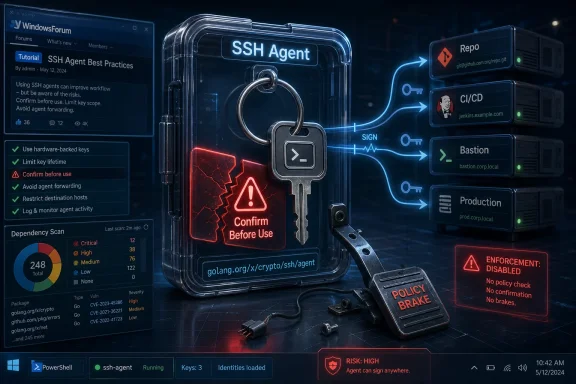 A Small Go Bug Exposes a Large Assumption About SSH Trust
The vulnerability sits in a part of Go’s extended cryptography library that many users never call directly, but many tools may inherit indirectly. The affected package, golang.org/x/crypto/ssh/agent, implements SSH agent behavior for Go programs, including an in-memory keyring created through NewKeyring(). In affected versions, that keyring could accept a key with the ConfirmBeforeUse constraint and then allow signatures without any confirmation prompt.That is the central fact, and it is more interesting than the severity label attached to it. Security software often depends on the distinction between “this key exists” and “this key may be used now.” Confirmation prompts, destination restrictions, lifetimes, and touch requirements are all ways of narrowing that second statement. CVE-2026-39833 matters because it collapses one of those distinctions.
The fix in
golang.org/x/crypto version 0.52.0 changes the behavior from silent acceptance to rejection when unsupported constraints are requested. That is a subtle but important design correction. A security constraint that cannot be enforced should fail loudly; accepting it and doing nothing is worse than not supporting it at all.For WindowsForum readers, the Windows angle is not that this is a Microsoft vulnerability in the traditional Patch Tuesday sense. The MSRC page reflects the modern reality that Microsoft’s security ecosystem now tracks open-source dependencies used across developer tooling, cloud services, containers, CI/CD systems, and cross-platform applications. Windows fleets increasingly depend on Go binaries they did not write and libraries they may never have audited.
The Vulnerability Is Really About Silent Failure
The dangerous word in this advisory is not “SSH,” “crypto,” or even “agent.” It is silently. The in-memory keyring accepted a request containing a security constraint and gave callers no meaningful indication that the requested policy was not actually in force.That pattern is one of the oldest sins in security engineering. A failed login is visible. A crashed daemon is visible. A missing package version is visible to anyone paying attention to dependency scans. But a security feature that appears to be enabled while doing nothing is almost perfectly shaped to survive code review, pass tests, and lull operators into believing risk has been reduced.
The
ConfirmBeforeUse constraint is meant to require an explicit confirmation before an SSH agent uses a key to sign. In practical terms, the constraint is supposed to make unattended signing harder. If an attacker reaches a process or workflow that can ask the agent to sign, the confirmation step is intended to add friction, user awareness, or both.In the affected Go implementation, that friction disappeared. The key would sign without a confirmation prompt. The caller, according to the Go security notice, had no indication that the constraint was not applied.
That turns a local policy expectation into a remote operational risk. If a Go-based tool uses this in-memory agent behavior in a context where confirmation is assumed, the difference between “the key is loaded” and “the key is usable without interruption” becomes the difference between constrained access and ambient authority.
SSH Agents Were Built for Convenience, Then Became Infrastructure
SSH agents began as a convenience layer. Instead of typing a passphrase repeatedly, users could unlock a key once and let the agent perform signing operations on demand. That model is still useful, but the environment around it has changed dramatically.Today, SSH keys are not just a developer’s shortcut into a shell account. They authenticate Git operations, deploy infrastructure, traverse bastion hosts, reach production servers, unlock automation workflows, and sometimes stand in for broader identity systems. In a Windows-heavy enterprise, those flows may cross WSL, PowerShell, Git for Windows, Visual Studio Code remote development, container build systems, and cloud-hosted runners.
That makes the SSH agent a policy enforcement point, whether administrators intended it or not. If a key is allowed to sign, access may follow. If a key is forwarded, delegated, or wrapped in an agent abstraction, the safety of the system depends on every layer preserving the constraints attached to that key.
CVE-2026-39833 is not an OpenSSH protocol apocalypse. It does not mean every SSH key on every Windows workstation is suddenly exposed. But it does remind us that modern infrastructure often entrusts sensitive authority to libraries whose behavior is treated as plumbing.
Plumbing failures rarely look dramatic at the point of failure. They look dramatic later, when someone asks why the floor is wet.
The Go Fix Chooses Honesty Over Compatibility
The repaired behavior is refreshingly blunt: ifNewKeyring() receives unsupported constraints, it now returns an error. That may break code that previously sailed through. It is also the right answer.Security APIs should not pretend to honor policies they cannot enforce. There are few exceptions to that rule. If a developer asks for confirmation-before-use semantics, the library has only two defensible choices: enforce the confirmation or reject the request.
The old behavior occupied the dangerous middle ground. It let software proceed as though the key was constrained. That could allow application logic, user interface text, or administrator guidance to make claims that the underlying agent did not support.
This is where developers sometimes reach for backward compatibility as a shield. “Existing applications might rely on the old behavior,” the argument goes. But in security-sensitive code, compatibility with a lie is not a virtue. The change may force some callers to handle errors they were not expecting, but that is precisely the point: the caller needs to know the requested protection did not happen.
For Go maintainers, the broader version 0.52.0 release also patched a batch of SSH-related issues in
golang.org/x/crypto, including agent constraint forwarding problems, certificate restriction bypasses, denial-of-service conditions, and hardware security key verification behavior. CVE-2026-39833 is one thread in a larger repair job around how Go’s SSH package handles promises of restriction.The Severity Score Can Mislead Both Ways
Some vulnerability databases list CVE-2026-39833 with a critical CVSS score. That will cause scanners to light up dashboards, managers to ask for remediation dates, and security teams to sort through yet another dependency alert. The question is not whether the bug deserves attention. It does. The question is whether the score alone tells you where the real danger lies.This vulnerability’s exploitability depends heavily on usage. A binary that imports
golang.org/x/crypto/ssh/agent but never uses NewKeyring() with confirmation constraints is not exposed in the same way as a tool that uses an in-memory agent to mediate sensitive keys. A developer workstation tool is not the same as a production access broker. A CI runner signing Git operations is not the same as an isolated test utility.That does not make the CVE unimportant. It makes context essential. Dependency scanners are good at answering “is this version present?” They are weaker at answering “is the vulnerable behavior reachable in this application, under conditions that matter?”
The practical response should therefore avoid both panic and complacency. Treat affected versions as needing an update. Then prioritize systems where SSH agent behavior is part of authentication, deployment, privileged access, source-code signing, or remote administration. In those places, silent constraint failure is not theoretical hygiene; it may touch the chain of trust.
Windows admins have seen this pattern before in other ecosystems. A component-level CVE lands with a scary score, but the operational risk varies wildly depending on whether the vulnerable code path is reachable. The mature response is not to ignore the score. It is to use the score as the beginning of triage, not the end.
Microsoft’s Advisory Is a Signpost, Not the Whole Map
The user-facing source here is an MSRC entry, wrapped in the familiar Microsoft Knowledge Base disclaimer language. That can create a misleading impression. This is not a Windows kernel bug, an Exchange zero-day, or a Defender engine flaw. It is an open-source Go package issue surfaced through Microsoft’s vulnerability-tracking machinery.That distinction matters because remediation will not look like a normal Windows Update story. There may be no monthly cumulative update that magically fixes every affected Go binary in an organization. If a third-party tool statically compiled an older vulnerable
golang.org/x/crypto version, Windows Update will not rewrite that binary for you.Go’s build model is part of the story. Go applications commonly compile dependencies into a single executable. That is convenient for deployment and excellent for portability, but it complicates vulnerability response. You cannot always patch a shared library on disk and call it done. You often need a rebuilt application.
This is where asset inventory becomes more important than advisory reading. Which Go-based tools are deployed? Which versions of
golang.org/x/crypto are embedded? Which vendors have issued updates? Which internal projects need a module bump and rebuild? Those are the questions that turn a CVE entry into operational work.For Windows environments, that means looking beyond the obvious Linux server estate. Go binaries are everywhere: command-line tools, cloud agents, backup utilities, security products, developer helpers, Kubernetes clients, Terraform providers, and internal automation. Some run on Windows endpoints. Others run in containers managed by Windows administrators. The dependency may be invisible until you inspect the build.
The Risk Is Highest Where Confirmation Was Part of the Security Story
The most exposed environments are not necessarily the ones with the largest number of Go binaries. They are the ones where someone explicitly depended on confirmation-before-use to contain key abuse.Imagine an internal tool that loads SSH keys into an in-memory Go agent and labels them as requiring confirmation before signing. A user or operator might assume each sensitive use will require approval. If that tool used the affected
NewKeyring() behavior, the interface promise and the cryptographic behavior diverged.The same concern applies to automation frameworks that try to make agent use safer by applying constraints around forwarded keys or temporary access. If the design relies on the agent as the enforcement point, then constraint handling is not a cosmetic feature. It is part of the security boundary.
There is a second-order problem as well. When constraints are silently ignored, logs and audit trails may not show the absence of enforcement. A successful signing operation looks like a successful signing operation. Unless the application explicitly tested that confirmation happened, there may be little evidence after the fact that the system operated in a weaker mode.
This is why “no indication to the caller” is such a damaging phrase. Many security controls fail closed, fail open, or fail noisy. CVE-2026-39833 failed plausibly. The system kept working, which is often the worst possible outcome for a broken control.
Developers Need to Audit Intent, Not Just Imports
For developers, the immediate fix is straightforward: updategolang.org/x/crypto to version 0.52.0 or later and rebuild affected applications. The harder part is determining whether the application’s security model assumed behavior the library did not provide.A simple dependency bump is necessary, but it may not be sufficient. Teams should review code paths that create in-memory SSH agents, add keys with constraints, forward agents, or present UI language promising confirmation before key use. If a tool told users “you will be prompted before this key is used,” developers should verify that the prompt is enforced by the actual agent implementation, not merely requested.
Tests should also change. Security constraints deserve negative tests: request a constraint that cannot be supported and ensure the program refuses to proceed. Test that confirmation requirements block unattended signing. Test that unsupported extensions do not vanish into a marshaling layer. The bug class here is not a missing if-statement; it is a mismatch between requested policy and enforced policy.
The repaired Go behavior helps by surfacing unsupported constraints as errors. But applications still need to handle those errors in a security-conscious way. Logging and continuing may recreate the old failure mode at a higher level. Falling back to unconstrained key use should be treated as a deliberate security exception, not a convenience path.
There is a cultural lesson here for Go developers. The
x/crypto packages are widely used and often trusted as close cousins of the standard library. That trust is generally earned, but it should not become an excuse to skip threat modeling around authentication flows. Cryptographic libraries provide primitives and protocols; applications still own the security semantics they build on top.Administrators Should Look for Binaries, Not Just Packages
Traditional patch management thinks in installed packages. Go-era patch management has to think in built artifacts. A Windows server may not have a visiblegolang.org/x/crypto package installed anywhere, yet still run several binaries that contain vulnerable code.That makes software composition analysis more important for compiled tools. Enterprises that already generate SBOMs for internal builds should search them for
golang.org/x/crypto versions earlier than 0.52.0. Teams without SBOM coverage may need to lean on vendor advisories, binary scanning, build metadata, or direct outreach to software suppliers.The priority should be systems where SSH keys grant meaningful access. Developer jump boxes, CI/CD runners, deployment orchestrators, Git automation, bastion tooling, secrets-management integrations, and remote administration utilities deserve early attention. A Go utility that never touches SSH agent behavior can wait behind a production access broker that does.
Windows-specific environments should also check the messy borderlands where platform assumptions blur. WSL development environments, Git clients, remote-SSH plugins, cross-platform DevOps agents, and containerized build tools may all participate in SSH workflows. The vulnerable library is cross-platform; the exposure follows the application, not the operating system logo.
Vendors should be expected to state whether they are affected, not merely whether they use Go. A useful vendor response will identify whether the vulnerable package and code path are present, which product versions are affected, and which releases include
golang.org/x/crypto 0.52.0 or later. “We are investigating” is acceptable on day one. It should not remain the answer indefinitely.The Open-Source Supply Chain Keeps Moving Into the Security Boundary
CVE-2026-39833 is a small example of a much larger industry shift. Open-source dependencies are no longer just implementation details. They are part of the security boundary of commercial software, cloud services, enterprise agents, and developer platforms.That is not an argument against open source. The Go team’s public advisory, coordinated reporting, and fixed release show the ecosystem functioning. The issue was identified, disclosed, and patched. The problem is not that open source fails uniquely; it is that modern software stacks make dependency behavior operationally consequential in ways many organizations still undercount.
The more uncomfortable point is that security features are often layered through assumptions. A product team assumes the library enforces a constraint. An administrator assumes the product enforces the policy described in its documentation. A user assumes the confirmation prompt will appear before a key signs. Each assumption may be reasonable in isolation. The failure appears when no one verifies the chain end to end.
That is why this CVE should be read less as a one-off Go bug and more as a reminder about semantic dependencies. It is not enough to know that a library can parse SSH keys or speak the agent protocol. You need to know whether it preserves the meaning of the security controls your application exposes.
The Go 0.52.0 batch is particularly revealing because several issues involve restrictions, constraints, permissions, or verification semantics rather than classic memory corruption. That is where modern security bugs increasingly live: not in code that obviously crashes, but in code that proceeds under the wrong rules.
The False Comfort of a Prompt That Never Comes
Confirmation prompts occupy a strange place in security design. They are often mocked as user-hostile speed bumps, and sometimes fairly so. A prompt that appears too often becomes background noise. A prompt that appears without context teaches users to click through.But in SSH agent workflows, confirmation can be more than theater. It can interrupt unattended key use. It can alert a user that some process is trying to sign. It can provide a last line of defense when agent forwarding or local process compromise creates an opportunity for misuse.
That is why a missing prompt is not merely a user-interface bug. It changes the threat model. A workflow designed around interactive approval becomes a workflow that may allow silent signing. A key intended for guarded use behaves like a key loaded for convenience.
The lesson is not that prompts are magic. They are not. The lesson is that if a system advertises a prompt as a control, the prompt must be real. Otherwise it becomes security theater in the most literal sense: a prop shown to the audience, disconnected from the mechanism backstage.
CVE-2026-39833 is therefore a bug about trust in interfaces. The interface between the caller and the keyring said one thing. The behavior underneath did another. Security breaks in that gap.
The Patch Is Simple; The Inventory Is Not
For organizations with disciplined dependency management, the remediation path is clear. Update togolang.org/x/crypto 0.52.0 or later, rebuild, redeploy, and verify. For everyone else, the work starts with finding out where the vulnerable code exists.That is easier said than done. Go binaries may not disclose their dependency versions in an obvious way. Internal teams may have forked modules, vendored dependencies, or pinned old versions for compatibility. Third-party vendors may not publish detailed SBOMs. Some tools may be abandoned but still sitting in automation paths that no one wants to touch.
The operational response should be risk-based but not casual. If a tool participates in SSH authentication or agent forwarding, it should move up the queue. If it holds or mediates keys for production systems, it should move further up. If it runs in CI/CD with access to repositories or deployment targets, it should be treated as part of the access-control plane.
Security teams should also resist the temptation to close the ticket the moment a patched library version appears in source control. The relevant artifact is the deployed binary. In Go environments, the phrase “we updated the module” is only halfway to “we remediated the vulnerability.”
The Version Number Is Only the First Line of Defense
The most concrete remediation step is to move off affectedgolang.org/x/crypto versions, but the smarter response goes deeper. CVE-2026-39833 should prompt teams to review how they model key authority inside applications.A program that needs confirmation-before-use should treat failure to enforce confirmation as fatal. A workflow that relies on constrained agent forwarding should test that constraints survive forwarding. A user interface that promises key confirmation should be backed by integration tests, not just optimistic API calls.
Administrators can help by setting expectations for vendors and internal teams. Ask whether SSH-agent constraints are used. Ask whether unsupported constraints fail closed. Ask whether the product has been rebuilt against the fixed library. These are sharper questions than “Are you affected by CVE-2026-39833?” because they force a discussion about behavior.
There is also a policy opportunity. Organizations that treat SSH keys as long-lived personal credentials should accelerate toward shorter-lived certificates, hardware-backed keys, stronger bastion controls, and auditable access brokers. Those approaches are not immune to implementation bugs, but they reduce the blast radius of any single agent behavior failure.
No one should pretend that one Go library update solves SSH key management. It solves this bug. The rest is engineering discipline.
The Fix List for a Bug That Pretended Everything Was Fine
The practical response to CVE-2026-39833 is not complicated, but it does require attention to the difference between source code, compiled binaries, and actual SSH-agent usage. Teams should treat the vulnerability as a prompt to verify the assumptions around constrained key use.- Update
golang.org/x/cryptoto version 0.52.0 or later in any project that uses the SSH or SSH agent packages. - Rebuild and redeploy affected Go applications, because statically compiled binaries will not be fixed merely by updating a module in source control.
- Prioritize tools that load SSH keys, create in-memory agents, forward agents, mediate production access, perform Git operations, or run inside CI/CD pipelines.
- Review application behavior that promises confirmation before key use, and verify that unsupported constraints now fail closed rather than falling back silently.
- Ask vendors of Go-based security, DevOps, backup, and remote-administration tools whether their affected products have been rebuilt with the fixed dependency.
- Treat this advisory as a reason to improve SSH key inventory, agent-forwarding policy, and audit coverage rather than as a one-line dependency chore.
References
- Primary source: MSRC
Published: 2026-06-11T01:42:10-07:00
Security Update Guide - Microsoft Security Response Center
 msrc.microsoft.com
- Related coverage: datacomm.com
- Related coverage: endorlabs.com
- Related coverage: mondoo.com
CVE-2026-39833 | Mondoo Vulnerability Intelligence
CVE-2026-39833 - CRITICAL severity: Invoking key constraints not enforced in golang.org/x/crypto/ssh/agentmondoo.com - Related coverage: archive.fosdem.org
- Related coverage: fosdem.org

- Related coverage: thehackerwire.com
CVE-2026-39833 - Critical Vulnerability - TheHackerWire
TheHackerWire - Your daily source for cybersecurity news, CVE alerts, hacking tutorials, and security tool reviews. Stay ahead of cyber threats.www.thehackerwire.com
- Related coverage: golang.org
- Related coverage: cert.kenet.or.ke
