
Zeta Labs released Viktor for Microsoft Teams on June 18, 2026, bringing its channel-native “AI employee” from Slack into Microsoft’s collaboration platform after building traction across tens of thousands of Slack workspaces. The launch is not just another chatbot arriving in Teams’ already crowded app drawer. It is a bet that the next workplace AI interface will not be a separate copilot pane, but the conversation stream where decisions, requests, and half-formed plans already live. For Microsoft customers, that makes Viktor both intriguing and uncomfortable: it promises useful automation precisely by sitting close to the messy center of daily work.
The most important thing about Viktor’s Teams launch is not that it supports another collaboration product. It is that Zeta Labs is treating the channel itself as the operating environment for an AI worker.
That distinction matters. Most enterprise AI tools still behave like upgraded search boxes: a user leaves the flow of work, asks a question, gets a response, and then decides what to do with it. Viktor’s pitch is different. It sits in the shared space where a team discusses customers, bugs, campaigns, budgets, and deadlines, then uses that accumulated context to perform work on the team’s behalf.
That is a more ambitious model than “summarize this thread.” Zeta describes Viktor as able to generate reports, dashboards, campaigns, code, and lightweight web apps, while connecting to thousands of business systems. If that works reliably, Teams becomes less a meeting-and-chat product and more a command layer over the rest of the company’s software estate.
It is also why Microsoft Teams is such an obvious next stop. Slack was the natural beachhead for developer-heavy startups and agencies, but Teams is where a large portion of the Microsoft 365 enterprise base lives. Bringing Viktor there means Zeta is no longer optimizing only for the early-adopter collaboration crowd. It is walking straight into the procurement, compliance, identity, and governance world that defines mainstream business IT.
That framing has obvious risks. “Employee” implies agency, responsibility, and continuity, even though the actual system remains software operated under vendor constraints, model limits, permissions, and customer configuration. No CIO should confuse a Slack or Teams app with a legal person, and no manager should treat automation output as magically accountable because the interface has a name.
Still, the language points to a genuine shift. The last two years of workplace AI have been dominated by copilots that sit beside a human user. Agent products like Viktor are trying to move from assistance to execution, especially for recurring work that spans multiple applications: pulling metrics, reconciling accounts, creating issues, drafting reports, updating dashboards, and nudging follow-ups.
That is why the channel matters. A private assistant knows one user’s prompts. A channel-resident agent can observe a group’s working context, including decisions, corrections, goals, and recurring requests. The value proposition is not simply more memory; it is shared memory.
For WindowsForum’s audience, that is the difference between a novelty integration and a potentially consequential enterprise pattern. If the collaboration channel becomes the agent’s workplace, then the security boundary, audit trail, retention policy, and data classification model of that channel become far more important than they were when chat was merely chat.
That is the hard part of Zeta’s move. Teams is deeply embedded in Microsoft 365 tenants, tied into Entra ID, Exchange, SharePoint, OneDrive, Purview, Defender, and a thick layer of organizational policy. The buyers and gatekeepers around Teams are often not the same people who experiment with Slack apps on a startup team. They are IT admins, security teams, legal departments, and business-unit leaders who need to know exactly what a third-party agent can read, write, retain, and trigger.
Zeta’s public positioning reflects that reality. The company emphasizes Microsoft approval for Teams, SOC 2 Type 1 certification, and the ability to connect to a long list of tools while remembering a team’s preferences and working history. Those are not casual website claims; they are procurement ammunition.
But certification and marketplace approval are not the same as universal enterprise readiness. SOC 2 Type 1 says something about controls at a point in time; it does not remove the need for customers to evaluate access scopes, data residency, retention, model behavior, incident response, and downstream integrations. An agent connected to Salesforce, Stripe, GitHub, ad platforms, and project management systems can become extremely useful. It can also become a high-value path for mistakes.
Teams customers will ask different questions than early Slack adopters. Can Viktor be limited to specific channels? How granular are tool permissions? What is logged when it writes code or changes records? Can a tenant admin disable certain actions globally? How does memory interact with deletion, retention, and legal hold? What happens when a user who trained or directed it leaves the company?
The launch opens a much larger market, but it also forces Viktor into a more formal conversation about governance. That may be exactly the point. The AI agent category cannot mature while living only in founder-led Slack workspaces and demo videos.
That puts Viktor in an interesting position relative to Microsoft’s own Copilot strategy. Microsoft 365 Copilot is designed to understand and operate across Microsoft’s productivity graph, with deep advantages inside Word, Excel, PowerPoint, Outlook, Teams, SharePoint, and the broader Microsoft ecosystem. Viktor, by contrast, is pitching itself as more tool-agnostic and more execution-oriented across a sprawling SaaS stack.
These are not identical products, and customers may use both. Copilot is the native Microsoft experience, with the gravitational pull of Microsoft 365 licensing and administration. Viktor is a specialist bet on a named agent embedded in the conversation layer, connecting to thousands of outside tools and producing deliverables rather than just assisting in Microsoft documents.
The question is whether enterprises want one broad platform AI or several specialized agents that live where teams work. Microsoft would prefer the former, or at least a world where third-party agents run inside its governance and extensibility model. Startups like Zeta are betting that speed, personality, workflow depth, and cross-tool action can carve out durable space even inside Microsoft’s house.
There is precedent for both outcomes. Microsoft Teams became a dominant collaboration platform in part because bundling matters. But Slack retained cultural and workflow strength in organizations that prized integrations, developer ergonomics, and conversational work. AI agents may follow a similar split: the bundled tool wins by default in many tenants, while third-party agents win where teams feel the native tool does not go far enough.
Viktor’s expansion into Teams is therefore not just a distribution update. It is a test of whether an AI-native startup can build a layer of work execution on top of the collaboration platforms rather than being absorbed by them.
Memory is what turns a chatbot into something more persistent. It allows the system to learn how a team describes customers, what metrics matter, what “weekly report” means, which dashboards are trusted, how campaigns are structured, and which internal workflows are normal. Without memory, every interaction is a fresh transaction. With memory, the agent starts to resemble an institutional process.
That can be powerful in growing companies where process documentation lags behind reality. Many organizations run on tribal knowledge encoded in chat history, old spreadsheets, recurring pings, and the habits of a few overloaded operators. A channel-native agent that can absorb and operationalize that context offers a seductive remedy: the process becomes executable before anyone writes the process manual.
But memory also creates new questions about boundaries. A team channel is rarely a perfectly curated source of truth. It contains jokes, assumptions, outdated decisions, confidential customer details, incomplete analysis, and arguments that were resolved three weeks later. If an agent learns from that stream, customers need to understand how it distinguishes durable instructions from conversational noise.
This is where enterprise AI products will either mature or lose trust. The useful agent must remember, but the safe agent must remember selectively, transparently, and reversibly. Users need ways to inspect and correct what it has learned. Admins need policies for what it may retain. Security teams need confidence that memory does not become a shadow database outside normal governance.
Zeta’s pitch that Viktor maintains context across sessions is commercially compelling. In a Teams tenant, it is also a governance commitment.
Code execution is useful because modern business work is full of ad hoc computation. Teams want a dashboard stitched from Stripe and HubSpot, a script to reconcile campaign data, a lightweight internal tool for tracking leads, or a one-off analysis that would otherwise die in a spreadsheet. An agent that can generate and execute code can bridge the gap between “someone should build this” and “here it is.”
But code execution also changes the failure modes. A bad summary may mislead a reader. A bad script can mutate records, expose data, miscalculate revenue, or silently produce a dashboard that looks authoritative while being wrong. The more polished the output, the more likely users are to trust it.
That does not mean products like Viktor should be dismissed. It means they must be evaluated like automation platforms, not like chatbots. The relevant questions are operational: What actions require confirmation? Are destructive operations blocked by default? Can generated code be reviewed? Where does execution occur? What credentials are used? Are API calls logged in a way that security teams can audit?
The industry’s language has not caught up to this shift. “AI assistant” sounds like a productivity feature. “AI employee” sounds like a brand choice. But once a system can act across company tools, remember team context, and generate code to complete tasks, it belongs in the same risk conversation as robotic process automation, low-code platforms, privileged SaaS integrations, and internal scripts.
That is the practical story behind the Teams launch. Viktor is not merely appearing in a new chat client. It is asking Microsoft 365 organizations to accept a new kind of actor inside the collaboration fabric.
Those numbers should be treated carefully, as all startup ARR figures should be. Annualized run rate is not the same thing as audited annual revenue, and early usage can be boosted by novelty, credits, founder-led support, or unusually aggressive adoption among a narrow customer profile. Still, the direction is clear: investors and customers are paying attention.
The reason is simple. If AI agents can absorb recurring operational work, the addressable market is not limited to a per-seat writing assistant. It reaches into agencies, sales operations, finance operations, marketing analytics, customer success, internal tooling, and the long tail of “we should automate this someday” tasks that companies never quite prioritize.
That market is especially attractive because it attacks headcount pressure. Zeta is careful to frame Viktor as additive rather than a replacement for workers, and that is the right public posture. Yet the economic appeal of an “AI employee” is inseparable from the possibility that some work will be done without hiring another person.
That does not mean mass replacement is the immediate outcome. In many organizations, the first impact will be on backlog, speed, and managerial bandwidth. The work that gets automated may be work no one had time to do consistently: weekly reporting, data cleanup, campaign checks, lead research, budget monitoring, internal dashboards, and customer follow-ups.
But the labor question will not stay theoretical. The more an agent is described as a hire, the more employees will reasonably ask what kind of hire it is replacing, delaying, or supervising.
That comparison cuts both ways for Zeta. Microsoft has the home-field advantage: identity, licensing, admin controls, native app access, and a direct relationship with enterprise IT. Copilot can surface inside the Microsoft apps people already use and benefit from Microsoft’s long campaign to make Teams the front door of the Microsoft 365 workday.
Viktor’s advantage, if it has one, is focus. The company can define its product around execution in shared channels without needing to be all things to all Microsoft 365 users. It can optimize for cross-SaaS tasks, recurring operational workflows, and team-level memory in a way that feels more opinionated than a broad platform assistant.
This is where the distinction between assistant and worker becomes commercially important, even if the wording is inflated. Copilot is often evaluated as a productivity enhancement for individuals and documents. Viktor wants to be evaluated as a shared resource that produces output for a team.
That difference will show up in pricing psychology. Zeta says one license covers everyone in a channel, which encourages adoption around a workflow rather than a named user. Microsoft’s per-user licensing model has familiar administrative simplicity, but it can make customers ask whether every employee really needs the AI add-on. Channel licensing asks a different question: is this workflow valuable enough to automate for the whole group?
Neither model is automatically better. Per-user licensing maps neatly to enterprise procurement and identity. Channel-based licensing maps more closely to shared work. The market will decide which framing makes AI agents feel like software seats and which makes them feel like operational capacity.
But the enterprise lesson of the last decade is that connectivity alone is not transformation. Companies already have integration platforms, workflow tools, dashboards, API connectors, and automation suites. Many of them are underused because the hard part is not merely reaching the data; it is knowing what to do, when to do it, who is allowed to approve it, and how to recover when the automation is wrong.
Viktor’s bet is that natural language, shared context, and code generation can make automation more accessible than traditional workflow builders. Instead of designing a rigid process in advance, the team asks for the outcome in the channel and the agent figures out the path. That is a meaningful improvement if the task is bounded and the data is clean enough.
The danger is that users may confuse “connected to” with “competent at.” A system may have access to Salesforce and Stripe but still misunderstand the company’s revenue definitions. It may read GitHub issues but not know which labels are obsolete. It may pull ad spend but miss a naming convention that separates tests from production campaigns.
The practical evaluation should focus less on the connector count and more on repeatable wins. Can Viktor perform the same weekly report accurately for eight weeks? Can it explain its assumptions? Can it handle missing data gracefully? Can it create artifacts that teams actually use after the demo glow fades?
Those are the questions that separate an impressive agent from an expensive parlor trick.
Microsoft’s app ecosystem gives organizations a controlled way to discover and deploy Teams apps, but tenant administrators still need to decide whether an application belongs in their environment. That decision becomes more complex when the app is not just posting notifications or hosting a tab, but acting as an agent with memory and external-tool access.
This is where Microsoft’s own security model can help, provided organizations use it rigorously. Teams app policies, permission review, Entra identity controls, conditional access, data loss prevention, auditing, and app governance should all be part of the rollout conversation. A pilot in one operations channel is not the same as tenant-wide availability.
The best early deployments will likely be narrow. A sales operations team may let Viktor generate pipeline summaries. A marketing agency may use it to reconcile campaign performance. A product team may ask it to create Linear issues and GitHub-linked dashboards. These are concrete workflows where success can be measured and permissions can be bounded.
The worst deployments will be vibes-based. If an organization installs an autonomous agent because “AI employee” sounds modern, connects half the company’s SaaS stack, and then lets every channel improvise, it is asking for confusion. The product may still be good, but the rollout would be bad.
That is the uncomfortable truth of agentic AI in Microsoft 365 environments. The vendor can ship the capability. The customer still owns the operating model.
Teams is a front-end to the modern Windows enterprise. It touches identity, endpoints, Office files, browser sessions, meetings, phone systems, SharePoint sites, guest access, third-party apps, and user behavior. When a new class of AI agent enters Teams, it enters the daily environment that many Windows admins are already responsible for securing and supporting.
That means the admin burden will expand. Help desks may be asked why Viktor cannot access a tool, why it remembers something incorrectly, why a generated report differs from the finance dashboard, or why it posted an update in the wrong channel. Security teams may need to investigate whether an agent action was authorized by a user, a channel policy, or a misconfigured connector.
The endpoint also remains part of the story. Users will interact with Viktor through Teams clients on Windows PCs, browsers, and mobile devices, but the data paths will run through cloud services and third-party APIs. Traditional endpoint thinking will not be enough. Admins need SaaS governance, identity discipline, and visibility into agent activity.
This is the broader pattern of the AI era in Windows environments. The operating system is still important, but much of the action is moving into cloud workspaces, browser-based applications, and collaboration surfaces. The new “desktop automation” may not click buttons on a local PC at all. It may live in Teams and call APIs.
For IT pros, that is both a relief and a complication. API-driven work can be logged and controlled more cleanly than screen-scraping automation. But it also means the blast radius of a bad permission grant can extend far beyond a single machine.
The second easiest reaction is awe. A named agent that lives in Teams, remembers context, connects to thousands of apps, writes code, and produces finished deliverables sounds like the workplace future arriving ahead of schedule. Some of that excitement is justified too.
The better reaction is disciplined curiosity. Products like Viktor are not interesting because they eliminate work overnight. They are interesting because they compress the distance between conversation and execution. In many organizations, that distance is where time disappears.
If a manager can ask for a real dashboard in the same channel where the team debates the metric, that changes the tempo of operations. If an agency can generate client-ready reporting without manually exporting from five platforms, that changes margins. If a product team can turn a decision thread into issues, code scaffolding, and status updates, that changes how coordination happens.
But every one of those wins depends on trust. Trust in the data. Trust in the permissions. Trust in the memory. Trust in the output. Trust that the agent will ask before taking actions that matter.
That is why the Teams launch is such a useful test. Microsoft’s collaboration platform is full of organizations that want productivity but cannot afford chaos. Viktor will have to prove it can be more than a clever coworker persona. It will have to prove it can be governed.
That is where enterprises should begin. Put the agent in a channel with a clear job, limited access, and measurable output. Let it produce the weekly report, reconcile the campaign numbers, create the issue list, or assemble the customer handoff. Then compare the result against the old process.
The goal should not be to find out whether Viktor can do everything. It should be to learn where it can do something reliably enough that the team changes its habits. AI agents become real infrastructure only when people stop treating them as experiments and start depending on their output.
That dependency should be earned slowly. Early enthusiasm is not evidence of durable value, and a fast-growing startup’s revenue run rate is not a substitute for internal validation. Teams admins have seen enough collaboration add-ons become shelfware to know that adoption theatre is cheap.
The organizations that get the most out of Viktor will likely be the ones that treat it as both a product and a process change. Someone must own its configuration. Someone must review its permissions. Someone must decide which outputs are official. Someone must know how to turn it off.
That is not anti-AI caution. It is how operational software becomes trustworthy.
That model has real advantages over isolated automation. It makes requests visible. It keeps context near the result. It lets colleagues correct the agent in public. It can turn a channel into a living record of both human decisions and machine actions.
It also creates new etiquette and control problems. Channels may become crowded with agent updates. Users may over-tag the agent for trivial tasks. Teams may disagree about whether an AI-generated report is “done.” Managers may start assigning work to the agent without making clear who reviews it.
The social layer matters because collaboration tools are already noisy. Adding agents that can act, remember, and generate artifacts may improve productivity, but it may also intensify the feeling that work is happening everywhere at once. The best products will need restraint as much as capability.
This is another area where Microsoft’s ecosystem will shape expectations. Teams users are accustomed to apps, bots, tabs, notifications, and meeting integrations, but an autonomous agent is a heavier presence. It needs to behave like a good participant: responsive, clear, interruptible, and aware of when not to speak.
If Viktor can manage that balance, it will make the channel feel more powerful. If it cannot, it will become another bot that users mute.
That makes the first wave of evaluation refreshingly grounded. Teams admins and business owners do not need to solve the future of labor before piloting Viktor. They need to answer a smaller set of operational questions.
Zeta Labs has made a smart move by bringing Viktor into Microsoft Teams, because Teams is where a vast amount of modern office work is already negotiated, assigned, and explained. The launch gives Microsoft customers a sharper version of the agentic AI promise: not a box that answers questions, but a participant that turns shared context into output. Whether that becomes a new layer of productive leverage or just another overconfident bot will depend less on the phrase “AI employee” than on the unglamorous details of governance, reliability, and trust. The next phase of workplace AI will be decided inside channels like these, one automated report, dashboard, issue, and approval at a time.
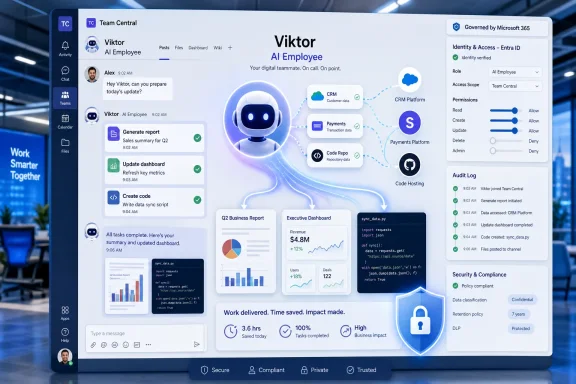 Viktor Moves the AI Agent Fight Into the Workplace Channel
The most important thing about Viktor’s Teams launch is not that it supports another collaboration product. It is that Zeta Labs is treating the channel itself as the operating environment for an AI worker.That distinction matters. Most enterprise AI tools still behave like upgraded search boxes: a user leaves the flow of work, asks a question, gets a response, and then decides what to do with it. Viktor’s pitch is different. It sits in the shared space where a team discusses customers, bugs, campaigns, budgets, and deadlines, then uses that accumulated context to perform work on the team’s behalf.
That is a more ambitious model than “summarize this thread.” Zeta describes Viktor as able to generate reports, dashboards, campaigns, code, and lightweight web apps, while connecting to thousands of business systems. If that works reliably, Teams becomes less a meeting-and-chat product and more a command layer over the rest of the company’s software estate.
It is also why Microsoft Teams is such an obvious next stop. Slack was the natural beachhead for developer-heavy startups and agencies, but Teams is where a large portion of the Microsoft 365 enterprise base lives. Bringing Viktor there means Zeta is no longer optimizing only for the early-adopter collaboration crowd. It is walking straight into the procurement, compliance, identity, and governance world that defines mainstream business IT.
The “AI Employee” Label Is Marketing, but the Product Bet Is Real
Calling Viktor an AI employee is theatrical, and deliberately so. It is meant to distance the product from the chatbot category, where users have learned to expect plausible prose, occasional hallucinations, and a lot of manual follow-through. The label says: do not judge this by how well it answers; judge it by whether the task is done.That framing has obvious risks. “Employee” implies agency, responsibility, and continuity, even though the actual system remains software operated under vendor constraints, model limits, permissions, and customer configuration. No CIO should confuse a Slack or Teams app with a legal person, and no manager should treat automation output as magically accountable because the interface has a name.
Still, the language points to a genuine shift. The last two years of workplace AI have been dominated by copilots that sit beside a human user. Agent products like Viktor are trying to move from assistance to execution, especially for recurring work that spans multiple applications: pulling metrics, reconciling accounts, creating issues, drafting reports, updating dashboards, and nudging follow-ups.
That is why the channel matters. A private assistant knows one user’s prompts. A channel-resident agent can observe a group’s working context, including decisions, corrections, goals, and recurring requests. The value proposition is not simply more memory; it is shared memory.
For WindowsForum’s audience, that is the difference between a novelty integration and a potentially consequential enterprise pattern. If the collaboration channel becomes the agent’s workplace, then the security boundary, audit trail, retention policy, and data classification model of that channel become far more important than they were when chat was merely chat.
Teams Gives Viktor Scale, but Also a Harsher Audience
Slack success can prove product love. Teams success has to prove administrative trust.That is the hard part of Zeta’s move. Teams is deeply embedded in Microsoft 365 tenants, tied into Entra ID, Exchange, SharePoint, OneDrive, Purview, Defender, and a thick layer of organizational policy. The buyers and gatekeepers around Teams are often not the same people who experiment with Slack apps on a startup team. They are IT admins, security teams, legal departments, and business-unit leaders who need to know exactly what a third-party agent can read, write, retain, and trigger.
Zeta’s public positioning reflects that reality. The company emphasizes Microsoft approval for Teams, SOC 2 Type 1 certification, and the ability to connect to a long list of tools while remembering a team’s preferences and working history. Those are not casual website claims; they are procurement ammunition.
But certification and marketplace approval are not the same as universal enterprise readiness. SOC 2 Type 1 says something about controls at a point in time; it does not remove the need for customers to evaluate access scopes, data residency, retention, model behavior, incident response, and downstream integrations. An agent connected to Salesforce, Stripe, GitHub, ad platforms, and project management systems can become extremely useful. It can also become a high-value path for mistakes.
Teams customers will ask different questions than early Slack adopters. Can Viktor be limited to specific channels? How granular are tool permissions? What is logged when it writes code or changes records? Can a tenant admin disable certain actions globally? How does memory interact with deletion, retention, and legal hold? What happens when a user who trained or directed it leaves the company?
The launch opens a much larger market, but it also forces Viktor into a more formal conversation about governance. That may be exactly the point. The AI agent category cannot mature while living only in founder-led Slack workspaces and demo videos.
The Platform War Is Now About Where Work Actually Happens
Microsoft has spent years arguing that Teams is the hub for work. Zeta is now making a related but more provocative argument: if Teams is the hub for work, then autonomous agents should live there, not in a separate AI portal.That puts Viktor in an interesting position relative to Microsoft’s own Copilot strategy. Microsoft 365 Copilot is designed to understand and operate across Microsoft’s productivity graph, with deep advantages inside Word, Excel, PowerPoint, Outlook, Teams, SharePoint, and the broader Microsoft ecosystem. Viktor, by contrast, is pitching itself as more tool-agnostic and more execution-oriented across a sprawling SaaS stack.
These are not identical products, and customers may use both. Copilot is the native Microsoft experience, with the gravitational pull of Microsoft 365 licensing and administration. Viktor is a specialist bet on a named agent embedded in the conversation layer, connecting to thousands of outside tools and producing deliverables rather than just assisting in Microsoft documents.
The question is whether enterprises want one broad platform AI or several specialized agents that live where teams work. Microsoft would prefer the former, or at least a world where third-party agents run inside its governance and extensibility model. Startups like Zeta are betting that speed, personality, workflow depth, and cross-tool action can carve out durable space even inside Microsoft’s house.
There is precedent for both outcomes. Microsoft Teams became a dominant collaboration platform in part because bundling matters. But Slack retained cultural and workflow strength in organizations that prized integrations, developer ergonomics, and conversational work. AI agents may follow a similar split: the bundled tool wins by default in many tenants, while third-party agents win where teams feel the native tool does not go far enough.
Viktor’s expansion into Teams is therefore not just a distribution update. It is a test of whether an AI-native startup can build a layer of work execution on top of the collaboration platforms rather than being absorbed by them.
Memory Is the Feature That Makes IT Nervous
The central promise of Viktor is that it does not forget everything between sessions. That is also the feature that should make administrators slow down.Memory is what turns a chatbot into something more persistent. It allows the system to learn how a team describes customers, what metrics matter, what “weekly report” means, which dashboards are trusted, how campaigns are structured, and which internal workflows are normal. Without memory, every interaction is a fresh transaction. With memory, the agent starts to resemble an institutional process.
That can be powerful in growing companies where process documentation lags behind reality. Many organizations run on tribal knowledge encoded in chat history, old spreadsheets, recurring pings, and the habits of a few overloaded operators. A channel-native agent that can absorb and operationalize that context offers a seductive remedy: the process becomes executable before anyone writes the process manual.
But memory also creates new questions about boundaries. A team channel is rarely a perfectly curated source of truth. It contains jokes, assumptions, outdated decisions, confidential customer details, incomplete analysis, and arguments that were resolved three weeks later. If an agent learns from that stream, customers need to understand how it distinguishes durable instructions from conversational noise.
This is where enterprise AI products will either mature or lose trust. The useful agent must remember, but the safe agent must remember selectively, transparently, and reversibly. Users need ways to inspect and correct what it has learned. Admins need policies for what it may retain. Security teams need confidence that memory does not become a shadow database outside normal governance.
Zeta’s pitch that Viktor maintains context across sessions is commercially compelling. In a Teams tenant, it is also a governance commitment.
“Writes and Runs Code” Changes the Risk Category
One of the sharper claims around Viktor is that it can write and run its own code to produce finished output. That moves the product beyond document drafting and into a more consequential class of automation.Code execution is useful because modern business work is full of ad hoc computation. Teams want a dashboard stitched from Stripe and HubSpot, a script to reconcile campaign data, a lightweight internal tool for tracking leads, or a one-off analysis that would otherwise die in a spreadsheet. An agent that can generate and execute code can bridge the gap between “someone should build this” and “here it is.”
But code execution also changes the failure modes. A bad summary may mislead a reader. A bad script can mutate records, expose data, miscalculate revenue, or silently produce a dashboard that looks authoritative while being wrong. The more polished the output, the more likely users are to trust it.
That does not mean products like Viktor should be dismissed. It means they must be evaluated like automation platforms, not like chatbots. The relevant questions are operational: What actions require confirmation? Are destructive operations blocked by default? Can generated code be reviewed? Where does execution occur? What credentials are used? Are API calls logged in a way that security teams can audit?
The industry’s language has not caught up to this shift. “AI assistant” sounds like a productivity feature. “AI employee” sounds like a brand choice. But once a system can act across company tools, remember team context, and generate code to complete tasks, it belongs in the same risk conversation as robotic process automation, low-code platforms, privileged SaaS integrations, and internal scripts.
That is the practical story behind the Teams launch. Viktor is not merely appearing in a new chat client. It is asking Microsoft 365 organizations to accept a new kind of actor inside the collaboration fabric.
The Startup Economics Explain the Urgency
Zeta Labs’ growth claims are part of the story because they explain why the company is moving quickly. Reports around its Series A described a $75 million round led by Accel, with total funding near $78 million, and the company has said Viktor reached a significant annualized revenue run rate shortly after launch. The source material for the Teams announcement also points to a run rate above $15 million, while Zeta’s CEO publicly claimed the company had crossed $20 million in annualized revenue run rate.Those numbers should be treated carefully, as all startup ARR figures should be. Annualized run rate is not the same thing as audited annual revenue, and early usage can be boosted by novelty, credits, founder-led support, or unusually aggressive adoption among a narrow customer profile. Still, the direction is clear: investors and customers are paying attention.
The reason is simple. If AI agents can absorb recurring operational work, the addressable market is not limited to a per-seat writing assistant. It reaches into agencies, sales operations, finance operations, marketing analytics, customer success, internal tooling, and the long tail of “we should automate this someday” tasks that companies never quite prioritize.
That market is especially attractive because it attacks headcount pressure. Zeta is careful to frame Viktor as additive rather than a replacement for workers, and that is the right public posture. Yet the economic appeal of an “AI employee” is inseparable from the possibility that some work will be done without hiring another person.
That does not mean mass replacement is the immediate outcome. In many organizations, the first impact will be on backlog, speed, and managerial bandwidth. The work that gets automated may be work no one had time to do consistently: weekly reporting, data cleanup, campaign checks, lead research, budget monitoring, internal dashboards, and customer follow-ups.
But the labor question will not stay theoretical. The more an agent is described as a hire, the more employees will reasonably ask what kind of hire it is replacing, delaying, or supervising.
Microsoft Customers Will Measure Viktor Against Copilot, Not ChatGPT
For a Teams customer, the default comparison is not necessarily Slack’s app ecosystem. It is Microsoft 365 Copilot.That comparison cuts both ways for Zeta. Microsoft has the home-field advantage: identity, licensing, admin controls, native app access, and a direct relationship with enterprise IT. Copilot can surface inside the Microsoft apps people already use and benefit from Microsoft’s long campaign to make Teams the front door of the Microsoft 365 workday.
Viktor’s advantage, if it has one, is focus. The company can define its product around execution in shared channels without needing to be all things to all Microsoft 365 users. It can optimize for cross-SaaS tasks, recurring operational workflows, and team-level memory in a way that feels more opinionated than a broad platform assistant.
This is where the distinction between assistant and worker becomes commercially important, even if the wording is inflated. Copilot is often evaluated as a productivity enhancement for individuals and documents. Viktor wants to be evaluated as a shared resource that produces output for a team.
That difference will show up in pricing psychology. Zeta says one license covers everyone in a channel, which encourages adoption around a workflow rather than a named user. Microsoft’s per-user licensing model has familiar administrative simplicity, but it can make customers ask whether every employee really needs the AI add-on. Channel licensing asks a different question: is this workflow valuable enough to automate for the whole group?
Neither model is automatically better. Per-user licensing maps neatly to enterprise procurement and identity. Channel-based licensing maps more closely to shared work. The market will decide which framing makes AI agents feel like software seats and which makes them feel like operational capacity.
The Integration List Is Impressive, but Integration Is Not Automation
Zeta says Viktor connects to more than 3,000 tools, including familiar systems such as Salesforce, HubSpot, Stripe, GitHub, Google Ads, Notion, and Linear. That number is meant to signal breadth, and breadth matters. Modern work is fragmented across SaaS silos, and any serious agent has to cross those borders.But the enterprise lesson of the last decade is that connectivity alone is not transformation. Companies already have integration platforms, workflow tools, dashboards, API connectors, and automation suites. Many of them are underused because the hard part is not merely reaching the data; it is knowing what to do, when to do it, who is allowed to approve it, and how to recover when the automation is wrong.
Viktor’s bet is that natural language, shared context, and code generation can make automation more accessible than traditional workflow builders. Instead of designing a rigid process in advance, the team asks for the outcome in the channel and the agent figures out the path. That is a meaningful improvement if the task is bounded and the data is clean enough.
The danger is that users may confuse “connected to” with “competent at.” A system may have access to Salesforce and Stripe but still misunderstand the company’s revenue definitions. It may read GitHub issues but not know which labels are obsolete. It may pull ad spend but miss a naming convention that separates tests from production campaigns.
The practical evaluation should focus less on the connector count and more on repeatable wins. Can Viktor perform the same weekly report accurately for eight weeks? Can it explain its assumptions? Can it handle missing data gracefully? Can it create artifacts that teams actually use after the demo glow fades?
Those are the questions that separate an impressive agent from an expensive parlor trick.
Teams Approval Is a Starting Gate, Not a Finish Line
Zeta’s claim that Viktor is approved by Microsoft for Teams will matter to buyers, but it should not be mistaken for a blanket endorsement of every deployment pattern. App availability and enterprise adoption are different stages of trust.Microsoft’s app ecosystem gives organizations a controlled way to discover and deploy Teams apps, but tenant administrators still need to decide whether an application belongs in their environment. That decision becomes more complex when the app is not just posting notifications or hosting a tab, but acting as an agent with memory and external-tool access.
This is where Microsoft’s own security model can help, provided organizations use it rigorously. Teams app policies, permission review, Entra identity controls, conditional access, data loss prevention, auditing, and app governance should all be part of the rollout conversation. A pilot in one operations channel is not the same as tenant-wide availability.
The best early deployments will likely be narrow. A sales operations team may let Viktor generate pipeline summaries. A marketing agency may use it to reconcile campaign performance. A product team may ask it to create Linear issues and GitHub-linked dashboards. These are concrete workflows where success can be measured and permissions can be bounded.
The worst deployments will be vibes-based. If an organization installs an autonomous agent because “AI employee” sounds modern, connects half the company’s SaaS stack, and then lets every channel improvise, it is asking for confusion. The product may still be good, but the rollout would be bad.
That is the uncomfortable truth of agentic AI in Microsoft 365 environments. The vendor can ship the capability. The customer still owns the operating model.
The Windows Angle Is Really an Admin Angle
At first glance, Viktor’s Teams launch may not seem like a Windows story. It is not a new build, a Start menu experiment, a Defender update, or a Copilot key. But for the WindowsForum crowd, the real connection is the Microsoft workplace stack.Teams is a front-end to the modern Windows enterprise. It touches identity, endpoints, Office files, browser sessions, meetings, phone systems, SharePoint sites, guest access, third-party apps, and user behavior. When a new class of AI agent enters Teams, it enters the daily environment that many Windows admins are already responsible for securing and supporting.
That means the admin burden will expand. Help desks may be asked why Viktor cannot access a tool, why it remembers something incorrectly, why a generated report differs from the finance dashboard, or why it posted an update in the wrong channel. Security teams may need to investigate whether an agent action was authorized by a user, a channel policy, or a misconfigured connector.
The endpoint also remains part of the story. Users will interact with Viktor through Teams clients on Windows PCs, browsers, and mobile devices, but the data paths will run through cloud services and third-party APIs. Traditional endpoint thinking will not be enough. Admins need SaaS governance, identity discipline, and visibility into agent activity.
This is the broader pattern of the AI era in Windows environments. The operating system is still important, but much of the action is moving into cloud workspaces, browser-based applications, and collaboration surfaces. The new “desktop automation” may not click buttons on a local PC at all. It may live in Teams and call APIs.
For IT pros, that is both a relief and a complication. API-driven work can be logged and controlled more cleanly than screen-scraping automation. But it also means the blast radius of a bad permission grant can extend far beyond a single machine.
The Sensible Read on Viktor Is Neither Hype Nor Dismissal
The easiest reaction to Viktor is cynicism. “AI employee” sounds like pitch-deck language, and the agent market is already crowded with products that overpromise autonomy while requiring human babysitting. Some of that skepticism is healthy.The second easiest reaction is awe. A named agent that lives in Teams, remembers context, connects to thousands of apps, writes code, and produces finished deliverables sounds like the workplace future arriving ahead of schedule. Some of that excitement is justified too.
The better reaction is disciplined curiosity. Products like Viktor are not interesting because they eliminate work overnight. They are interesting because they compress the distance between conversation and execution. In many organizations, that distance is where time disappears.
If a manager can ask for a real dashboard in the same channel where the team debates the metric, that changes the tempo of operations. If an agency can generate client-ready reporting without manually exporting from five platforms, that changes margins. If a product team can turn a decision thread into issues, code scaffolding, and status updates, that changes how coordination happens.
But every one of those wins depends on trust. Trust in the data. Trust in the permissions. Trust in the memory. Trust in the output. Trust that the agent will ask before taking actions that matter.
That is why the Teams launch is such a useful test. Microsoft’s collaboration platform is full of organizations that want productivity but cannot afford chaos. Viktor will have to prove it can be more than a clever coworker persona. It will have to prove it can be governed.
The First Teams Pilots Should Be Boring on Purpose
The strongest case for Viktor will not come from spectacular demos. It will come from boring workflows that quietly stop consuming human attention.That is where enterprises should begin. Put the agent in a channel with a clear job, limited access, and measurable output. Let it produce the weekly report, reconcile the campaign numbers, create the issue list, or assemble the customer handoff. Then compare the result against the old process.
The goal should not be to find out whether Viktor can do everything. It should be to learn where it can do something reliably enough that the team changes its habits. AI agents become real infrastructure only when people stop treating them as experiments and start depending on their output.
That dependency should be earned slowly. Early enthusiasm is not evidence of durable value, and a fast-growing startup’s revenue run rate is not a substitute for internal validation. Teams admins have seen enough collaboration add-ons become shelfware to know that adoption theatre is cheap.
The organizations that get the most out of Viktor will likely be the ones that treat it as both a product and a process change. Someone must own its configuration. Someone must review its permissions. Someone must decide which outputs are official. Someone must know how to turn it off.
That is not anti-AI caution. It is how operational software becomes trustworthy.
The Channel Becomes the New Automation Console
Viktor’s arrival in Teams points toward a larger shift in workplace software: the collaboration channel is becoming an automation console with human witnesses. The team discusses the work, the agent interprets the request, the connected systems provide the data, and the output returns to the same thread where everyone can challenge or refine it.That model has real advantages over isolated automation. It makes requests visible. It keeps context near the result. It lets colleagues correct the agent in public. It can turn a channel into a living record of both human decisions and machine actions.
It also creates new etiquette and control problems. Channels may become crowded with agent updates. Users may over-tag the agent for trivial tasks. Teams may disagree about whether an AI-generated report is “done.” Managers may start assigning work to the agent without making clear who reviews it.
The social layer matters because collaboration tools are already noisy. Adding agents that can act, remember, and generate artifacts may improve productivity, but it may also intensify the feeling that work is happening everywhere at once. The best products will need restraint as much as capability.
This is another area where Microsoft’s ecosystem will shape expectations. Teams users are accustomed to apps, bots, tabs, notifications, and meeting integrations, but an autonomous agent is a heavier presence. It needs to behave like a good participant: responsive, clear, interruptible, and aware of when not to speak.
If Viktor can manage that balance, it will make the channel feel more powerful. If it cannot, it will become another bot that users mute.
The Viktor Test for Microsoft Shops Is Practical, Not Philosophical
The debate over AI employees can quickly become abstract. For Teams customers, the near-term test is more concrete: does this agent reduce friction in real workflows without creating unacceptable risk?That makes the first wave of evaluation refreshingly grounded. Teams admins and business owners do not need to solve the future of labor before piloting Viktor. They need to answer a smaller set of operational questions.
- Viktor should first be tested in a limited channel where the workflow, data sources, and success criteria are clear.
- The agent’s external tool permissions should be granted narrowly, reviewed regularly, and documented like any other production integration.
- Teams administrators should treat persistent memory as governed business data, not as a harmless convenience.
- Any workflow involving code execution, record changes, customer data, finance data, or public-facing output should include human review until reliability is proven.
- The strongest early use cases are recurring operational tasks where accuracy can be compared against an existing manual process.
- Microsoft 365 Copilot and Viktor should be evaluated as different tools, because one is a native productivity layer and the other is pitching itself as shared execution capacity.
Zeta Labs has made a smart move by bringing Viktor into Microsoft Teams, because Teams is where a vast amount of modern office work is already negotiated, assigned, and explained. The launch gives Microsoft customers a sharper version of the agentic AI promise: not a box that answers questions, but a participant that turns shared context into output. Whether that becomes a new layer of productive leverage or just another overconfident bot will depend less on the phrase “AI employee” than on the unglamorous details of governance, reliability, and trust. The next phase of workplace AI will be decided inside channels like these, one automated report, dashboard, issue, and approval at a time.
References
- Primary source: TestingCatalog AI News
Published: Thu, 18 Jun 2026 14:09:17 GMT
Loading…
www.testingcatalog.com - Related coverage: fortune.com
Loading…
fortune.com - Related coverage: viktor.com
Loading…
viktor.com - Related coverage: thenextweb.com
Loading…
thenextweb.com - Related coverage: stockanalysis.com
Loading…
stockanalysis.com - Related coverage: app.dealroom.co
Loading…
app.dealroom.co
