

XPAND K.K., a Tokyo-based enterprise AI company, opened early access on June 5, 2026, to Ainvis, a multilingual “AI executive team” platform that brings five role-based AI advisers into web and Microsoft Teams decision workflows. The pitch is not another meeting recorder, and that distinction matters. Ainvis is trying to move AI from the productivity layer into the judgment layer, where founders and operators decide whether a plan is worth doing at all. If the product works as described, it is less a chatbot than a synthetic management committee.
The AI software market has spent the last few years teaching office workers to expect summaries, action items, transcript search, and polite rewrites. That was useful, but it was also bounded. Most meeting AI listens after the fact, organizes what humans already said, and tries not to get in the way.
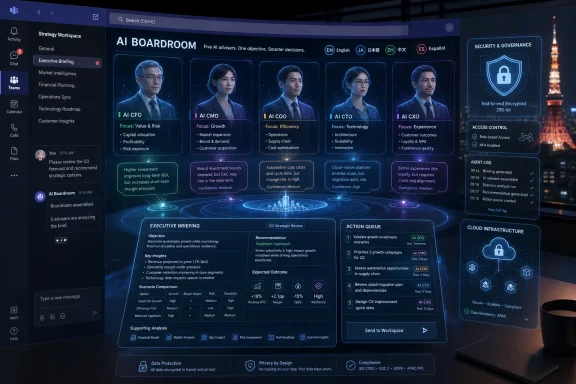
Ainvis is entering with a more aggressive claim: the AI should be in the room before the decision hardens. XPAND’s framing is that a founder should be able to drop a market expansion question into Teams and receive separate reactions from an AI CFO, CMO, COO, CTO, and CXO. The value proposition is not “here is what happened.” It is “here is the argument you have not yet had.”
That is a subtle but important shift. The enterprise AI stack has been filling up with copilots, agents, note-takers, workflow routers, and code assistants. Ainvis borrows from all of those categories, but it is packaged around a boardroom metaphor: five executives, five briefs, one decision.
The metaphor will either be the product’s advantage or its burden. Executives do not merely answer questions; they own consequences, resolve trade-offs, and take responsibility for incomplete information. An AI can simulate that behavior, but a company buying Ainvis will still need to decide whether it wants software that sounds like leadership or software that materially improves leadership.
Most workplace AI products are designed to collapse complexity into a single neat answer. Ainvis instead promises tension: the CFO maps exposure, the CMO challenges timing, the COO checks execution, the CTO examines technical risk, and the CXO looks at people and organizational impact. In theory, that is closer to how serious decisions actually happen.
The company’s distinction between an AI agent and an AI executive is doing a lot of work here. An agent carries out a task after instruction. An executive, in XPAND’s telling, joins the decision itself. That distinction may sound like marketing, but it points to a real product divide emerging in enterprise AI.
The first wave of agent software was obsessed with action. Book the meeting, update the CRM, write the pull request, file the ticket, send the follow-up. The next wave is circling the more delicate question of judgment: which action should be taken, in what order, with whose money, under which assumptions, and with which risks accepted.
Ainvis is explicitly on the judgment side of that divide. That makes it more ambitious than a task bot, but also harder to validate. A workflow either completed correctly or it did not. A strategic recommendation may look brilliant in a demo and reckless six months later.
Teams is also the obvious distribution channel for this kind of tool. For many companies, the real operating system of work is not Windows itself but the mesh of Teams, Outlook, SharePoint, OneDrive, and Microsoft 365 identity. If Ainvis can appear inside that flow without requiring users to learn a new executive dashboard, it has a chance to become part of the decision ritual rather than another tab someone forgets to open.
But the Teams angle comes with a problem: Microsoft is already there. Copilot in Teams can summarize meetings, identify action items, answer questions about a transcript, and help users catch up on conversations. Microsoft has also been pushing agent-like experiences deeper into Microsoft 365, meaning third-party vendors must explain why customers should pay again for something adjacent to the platform they already license.
XPAND’s answer is that Copilot summarizes while Ainvis argues. That is the cleanest version of the differentiation, and it is the one the company will need to keep proving. If users treat Ainvis as a prettier recap engine, Microsoft’s gravitational pull wins. If Ainvis consistently generates sharper cross-functional debate than a single assistant prompt, it becomes something more defensible.
That is not enough. A real executive team is valuable because each function has access to different constraints and because disagreement forces choices. If all five Ainvis executives merely decorate the same answer with functional language, the product becomes a management cosplay layer over ordinary AI output.
The stronger version of Ainvis would use those roles to surface incompatible priorities. A CFO might recommend delaying a launch because working capital is tight. A CMO might argue that delay sacrifices a rare market window. A CTO might warn that a rushed integration will create support liabilities. A COO might propose a narrower launch plan that preserves the timing while reducing operational exposure.
That is where AI could become genuinely useful to founders and small leadership teams. Many early-stage companies lack the luxury of a full executive bench. They make financial, operational, technical, and people decisions through a tiny group of overloaded generalists. Ainvis is pitching itself into that gap.
The danger is that users may confuse coverage with correctness. Having five AI viewpoints can make a recommendation feel more thoroughly vetted than it is. The system may still share the same underlying blind spots, especially if the models draw from the same incomplete company context or rely on the same flawed assumptions in the prompt.
That matters because leadership software has often been English-first even when companies themselves are not. Cross-border teams do not merely translate words; they translate hierarchy, politeness, risk tolerance, meeting norms, and disagreement styles. A blunt English executive critique may not land the same way in Japanese. A Spanish-language growth discussion may not map cleanly onto U.S.-centric marketing assumptions.
If XPAND has built language support at the product-design level rather than bolting it on through model translation, that could be meaningful. The company is based in Tokyo and appears to be positioning Ainvis for global founding teams, not just U.S. SaaS buyers. That gives the product a different center of gravity than many English-first AI workplace tools.
Still, multilingual quality is notoriously difficult to judge from a launch announcement. Fluency is not the same as executive usefulness. A product can sound natural in five languages and still fail to understand the local business norms that shape a decision.
The voice component raises the stakes further. XPAND says Ainvis executives can respond out loud in live web sessions with distinctive voices, natural cadence, filler acknowledgements, and structured arguments. If that feels smooth, it could make the product more present in meetings. If it feels uncanny or verbose, it could become the fastest way to irritate a leadership team.
Executive decisions are among the most sensitive data a company has. Market expansion plans, runway assumptions, acquisition talks, employee issues, board materials, product roadmaps, and financial documents are precisely the kinds of information organizations are least willing to spray into an opaque AI system. If Ainvis wants to sit at the leadership table, it must survive security review.
The product’s encryption language is especially ambitious. XPAND says files are encrypted on the device before upload and that, while locked, neither Ainvis nor Microsoft administrators can read them. It also describes conversations as double-encrypted, stored on encrypted Azure infrastructure and then encrypted again with a key held by the customer.
Those are strong claims, and they invite strong scrutiny. IT teams will want to know the details: how keys are generated, rotated, escrowed, and revoked; what metadata remains visible; how retrieval-augmented generation works against encrypted documents; what logs are retained; which subprocessors touch data; and how model providers are isolated from tenant content.
For WindowsForum readers, the Azure and Teams posture is reassuring only up to a point. Azure-native does not automatically mean risk-free, and Teams integration does not automatically mean Microsoft-grade governance. The real question is whether Ainvis can document its controls with the precision enterprise buyers expect, especially if it is asking to ingest financial documents and strategic conversations.
That pricing tells a story. XPAND is not trying to be a $10 assistant for casual users. It is pricing Ainvis as a decision-support product for founders, leadership teams, and business owners who can justify a subscription if it saves a meeting, prevents a bad hire, sharpens a board memo, or accelerates a market decision.
The lifetime founding customer rate is a classic early-access move, but it is particularly interesting here because the product’s cost structure may be nontrivial. Multi-model AI, voice sessions, company document retrieval, encryption, Teams integration, and executive customization can all add compute and support burden. Locking in early users may help XPAND build a reference base, but it also requires confidence that usage economics will not punish the company later.
There is also a packaging question. The free trial covers Chat Mode, while voice requires a paid tier. That makes sense operationally, but voice is arguably the feature that most clearly distinguishes Ainvis from a conventional multi-persona chatbot. XPAND will need the free experience to be impressive enough in text to make founders imagine the live meeting version.
For small teams, the math may be attractive if Ainvis becomes a substitute for external advisory hours. For larger organizations, price will be less important than governance, integration depth, and whether the system produces advice good enough to enter official decision records.
That includes human advisors, fractional executives, board members, strategy consultants, internal chiefs of staff, finance planning tools, product analytics dashboards, and the increasingly capable general-purpose AI systems employees already use. A founder can ask a frontier model to role-play a CFO and a CMO today. The question is whether Ainvis turns that ad hoc prompting into a reliable, governed, repeatable workflow.
This is where the product’s structure could matter. A raw model prompt depends heavily on the user’s skill. A purpose-built platform can enforce recurring roles, preserve company context, generate minutes, maintain action queues, and integrate into Teams. That is not magic, but it is workflow discipline.
The more serious challenge may come from platform incumbents. Microsoft can keep expanding Copilot’s meeting intelligence. OpenAI, Anthropic, and Google can make their enterprise assistants more agentic and better at multi-perspective reasoning. Specialized startups can attack narrower slices such as financial planning, sales strategy, or product operations with deeper domain data.
Ainvis therefore has to win on experience, not just capability. It must make the executive-team metaphor feel like a better way to decide, not merely a branded prompt template. That requires consistency, speed, trust, and a tone that busy leaders actually tolerate.
The appeal is obvious. Many decisions stall because no one has time to gather the finance, growth, operations, engineering, and people implications into one coherent recommendation. A self-running debate could give a founder a structured first pass before the real meeting begins. It could also expose trade-offs that a single executive sponsor might suppress.
But “no human in the loop” is a phrase that lands differently in enterprise software than it does in a launch deck. For trivial matters, autonomy is convenient. For strategic decisions, it needs boundaries. A system that debates a market entry plan is fine; a system that quietly initiates actions based on that debate is another matter.
XPAND also describes an Action Items Queue, where tasks that arise in conversation are picked up by the right executive and handled. That sounds powerful, but the distinction between recommending an action and executing one must be explicit. IT administrators will want approval flows, audit trails, permission scopes, and kill switches.
The future of this category will depend less on whether AI can generate plausible executive debate and more on whether organizations can govern it. The product that wins will not be the one with the most dramatic demo. It will be the one that knows when to stop.
Retrieval-augmented generation, or RAG, has become the standard answer to the enterprise AI context problem. Rather than training a model on a company’s private data, the system retrieves relevant documents at query time and uses them to ground the response. In practice, RAG quality varies wildly.
For Ainvis, the quality bar is unusually high. If the CFO executive analyzes financial exposure, it must retrieve the right financial assumptions. If the COO stress-tests execution, it must understand operational constraints. If the CXO weighs people impact, it must not hallucinate policies or infer sensitive personnel facts from thin context.
That turns document hygiene into decision hygiene. A messy knowledge base will produce messy executive advice. Outdated decks, duplicate forecasts, contradictory plans, and stale policies can all contaminate the output. Ainvis may need to guide customers not only in using AI but in curating the corporate memory the AI depends on.
There is a deeper accountability issue too. When a human executive cites a forecast, other people can challenge the source. When an AI executive synthesizes three documents and a meeting thread, users need enough traceability to understand why it reached its recommendation. Strategic AI without provenance becomes a persuasion machine.
Management has always included a large amount of pattern matching. A CFO recognizes cash-flow risk because she has seen companies overhire into optimism. A COO spots execution drag because he knows which dependencies always slip. A CMO senses that a launch window is closing because market narratives move faster than internal planning cycles.
AI systems are increasingly good at simulating that kind of pattern recognition. They can draw from broad business knowledge, ingest company-specific material, and generate structured arguments quickly. They do not get tired, embarrassed, politically cautious, or protective of departmental turf.
But they also do not bear responsibility. They do not know the informal trust dynamics inside a leadership team. They do not understand the emotional cost of a reorganization except as language. They do not have skin in the game when a strategic recommendation fails.
That does not make Ainvis useless. It means the product should be understood as a pressure-testing layer, not a replacement management team. The best use case is not “let the AI decide.” It is “make the human decision better before it becomes expensive.”
Teams integration is not just a convenience feature. It is an identity, permissions, compliance, and data-boundary question. If Ainvis participates in channel conversations, reads prompts, posts minutes, or pushes action items, administrators need clarity on what app permissions are required and how those permissions map to Microsoft Entra ID policies.
The same is true for guest access and cross-tenant collaboration. Leadership teams often include outside counsel, investors, consultants, and contractors. If Ainvis is present in those workflows, tenant isolation and meeting access rules become operationally significant. A product built for executive decisions cannot treat identity as an afterthought.
Audit logs will also matter. If an AI-generated recommendation influences a budget cut, hiring decision, vendor selection, or product delay, organizations may later need to reconstruct who asked what, what data was used, what answer was produced, and what action followed. That is not bureaucracy; it is basic governance.
XPAND’s announcement checks many of the right boxes, but the proof will be in documentation and customer deployments. Early access products often sound enterprise-ready before their admin tooling has been hardened by real IT departments. Ainvis will need those departments to trust it.
AI assistants are moving from individual productivity toward organizational behavior. First they helped a person write faster. Then they helped a team summarize meetings. Now vendors are trying to insert AI into planning, governance, debate, and execution. That trajectory was inevitable because the highest-value enterprise decisions are collective, not individual.
Ainvis is one of the clearer examples of that shift. It does not hide behind a neutral assistant persona. It says the AI should take a seat at the table, hold a functional brief, and challenge the humans. That is provocative because it moves AI into territory companies usually reserve for trusted people.
The product’s success will depend on whether customers find that provocative in a useful way. Some founders will welcome a tireless synthetic executive team, especially if they lack access to seasoned functional leaders. Some executives will see it as noise, risk, or performative software wrapped in management language.
Both reactions can be true. AI often enters organizations first as a toy, then as a convenience, then as infrastructure. Ainvis is trying to skip part of that path by presenting itself as infrastructure for decisions from day one.
A weekly leadership review is a controlled environment. Real companies are messier. Questions are half-formed, documents are missing, politics shape phrasing, and the most important constraint is often the one nobody wants to write down. Ainvis will need to function in that ambiguity without becoming either too timid or too confident.
The product also has to avoid meeting inflation. If every decision now produces five AI opinions, leaders may drown in structured commentary. The value is not more words; it is sharper trade-offs. A good AI executive should sometimes say, in effect, “this decision is not ready,” or “the real issue is not the one you asked about.”
That editorial discipline is hard for AI products. Models are generally eager to answer. Executive judgment sometimes requires refusing the frame. If Ainvis can learn that posture, it becomes much more interesting.
 Ainvis Arrives Where Meeting AI Has Started to Feel Small
The AI software market has spent the last few years teaching office workers to expect summaries, action items, transcript search, and polite rewrites. That was useful, but it was also bounded. Most meeting AI listens after the fact, organizes what humans already said, and tries not to get in the way.Ainvis is entering with a more aggressive claim: the AI should be in the room before the decision hardens. XPAND’s framing is that a founder should be able to drop a market expansion question into Teams and receive separate reactions from an AI CFO, CMO, COO, CTO, and CXO. The value proposition is not “here is what happened.” It is “here is the argument you have not yet had.”
That is a subtle but important shift. The enterprise AI stack has been filling up with copilots, agents, note-takers, workflow routers, and code assistants. Ainvis borrows from all of those categories, but it is packaged around a boardroom metaphor: five executives, five briefs, one decision.
The metaphor will either be the product’s advantage or its burden. Executives do not merely answer questions; they own consequences, resolve trade-offs, and take responsibility for incomplete information. An AI can simulate that behavior, but a company buying Ainvis will still need to decide whether it wants software that sounds like leadership or software that materially improves leadership.
The “AI Executive” Label Is a Bet on Friction, Not Automation
The most interesting part of Ainvis is not that it uses multiple AI personas. That idea has been around since early multi-agent demos, where one model criticizes another or a synthetic panel debates a prompt. The interesting move is that XPAND is making friction the feature.Most workplace AI products are designed to collapse complexity into a single neat answer. Ainvis instead promises tension: the CFO maps exposure, the CMO challenges timing, the COO checks execution, the CTO examines technical risk, and the CXO looks at people and organizational impact. In theory, that is closer to how serious decisions actually happen.
The company’s distinction between an AI agent and an AI executive is doing a lot of work here. An agent carries out a task after instruction. An executive, in XPAND’s telling, joins the decision itself. That distinction may sound like marketing, but it points to a real product divide emerging in enterprise AI.
The first wave of agent software was obsessed with action. Book the meeting, update the CRM, write the pull request, file the ticket, send the follow-up. The next wave is circling the more delicate question of judgment: which action should be taken, in what order, with whose money, under which assumptions, and with which risks accepted.
Ainvis is explicitly on the judgment side of that divide. That makes it more ambitious than a task bot, but also harder to validate. A workflow either completed correctly or it did not. A strategic recommendation may look brilliant in a demo and reckless six months later.
Microsoft Teams Is the Right Beachhead, But Also a Crowded One
Ainvis is clearly aimed at organizations that already live in Microsoft Teams. Chat Mode runs in Teams and on the web, while web-based voice meetings are available now, with voice inside Teams meetings promised later. That sequencing is pragmatic: start with text where integration is easier, then move toward the live meeting experience where the product’s “executive team” identity becomes more tangible.Teams is also the obvious distribution channel for this kind of tool. For many companies, the real operating system of work is not Windows itself but the mesh of Teams, Outlook, SharePoint, OneDrive, and Microsoft 365 identity. If Ainvis can appear inside that flow without requiring users to learn a new executive dashboard, it has a chance to become part of the decision ritual rather than another tab someone forgets to open.
But the Teams angle comes with a problem: Microsoft is already there. Copilot in Teams can summarize meetings, identify action items, answer questions about a transcript, and help users catch up on conversations. Microsoft has also been pushing agent-like experiences deeper into Microsoft 365, meaning third-party vendors must explain why customers should pay again for something adjacent to the platform they already license.
XPAND’s answer is that Copilot summarizes while Ainvis argues. That is the cleanest version of the differentiation, and it is the one the company will need to keep proving. If users treat Ainvis as a prettier recap engine, Microsoft’s gravitational pull wins. If Ainvis consistently generates sharper cross-functional debate than a single assistant prompt, it becomes something more defensible.
Five Executives Are Useful Only If They Disagree Productively
The promise of five AI executives is immediately understandable. It is also easy to overdo. Anyone who has used role-based prompting knows that synthetic experts can quickly become theatrical: the finance voice says “margin,” the marketing voice says “brand,” the engineering voice says “technical debt,” and the people voice says “alignment.”That is not enough. A real executive team is valuable because each function has access to different constraints and because disagreement forces choices. If all five Ainvis executives merely decorate the same answer with functional language, the product becomes a management cosplay layer over ordinary AI output.
The stronger version of Ainvis would use those roles to surface incompatible priorities. A CFO might recommend delaying a launch because working capital is tight. A CMO might argue that delay sacrifices a rare market window. A CTO might warn that a rushed integration will create support liabilities. A COO might propose a narrower launch plan that preserves the timing while reducing operational exposure.
That is where AI could become genuinely useful to founders and small leadership teams. Many early-stage companies lack the luxury of a full executive bench. They make financial, operational, technical, and people decisions through a tiny group of overloaded generalists. Ainvis is pitching itself into that gap.
The danger is that users may confuse coverage with correctness. Having five AI viewpoints can make a recommendation feel more thoroughly vetted than it is. The system may still share the same underlying blind spots, especially if the models draw from the same incomplete company context or rely on the same flawed assumptions in the prompt.
Multilingual Strategy Is More Than a Localization Checkbox
XPAND is making a notable claim around language. Ainvis is described as supporting English, Japanese, Chinese, and Spanish, with Japanese materials referring to both simplified and traditional Chinese support. The company calls the product pentalingual and emphasizes culturally tuned voice, rhythm, and vocabulary.That matters because leadership software has often been English-first even when companies themselves are not. Cross-border teams do not merely translate words; they translate hierarchy, politeness, risk tolerance, meeting norms, and disagreement styles. A blunt English executive critique may not land the same way in Japanese. A Spanish-language growth discussion may not map cleanly onto U.S.-centric marketing assumptions.
If XPAND has built language support at the product-design level rather than bolting it on through model translation, that could be meaningful. The company is based in Tokyo and appears to be positioning Ainvis for global founding teams, not just U.S. SaaS buyers. That gives the product a different center of gravity than many English-first AI workplace tools.
Still, multilingual quality is notoriously difficult to judge from a launch announcement. Fluency is not the same as executive usefulness. A product can sound natural in five languages and still fail to understand the local business norms that shape a decision.
The voice component raises the stakes further. XPAND says Ainvis executives can respond out loud in live web sessions with distinctive voices, natural cadence, filler acknowledgements, and structured arguments. If that feels smooth, it could make the product more present in meetings. If it feels uncanny or verbose, it could become the fastest way to irritate a leadership team.
Security Claims Will Get the Hardest Questions
Ainvis is also being sold as security-first. The announcement emphasizes Azure-native architecture, strict tenant isolation, audit logs, company knowledge retrieval, encrypted files, bring-your-own-key-style controls, and optional Azure Key Vault integration for higher plans. For the intended customer base, those claims are not decorative.Executive decisions are among the most sensitive data a company has. Market expansion plans, runway assumptions, acquisition talks, employee issues, board materials, product roadmaps, and financial documents are precisely the kinds of information organizations are least willing to spray into an opaque AI system. If Ainvis wants to sit at the leadership table, it must survive security review.
The product’s encryption language is especially ambitious. XPAND says files are encrypted on the device before upload and that, while locked, neither Ainvis nor Microsoft administrators can read them. It also describes conversations as double-encrypted, stored on encrypted Azure infrastructure and then encrypted again with a key held by the customer.
Those are strong claims, and they invite strong scrutiny. IT teams will want to know the details: how keys are generated, rotated, escrowed, and revoked; what metadata remains visible; how retrieval-augmented generation works against encrypted documents; what logs are retained; which subprocessors touch data; and how model providers are isolated from tenant content.
For WindowsForum readers, the Azure and Teams posture is reassuring only up to a point. Azure-native does not automatically mean risk-free, and Teams integration does not automatically mean Microsoft-grade governance. The real question is whether Ainvis can document its controls with the precision enterprise buyers expect, especially if it is asking to ingest financial documents and strategic conversations.
The Pricing Signals a Founder Tool That Wants Enterprise Credibility
Ainvis early access pricing starts at $99 per month for Solo, with annual pricing available, and rises through Growth and Team tiers before custom Enterprise deals. Voice Meeting Mode begins at Growth, while executive customization, CFO financial document retrieval, and Azure Key Vault opt-in sit higher in the stack. Founding customers are promised a lifetime locked rate.That pricing tells a story. XPAND is not trying to be a $10 assistant for casual users. It is pricing Ainvis as a decision-support product for founders, leadership teams, and business owners who can justify a subscription if it saves a meeting, prevents a bad hire, sharpens a board memo, or accelerates a market decision.
The lifetime founding customer rate is a classic early-access move, but it is particularly interesting here because the product’s cost structure may be nontrivial. Multi-model AI, voice sessions, company document retrieval, encryption, Teams integration, and executive customization can all add compute and support burden. Locking in early users may help XPAND build a reference base, but it also requires confidence that usage economics will not punish the company later.
There is also a packaging question. The free trial covers Chat Mode, while voice requires a paid tier. That makes sense operationally, but voice is arguably the feature that most clearly distinguishes Ainvis from a conventional multi-persona chatbot. XPAND will need the free experience to be impressive enough in text to make founders imagine the live meeting version.
For small teams, the math may be attractive if Ainvis becomes a substitute for external advisory hours. For larger organizations, price will be less important than governance, integration depth, and whether the system produces advice good enough to enter official decision records.
The Competitive Set Is Wider Than XPAND Suggests
XPAND positions Ainvis against products such as Microsoft 365 Copilot and other AI founder or meeting tools. That comparison is useful, but the real competitive landscape is broader. Ainvis is competing with every place a leadership team already seeks structured judgment.That includes human advisors, fractional executives, board members, strategy consultants, internal chiefs of staff, finance planning tools, product analytics dashboards, and the increasingly capable general-purpose AI systems employees already use. A founder can ask a frontier model to role-play a CFO and a CMO today. The question is whether Ainvis turns that ad hoc prompting into a reliable, governed, repeatable workflow.
This is where the product’s structure could matter. A raw model prompt depends heavily on the user’s skill. A purpose-built platform can enforce recurring roles, preserve company context, generate minutes, maintain action queues, and integrate into Teams. That is not magic, but it is workflow discipline.
The more serious challenge may come from platform incumbents. Microsoft can keep expanding Copilot’s meeting intelligence. OpenAI, Anthropic, and Google can make their enterprise assistants more agentic and better at multi-perspective reasoning. Specialized startups can attack narrower slices such as financial planning, sales strategy, or product operations with deeper domain data.
Ainvis therefore has to win on experience, not just capability. It must make the executive-team metaphor feel like a better way to decide, not merely a branded prompt template. That requires consistency, speed, trust, and a tone that busy leaders actually tolerate.
Autonomous Debate Is the Feature That Will Divide Buyers
One of the bolder capabilities in the announcement is Autonomous Debate. For high-stakes questions, XPAND says the five executives can hash it out themselves, with no human in the loop, and return a considered conclusion. That is exactly the kind of feature that excites AI enthusiasts and alarms governance teams.The appeal is obvious. Many decisions stall because no one has time to gather the finance, growth, operations, engineering, and people implications into one coherent recommendation. A self-running debate could give a founder a structured first pass before the real meeting begins. It could also expose trade-offs that a single executive sponsor might suppress.
But “no human in the loop” is a phrase that lands differently in enterprise software than it does in a launch deck. For trivial matters, autonomy is convenient. For strategic decisions, it needs boundaries. A system that debates a market entry plan is fine; a system that quietly initiates actions based on that debate is another matter.
XPAND also describes an Action Items Queue, where tasks that arise in conversation are picked up by the right executive and handled. That sounds powerful, but the distinction between recommending an action and executing one must be explicit. IT administrators will want approval flows, audit trails, permission scopes, and kill switches.
The future of this category will depend less on whether AI can generate plausible executive debate and more on whether organizations can govern it. The product that wins will not be the one with the most dramatic demo. It will be the one that knows when to stop.
RAG Makes the Product Useful, and Also Accountable
Company Knowledge Base support is central to the Ainvis pitch. Without company context, AI executives are just generic consultants with confident voices. With the right documents, they can reason over plans, financials, policies, market notes, product specs, and prior decisions.Retrieval-augmented generation, or RAG, has become the standard answer to the enterprise AI context problem. Rather than training a model on a company’s private data, the system retrieves relevant documents at query time and uses them to ground the response. In practice, RAG quality varies wildly.
For Ainvis, the quality bar is unusually high. If the CFO executive analyzes financial exposure, it must retrieve the right financial assumptions. If the COO stress-tests execution, it must understand operational constraints. If the CXO weighs people impact, it must not hallucinate policies or infer sensitive personnel facts from thin context.
That turns document hygiene into decision hygiene. A messy knowledge base will produce messy executive advice. Outdated decks, duplicate forecasts, contradictory plans, and stale policies can all contaminate the output. Ainvis may need to guide customers not only in using AI but in curating the corporate memory the AI depends on.
There is a deeper accountability issue too. When a human executive cites a forecast, other people can challenge the source. When an AI executive synthesizes three documents and a meeting thread, users need enough traceability to understand why it reached its recommendation. Strategic AI without provenance becomes a persuasion machine.
This Is Really a Test of How Much Management Can Be Productized
Ainvis belongs to a larger movement: the attempt to productize management labor. Not administration, not scheduling, not note-taking, but the messy middle layer of analysis, challenge, synthesis, and follow-through. That is why the product is interesting even if early versions prove uneven.Management has always included a large amount of pattern matching. A CFO recognizes cash-flow risk because she has seen companies overhire into optimism. A COO spots execution drag because he knows which dependencies always slip. A CMO senses that a launch window is closing because market narratives move faster than internal planning cycles.
AI systems are increasingly good at simulating that kind of pattern recognition. They can draw from broad business knowledge, ingest company-specific material, and generate structured arguments quickly. They do not get tired, embarrassed, politically cautious, or protective of departmental turf.
But they also do not bear responsibility. They do not know the informal trust dynamics inside a leadership team. They do not understand the emotional cost of a reorganization except as language. They do not have skin in the game when a strategic recommendation fails.
That does not make Ainvis useless. It means the product should be understood as a pressure-testing layer, not a replacement management team. The best use case is not “let the AI decide.” It is “make the human decision better before it becomes expensive.”
Windows Shops Will Care About the Admin Surface
For many WindowsForum readers, the product’s most important details will be less glamorous than AI voices and synthetic executives. They will want to know how Ainvis is deployed, managed, licensed, audited, and removed. The success of any Teams-adjacent AI tool depends heavily on the admin surface.Teams integration is not just a convenience feature. It is an identity, permissions, compliance, and data-boundary question. If Ainvis participates in channel conversations, reads prompts, posts minutes, or pushes action items, administrators need clarity on what app permissions are required and how those permissions map to Microsoft Entra ID policies.
The same is true for guest access and cross-tenant collaboration. Leadership teams often include outside counsel, investors, consultants, and contractors. If Ainvis is present in those workflows, tenant isolation and meeting access rules become operationally significant. A product built for executive decisions cannot treat identity as an afterthought.
Audit logs will also matter. If an AI-generated recommendation influences a budget cut, hiring decision, vendor selection, or product delay, organizations may later need to reconstruct who asked what, what data was used, what answer was produced, and what action followed. That is not bureaucracy; it is basic governance.
XPAND’s announcement checks many of the right boxes, but the proof will be in documentation and customer deployments. Early access products often sound enterprise-ready before their admin tooling has been hardened by real IT departments. Ainvis will need those departments to trust it.
The Launch Says as Much About AI’s Direction as It Does About XPAND
Ainvis may or may not become a major product. Early access launches are promises, not verdicts. What is harder to dismiss is the direction of travel.AI assistants are moving from individual productivity toward organizational behavior. First they helped a person write faster. Then they helped a team summarize meetings. Now vendors are trying to insert AI into planning, governance, debate, and execution. That trajectory was inevitable because the highest-value enterprise decisions are collective, not individual.
Ainvis is one of the clearer examples of that shift. It does not hide behind a neutral assistant persona. It says the AI should take a seat at the table, hold a functional brief, and challenge the humans. That is provocative because it moves AI into territory companies usually reserve for trusted people.
The product’s success will depend on whether customers find that provocative in a useful way. Some founders will welcome a tireless synthetic executive team, especially if they lack access to seasoned functional leaders. Some executives will see it as noise, risk, or performative software wrapped in management language.
Both reactions can be true. AI often enters organizations first as a toy, then as a convenience, then as infrastructure. Ainvis is trying to skip part of that path by presenting itself as infrastructure for decisions from day one.
The Real Trial Begins After the Demo Ends
The launch materials are strongest when they describe concrete workflows: a strategic question in Teams, five role-based responses, structured minutes, action items, and voice sessions on the web. They are weakest where every AI launch is weakest: in the gap between a compelling scenario and daily organizational use.A weekly leadership review is a controlled environment. Real companies are messier. Questions are half-formed, documents are missing, politics shape phrasing, and the most important constraint is often the one nobody wants to write down. Ainvis will need to function in that ambiguity without becoming either too timid or too confident.
The product also has to avoid meeting inflation. If every decision now produces five AI opinions, leaders may drown in structured commentary. The value is not more words; it is sharper trade-offs. A good AI executive should sometimes say, in effect, “this decision is not ready,” or “the real issue is not the one you asked about.”
That editorial discipline is hard for AI products. Models are generally eager to answer. Executive judgment sometimes requires refusing the frame. If Ainvis can learn that posture, it becomes much more interesting.
The Early-Access Signal to Watch Is Whether Teams Invite It Back
Ainvis should be judged less by its first demo than by whether leadership teams keep inviting it into consequential conversations. The product’s claims are concrete enough to test, and the early-access period should reveal where the executive-team metaphor holds up.- Ainvis launched early access on June 5, 2026, from Tokyo-based XPAND K.K. as a five-role AI executive platform for web and Microsoft Teams workflows.
- The core distinction is that Ainvis is positioned as decision support, not merely task automation or meeting transcription.
- Chat Mode is available through Teams and the web, while web voice meetings are available now and voice inside Teams meetings is planned.
- The product’s most important enterprise claims involve multilingual support, Azure-native deployment, tenant isolation, audit logs, encrypted company knowledge, and customer-held key options.
- Its hardest competitive test will be proving that five role-based AI advisers produce better decisions than Microsoft 365 Copilot, general-purpose AI prompting, or human advisory workflows.
- The biggest governance question is how far Ainvis moves from recommending decisions toward executing actions, and how clearly administrators can control that boundary.
References
- Primary source: openpr.com
Published: 2026-06-08T07:42:08.131452
XPAND K.K. opens early access to Ainvis - an AI executive team that
Press release - XPAND K.K. - XPAND K.K. opens early access to Ainvis - an AI executive team that joins your decisions - published on openPR.comwww.openpr.com - Related coverage: assets.noviams.com
- Official source: learn.microsoft.com
Connect to the Microsoft Copilot Dashboard for Microsoft 365 customers | Microsoft Learn
Explains how to set up and use the Microsoft Copilot Dashboard, which provides various metrics to help you see how employees are using Copilot and the impact it could have on your organization.learn.microsoft.com
