
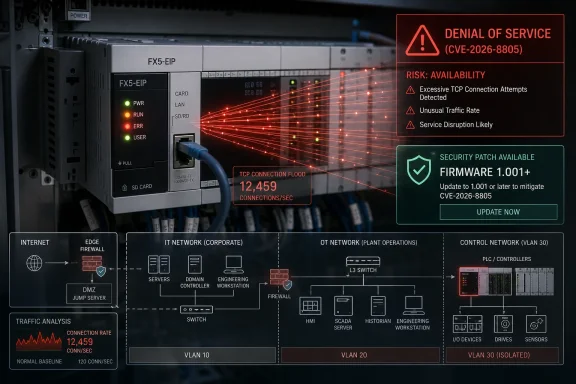
Mitsubishi Electric and CISA disclosed on June 18, 2026, that MELSEC iQ-F Series FX5-EIP EtherNet/IP modules running version 1.000 or earlier are vulnerable to a remotely triggerable denial-of-service flaw tracked as CVE-2026-8805. The fix is firmware version 1.001 or later, but the more important lesson is that industrial availability risk keeps arriving through the most ordinary network behaviors. This is not a cinematic exploit chain or a ransomware detonation. It is a reminder that a factory floor can be pushed toward failure by the simple act of opening too many TCP connections too quickly.
The vulnerability sits in the EtherNet/IP function of Mitsubishi Electric’s FX5-EIP module, part of the MELSEC iQ-F family used in compact industrial control deployments. According to the advisory, a remote attacker can rapidly establish a large number of TCP connections to the product, causing an inconsistency in the module’s internal connection management and triggering improper memory access. The result is denial of service: a device meant to participate in deterministic industrial communication can be knocked out of reliable operation by network pressure.
That phrasing matters because it moves the issue away from the usual mental model of “malware in the plant” and toward something less dramatic but often more operationally relevant. This is not about an attacker taking over a programmable logic controller and rewriting ladder logic. It is about the fragility that appears when embedded network stacks, industrial protocols, and real-time expectations collide.
The assigned CVSS v3.1 score is 7.5, high severity, with network attack vector, low complexity, no privileges required, and no user interaction. The CVSS v4.0 score rises to 8.7, also high. Those numbers do not mean every exposed FX5-EIP is one packet away from catastrophe, but they do mean defenders should treat this as a credible availability issue rather than a theoretical bug.
For WindowsForum readers, this may look at first like an industrial control systems story at the edge of the usual Windows beat. It is not. Windows workstations, engineering laptops, HMIs, historians, patch servers, remote access jump boxes, and Active Directory-connected plant networks are often the connective tissue around devices like these. When a flaw is triggered over TCP, the boundary between “OT network issue” and “IT network issue” becomes a management fiction.
Industrial denial-of-service vulnerabilities are sometimes underrated because they do not promise data theft, privilege escalation, or code execution. In enterprise IT, a service crash may be annoying, noisy, and recoverable. In industrial automation, availability is often the security property that matters most, because the cost of interruption is measured in downtime, scrap, safety procedures, missed production windows, and weekend calls to people who know exactly which cabinet contains which module.
A device that mishandles connection management is especially awkward in an industrial environment because network troubleshooting itself can become part of the stress. Scanners, monitoring platforms, misconfigured clients, vulnerability assessment tools, and accidental loops can all produce unusual connection behavior. An attacker does not need to be clever if the vulnerable condition resembles the kind of bursty traffic a badly segmented or poorly governed network can already produce.
That is why the advisory’s “remote attacker” wording should be read broadly. Remote does not necessarily mean “on the public internet.” In ICS, remote can mean a compromised engineering workstation, a vendor VPN account, a laptop plugged into a maintenance network, a Windows server bridging zones it should not bridge, or a plant-floor device reachable from a corporate subnet because nobody wanted to break a decades-old integration.
That does not make the warning less useful. It does mean operators should resist reading the advisory as a fully contextualized risk assessment. CISA’s republication is a signal flare, not a plant-specific answer.
The vulnerability is classified as CWE-190, integer overflow or wraparound. In ordinary software engineering, that category often sounds like a textbook error: a value grows beyond what the program expects, wraps, and corrupts assumptions downstream. In embedded industrial devices, those assumptions may live inside compact memory budgets, protocol state machines, and long-lived connection tables that were never meant to behave like cloud-native services under hostile load.
The advisory describes an “inconsistency” in internal connection management. That is a telling word. Industrial devices are often engineered for predictable patterns: known peers, configured scan rates, stable communications, and limited churn. Throw internet-style connection abuse at that model, and the failure mode is not always graceful degradation. Sometimes it is improper memory access and loss of service.
This is the bargain industrial automation has been making for years. Proprietary fieldbus islands gave way to Ethernet-based integration because plants needed visibility, flexibility, interoperability, and vendor ecosystems that could move data beyond a single cell. The same move allowed production lines to connect to historians, dashboards, MES platforms, analytics tools, remote support, and eventually cloud services.
No serious operator is going back to isolated islands just because Ethernet-based control networks create new risk. But the FX5-EIP advisory is a good example of why convergence has never meant that IT and OT can be secured with the same assumptions. A Windows file server can tolerate a style of monitoring, scanning, and reboot scheduling that a production cell cannot. A PLC communication module can sit on Ethernet and still behave like a real-time industrial component, not a web service.
The danger is not that EtherNet/IP exists. The danger is when organizations treat the presence of RJ45 ports as permission to collapse architecture. A protocol that rides over TCP/IP does not magically inherit the resilience, logging, patch cadence, or defensive tooling of a hardened enterprise endpoint.
Industrial firmware updates rarely behave that cleanly. The device may be inside a running production system. The maintenance window may be quarterly. The integrator that commissioned the line may be gone, busy, or under a support contract that requires paperwork. The engineering workstation may run a particular version of a vendor tool because a newer one broke a configuration workflow five years ago. The plant may need to validate the module’s behavior against a safety case, production recipe, or customer quality requirement.
None of that is an excuse not to patch. It is the reason patch management in OT has to be treated as engineering work rather than administrative hygiene. The advisory’s fixed version number gives asset owners a target, but getting there requires inventory, configuration backups, regression planning, and a rollback path.
The version boundary also creates a practical discovery problem. Many organizations still do not have a clean inventory of industrial communication modules, firmware revisions, network paths, and protocol exposure. They may know they have Mitsubishi PLCs. They may even know they have iQ-F controllers. But the difference between a CPU’s built-in Ethernet port, an FX5-EIP module, an FX5-ENET/IP module, and other network adapters can be buried in old drawings, cabinet labels, and tribal memory.
That is why the first useful response is not panic patching; it is disciplined scoping. Find the affected modules. Confirm firmware versions. Map which hosts can reach them. Identify whether EtherNet/IP traffic crosses VLANs, firewalls, VPNs, remote support paths, or Windows-based engineering stations. Only then does “install version 1.001” become an actionable sentence.
It is tempting to dismiss this as boilerplate. It is also mostly correct.
The most important mitigation for this kind of flaw is not a magical intrusion prevention signature. It is reducing who can open connections to the module in the first place. If only a small set of controllers, engineering workstations, and management hosts can reach the FX5-EIP over the relevant ports, then the attack surface shrinks dramatically. If the module is reachable from half the corporate network, the organization has converted a device-level bug into an enterprise lateral movement opportunity.
VPN advice needs special care. The advisory recommends VPNs when internet access is required, but a VPN should not be treated as a sanctifying tunnel. A VPN extends trust from one endpoint to another; it does not prove that the connected laptop is clean, that the account has not been phished, or that the allowed network path is minimal. CISA’s familiar warning that a VPN is only as secure as its connected devices remains painfully relevant.
The IP filter function may be the most product-specific compensating control in the advisory. If operators cannot patch immediately, using the FX5-EIP’s own filtering to block untrusted hosts can add a useful layer. But device-level filters should complement, not replace, network enforcement. A control module should not have to be its own first and last firewall.
This is where IT and OT arguments tend to get unhelpful. OT teams are right that industrial systems have different constraints. IT teams are right that unmanaged, underpatched, poorly segmented networks are unacceptable. The FX5-EIP flaw is exactly the kind of issue that should force both sides into a more concrete conversation: which Windows hosts can talk to the module, under what account model, through what firewall rules, and with what monitoring?
Anti-virus on PCs that can access the affected product is included in Mitsubishi’s mitigations, but it is the floor, not the ceiling. Endpoint detection, application control, least-privilege administration, controlled engineering tool deployment, MFA for remote access, and logging of remote sessions all matter because they reduce the chance that an ordinary corporate compromise becomes plant-floor packet abuse.
Vulnerability scanning is another Windows-adjacent tension point. Security teams may want to scan everything. OT teams may object because active scanning can destabilize fragile devices. This advisory gives both sides evidence for a more mature approach: test scanning profiles, segment scans by asset class, use passive discovery where possible, and never assume that a network stack inside an industrial module will respond like a domain-joined server.
The practical lesson is not “do not scan ICS.” It is “do not scan ICS blindly.” If rapid TCP connection establishment can trigger a denial-of-service condition, then the security tooling used to find vulnerable devices must be governed with the same care as any other industrial change.
A denial-of-service condition can have different consequences depending on where the affected module sits. If it supports a test bench, the impact may be a nuisance. If it bridges a controller to remote I/O in a production cell, the impact may be a line stoppage. If recovery requires physical intervention or a controlled restart, the incident clock starts ticking in dollars and operational risk.
The advisory does not claim exploitation has occurred in the wild. It also does not describe remote code execution, data manipulation, or safety system compromise. That restraint is important. Overstating ICS bugs helps no one, especially in environments where credibility determines whether operations teams listen to security recommendations.
But understatement has its own cost. A high-severity, unauthenticated, network-triggered availability flaw in equipment deployed worldwide across critical manufacturing is not background noise. It belongs in risk registers, maintenance planning, and network access reviews.
For large organizations, this is both a blessing and a burden. Machine-readable advisories can feed vulnerability management platforms, asset inventories, ticketing systems, and supplier risk workflows. They can help security teams match affected product names and versions against known environments. They can reduce the lag between vendor disclosure and internal action.
But advisory automation does not solve the hardest part of ICS vulnerability response: knowing what is actually installed, whether it is reachable, what process it supports, and when it can safely be changed. A CSAF file can say “FX5-EIP <=1.000.” It cannot tell you that the module is in line three, cabinet B, connected to a cell that runs six days a week and has not had a clean shutdown since last summer.
This is where the next generation of asset management either proves itself or fails. If an organization cannot connect a vendor advisory to a real device, a real network path, and a real maintenance plan, machine-readable disclosure just produces better-formatted anxiety.
That ambiguity slows remediation. A security team may file a ticket to patch the module but lack the authority to schedule downtime. A plant team may want to update but lack confidence that the firmware package is correct. An integrator may recommend waiting until a broader service visit. Corporate IT may block remote access changes without understanding production impact. Everyone may agree the vulnerability is real while no one owns the last mile.
The advisory’s mitigation language implicitly assumes coordination. Firewalls require network teams. VPN hardening requires identity and remote access teams. IP filtering requires controls knowledge. Physical access restrictions require site operations. Anti-virus on engineering PCs requires endpoint management. Firmware updates require industrial maintenance planning.
That is why the right response is not just a patch ticket. It is an owner map. Organizations should know who can approve compensating controls, who can test the firmware, who can touch the production system, who can validate recovery, and who communicates risk acceptance if the update cannot happen quickly.
But the more common and more difficult risk is internal exposure. Many plants have grown networks incrementally. A machine builder adds a remote support router. A maintenance team requests easier access from the office. A data project connects production equipment to a server. A temporary firewall rule becomes permanent. A flat VLAN survives because nobody wants to find out what depends on broadcast discovery.
The FX5-EIP flaw is a reason to revisit those decisions. Not because this one CVE will topple every plant, but because it gives defenders a concrete test case: can an untrusted workstation reach the module? Can a corporate subnet initiate TCP connections to it? Can a vendor VPN user see more than the one engineering host they need? Are firewall rules written by process requirement or by convenience?
A well-designed industrial network does not assume every device is perfectly robust. It assumes some devices will fail under hostile or malformed traffic and therefore limits who can send that traffic. That architectural humility is the difference between vulnerability management and wishful thinking.
The more strategic task is to use this advisory as a forcing function for asset visibility. If the organization cannot answer the affected-product question quickly, that is itself a finding. A high-severity advisory should not require a scavenger hunt through cabinets, spreadsheets, old project files, and retired integrator emails.
For smaller shops, the response may be pragmatic: inspect the machine, check the module, download the vendor update, coordinate a downtime window, and add firewall rules that should have existed already. For larger manufacturers, the response should become repeatable: advisory intake, product matching, reachability analysis, compensating control selection, change approval, deployment, verification, and documentation.
This is where Windows administrators can contribute without pretending to be controls engineers. They can help identify Windows hosts with routes into OT networks, review remote access groups, harden jump boxes, confirm endpoint protection coverage, and make sure DNS, DHCP, logging, and identity dependencies are understood. They can also stop treating plant networks as mysterious exceptions that only become visible during an incident.
Here is the practical read for teams that need to move from advisory to action:
 The Weak Point Is Not Exotic, and That Is the Problem
The vulnerability sits in the EtherNet/IP function of Mitsubishi Electric’s FX5-EIP module, part of the MELSEC iQ-F family used in compact industrial control deployments. According to the advisory, a remote attacker can rapidly establish a large number of TCP connections to the product, causing an inconsistency in the module’s internal connection management and triggering improper memory access. The result is denial of service: a device meant to participate in deterministic industrial communication can be knocked out of reliable operation by network pressure.That phrasing matters because it moves the issue away from the usual mental model of “malware in the plant” and toward something less dramatic but often more operationally relevant. This is not about an attacker taking over a programmable logic controller and rewriting ladder logic. It is about the fragility that appears when embedded network stacks, industrial protocols, and real-time expectations collide.
The assigned CVSS v3.1 score is 7.5, high severity, with network attack vector, low complexity, no privileges required, and no user interaction. The CVSS v4.0 score rises to 8.7, also high. Those numbers do not mean every exposed FX5-EIP is one packet away from catastrophe, but they do mean defenders should treat this as a credible availability issue rather than a theoretical bug.
For WindowsForum readers, this may look at first like an industrial control systems story at the edge of the usual Windows beat. It is not. Windows workstations, engineering laptops, HMIs, historians, patch servers, remote access jump boxes, and Active Directory-connected plant networks are often the connective tissue around devices like these. When a flaw is triggered over TCP, the boundary between “OT network issue” and “IT network issue” becomes a management fiction.
A Denial-of-Service Bug Can Be a Production Incident
The affected product is specific: Mitsubishi Electric MELSEC iQ-F Series FX5-EIP EtherNet/IP Module FX5-EIP, version 1.000 and earlier. Mitsubishi says it is releasing fixed version 1.001 or later and directs customers to download the update through its Factory Automation download portal. That narrow affected range is useful for asset owners, but it should not obscure the wider operational pattern.Industrial denial-of-service vulnerabilities are sometimes underrated because they do not promise data theft, privilege escalation, or code execution. In enterprise IT, a service crash may be annoying, noisy, and recoverable. In industrial automation, availability is often the security property that matters most, because the cost of interruption is measured in downtime, scrap, safety procedures, missed production windows, and weekend calls to people who know exactly which cabinet contains which module.
A device that mishandles connection management is especially awkward in an industrial environment because network troubleshooting itself can become part of the stress. Scanners, monitoring platforms, misconfigured clients, vulnerability assessment tools, and accidental loops can all produce unusual connection behavior. An attacker does not need to be clever if the vulnerable condition resembles the kind of bursty traffic a badly segmented or poorly governed network can already produce.
That is why the advisory’s “remote attacker” wording should be read broadly. Remote does not necessarily mean “on the public internet.” In ICS, remote can mean a compromised engineering workstation, a vendor VPN account, a laptop plugged into a maintenance network, a Windows server bridging zones it should not bridge, or a plant-floor device reachable from a corporate subnet because nobody wanted to break a decades-old integration.
The Calendar Says New CVE, but the Pattern Is Old
Mitsubishi Electric’s June advisory follows a familiar ICS disclosure rhythm. The vendor reports the flaw, CISA republishes it to increase visibility, and the remediation language urges firmware updates where possible and compensating controls where not. The CSAF conversion disclaimer is unusually blunt about the mechanics: CISA is republishing the Mitsubishi advisory “as-is” and is not taking responsibility for the vendor’s editorial or technical accuracy.That does not make the warning less useful. It does mean operators should resist reading the advisory as a fully contextualized risk assessment. CISA’s republication is a signal flare, not a plant-specific answer.
The vulnerability is classified as CWE-190, integer overflow or wraparound. In ordinary software engineering, that category often sounds like a textbook error: a value grows beyond what the program expects, wraps, and corrupts assumptions downstream. In embedded industrial devices, those assumptions may live inside compact memory budgets, protocol state machines, and long-lived connection tables that were never meant to behave like cloud-native services under hostile load.
The advisory describes an “inconsistency” in internal connection management. That is a telling word. Industrial devices are often engineered for predictable patterns: known peers, configured scan rates, stable communications, and limited churn. Throw internet-style connection abuse at that model, and the failure mode is not always graceful degradation. Sometimes it is improper memory access and loss of service.
EtherNet/IP Brought the Factory Closer to IT’s Blast Radius
EtherNet/IP is not “Ethernet plus IP” in the generic sense; it is an industrial protocol built on the Common Industrial Protocol and widely used for communication among controllers, I/O, drives, sensors, and supervisory systems. Its value is precisely that it lets automation equipment speak over familiar network infrastructure. Its risk is that familiar infrastructure brings familiar attack surfaces.This is the bargain industrial automation has been making for years. Proprietary fieldbus islands gave way to Ethernet-based integration because plants needed visibility, flexibility, interoperability, and vendor ecosystems that could move data beyond a single cell. The same move allowed production lines to connect to historians, dashboards, MES platforms, analytics tools, remote support, and eventually cloud services.
No serious operator is going back to isolated islands just because Ethernet-based control networks create new risk. But the FX5-EIP advisory is a good example of why convergence has never meant that IT and OT can be secured with the same assumptions. A Windows file server can tolerate a style of monitoring, scanning, and reboot scheduling that a production cell cannot. A PLC communication module can sit on Ethernet and still behave like a real-time industrial component, not a web service.
The danger is not that EtherNet/IP exists. The danger is when organizations treat the presence of RJ45 ports as permission to collapse architecture. A protocol that rides over TCP/IP does not magically inherit the resilience, logging, patch cadence, or defensive tooling of a hardened enterprise endpoint.
The Fix Is Simple on Paper and Complicated in the Plant
Mitsubishi’s primary remediation is straightforward: update the FX5-EIP module to version 1.001 or later. In a software-only world, that would be the end of the story. Download, deploy, verify, close ticket.Industrial firmware updates rarely behave that cleanly. The device may be inside a running production system. The maintenance window may be quarterly. The integrator that commissioned the line may be gone, busy, or under a support contract that requires paperwork. The engineering workstation may run a particular version of a vendor tool because a newer one broke a configuration workflow five years ago. The plant may need to validate the module’s behavior against a safety case, production recipe, or customer quality requirement.
None of that is an excuse not to patch. It is the reason patch management in OT has to be treated as engineering work rather than administrative hygiene. The advisory’s fixed version number gives asset owners a target, but getting there requires inventory, configuration backups, regression planning, and a rollback path.
The version boundary also creates a practical discovery problem. Many organizations still do not have a clean inventory of industrial communication modules, firmware revisions, network paths, and protocol exposure. They may know they have Mitsubishi PLCs. They may even know they have iQ-F controllers. But the difference between a CPU’s built-in Ethernet port, an FX5-EIP module, an FX5-ENET/IP module, and other network adapters can be buried in old drawings, cabinet labels, and tribal memory.
That is why the first useful response is not panic patching; it is disciplined scoping. Find the affected modules. Confirm firmware versions. Map which hosts can reach them. Identify whether EtherNet/IP traffic crosses VLANs, firewalls, VPNs, remote support paths, or Windows-based engineering stations. Only then does “install version 1.001” become an actionable sentence.
Segmentation Is the Mitigation Everyone Recommends Because It Still Works
Mitsubishi’s interim mitigations read like the standard ICS defensive playbook: keep the affected product within a LAN, block access from untrusted networks and hosts, use firewalls, use VPNs when internet access is required, restrict physical access, use the module’s IP filter function, and install anti-virus software on PCs that can access the device. CISA adds the broader guidance: minimize network exposure for control systems, keep them off the internet, place them behind firewalls, isolate them from business networks, and use secure remote access.It is tempting to dismiss this as boilerplate. It is also mostly correct.
The most important mitigation for this kind of flaw is not a magical intrusion prevention signature. It is reducing who can open connections to the module in the first place. If only a small set of controllers, engineering workstations, and management hosts can reach the FX5-EIP over the relevant ports, then the attack surface shrinks dramatically. If the module is reachable from half the corporate network, the organization has converted a device-level bug into an enterprise lateral movement opportunity.
VPN advice needs special care. The advisory recommends VPNs when internet access is required, but a VPN should not be treated as a sanctifying tunnel. A VPN extends trust from one endpoint to another; it does not prove that the connected laptop is clean, that the account has not been phished, or that the allowed network path is minimal. CISA’s familiar warning that a VPN is only as secure as its connected devices remains painfully relevant.
The IP filter function may be the most product-specific compensating control in the advisory. If operators cannot patch immediately, using the FX5-EIP’s own filtering to block untrusted hosts can add a useful layer. But device-level filters should complement, not replace, network enforcement. A control module should not have to be its own first and last firewall.
Windows Is Still in the Story Even When the Vulnerable Box Is Not Running Windows
A Mitsubishi communication module is not a Windows endpoint, but Windows environments often decide whether the vulnerability is exploitable in practice. The engineering workstation that configures the PLC may be Windows. The HMI may be Windows. The historian may run on Windows Server. The vendor remote access path may land on a Windows jump host. The malware that opens a path into the plant may begin with a Windows credential.This is where IT and OT arguments tend to get unhelpful. OT teams are right that industrial systems have different constraints. IT teams are right that unmanaged, underpatched, poorly segmented networks are unacceptable. The FX5-EIP flaw is exactly the kind of issue that should force both sides into a more concrete conversation: which Windows hosts can talk to the module, under what account model, through what firewall rules, and with what monitoring?
Anti-virus on PCs that can access the affected product is included in Mitsubishi’s mitigations, but it is the floor, not the ceiling. Endpoint detection, application control, least-privilege administration, controlled engineering tool deployment, MFA for remote access, and logging of remote sessions all matter because they reduce the chance that an ordinary corporate compromise becomes plant-floor packet abuse.
Vulnerability scanning is another Windows-adjacent tension point. Security teams may want to scan everything. OT teams may object because active scanning can destabilize fragile devices. This advisory gives both sides evidence for a more mature approach: test scanning profiles, segment scans by asset class, use passive discovery where possible, and never assume that a network stack inside an industrial module will respond like a domain-joined server.
The practical lesson is not “do not scan ICS.” It is “do not scan ICS blindly.” If rapid TCP connection establishment can trigger a denial-of-service condition, then the security tooling used to find vulnerable devices must be governed with the same care as any other industrial change.
Availability Bugs Are Security Bugs, Even Without Theft or Takeover
The security industry still has a bias toward confidentiality drama. Data exfiltration, ransomware leaks, credential dumps, and zero-click compromise stories are easier to narrate than a PLC communication module that falls over under connection pressure. But in critical manufacturing, availability is not a second-class concern. It is the business.A denial-of-service condition can have different consequences depending on where the affected module sits. If it supports a test bench, the impact may be a nuisance. If it bridges a controller to remote I/O in a production cell, the impact may be a line stoppage. If recovery requires physical intervention or a controlled restart, the incident clock starts ticking in dollars and operational risk.
The advisory does not claim exploitation has occurred in the wild. It also does not describe remote code execution, data manipulation, or safety system compromise. That restraint is important. Overstating ICS bugs helps no one, especially in environments where credibility determines whether operations teams listen to security recommendations.
But understatement has its own cost. A high-severity, unauthenticated, network-triggered availability flaw in equipment deployed worldwide across critical manufacturing is not background noise. It belongs in risk registers, maintenance planning, and network access reviews.
CSAF Makes the Warning Machine Faster, Not Smarter
One subtle detail in the advisory deserves attention: CISA says the ICSA is a verbatim republication of Mitsubishi Electric’s 2026-002 advisory from a direct conversion of the vendor’s Common Security Advisory Framework advisory. CSAF is intended to make security advisories machine-readable and easier to distribute. That is good. It also means defenders are going to see more advisories arrive faster, with less editorial mediation.For large organizations, this is both a blessing and a burden. Machine-readable advisories can feed vulnerability management platforms, asset inventories, ticketing systems, and supplier risk workflows. They can help security teams match affected product names and versions against known environments. They can reduce the lag between vendor disclosure and internal action.
But advisory automation does not solve the hardest part of ICS vulnerability response: knowing what is actually installed, whether it is reachable, what process it supports, and when it can safely be changed. A CSAF file can say “FX5-EIP <=1.000.” It cannot tell you that the module is in line three, cabinet B, connected to a cell that runs six days a week and has not had a clean shutdown since last summer.
This is where the next generation of asset management either proves itself or fails. If an organization cannot connect a vendor advisory to a real device, a real network path, and a real maintenance plan, machine-readable disclosure just produces better-formatted anxiety.
The Risk Lives in the Gaps Between Ownership Models
Industrial vulnerabilities often expose a governance problem before they expose a technical one. Who owns the FX5-EIP module? The controls engineer? The plant manager? The central security team? The integrator? The vendor? The answer may be different depending on whether the question is purchasing, configuration, patching, monitoring, warranty, or incident response.That ambiguity slows remediation. A security team may file a ticket to patch the module but lack the authority to schedule downtime. A plant team may want to update but lack confidence that the firmware package is correct. An integrator may recommend waiting until a broader service visit. Corporate IT may block remote access changes without understanding production impact. Everyone may agree the vulnerability is real while no one owns the last mile.
The advisory’s mitigation language implicitly assumes coordination. Firewalls require network teams. VPN hardening requires identity and remote access teams. IP filtering requires controls knowledge. Physical access restrictions require site operations. Anti-virus on engineering PCs requires endpoint management. Firmware updates require industrial maintenance planning.
That is why the right response is not just a patch ticket. It is an owner map. Organizations should know who can approve compensating controls, who can test the firmware, who can touch the production system, who can validate recovery, and who communicates risk acceptance if the update cannot happen quickly.
Internet Exposure Would Be Negligence, but Internal Exposure Is the Real Fight
CISA’s standard recommendation to keep control systems off the internet remains necessary because internet-exposed ICS devices still appear far too often. For this vulnerability, internet exposure would be especially indefensible: unauthenticated, low-complexity network-triggered denial of service is exactly the kind of condition that should never be reachable from the public side of a firewall.But the more common and more difficult risk is internal exposure. Many plants have grown networks incrementally. A machine builder adds a remote support router. A maintenance team requests easier access from the office. A data project connects production equipment to a server. A temporary firewall rule becomes permanent. A flat VLAN survives because nobody wants to find out what depends on broadcast discovery.
The FX5-EIP flaw is a reason to revisit those decisions. Not because this one CVE will topple every plant, but because it gives defenders a concrete test case: can an untrusted workstation reach the module? Can a corporate subnet initiate TCP connections to it? Can a vendor VPN user see more than the one engineering host they need? Are firewall rules written by process requirement or by convenience?
A well-designed industrial network does not assume every device is perfectly robust. It assumes some devices will fail under hostile or malformed traffic and therefore limits who can send that traffic. That architectural humility is the difference between vulnerability management and wishful thinking.
The June 18 Advisory Should Trigger an Inventory Sprint
The immediate operational task is narrow enough to be manageable. Organizations using Mitsubishi MELSEC iQ-F equipment should determine whether they have FX5-EIP EtherNet/IP modules and whether those modules run version 1.000 or earlier. If they do, version 1.001 or later is the vendor fix.The more strategic task is to use this advisory as a forcing function for asset visibility. If the organization cannot answer the affected-product question quickly, that is itself a finding. A high-severity advisory should not require a scavenger hunt through cabinets, spreadsheets, old project files, and retired integrator emails.
For smaller shops, the response may be pragmatic: inspect the machine, check the module, download the vendor update, coordinate a downtime window, and add firewall rules that should have existed already. For larger manufacturers, the response should become repeatable: advisory intake, product matching, reachability analysis, compensating control selection, change approval, deployment, verification, and documentation.
This is where Windows administrators can contribute without pretending to be controls engineers. They can help identify Windows hosts with routes into OT networks, review remote access groups, harden jump boxes, confirm endpoint protection coverage, and make sure DNS, DHCP, logging, and identity dependencies are understood. They can also stop treating plant networks as mysterious exceptions that only become visible during an incident.
The Patch Is Version 1.001, but the Real Upgrade Is Discipline
The concrete facts are easy to state, and that is what makes the operational questions harder to avoid. Mitsubishi Electric has named the affected module and version boundary. CISA has amplified the advisory. The vulnerability is high severity, remotely triggerable, and tied to denial of service through rapid TCP connection establishment.Here is the practical read for teams that need to move from advisory to action:
- Organizations should identify all MELSEC iQ-F FX5-EIP EtherNet/IP modules and verify whether any are running version 1.000 or earlier.
- Affected modules should be updated to firmware version 1.001 or later after appropriate impact analysis, backups, and maintenance-window planning.
- Network access to the module should be restricted so only required controllers, engineering systems, and trusted management hosts can initiate connections.
- Remote access paths should be reviewed because VPN connectivity can expand risk if it grants broad plant-floor reachability from compromised or unmanaged endpoints.
- Security teams should coordinate active scanning carefully, since connection-heavy discovery or assessment methods can be risky around fragile industrial network stacks.
- If immediate patching is not possible, firewall rules, LAN containment, IP filtering, physical access controls, and hardened Windows engineering workstations become the compensating-control stack.
References
- Primary source: CISA
Published: 2026-06-18T12:00:00+00:00

Mitsubishi Electric MELSEC iQ-F Series | CISA
www.cisa.gov
- Related coverage: cve.imfht.com

MELSEC iQ-F Series FX5-EIP EtherNet/IP Module FX5-EIP Vulnerabilities (1 CVEs) | Shenlong CVE Platform
All 1 CVE vulnerabilities found in MELSEC iQ-F Series FX5-EIP EtherNet/IP Module FX5-EIP, with AI-generated Chinese analysis, references, and POCs.
cve.imfht.com
- Related coverage: app.opencve.io
Melsec Iq-f Series Fx5-eip Ethernet/ip Module Fx5-eip CVEs and Security Vulnerabilities - OpenCVE
Explore the latest vulnerabilities and security issues of Melsec Iq-f Series Fx5-eip Ethernet/ip Module Fx5-eip in the CVE databaseapp.opencve.io - Related coverage: 1898advisories.burnsmcd.com

Mitsubishi Electric: High-Severity Denial-of-Service Vulnerability in MELSEC iQ-F Series FX5-EIP EtherNet/IP Module
Mitsubishi Electric Corporation has disclosed a high-severity vulnerability affecting the MELSEC iQ-F Series FX5-EIP EtherNet/IP Module, tracked as CVE-2026-1875, with a CVSS v4.0 score of 8.7.
1898advisories.burnsmcd.com
- Related coverage: cyber.gc.ca
[Control systems] Mitsubishi Electric security advisory (AV26-191) - Canadian Centre for Cyber Security
[Control systems] Mitsubishi Electric security advisory (AV26-191)www.cyber.gc.ca
