

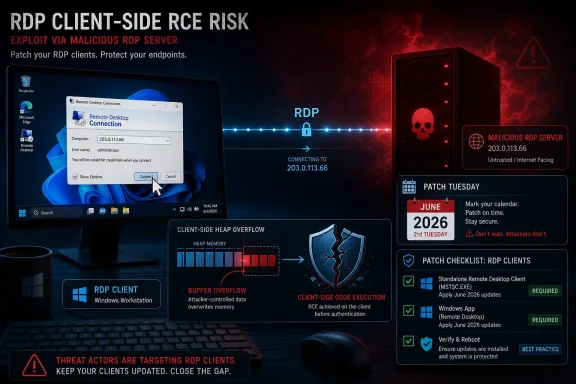
Microsoft disclosed CVE-2026-42909 on June 9, 2026, as an Important-rated Remote Desktop Client remote code execution vulnerability affecting supported Windows client and server releases, the standalone Remote Desktop client for Windows Desktop, and the newer Windows App client. The uncomfortable part is not the word “Important,” which can sound almost reassuring in Microsoft’s taxonomy. The uncomfortable part is the attack shape: a malicious or compromised Remote Desktop server can reportedly execute code on the client machine when a victim connects. For administrators who treat outbound RDP as routine, this is a reminder that the client is also part of the attack surface.
Remote Desktop has trained generations of Windows administrators to think defensively about servers. Lock down port 3389, require Network Level Authentication, hide RDP behind VPN or Zero Trust access, audit exposed hosts, and never leave administrator consoles dangling on the public Internet. That advice remains sound, but CVE-2026-42909 points in the opposite direction: the danger begins when a Windows machine acts as the client.
Microsoft’s own description is terse but meaningful. The vulnerability is a heap-based buffer overflow in Remote Desktop Client, with remote code execution possible over a network by an unauthorized attacker. The FAQ attached to the advisory narrows the scenario further: an attacker controlling a Remote Desktop Server could trigger code execution on the victim’s machine when that victim connects using a vulnerable client.
That is a very different operational risk from the classic “unpatched server waiting to be scanned” story. Here, the victim may be the help desk technician, systems engineer, MSP operator, contractor, or developer who initiates a connection. The attacker does not need to break into the client first; the attacker needs to lure or route the client toward an RDP endpoint under hostile control.
This distinction matters because administrators often give elevated trust to their own workstations. A privileged admin box that connects to domain controllers, jump hosts, cloud consoles, and customer environments is not just another endpoint. If the Remote Desktop client on that machine becomes the entry point, the blast radius can be much larger than the CVSS label suggests.
The key modifier is attack complexity: high. Microsoft says successful exploitation requires the attacker to win a race condition. Race conditions are timing bugs, and timing bugs often resist clean weaponization because the attacker must hit a narrow execution window in a target process whose state may vary by build, hardware, load, network timing, and configuration.
But “high complexity” should not be misread as “academic.” Attackers automate timing problems for a living. A race condition that is unreliable in a lab may still be useful in repeated attempts, targeted intrusions, or environments where the attacker controls the server side of the conversation and can shape the conditions under which the client processes hostile data.
The impact fields are the part that should get attention. Microsoft scored confidentiality, integrity, and availability as high. That is the CVSS way of saying that if the exploit lands, the result is not a cosmetic crash or a minor information leak. It is code execution with serious consequences on the connecting machine.
At the same time, Microsoft says the vulnerability was not publicly disclosed and not exploited at the time of publication. The exploit code maturity is listed as Unproven, and the exploitability assessment is “Exploitation Unlikely.” That gives defenders a window, but not a reason to ignore it. Windows patch history is full of vulnerabilities that moved from “unlikely” to “interesting” once reverse engineers had time to diff the patch.
There is a familiar race after every Patch Tuesday. Microsoft ships binaries, defenders deploy them, and attackers examine the delta between old and new code. For a memory-corruption issue in a network-facing parser or protocol client, that reverse-engineering phase can be enough to turn a sparse advisory into a working hypothesis.
The practical reading is straightforward. There is no evidence in Microsoft’s advisory that CVE-2026-42909 is being actively used in the wild as of its initial release. There is also no ambiguity that Microsoft considers the vulnerability real and fixed. That combination argues for disciplined patching rather than emergency theater.
The fixed builds tell the story of a vulnerability that rides inside the wider Windows servicing train. Windows 11 24H2 and 25H2 systems are covered under the June cumulative update line, while Windows 11 23H2 has its own update path. Windows 10 22H2 and older supported branches, including long-term servicing and server variants, also appear in the affected software list.
Server entries may look odd at first glance because the advisory is about the Remote Desktop Client. But servers often act as clients in real administrative workflows. A server can initiate RDP connections to another server, a management host, or a nested environment; Server Core installations also appear in the affected list. The product name should not tempt admins into thinking only desktop PCs need attention.
The standalone Remote Desktop client is separately listed with a fixed build of 1.2.7214.0. Windows App Client for Windows Desktop is listed with a fixed build of 2.0.1193.0. That split matters because enterprises increasingly mix inbox Windows components, Microsoft Store-delivered apps, MSI-deployed remote access clients, and the newer Windows App branding in the same fleet.
CVE-2026-42909 flips that psychology. A malicious server is not just an untrusted destination; it is an active participant in a complex protocol conversation. If the client mishandles server-controlled data, the server can become the attacker’s delivery mechanism.
This is not unique to RDP. Browsers, SSH clients, VPN clients, email clients, document viewers, and file-transfer tools all have histories of client-side vulnerabilities triggered by hostile servers or files. The difference is that RDP is disproportionately used by people with administrative rights, stored credentials, privileged network reachability, and access to sensitive management planes.
That is why “user interaction required” is weaker comfort here than it would be for a random consumer app. The required interaction may be a normal administrative act: connecting to a server. If the attacker can poison a saved connection target, compromise a host that admins already trust, or socially engineer a support operator into opening a session, the human step is not exotic.
We should be careful not to over-interpret beyond what Microsoft published. The advisory does not provide a technical root-cause walkthrough, exploit trace, packet format, or proof of concept. It does, however, identify enough classes of weakness to explain why exploitation might be hard but consequential.
Race conditions can be frustrating for attackers because they are probabilistic. The same input may crash once, do nothing the next time, and produce useful corruption only under specific timing. But attackers who control the server side can often repeat handshakes, manipulate protocol state, alter timing, and tune payload delivery until reliability improves.
Use-after-free and heap-based corruption bugs have a long history of becoming more dangerous when attackers can shape allocations around the vulnerable operation. Modern Windows mitigations raise the bar, but they do not erase the risk. In a privileged client-side application, especially one used in administrative workflows, even partial reliability can be attractive.
A domain admin’s laptop, a help desk jump box, or an MSP technician’s machine may have exactly the sort of access an attacker wants after initial code execution. Even if the exploit runs only in the context of the current user, that user may have cached credentials, privileged tokens, SSH keys, VPN access, browser sessions, management tools, scripts, and documentation that make lateral movement easier.
This is where the advisory’s “unchanged scope” can sound misleading outside CVSS jargon. It means the vulnerability does not automatically cross a security authority boundary in the scoring model. It does not mean the compromised client is unimportant. If the client belongs to an administrator, the same-security-context compromise may still be devastating.
Organizations that already maintain privileged access workstations should treat this as another argument for keeping those machines narrowly purposed and aggressively updated. Organizations that allow administrators to browse the web, read email, run Teams, download tools, and RDP into production from the same everyday workstation should see the problem. The client is a bridge, and bridges are where attackers like to stand.
But patching is not the only lesson. If the exploit scenario requires a victim to connect to an attacker-controlled Remote Desktop server, then connection governance matters. Saved RDP files, undocumented jump hosts, vendor-provided endpoints, lab systems, and customer-supplied connection instructions are all part of the risk surface.
Enterprises should inventory where RDP clients are used, not just where RDP servers listen. That includes administrator workstations, terminal servers used as jump boxes, support tools that launch mstsc.exe or the newer clients, and automation workflows that initiate remote sessions. Client-side exposure is harder to see because it is outbound and episodic.
There is also a policy dimension. Users who can initiate RDP connections to arbitrary hosts can become involuntary test harnesses for hostile servers. Restricting outbound RDP to known management networks, brokers, bastions, or gateways is not just network neatness. It is a way to reduce the chance that a client-side RDP bug becomes an enterprise foothold.
For defenders, this creates a familiar operational trap. The newest Windows 11 machines may patch quickly, while the systems that require the most care — older servers, specialty images, embedded management hosts, isolated jump boxes — patch slowly because they are fragile or politically protected. Yet those older systems are often exactly where administrators perform remote management.
Windows Server 2012 and 2012 R2 are especially notable because they sit outside ordinary mainstream support and depend on extended security update arrangements. Their presence in the advisory means some customers still have a patch path, but only if they are entitled, configured, and actually deploying those updates. In real networks, that last condition is the hard one.
The same goes for Remote Desktop client variants. Microsoft’s client branding has grown more complicated, with the classic inbox client, the separately distributed Remote Desktop client, and Windows App occupying overlapping territory. Security teams cannot defend what they cannot name. Software inventory needs to understand which client is installed, how it updates, and whether the fixed build is present.
This is the uncomfortable economics of Patch Tuesday. Before release, only Microsoft, the reporter, and perhaps a small disclosure circle may know enough to reproduce the bug. After release, every attacker can compare patched and unpatched binaries, review changed functions, and decide whether the vulnerability is worth weaponizing. The clock starts when defenders get the fix, but it starts for attackers too.
The “Exploitation Unlikely” assessment should be read as Microsoft’s best judgment at publication, not a warranty. Microsoft makes those assessments across a massive vulnerability portfolio, and many Important bugs never become mass exploitation events. But targeted attackers do not need mass exploitation. They need one useful path into a high-value environment.
That is especially relevant for MSPs, incident response firms, software vendors, and enterprises with shared administration teams. A malicious RDP endpoint that compromises an admin client could be more strategic than another server-side RDP bug on the open Internet. It turns the operator into the target.
It also means the absence of a public proof of concept should not be confused with absence of technical substance. The report confidence metric is Confirmed, and Microsoft shipped fixes. The vulnerability is real enough to patch and serious enough to rate as remote code execution with high impact.
The industry sometimes overreacts to flashy names and underreacts to dull advisories. CVE-2026-42909 has no logo, no catchy brand, no viral demo, and no emergency blog chorus at publication. But client-side RDP code execution sits in a category that experienced defenders should respect.
The most mature response is boring on purpose. Patch, verify, restrict where privileged clients connect, and keep watching for changes in exploit status. Security programs do not win by treating every advisory as a catastrophe; they win by correctly identifying which “Important” bugs matter in their own architecture.
 The Dangerous End of RDP Is Not Always the Server
Remote Desktop has trained generations of Windows administrators to think defensively about servers. Lock down port 3389, require Network Level Authentication, hide RDP behind VPN or Zero Trust access, audit exposed hosts, and never leave administrator consoles dangling on the public Internet. That advice remains sound, but CVE-2026-42909 points in the opposite direction: the danger begins when a Windows machine acts as the client.Microsoft’s own description is terse but meaningful. The vulnerability is a heap-based buffer overflow in Remote Desktop Client, with remote code execution possible over a network by an unauthorized attacker. The FAQ attached to the advisory narrows the scenario further: an attacker controlling a Remote Desktop Server could trigger code execution on the victim’s machine when that victim connects using a vulnerable client.
That is a very different operational risk from the classic “unpatched server waiting to be scanned” story. Here, the victim may be the help desk technician, systems engineer, MSP operator, contractor, or developer who initiates a connection. The attacker does not need to break into the client first; the attacker needs to lure or route the client toward an RDP endpoint under hostile control.
This distinction matters because administrators often give elevated trust to their own workstations. A privileged admin box that connects to domain controllers, jump hosts, cloud consoles, and customer environments is not just another endpoint. If the Remote Desktop client on that machine becomes the entry point, the blast radius can be much larger than the CVSS label suggests.
Microsoft’s Score Says “High Friction,” Not “Low Impact”
CVE-2026-42909 carries a CVSS 3.1 base score of 7.5, with Microsoft listing the maximum severity as Important rather than Critical. The vector explains why: network attack vector, no privileges required, user interaction required, high attack complexity, unchanged scope, and high confidentiality, integrity, and availability impact. In plainer English, the bug can be reached remotely and can do serious damage, but the exploit path is not expected to work reliably on demand.The key modifier is attack complexity: high. Microsoft says successful exploitation requires the attacker to win a race condition. Race conditions are timing bugs, and timing bugs often resist clean weaponization because the attacker must hit a narrow execution window in a target process whose state may vary by build, hardware, load, network timing, and configuration.
But “high complexity” should not be misread as “academic.” Attackers automate timing problems for a living. A race condition that is unreliable in a lab may still be useful in repeated attempts, targeted intrusions, or environments where the attacker controls the server side of the conversation and can shape the conditions under which the client processes hostile data.
The impact fields are the part that should get attention. Microsoft scored confidentiality, integrity, and availability as high. That is the CVSS way of saying that if the exploit lands, the result is not a cosmetic crash or a minor information leak. It is code execution with serious consequences on the connecting machine.
The Confirmed Metric Is the Quiet Alarm Bell
The user-submitted detail about report confidence is not trivia; it is the hinge of the advisory. Microsoft marks the report confidence for CVE-2026-42909 as Confirmed, meaning the vendor acknowledges the vulnerability and the technical basis is credible enough to drive a shipped fix. That separates this case from rumor-driven vulnerability chatter, proof-of-concept speculation, or vague “possible issue” advisories.At the same time, Microsoft says the vulnerability was not publicly disclosed and not exploited at the time of publication. The exploit code maturity is listed as Unproven, and the exploitability assessment is “Exploitation Unlikely.” That gives defenders a window, but not a reason to ignore it. Windows patch history is full of vulnerabilities that moved from “unlikely” to “interesting” once reverse engineers had time to diff the patch.
There is a familiar race after every Patch Tuesday. Microsoft ships binaries, defenders deploy them, and attackers examine the delta between old and new code. For a memory-corruption issue in a network-facing parser or protocol client, that reverse-engineering phase can be enough to turn a sparse advisory into a working hypothesis.
The practical reading is straightforward. There is no evidence in Microsoft’s advisory that CVE-2026-42909 is being actively used in the wild as of its initial release. There is also no ambiguity that Microsoft considers the vulnerability real and fixed. That combination argues for disciplined patching rather than emergency theater.
The Patch Footprint Is Broader Than One App Icon
One reason CVE-2026-42909 deserves attention is the breadth of affected products. Microsoft lists updates across mainstream Windows 10 and Windows 11 releases, multiple Windows Server generations, and both the standalone Remote Desktop client for Windows Desktop and Windows App Client for Windows Desktop. This is not merely a niche bug in an optional administrator utility.The fixed builds tell the story of a vulnerability that rides inside the wider Windows servicing train. Windows 11 24H2 and 25H2 systems are covered under the June cumulative update line, while Windows 11 23H2 has its own update path. Windows 10 22H2 and older supported branches, including long-term servicing and server variants, also appear in the affected software list.
Server entries may look odd at first glance because the advisory is about the Remote Desktop Client. But servers often act as clients in real administrative workflows. A server can initiate RDP connections to another server, a management host, or a nested environment; Server Core installations also appear in the affected list. The product name should not tempt admins into thinking only desktop PCs need attention.
The standalone Remote Desktop client is separately listed with a fixed build of 1.2.7214.0. Windows App Client for Windows Desktop is listed with a fixed build of 2.0.1193.0. That split matters because enterprises increasingly mix inbox Windows components, Microsoft Store-delivered apps, MSI-deployed remote access clients, and the newer Windows App branding in the same fleet.
Remote Desktop’s Client-Side Risk Has Been Underpriced
RDP is a protocol of convenience, and convenience tends to blur trust boundaries. Administrators connect from laptops to servers, from jump boxes to vendor appliances, from cloud workstations to lab machines, and from support desks to user PCs. The mental model is often that the client is the operator and the server is the object being controlled.CVE-2026-42909 flips that psychology. A malicious server is not just an untrusted destination; it is an active participant in a complex protocol conversation. If the client mishandles server-controlled data, the server can become the attacker’s delivery mechanism.
This is not unique to RDP. Browsers, SSH clients, VPN clients, email clients, document viewers, and file-transfer tools all have histories of client-side vulnerabilities triggered by hostile servers or files. The difference is that RDP is disproportionately used by people with administrative rights, stored credentials, privileged network reachability, and access to sensitive management planes.
That is why “user interaction required” is weaker comfort here than it would be for a random consumer app. The required interaction may be a normal administrative act: connecting to a server. If the attacker can poison a saved connection target, compromise a host that admins already trust, or socially engineer a support operator into opening a session, the human step is not exotic.
The Race Condition Explains the Score, Not the Strategy
Microsoft’s FAQ says exploitation requires winning a race condition, and the weakness list includes both a race condition and use-after-free. The executive summary also refers to a heap-based buffer overflow. That combination suggests a memory-safety failure in code that handles Remote Desktop client state under timing-sensitive conditions.We should be careful not to over-interpret beyond what Microsoft published. The advisory does not provide a technical root-cause walkthrough, exploit trace, packet format, or proof of concept. It does, however, identify enough classes of weakness to explain why exploitation might be hard but consequential.
Race conditions can be frustrating for attackers because they are probabilistic. The same input may crash once, do nothing the next time, and produce useful corruption only under specific timing. But attackers who control the server side can often repeat handshakes, manipulate protocol state, alter timing, and tune payload delivery until reliability improves.
Use-after-free and heap-based corruption bugs have a long history of becoming more dangerous when attackers can shape allocations around the vulnerable operation. Modern Windows mitigations raise the bar, but they do not erase the risk. In a privileged client-side application, especially one used in administrative workflows, even partial reliability can be attractive.
The Admin Workstation Is the Real Crown Jewel
For home users, the risk is mostly about connecting to an untrusted Remote Desktop server. That is not a common everyday action, though enthusiasts, lab users, and small-business operators do it more often than Microsoft’s consumer messaging tends to assume. For enterprise IT, the more serious concern is the privileged workstation.A domain admin’s laptop, a help desk jump box, or an MSP technician’s machine may have exactly the sort of access an attacker wants after initial code execution. Even if the exploit runs only in the context of the current user, that user may have cached credentials, privileged tokens, SSH keys, VPN access, browser sessions, management tools, scripts, and documentation that make lateral movement easier.
This is where the advisory’s “unchanged scope” can sound misleading outside CVSS jargon. It means the vulnerability does not automatically cross a security authority boundary in the scoring model. It does not mean the compromised client is unimportant. If the client belongs to an administrator, the same-security-context compromise may still be devastating.
Organizations that already maintain privileged access workstations should treat this as another argument for keeping those machines narrowly purposed and aggressively updated. Organizations that allow administrators to browse the web, read email, run Teams, download tools, and RDP into production from the same everyday workstation should see the problem. The client is a bridge, and bridges are where attackers like to stand.
Patching Is Necessary, but Connection Hygiene Is the Control Plane
The official fix is the primary control. Microsoft has issued updates across the affected Windows releases and client apps, and those updates should flow through Windows Update, Windows Server Update Services, Microsoft Configuration Manager, Intune, or whatever patching system an organization uses. For the standalone Remote Desktop client and Windows App, admins should verify application versions rather than assuming the OS cumulative update covers every installed client.But patching is not the only lesson. If the exploit scenario requires a victim to connect to an attacker-controlled Remote Desktop server, then connection governance matters. Saved RDP files, undocumented jump hosts, vendor-provided endpoints, lab systems, and customer-supplied connection instructions are all part of the risk surface.
Enterprises should inventory where RDP clients are used, not just where RDP servers listen. That includes administrator workstations, terminal servers used as jump boxes, support tools that launch mstsc.exe or the newer clients, and automation workflows that initiate remote sessions. Client-side exposure is harder to see because it is outbound and episodic.
There is also a policy dimension. Users who can initiate RDP connections to arbitrary hosts can become involuntary test harnesses for hostile servers. Restricting outbound RDP to known management networks, brokers, bastions, or gateways is not just network neatness. It is a way to reduce the chance that a client-side RDP bug becomes an enterprise foothold.
The Legacy Tail Still Complicates Windows Security
The affected list includes old server families still alive through extended servicing arrangements, alongside the latest Windows 11 releases and Windows Server 2025. That is the reality of Windows security in 2026: the ecosystem spans modern cloud-managed endpoints and long-lived infrastructure that refuses to die. A vulnerability in a common component must be fixed across both worlds.For defenders, this creates a familiar operational trap. The newest Windows 11 machines may patch quickly, while the systems that require the most care — older servers, specialty images, embedded management hosts, isolated jump boxes — patch slowly because they are fragile or politically protected. Yet those older systems are often exactly where administrators perform remote management.
Windows Server 2012 and 2012 R2 are especially notable because they sit outside ordinary mainstream support and depend on extended security update arrangements. Their presence in the advisory means some customers still have a patch path, but only if they are entitled, configured, and actually deploying those updates. In real networks, that last condition is the hard one.
The same goes for Remote Desktop client variants. Microsoft’s client branding has grown more complicated, with the classic inbox client, the separately distributed Remote Desktop client, and Windows App occupying overlapping territory. Security teams cannot defend what they cannot name. Software inventory needs to understand which client is installed, how it updates, and whether the fixed build is present.
The Absence of Exploitation Is a Perishable Fact
Microsoft’s advisory says CVE-2026-42909 was not exploited and not publicly disclosed at original publication. That is useful information, but it ages quickly. The patch itself changes the information environment by revealing where Microsoft made defensive changes.This is the uncomfortable economics of Patch Tuesday. Before release, only Microsoft, the reporter, and perhaps a small disclosure circle may know enough to reproduce the bug. After release, every attacker can compare patched and unpatched binaries, review changed functions, and decide whether the vulnerability is worth weaponizing. The clock starts when defenders get the fix, but it starts for attackers too.
The “Exploitation Unlikely” assessment should be read as Microsoft’s best judgment at publication, not a warranty. Microsoft makes those assessments across a massive vulnerability portfolio, and many Important bugs never become mass exploitation events. But targeted attackers do not need mass exploitation. They need one useful path into a high-value environment.
That is especially relevant for MSPs, incident response firms, software vendors, and enterprises with shared administration teams. A malicious RDP endpoint that compromises an admin client could be more strategic than another server-side RDP bug on the open Internet. It turns the operator into the target.
The Security Community Gets a Quiet Credit
Microsoft credits pwn2addr in the advisory, which indicates coordinated vulnerability disclosure rather than a chaotic public drop. That is good news. Coordinated reports give vendors time to build fixes and give defenders a clean remediation path before technical details spread widely.It also means the absence of a public proof of concept should not be confused with absence of technical substance. The report confidence metric is Confirmed, and Microsoft shipped fixes. The vulnerability is real enough to patch and serious enough to rate as remote code execution with high impact.
The industry sometimes overreacts to flashy names and underreacts to dull advisories. CVE-2026-42909 has no logo, no catchy brand, no viral demo, and no emergency blog chorus at publication. But client-side RDP code execution sits in a category that experienced defenders should respect.
The most mature response is boring on purpose. Patch, verify, restrict where privileged clients connect, and keep watching for changes in exploit status. Security programs do not win by treating every advisory as a catastrophe; they win by correctly identifying which “Important” bugs matter in their own architecture.
The June RDP Fix Belongs on the Admin Checklist
The concrete response to CVE-2026-42909 is not complicated, but it does require looking past the headline severity. This is a client-side RDP vulnerability with a malicious-server exploit scenario, confirmed by Microsoft and fixed in June 2026 updates. The organizations most exposed are the ones whose privileged users connect outward to many RDP destinations with limited control or verification.- Administrators should prioritize June 2026 Windows security updates on machines that initiate Remote Desktop sessions, especially privileged access workstations, help desk machines, jump boxes, and MSP operator systems.
- Security teams should verify standalone Remote Desktop client installations are updated to the fixed 1.2.7214.0 build or later where that client is deployed.
- Organizations using Windows App Client for Windows Desktop should verify deployment of the fixed 2.0.1193.0 build or later rather than assuming the operating system update is sufficient.
- Network policy should limit outbound RDP from privileged systems to approved destinations such as gateways, bastions, and management networks.
- Saved RDP files, vendor connection instructions, and ad hoc support workflows should be treated as potential routes to malicious or compromised servers.
- The lack of known exploitation at release should be monitored as a changing condition, not treated as a permanent property of the vulnerability.
References
- Primary source: MSRC
Published: 2026-06-09T07:00:00-07:00
Security Update Guide - Microsoft Security Response Center
 msrc.microsoft.com
