

Microsoft’s RDP Risk Has Moved to the Chair in Front of the Keyboard
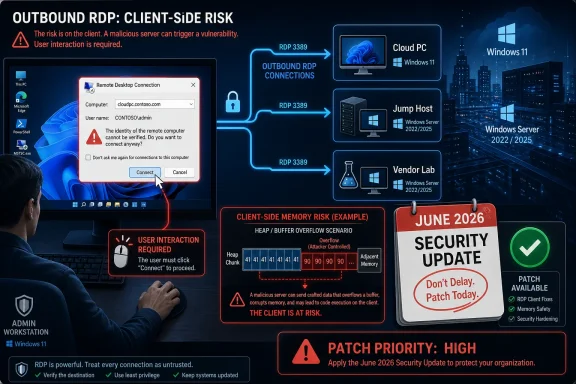
For years, the scariest Remote Desktop stories were about exposed servers waiting on the public internet. BlueKeep trained an entire generation of admins to look for listening RDP services, firewall mistakes, and forgotten Windows Server builds. CVE-2026-42913 flips the perspective: the vulnerable component is the client, and the dangerous moment is the connection initiated by a user.
That distinction matters because it changes who owns the mitigation. Network teams can block inbound TCP 3389 until the end of time and still leave users exposed if those users are permitted to connect to untrusted RDP endpoints. In this model, the attacker does not necessarily need to breach the perimeter first; they need to persuade or position a victim into opening a remote desktop session to a system the attacker controls.
Microsoft’s available description says the flaw is a heap-based buffer overflow in Remote Desktop Client that could allow an unauthorized attacker to execute code over a network. The CVSS vector published by vulnerability aggregators maps the issue as network-accessible, high attack complexity, no privileges required, user interaction required, and high impact to confidentiality, integrity, and availability. That is not a wormable panic button. It is also not a shrug.
The phrase user interaction required is doing a lot of work here. In a consumer context, it may mean a social-engineering lure. In an enterprise context, it can mean a help desk technician connecting to a “test” host, a contractor using a supplied RDP file, or an engineer reaching into a lab environment that no one has validated in months. RDP is not merely a protocol; it is a habit.
A High-Severity Bug Hiding Inside a Record-Scale Patch Tuesday
June 2026’s Patch Tuesday was not a quiet servicing release. Microsoft’s monthly security bundle reportedly addressed about 200 vulnerabilities, with several security firms and news outlets noting that this was one of the largest Microsoft patch drops in recent memory. Against that backdrop, a CVSS 7.5 Remote Desktop Client RCE can look like one more row in a swollen spreadsheet.
That is the trap. Patch Tuesday triage has become a sorting exercise in which “critical,” “exploited,” and “publicly disclosed” get all the oxygen. CVE-2026-42913 is rated important by Microsoft’s usual taxonomy, not critical. It was not, based on the public data available at disclosure, marked as exploited in the wild. The exploitability is constrained by a required user action and high complexity.
But remote code execution in a client used for administrative access deserves a different kind of attention. Remote Desktop clients often run on machines belonging to admins, developers, support staff, and power users. Those machines have saved credentials, access tokens, VPN reachability, privileged tooling, and browser sessions into internal portals. The initial code execution may land on a workstation, but the blast radius depends on who sits at that workstation.
The patching priority therefore should not be determined only by the CVSS number. It should be determined by exposure patterns. An RDP client flaw on a locked-down kiosk that never initiates outbound RDP is uninteresting. The same flaw on a privileged admin laptop used to connect to customer environments, Azure Virtual Desktop, Windows 365, or third-party jump boxes is a different story.
The Client-Side Attack Path Is Messier Than the Score Suggests
The public CVSS vector for CVE-2026-42913 is a useful shorthand, but it can flatten the operational reality. Attack complexity is listed as high, which usually means exploitation depends on conditions beyond simply sending a packet. User interaction is required, which means the victim must do something. Privileges are not required, which means the attacker does not need an account on the victim system to begin the attack chain.
That combination points toward a familiar pattern: build or compromise an RDP endpoint, then induce a target to connect to it. The exact mechanics are not public, and Microsoft has not published exploit details. But the shape of the risk is plain enough for defenders to act without reverse-engineering the bug.
The most obvious lure is a malicious .rdp file or a link embedded in a support workflow. In many organizations, RDP files are treated as harmless configuration shortcuts rather than executable-adjacent content. Users forward them, download them from portals, and keep them on desktops with names like “prod-jumpbox” or “vendor-support.” A vulnerability in the client makes that casual trust more expensive.
There is also a supply-chain flavor to the problem. Plenty of enterprises connect to systems they do not fully control: outsourced support environments, customer-hosted servers, acquisition targets, training labs, and cloud desktops. A malicious RDP server does not have to live in the same domain or even the same business relationship forever. It only has to be convincing at the moment a victim initiates a session.
Remote Desktop Is No Longer One Thing, Which Makes Patching Less Obvious
One reason this class of bug is annoying is that “Remote Desktop” now refers to a small family of clients, experiences, and deployment paths. There is the classic Remote Desktop Connection client built into Windows. There has been a standalone Remote Desktop client for Windows distributed as an MSI. There was the Microsoft Store Remote Desktop app, which Microsoft has been moving users away from. There is now Windows App, positioned as the client for Azure Virtual Desktop, Windows 365, Microsoft Dev Box, Remote Desktop Services, and remote PCs.
Microsoft’s own documentation has spent the last couple of years steering users toward Windows App for cloud and virtual desktop scenarios, while noting that older Remote Desktop app paths have been retired or deprecated in some contexts. That transition is rational from a product-strategy perspective, but it complicates vulnerability response. Security teams do not patch a brand name. They patch binaries, packages, app channels, and operating system components.
For CVE-2026-42913, public vulnerability databases list Windows 11, Windows Server 2022, and Windows Server 2025 among affected products. Other Remote Desktop Client vulnerabilities disclosed around the same Patch Tuesday appear to touch related client families, including Windows App Client for Windows Desktop. That overlap should push administrators to inventory more carefully rather than assume that one Windows cumulative update covers every possible RDP client on every endpoint.
This is where consumer simplicity and enterprise reality diverge. A home user with Windows Update enabled probably receives the relevant fixes as part of normal servicing. A managed environment may have Intune app deployments, winget packages, Store apps, MSI-installed clients, golden images, VDI templates, and offline server builds. The phrase “Remote Desktop Client” is simple; the estate rarely is.
The Vulnerability Is Confirmed, but the Exploit Story Is Still Sparse
The user-supplied MSRC context points to the “confidence” dimension of vulnerability scoring: how certain we are that the vulnerability exists and how credible the technical details are. For CVE-2026-42913, the existence of the vulnerability is not speculative. Microsoft has an advisory page, the CVE is published, and the issue is part of the June 2026 security release.
What remains sparse is the exploit narrative. Public information says heap-based buffer overflow. It says Remote Desktop Client. It says network attack vector, no privileges required, user interaction required, and high impact if successful. It does not provide a proof of concept, a packet-level breakdown, or the kind of exploit chain attackers could immediately paste into a tool.
That distinction should shape the tone of response. This is not a moment for theatrical claims that every RDP session is compromised. It is also not a moment for waiting until a proof-of-concept repository appears. The history of Windows vulnerabilities has repeatedly shown that the window between patch release and attacker experimentation can be short, especially once monthly updates become a roadmap for diffing.
The responsible posture is boring and effective: patch first, restrict risky connection behavior second, and monitor for odd RDP usage while the patch rolls through the fleet. Organizations that wait for “confirmed exploitation” before touching client-side RCEs are effectively using other people’s incidents as their detection system.
The Old RDP Playbook Does Not Fully Fit the New Problem
Classic RDP security guidance is still valid. Do not expose RDP directly to the internet. Use VPNs, gateways, conditional access, and multi-factor authentication. Limit who can log on remotely. Turn on Network Level Authentication where applicable. Monitor brute-force attempts. Remove stale local administrator accounts. These remain table stakes.
But CVE-2026-42913 sits outside much of that checklist. Network Level Authentication on your own servers does not save a user who connects to a malicious external RDP endpoint. Blocking inbound RDP does not necessarily prevent outbound RDP. Even disabling Remote Desktop Services on servers does not remove vulnerable client software from administrator workstations.
The mitigation conversation has to include outbound trust. Which users are allowed to initiate RDP sessions to arbitrary hosts? Are .rdp files from email or chat treated as risky attachments? Do admins use hardened privileged access workstations, or do they connect to production from the same laptops used for web browsing and email? Are third-party support instructions reviewed, or do users follow them in real time?
In many environments, outbound RDP is governed mostly by culture. Engineers have always used it, vendors request it, and help desks normalize it. A client-side RCE is a reminder that every outbound administration channel is also an inbound content parser.
Heap Bugs Are Old, but They Keep Finding New Rooms
The public description identifies CVE-2026-42913 as a heap-based buffer overflow. That phrase has been around long enough to feel almost retro, but it remains a serious class of memory corruption bug. In plain English, the vulnerable program mishandles data in memory in a way that can allow an attacker to corrupt adjacent structures and, under the right conditions, steer execution.
Modern Windows has layers of mitigations that make exploitation harder than it was in the early 2000s. Address space layout randomization, control-flow protections, heap hardening, sandboxing in some contexts, and compiler defenses all raise the cost of reliable exploitation. That is likely part of why the attack complexity is high.
Yet “hard” is not “irrelevant.” Attackers do not need perfect reliability in every case, particularly if they can choose targets, retry attempts, or combine a memory corruption bug with an information disclosure weakness. The same June 2026 patch ecosystem contains many vulnerabilities across Windows components, and mature exploit developers are comfortable chaining bugs when the prize is worthwhile.
Remote Desktop Client is also an attractive parser surface because it processes rich protocol interactions. Graphics, input, clipboard redirection, drive mapping, device redirection, authentication handshakes, and session negotiation all create complex states. Complexity is where memory safety bugs like to hide.
The Enterprise Exposure Is in the Admin Tier
The most sensitive machines in this story are not necessarily the most numerous ones. They are the admin workstations, help desk machines, engineering laptops, cloud operations jump clients, and vendor-management endpoints that initiate RDP sessions as part of their daily work. If those devices are compromised, the attacker may inherit a map of the enterprise.
This is why patch prioritization should be risk-weighted. A broad deployment through normal Windows servicing is the goal, but the first wave should include systems used by privileged operators. If an admin workstation has RDP clients, remote management tools, SSH keys, saved Azure sessions, privileged browser cookies, and access to password vaults, a client-side RCE on that box is not “just a desktop compromise.”
There is also a Windows Server wrinkle. Servers are often thought of as RDP destinations, not RDP clients, but administrators frequently use servers as jump points. A Server 2022 or Server 2025 machine with outbound RDP access can be a client in practice. If the vulnerable component is present and used, the server’s role label does not protect it.
Security teams should be especially skeptical of shared jump boxes. They concentrate credentials and access paths, and they are exactly the systems from which users may connect outward to multiple remote environments. A malicious or compromised downstream host could turn a trusted jump system into the first domino.
The Windows App Transition Adds a Governance Problem
Microsoft’s broader remote-access client transition is relevant because it affects how organizations know they are patched. The retirement of older Remote Desktop app paths and the push toward Windows App may be sensible for Azure Virtual Desktop and Windows 365 alignment, but product consolidation can leave residues. Old clients linger in user profiles, app inventories, scripts, and documentation.
An enterprise might believe it has standardized on Windows App while still having the standalone Remote Desktop MSI on developer machines. Another might remove Store apps but leave classic mstsc.exe usage untouched. A third might manage Windows App through Intune while ignoring winget-installed packages. The attack surface is not what the architecture diagram says; it is what is installed and launchable.
This is where vulnerability management often underperforms. CVE scanners are good at finding operating system build numbers. They are less consistently good at mapping every client variant in a product family, especially when Microsoft is renaming, retiring, or repositioning apps. RDP client governance is a test of software inventory maturity.
The practical answer is not to ban Remote Desktop by reflex. RDP remains essential in Windows administration. The answer is to know which clients are present, how they are updated, who can use them, and where they can connect.
The “Remote” in Remote Code Execution Can Mislead Users
Remote code execution is one of security’s most abused phrases because it sounds like magic from across the internet. In CVE-2026-42913, remote does not necessarily mean an attacker can silently reach into every Windows 11 machine from the public network. The available scoring indicates that the victim must interact with the attack path.
That nuance matters for honest risk communication. Users should not be told that merely having Remote Desktop installed means they are already owned. They should be told that connecting to untrusted remote desktop endpoints can be dangerous until patches are applied, and that RDP files or connection instructions from unfamiliar sources deserve suspicion.
For help desks and IT departments, the message should be even more concrete. Do not ask users to connect to arbitrary hosts as part of support triage. Do not accept vendor-provided RDP files without validation. Do not let privileged users browse email, download connection files, and administer production from the same unrestricted session.
Security awareness often focuses on documents, macros, and browser links. CVE-2026-42913 is a reminder that administrative protocols can be phish bait too.
Patch Tuesday Triage Needs a Remote-Access Lane
The June 2026 update cycle underscores a deeper problem: patch volume has outgrown human attention. When Microsoft ships fixes for roughly 200 vulnerabilities in one month, organizations cannot convene a bespoke risk committee for each CVE. They need lanes.
Remote-access client vulnerabilities should be one of those lanes. They combine user interaction, privileged workflows, and cross-boundary connectivity. Even when they are not marked critical, they deserve accelerated handling on systems that initiate administrative sessions.
A practical lane would identify affected operating systems and client packages, patch privileged workstations first, validate remote-access workflows after patching, and then expand deployment to the broader fleet. It would also include communications tailored to admins and support staff, not just generic “install updates” messaging. The people most likely to trigger the exploit path should understand what behavior is risky.
This is not glamorous security work. It is the discipline of matching the patch to the workflow. CVE-2026-42913 is a workflow vulnerability as much as a software vulnerability.
Microsoft’s Sparse Advisories Leave Defenders Filling in the Gaps
Microsoft’s Security Update Guide has become terse by design. It gives CVSS vectors, affected products, exploitability assessments, and update information, but it rarely offers the operational narrative defenders want. That restraint is understandable; too much detail can help attackers. But sparse advisories force administrators to infer exposure from product names and scoring fields.
For CVE-2026-42913, the most important inference is that the attacker-controlled side is likely the remote endpoint or network interaction that the client processes. The user interaction requirement implies that exploitation depends on convincing the victim to connect or otherwise trigger the vulnerable client behavior. The high impact fields imply that successful exploitation is not limited to a crash or nuisance.
Those inferences are not a substitute for Microsoft’s internal analysis, but they are enough for defensive action. Patch the client. Limit outbound RDP to trusted destinations where feasible. Treat RDP connection files as untrusted content. Put privileged remote administration behind controlled access paths.
The industry has a habit of treating vendor advisories as if they must contain a complete battle plan. They rarely do. The job of enterprise security is to translate a terse advisory into controls that match the environment.
The June Signal Is Bigger Than One CVE
CVE-2026-42913 arrived alongside a cluster of other Microsoft vulnerabilities, including other Remote Desktop and RDP-related issues tracked in public databases. That clustering does not mean the flaws are technically related. It does mean the remote-access surface continues to be an active area of vulnerability discovery and patch churn.
This is unsurprising. Remote desktop technology sits at the intersection of graphics, authentication, device redirection, network protocols, compression, clipboard handling, and legacy compatibility. It has to work across old servers, new clients, cloud desktops, hybrid identity, and changing security baselines. That is a lot of code and a lot of trust.
For WindowsForum readers, the point is not to panic about RDP. The point is to stop treating it as a solved plumbing layer. Remote access is now identity infrastructure, productivity infrastructure, and attack surface all at once. Its client side deserves the same attention that its server side has received since BlueKeep.
The RDP Client Patch Belongs at the Front of the Admin Queue
CVE-2026-42913 is not the kind of vulnerability that should send everyone unplugging networks, but it is concrete enough to justify fast, targeted action. The most important move is to prioritize the machines that initiate sensitive RDP sessions, not merely the machines that accept them.
- Organizations should deploy the June 2026 Windows security updates promptly to Windows 11, Windows Server 2022, and Windows Server 2025 systems that use Remote Desktop Client functionality.
- Administrators should inventory Remote Desktop client variants, including classic Windows components, standalone Remote Desktop clients, and Windows App deployments.
- Privileged access workstations, help desk systems, jump boxes, and engineering laptops should be patched before lower-risk endpoints where possible.
- Users should be warned not to open unsolicited RDP files or connect to remote desktop hosts supplied through unverified email, chat, or support channels.
- Security teams should review outbound RDP policies and consider limiting connections to approved destinations for privileged users.
- Monitoring should look for unusual outbound RDP activity, especially from administrative workstations or shared jump systems.
The uncomfortable lesson of CVE-2026-42913 is that Remote Desktop risk is no longer just the exposed server waiting for a scan; it is also the trusted client reaching outward in the course of ordinary work. Microsoft has patched the flaw, but the broader discipline is on administrators: know which remote-access clients you run, keep them current, and treat every cross-boundary desktop session as a security decision rather than a convenience click.