

Microsoft disclosed CVE-2026-48563 on June 9, 2026, as a Critical remote code execution vulnerability in the Windows Remote Desktop Client, part of a June Patch Tuesday release that also included multiple other Remote Desktop Client flaws across supported Windows releases. The headline is not merely that another RDP-adjacent bug exists. It is that Microsoft’s client-side remote access stack remains a high-value attack surface even when administrators think they have already “secured RDP” by hardening servers. For Windows users and IT teams, this is a reminder that the machine initiating a remote session can be the prize.
Remote Desktop has always carried a psychological asymmetry. Administrators worry about exposed servers, open TCP 3389, brute-force login attempts, weak gateways, and legacy hosts sitting naked on the internet. That mental model is useful, but CVE-2026-48563 points in the other direction: the vulnerable component is the Remote Desktop Client, the software used by a Windows machine to connect outward.
That distinction matters. A client-side remote code execution flaw changes the story from “who can reach my RDP server?” to “what happens when my user connects to something malicious or compromised?” In practice, the trusted action is the risky action. A help desk technician, contractor, MSP engineer, or power user opens a remote session and assumes the danger lives on the other end.
The grim elegance of client-side RCE is that it weaponizes normal workflow. Remote access is not a fringe behavior in 2026 Windows environments; it is how administrators jump between machines, how vendors support customers, how cloud-hosted desktops are reached, and how legacy line-of-business systems remain usable. If the client can be made to mishandle crafted data from a server or session endpoint, the user’s own machine becomes the attack surface.
That is why a Critical label on a Remote Desktop Client bug deserves attention even before exploit code is public. The risk is not hypothetical simply because the vulnerable side is the client. Attackers have long understood that users can be lured into connecting, opening, previewing, importing, syncing, or authenticating against attacker-controlled infrastructure.
That is the operational trap. Patch Tuesday is designed for regularity, but regularity can dull urgency. Security teams see a familiar cadence, vulnerability scanners light up, ticket queues fill, and the truly consequential bugs must compete with hundreds of other line items for attention.
Remote Desktop Client vulnerabilities are especially prone to being underestimated because they do not always map cleanly to perimeter exposure. A scanner that finds an internet-facing RDP service creates an obvious escalation path: close the port, enforce gateway access, check MFA, audit logins. A vulnerable client installed across thousands of laptops is messier. It is both everywhere and nowhere.
The June cluster makes the pattern harder to ignore. CVE-2026-48563 was not a lonely advisory in an otherwise quiet component. Microsoft listed several Remote Desktop Client RCE flaws in the same release, with multiple entries rated Critical. When one component accumulates that many memory-safety or input-handling failures in a single month, defenders should treat the product area as an attack surface under active scrutiny, not as an isolated bug.
For CVE-2026-48563, the key practical point is remote code execution in the client. That generally means successful exploitation could allow attacker-controlled code to run on the machine using the Remote Desktop Client, likely in the context of the user running the client. That is not the same as unauthenticated code execution against an exposed server, and it should not be described as a BlueKeep-style repeat without evidence.
But it is also not benign. Client-side compromise can be the bridge into privileged workstations, management networks, source repositories, password vaults, browser sessions, VPN contexts, and remote administration tools. A compromised administrator workstation is often more valuable than a compromised random server because it carries trust, credentials, and reach.
The right severity conversation is therefore not “is this internet-wormable?” It is “which users initiate RDP sessions into environments they do not fully control?” In MSPs, support desks, industrial operators, contractors, and hybrid enterprises, that answer may be uncomfortable.
Microsoft’s acknowledgement makes CVE-2026-48563 real in the way enterprise systems care about. It is no longer rumor, a disputed researcher claim, or a speculative weakness inferred from behavior. It is a vendor-tracked, patched vulnerability with a CVE, a product assignment, and a severity rating.
That does not automatically mean a public exploit exists. It does mean the clock has started. Once patches ship, attackers can compare pre-patch and post-patch binaries, look for changed code paths, and attempt to infer the vulnerable condition. The more concentrated the Patch Tuesday changes are around one component, the more attractive that component becomes for diffing.
This is the uncomfortable bargain of coordinated disclosure. Patching protects customers, but the patch itself can become a map. The practical answer is not secrecy; it is speed. Organizations should assume that the period immediately after Patch Tuesday is when capable actors begin turning vendor fixes into working exploit knowledge.
That is why patch priority should not be based solely on asset count. A thousand lightly used kiosk systems with the vulnerable client installed may matter less than fifty administrator workstations that initiate daily sessions into production, customer, or domain infrastructure. Risk follows behavior.
Privileged Access Workstations, jump boxes, and hardened admin devices were created precisely because administrative endpoints are so consequential. But in many real environments, Remote Desktop usage sprawls beyond those clean models. Engineers RDP from laptops. Contractors connect from managed but less-hardened machines. Support teams maintain saved connection profiles. Users connect to cloud PCs and lab hosts. The client becomes a quiet constant.
CVE-2026-48563 should prompt an inventory question that many organizations rarely ask: not merely “where is Remote Desktop enabled?” but “where is Remote Desktop Client used, by whom, and to connect to what?” The second question is harder. It is also closer to the actual risk.
That persuasion layer is familiar. Attackers can impersonate support portals, seed connection files, compromise vendor infrastructure, or abuse social engineering around remote assistance. In a world where “connect to this machine so we can troubleshoot” is a normal business sentence, Remote Desktop workflows can become phishing infrastructure with a Windows-native accent.
The Microsoft advisory title alone does not prove the precise exploit path for CVE-2026-48563, and defenders should be careful not to invent technical details that are not public. But the broad defensive model is clear enough: any RCE in a remote client raises concern about crafted data arriving from the far side of a session. That makes trust boundaries less obvious than firewall diagrams suggest.
This is where security awareness often lags behind architecture. Users have been trained not to open strange attachments, not to run unknown executables, and not to enter passwords into suspicious pages. Far fewer have been trained to treat a remote desktop endpoint as content that can attack the viewer.
In managed environments, the answer is still patching, but with targeting. Prioritize machines used for administration, support, vendor access, privileged remote sessions, and access to sensitive internal networks. If an administrator’s workstation is behind on this update, that is a bigger problem than a conference-room PC missing the same patch.
Enterprises should also look at how Remote Desktop connection files and saved targets are distributed. If users receive RDP files through email, ticketing systems, chat, or vendor portals, those channels deserve scrutiny. A client-side RCE class vulnerability makes the provenance of connection material more important.
Network controls still help, but they help differently. Blocking inbound RDP does not eliminate risk from a vulnerable client. Restricting which remote hosts users can connect to, routing administrative access through hardened gateways, and requiring privileged access workflows can reduce the chance that a user casually connects to hostile infrastructure.
CVE-2026-48563 is a good example of why. A Critical Remote Desktop Client RCE may be urgent for an MSP whose technicians connect to many customer systems every day. It may be less urgent, though still important, for a tightly locked-down fleet where Remote Desktop Client is rarely used and outbound RDP is restricted. The vulnerability is the same; the exposure is not.
That does not mean organizations should over-customize themselves into paralysis. Patch the thing. But when deciding what must be patched first, the best signal is the intersection of severity, exploitability knowledge, user role, and workflow. Remote Desktop Client sits close to privileged workflow in many Windows environments, which pushes it up the queue.
This is also why “no known exploitation” should be read carefully. It is reassuring only in the narrow sense that defenders are not yet responding to confirmed in-the-wild abuse. It is not a promise about tomorrow, and it is not evidence that the bug is unexploitable. Patch Tuesday history is full of vulnerabilities that became more interesting after the patch clarified where to look.
Still, BlueKeep changed how Windows administrators hear the letters RDP. It taught even non-specialists that remote access code can sit near catastrophic failure modes. That memory is useful as long as it sharpens attention rather than distorts analysis.
The better analogy is not “this is BlueKeep again.” It is that Remote Desktop remains complex, old, widely deployed, and deeply trusted. Those are the ingredients that make vulnerability classes persist. Protocol handlers, graphics paths, clipboard redirection, device redirection, authentication negotiation, and session features all create parsing and state-management complexity.
Modern Windows has added layers of mitigation, sandboxing, memory protection, and update automation that make exploitation harder than it was in older eras. But complexity does not disappear because a component is mature. Sometimes maturity means the code is everywhere, the behaviors are compatibility-bound, and the attack surface has accumulated over decades.
For enthusiasts, homelab users, and small-office administrators, the calculus is slightly different. Remote Desktop is common in home labs, media servers, test boxes, and small business setups. If you connect from your main PC into experimental systems, untrusted networks, borrowed cloud instances, or machines exposed to other users, update the client machine promptly.
For enterprises, the patch should be paired with telemetry. Security teams should identify machines that launch Remote Desktop Client, users who initiate frequent sessions, and destinations outside normal administrative patterns. If outbound RDP is allowed broadly, this is a good moment to ask why.
This is not about turning every advisory into a six-month architecture project. It is about using a Critical client-side RCE as a forcing function. Patch now, then decide whether Remote Desktop usage still matches the organization you think you run.
That is good news in one sense. Bugs found and patched through coordinated channels are better than bugs found first by attackers. Microsoft’s security machinery is doing the work customers need it to do: acknowledging flaws, assigning CVEs, shipping updates, and giving defenders a path forward.
But clusters also create attacker incentives. If researchers and Microsoft found several bugs in a component, offensive teams may wonder how many related issues remain. Patch diffing becomes more efficient when multiple fixes point toward the same subsystem. Defensive teams should assume that Remote Desktop Client will remain an area of interest beyond this single CVE.
The correct response is not to abandon Remote Desktop. It is to treat Remote Desktop as privileged infrastructure, even on the client side. That means timely updates, controlled usage, monitored connections, hardened admin endpoints, and skepticism toward unsolicited connection instructions.
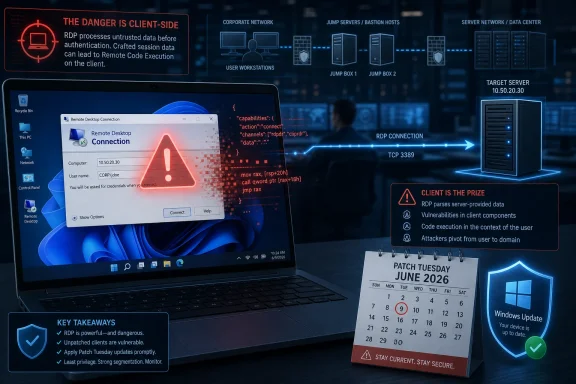 The Dangerous Side of Remote Desktop Is the One Users Trust
Remote Desktop has always carried a psychological asymmetry. Administrators worry about exposed servers, open TCP 3389, brute-force login attempts, weak gateways, and legacy hosts sitting naked on the internet. That mental model is useful, but CVE-2026-48563 points in the other direction: the vulnerable component is the Remote Desktop Client, the software used by a Windows machine to connect outward.That distinction matters. A client-side remote code execution flaw changes the story from “who can reach my RDP server?” to “what happens when my user connects to something malicious or compromised?” In practice, the trusted action is the risky action. A help desk technician, contractor, MSP engineer, or power user opens a remote session and assumes the danger lives on the other end.
The grim elegance of client-side RCE is that it weaponizes normal workflow. Remote access is not a fringe behavior in 2026 Windows environments; it is how administrators jump between machines, how vendors support customers, how cloud-hosted desktops are reached, and how legacy line-of-business systems remain usable. If the client can be made to mishandle crafted data from a server or session endpoint, the user’s own machine becomes the attack surface.
That is why a Critical label on a Remote Desktop Client bug deserves attention even before exploit code is public. The risk is not hypothetical simply because the vulnerable side is the client. Attackers have long understood that users can be lured into connecting, opening, previewing, importing, syncing, or authenticating against attacker-controlled infrastructure.
Microsoft’s Patch Tuesday Flood Makes This One Easy to Miss
CVE-2026-48563 arrived inside a crowded June 2026 Patch Tuesday. Microsoft’s monthly release addressed roughly 200 vulnerabilities, including dozens of remote code execution bugs and a substantial cluster of Remote Desktop Client issues. In that kind of volume, even a Critical vulnerability can become just another row in a spreadsheet.That is the operational trap. Patch Tuesday is designed for regularity, but regularity can dull urgency. Security teams see a familiar cadence, vulnerability scanners light up, ticket queues fill, and the truly consequential bugs must compete with hundreds of other line items for attention.
Remote Desktop Client vulnerabilities are especially prone to being underestimated because they do not always map cleanly to perimeter exposure. A scanner that finds an internet-facing RDP service creates an obvious escalation path: close the port, enforce gateway access, check MFA, audit logins. A vulnerable client installed across thousands of laptops is messier. It is both everywhere and nowhere.
The June cluster makes the pattern harder to ignore. CVE-2026-48563 was not a lonely advisory in an otherwise quiet component. Microsoft listed several Remote Desktop Client RCE flaws in the same release, with multiple entries rated Critical. When one component accumulates that many memory-safety or input-handling failures in a single month, defenders should treat the product area as an attack surface under active scrutiny, not as an isolated bug.
“Critical” Does Not Mean “Wormable,” but It Does Mean You Should Stop Shrugging
The word Critical has suffered from inflation. Every administrator has seen advisories rated severe that require improbable conditions, unusual configurations, or a degree of user cooperation that makes exploitation far less likely than the score suggests. But dismissing the rating entirely is just as lazy as blindly panicking over it.For CVE-2026-48563, the key practical point is remote code execution in the client. That generally means successful exploitation could allow attacker-controlled code to run on the machine using the Remote Desktop Client, likely in the context of the user running the client. That is not the same as unauthenticated code execution against an exposed server, and it should not be described as a BlueKeep-style repeat without evidence.
But it is also not benign. Client-side compromise can be the bridge into privileged workstations, management networks, source repositories, password vaults, browser sessions, VPN contexts, and remote administration tools. A compromised administrator workstation is often more valuable than a compromised random server because it carries trust, credentials, and reach.
The right severity conversation is therefore not “is this internet-wormable?” It is “which users initiate RDP sessions into environments they do not fully control?” In MSPs, support desks, industrial operators, contractors, and hybrid enterprises, that answer may be uncomfortable.
The Exploitability Signal Is About Certainty, Not Just Hype
The user-supplied metric language around exploitability confidence is worth pausing on because it captures a subtle but important distinction. Vulnerability risk is not only about impact; it is also about how much the world knows. A confirmed vendor advisory with enough technical shape gives defenders confidence that the bug is real, but it can also give attackers confidence that reverse engineering the patch will be worthwhile.Microsoft’s acknowledgement makes CVE-2026-48563 real in the way enterprise systems care about. It is no longer rumor, a disputed researcher claim, or a speculative weakness inferred from behavior. It is a vendor-tracked, patched vulnerability with a CVE, a product assignment, and a severity rating.
That does not automatically mean a public exploit exists. It does mean the clock has started. Once patches ship, attackers can compare pre-patch and post-patch binaries, look for changed code paths, and attempt to infer the vulnerable condition. The more concentrated the Patch Tuesday changes are around one component, the more attractive that component becomes for diffing.
This is the uncomfortable bargain of coordinated disclosure. Patching protects customers, but the patch itself can become a map. The practical answer is not secrecy; it is speed. Organizations should assume that the period immediately after Patch Tuesday is when capable actors begin turning vendor fixes into working exploit knowledge.
Remote Desktop Client Bugs Target the People Who Hold the Keys
Most Windows shops separate users into rough classes: standard users, developers, administrators, help desk staff, server operators, and third-party support. A Remote Desktop Client flaw does not hit those groups equally. The people most likely to use the client heavily are often the people with the most useful access.That is why patch priority should not be based solely on asset count. A thousand lightly used kiosk systems with the vulnerable client installed may matter less than fifty administrator workstations that initiate daily sessions into production, customer, or domain infrastructure. Risk follows behavior.
Privileged Access Workstations, jump boxes, and hardened admin devices were created precisely because administrative endpoints are so consequential. But in many real environments, Remote Desktop usage sprawls beyond those clean models. Engineers RDP from laptops. Contractors connect from managed but less-hardened machines. Support teams maintain saved connection profiles. Users connect to cloud PCs and lab hosts. The client becomes a quiet constant.
CVE-2026-48563 should prompt an inventory question that many organizations rarely ask: not merely “where is Remote Desktop enabled?” but “where is Remote Desktop Client used, by whom, and to connect to what?” The second question is harder. It is also closer to the actual risk.
The Server May Be Innocent and Still Be Dangerous
One of the more counterintuitive aspects of client-side RDP risk is that the remote endpoint does not need to be a traditional compromised Windows server in the way defenders imagine. The danger can come from a malicious server, a rogue endpoint, a manipulated connection path, or an environment that the user has been persuaded to trust.That persuasion layer is familiar. Attackers can impersonate support portals, seed connection files, compromise vendor infrastructure, or abuse social engineering around remote assistance. In a world where “connect to this machine so we can troubleshoot” is a normal business sentence, Remote Desktop workflows can become phishing infrastructure with a Windows-native accent.
The Microsoft advisory title alone does not prove the precise exploit path for CVE-2026-48563, and defenders should be careful not to invent technical details that are not public. But the broad defensive model is clear enough: any RCE in a remote client raises concern about crafted data arriving from the far side of a session. That makes trust boundaries less obvious than firewall diagrams suggest.
This is where security awareness often lags behind architecture. Users have been trained not to open strange attachments, not to run unknown executables, and not to enter passwords into suspicious pages. Far fewer have been trained to treat a remote desktop endpoint as content that can attack the viewer.
Windows Update Is the Fix, but Not the Whole Defense
For most consumers and small businesses, the answer is simple: install the June 2026 Windows security updates and make sure the Microsoft Remote Desktop app, where applicable, is current. There is no virtue in waiting for exploit chatter when the vendor has already shipped a fix.In managed environments, the answer is still patching, but with targeting. Prioritize machines used for administration, support, vendor access, privileged remote sessions, and access to sensitive internal networks. If an administrator’s workstation is behind on this update, that is a bigger problem than a conference-room PC missing the same patch.
Enterprises should also look at how Remote Desktop connection files and saved targets are distributed. If users receive RDP files through email, ticketing systems, chat, or vendor portals, those channels deserve scrutiny. A client-side RCE class vulnerability makes the provenance of connection material more important.
Network controls still help, but they help differently. Blocking inbound RDP does not eliminate risk from a vulnerable client. Restricting which remote hosts users can connect to, routing administrative access through hardened gateways, and requiring privileged access workflows can reduce the chance that a user casually connects to hostile infrastructure.
The CVSS Score Is a Starting Gun, Not a Triage System
The industry keeps trying to make one score do three jobs. CVSS tries to describe technical severity. EPSS tries to estimate exploitation probability. Vendor severity tries to communicate customer urgency. Asset management tries to translate all of that into local risk. No single number can replace that chain.CVE-2026-48563 is a good example of why. A Critical Remote Desktop Client RCE may be urgent for an MSP whose technicians connect to many customer systems every day. It may be less urgent, though still important, for a tightly locked-down fleet where Remote Desktop Client is rarely used and outbound RDP is restricted. The vulnerability is the same; the exposure is not.
That does not mean organizations should over-customize themselves into paralysis. Patch the thing. But when deciding what must be patched first, the best signal is the intersection of severity, exploitability knowledge, user role, and workflow. Remote Desktop Client sits close to privileged workflow in many Windows environments, which pushes it up the queue.
This is also why “no known exploitation” should be read carefully. It is reassuring only in the narrow sense that defenders are not yet responding to confirmed in-the-wild abuse. It is not a promise about tomorrow, and it is not evidence that the bug is unexploitable. Patch Tuesday history is full of vulnerabilities that became more interesting after the patch clarified where to look.
The RDP Brand Still Carries BlueKeep’s Shadow
Any Remote Desktop vulnerability invites comparison to BlueKeep, the 2019 Remote Desktop Services flaw that triggered emergency warnings because of its pre-authentication, wormable potential on exposed systems. CVE-2026-48563 should not be lazily placed in that category without evidence. The affected component here is the client, not simply the server-side service that accepts inbound RDP connections.Still, BlueKeep changed how Windows administrators hear the letters RDP. It taught even non-specialists that remote access code can sit near catastrophic failure modes. That memory is useful as long as it sharpens attention rather than distorts analysis.
The better analogy is not “this is BlueKeep again.” It is that Remote Desktop remains complex, old, widely deployed, and deeply trusted. Those are the ingredients that make vulnerability classes persist. Protocol handlers, graphics paths, clipboard redirection, device redirection, authentication negotiation, and session features all create parsing and state-management complexity.
Modern Windows has added layers of mitigation, sandboxing, memory protection, and update automation that make exploitation harder than it was in older eras. But complexity does not disappear because a component is mature. Sometimes maturity means the code is everywhere, the behaviors are compatibility-bound, and the attack surface has accumulated over decades.
Home Users Should Patch, but Enterprises Should Investigate Usage
For a home Windows user, CVE-2026-48563 is not a reason to panic. If Windows Update is enabled and the June 2026 cumulative update installs successfully, the practical risk drops sharply. Users who never initiate Remote Desktop sessions are less exposed than those who do, though patching remains the correct answer.For enthusiasts, homelab users, and small-office administrators, the calculus is slightly different. Remote Desktop is common in home labs, media servers, test boxes, and small business setups. If you connect from your main PC into experimental systems, untrusted networks, borrowed cloud instances, or machines exposed to other users, update the client machine promptly.
For enterprises, the patch should be paired with telemetry. Security teams should identify machines that launch Remote Desktop Client, users who initiate frequent sessions, and destinations outside normal administrative patterns. If outbound RDP is allowed broadly, this is a good moment to ask why.
This is not about turning every advisory into a six-month architecture project. It is about using a Critical client-side RCE as a forcing function. Patch now, then decide whether Remote Desktop usage still matches the organization you think you run.
The June Cluster Points to a Component Under the Microscope
One Critical Remote Desktop Client vulnerability would be notable. A Patch Tuesday release containing a cluster of Remote Desktop Client RCEs is more revealing. It suggests either a focused internal review, a wave of external researcher findings, or a combination of both.That is good news in one sense. Bugs found and patched through coordinated channels are better than bugs found first by attackers. Microsoft’s security machinery is doing the work customers need it to do: acknowledging flaws, assigning CVEs, shipping updates, and giving defenders a path forward.
But clusters also create attacker incentives. If researchers and Microsoft found several bugs in a component, offensive teams may wonder how many related issues remain. Patch diffing becomes more efficient when multiple fixes point toward the same subsystem. Defensive teams should assume that Remote Desktop Client will remain an area of interest beyond this single CVE.
The correct response is not to abandon Remote Desktop. It is to treat Remote Desktop as privileged infrastructure, even on the client side. That means timely updates, controlled usage, monitored connections, hardened admin endpoints, and skepticism toward unsolicited connection instructions.
The Patch Queue Should Follow the People Who Click Connect
The operational lesson from CVE-2026-48563 is narrow enough to act on and broad enough to matter. This is a client-side Remote Desktop bug with Critical severity, disclosed in a busy June 2026 Microsoft security release, and it belongs near the front of the patch queue wherever Remote Desktop is part of privileged work.- Organizations should patch Windows systems and Remote Desktop clients covered by the June 2026 security updates before waiting for public exploit chatter.
- Administrator workstations, help desk machines, MSP technician devices, jump hosts, and contractor endpoints should receive priority over low-value systems with little or no Remote Desktop usage.
- Security teams should review how RDP files, saved connections, and remote support instructions are distributed to users.
- Blocking inbound RDP is not a complete mitigation for a vulnerable Remote Desktop Client because the risky action may be an outbound connection.
- The absence of confirmed exploitation should be treated as temporary comfort, not as a reason to defer the update.
- Remote Desktop usage telemetry can turn a generic Critical advisory into a targeted remediation plan.
References
- Primary source: MSRC
Published: 2026-06-09T07:00:00-07:00
Security Update Guide - Microsoft Security Response Center
 msrc.microsoft.com
- Related coverage: sentinelone.com
CVE-2025-27487: Remote Desktop Client RCE Vulnerability
CVE-2025-27487 is a remote code execution vulnerability in Microsoft Remote Desktop Client. Learn about its impact, affected versions, and mitigation methods.www.sentinelone.com
- Related coverage: cybersecuritynews.com
Microsoft Remote Desktop Client Vulnerability Let Attackers Execute Remote Code
A critical security vulnerability in Microsoft Remote Desktop Client that could allow attackers to execute arbitrary code on victim systems. cybersecuritynews.com
- Related coverage: rapid7.com
Rapid7 Vulnerability Database
Rapid7's VulnDB is curated repository of vetted computer software exploits and exploitable vulnerabilities.www.rapid7.com - Related coverage: db.gcve.eu
Vulnerability-Lookup
Vulnerability-Lookup - Fast vulnerability lookup correlation from different sources.db.gcve.eu - Related coverage: stack.watch

- Related coverage: cve.ics-csirt.io
Microsoft - Remote Desktop Client CVE - OpenCVE
cve.ics-csirt.io
- Official source: learn.microsoft.com
Windows Remote Desktop Services (RDS) Privilege Escalation Vulnerability - Microsoft Q&A
Version: server 20216 All patch packages are requiredlearn.microsoft.com - Related coverage: techradar.com
Microsoft quietly patches LNK vulnerability that's been weaponized for years | TechRadar
The November Patch Tuesday fixed an age-old bugwww.techradar.com - Related coverage: unit42.paloaltonetworks.com
Microsoft WSUS Remote Code Execution (CVE-2025-59287) Actively Exploited in the Wild (Updated November 3)
CVE-2025-59287 is a critical RCE vulnerability identified in Microsoft’s WSUS. Our observations from cases show a consistent methodology.unit42.paloaltonetworks.com - Related coverage: first.org
The National Vulnerability Database Ms. Tanya Brewer NVD Program Manager June 2024
PDF documentwww.first.org
- Official source: microsoft.com
MSRC - Microsoft Security Response Center
The Microsoft Security Response Center is part of the defender community and on the front line of security response evolution. For over twenty years, we have been engaged with security researchers working to protect customers and the broader ecosystem.www.microsoft.com
- Related coverage: sra.io
- Related coverage: cert.gov.vu
Advisory 118 CVE 2026 21509 Microsoft Office Security Feature Bypass Vulnerability
PDF documentcert.gov.vu
- Related coverage: bleepingcomputer.com
Microsoft June 2026 Patch Tuesday fixes 3 zero-day, 200 flaws
Today is Microsoft's June 2026 Patch Tuesday, with security updates for 200 flaws and three publicly disclosed zero-day vulnerabilities.www.bleepingcomputer.com
- Related coverage: redpacketsecurity.com
US-CERT Vulnerability Summary for the Week of January 26, 2026 - RedPacket Security
Bulletins provide weekly summaries of new vulnerabilities. Patch information is provided when available. www.redpacketsecurity.com
- Related coverage: elevenforum.com
Microsoft June / July 2026 Security Updates | Windows 11 Forum
June 2026 Security Updates This release consists of the following 206 Microsoft CVEs: Tag CVE Base Score CVSS Vector Exploitability FAQs? Workarounds...www.elevenforum.com - Related coverage: vulnerability.circl.lu
Vulnerability-Lookup
Vulnerability-Lookup - Fast vulnerability lookup correlation from different sources.vulnerability.circl.lu
