

SharePoint Risk Rarely Arrives as a Single Clean Story
SharePoint vulnerabilities tend to land badly because SharePoint itself is rarely a small, tidy system. It is a document platform, workflow engine, intranet host, search surface, authentication participant, and legacy application container, often all at once. When Microsoft labels a SharePoint Server issue as remote code execution, administrators do not get the luxury of treating it as just another web application bug.
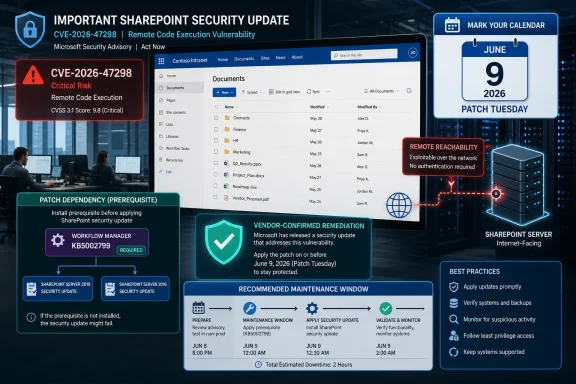
CVE-2026-47298 appears in Microsoft’s June 9, 2026 security material as part of a broad SharePoint Server update set. For SharePoint Server Subscription Edition, Microsoft’s KB5002873 says the update resolves SharePoint Server remote code execution and spoofing vulnerabilities and lists CVE-2026-47298 among a long run of CVEs. For SharePoint Server 2016, KB5002880 also lists CVE-2026-47298 in the June security update package.
That breadth matters. A single CVE in a SharePoint cumulative update is not just a line item for the vulnerability scanner; it is a change-control event for farms that may have custom web parts, workflow dependencies, third-party integrations, and brittle business processes layered on top. The security team may see a patch. The SharePoint admin sees a maintenance window with consequences.
Microsoft’s advisory page, as presented through the Security Update Guide, gives the vulnerability the formal shape that enterprise tooling expects: a CVE identifier, an affected product family, and vendor remediation. But the surrounding context is what decides urgency. The June SharePoint updates bundle many fixes, and CVE-2026-47298 is one of the reasons organizations still running on-premises SharePoint should resist the temptation to let this month’s cumulative update age quietly in a test folder.
The Confidence Metric Is a Warning About Reality, Not Just Severity
The text attached to the user’s source describes a metric that measures confidence in the existence of a vulnerability and the credibility of known technical details. That framing is easy to overlook because most patch conversations are dominated by CVSS base scores, exploitability labels, and whether the issue is already being exploited. But confidence is the difference between chasing smoke and responding to fire.
In vulnerability management, “remote code execution” is a category of impact. It tells defenders what could happen if an attacker successfully exploits the bug. Confidence tells defenders how much faith they should place in the claim that the bug really exists, that the described impact is real, and that technical knowledge about the issue is sufficient for attackers or researchers to move beyond speculation.
CVE-2026-47298 sits on the stronger end of that confidence spectrum because Microsoft has acknowledged it through its own Security Update Guide and shipped fixes through SharePoint security updates. That does not mean every technical detail is public. In fact, Microsoft’s advisories often withhold exploit mechanics, vulnerable code paths, and proof-of-concept material precisely because premature detail can accelerate weaponization.
The practical consequence is subtle but important. Administrators should not wait for a public exploit write-up before treating the issue as real. Vendor confirmation and a shipped security update are enough to move the vulnerability out of the “watch” pile and into the “schedule and verify deployment” pile.
Patch Tuesday Turns Certainty Into an Operations Problem
June 9, 2026 was not just the publication date for CVE-2026-47298; it was Patch Tuesday, which means the SharePoint fix arrived amid a broader monthly security cycle. That timing is convenient for automation and reporting, but it also encourages a dangerous kind of batching. When dozens of CVEs appear at once, individual server-side flaws can blur into the background.
SharePoint deserves different treatment because the affected systems often sit close to sensitive business data. Even intranet-only deployments can expose document repositories, identity claims, workflow secrets, and internal application pages that attackers value after gaining an initial foothold elsewhere. “Internal” does not mean “safe” when phishing, stolen VPN credentials, and compromised endpoints are already part of normal threat models.
The June update for SharePoint Server Subscription Edition is also more than a pure security payload. Microsoft says KB5002873 introduces the SharePoint Server Subscription Edition Version 26H1 feature update and includes nonsecurity fixes. That is normal for SharePoint cumulative updates, but it complicates emergency patching because organizations must validate not only whether the exploit path is closed, but whether day-to-day farm behavior changes.
SharePoint Server 2016 carries its own operational baggage. KB5002880 notes that the update is build 16.0.5556.1005 and replaces a previously released security update. It also reiterates old feature-pack history and includes a nonsecurity fix involving user controls flagged as unsafe. That is exactly the sort of detail that makes SharePoint patching feel less like applying a hotfix and more like touching a load-bearing wall.
Workflow Manager Is the Dependency That Can Break the Calendar
The most immediately actionable detail in Microsoft’s June SharePoint update notes is not hidden in the CVE title. It is the warning about Workflow Manager. For both SharePoint Server Subscription Edition and SharePoint Server 2016, Microsoft says farms using SharePoint Workflow Manager must install SharePoint Workflow Manager KB5002799 before installing the cumulative update.
That requirement turns the patch into a sequence, not a single installation. In a small lab, that is an annoyance. In a production farm with multiple servers, business-critical workflows, and tightly rationed maintenance windows, sequencing is the difference between a clean deployment and a Monday morning incident bridge.
Microsoft also says organizations still using the classic version of Workflow Manager must enable a debug flag to continue using it. The command sequence is short, but the implication is not. Security remediation now intersects with legacy workflow survival, which means the people responsible for vulnerability closure need to talk to the people who know what approvals, routing rules, and automated processes still depend on old workflow infrastructure.
This is where many SharePoint patch programs fail. The security bulletin says “install the update.” The farm reality says “install a prerequisite, confirm workflow mode, adjust farm behavior if necessary, patch SharePoint, run the configuration wizard, test customizations, check search, validate workflows, and only then declare victory.” CVE-2026-47298 is the security driver, but the dependency chain is the work.
Remote Code Execution Still Has a Special Weight on Server Products
The industry has become numb to the phrase “remote code execution” because it appears so often in monthly advisories. That numbness is a mistake, especially for server-side products. On a client application, RCE may require a user to open a malicious file. On a server platform, depending on authentication and attack complexity, it can become a direct path from network reachability to code running in a privileged application context.
Microsoft’s public material for CVE-2026-47298 identifies the vulnerability class and product family, but does not, in the readily visible support material, publish a friendly narrative of the root cause. That is not unusual. Defenders often have to act with enough information to prioritize remediation, but not enough information to understand the vulnerable code path in satisfying detail.
That asymmetry is uncomfortable, but it is also the normal state of enterprise security. Attackers do not need a marketing-grade explanation to begin diffing patches, probing exposed systems, or looking for related weaknesses across builds. Once an update ships, the patch itself becomes a source of information for capable adversaries.
For SharePoint, that window is particularly unforgiving. Internet-exposed farms are obvious candidates for prioritization, but internal farms should not be waved through a slower process simply because they sit behind a firewall. The last decade of intrusions has taught defenders that internal web applications become post-compromise stepping stones, not quiet back-office utilities.
The 2025 SharePoint Scars Make This One Harder to Ignore
Administrators do not evaluate CVE-2026-47298 in a vacuum. SharePoint has recent history as an attractive target, including high-profile exploitation of on-premises SharePoint vulnerabilities in 2025. Those incidents reinforced a lesson that should now be institutional memory: on-premises collaboration servers are not boring legacy infrastructure when they can be converted into persistence, credential access, or data theft platforms.
The key comparison is not that CVE-2026-47298 is necessarily the same kind of flaw as earlier SharePoint bugs. The point is that the defender’s posture has changed. Any Microsoft-confirmed SharePoint Server RCE now lands in an environment where attackers have already demonstrated interest in this product family and where security teams have seen how quickly theoretical SharePoint exposure can become emergency response.
This is also where SharePoint Online complicates the conversation. Many organizations have moved collaboration workloads into Microsoft 365, but that does not mean on-premises SharePoint disappeared. Hybrid farms, legacy portals, regulatory holdouts, custom intranets, and departmental deployments can persist long after the official migration narrative says the cloud won.
That persistence creates blind spots. Asset inventories may be better at tracking Windows endpoints than SharePoint farm roles. Vulnerability dashboards may show the missing KB but not the business owner. A server may be “internal” yet reachable from broad network segments. CVE-2026-47298 is a reminder that the old platform still has new risk.
Microsoft’s Sparse Advisories Force Defenders to Read Between the Lines
Microsoft’s vulnerability disclosures often give defenders enough to act but not enough to satisfy curiosity. That is a deliberate balancing act. Too little detail frustrates administrators and researchers; too much detail can hand attackers a roadmap before patch adoption catches up.
For CVE-2026-47298, the support articles are more operational than explanatory. They tell customers which update packages exist, which SharePoint versions are covered, which prerequisite matters, and which previous updates are replaced. They do not turn the vulnerability into a case study.
That puts extra weight on the confidence concept from the source description. A confirmed vulnerability with limited public technical detail is not low risk simply because the root cause is not spelled out. It may instead be a vulnerability whose full mechanics are known to Microsoft, the reporter, and eventually anyone willing to reverse-engineer the patch.
Administrators should therefore separate certainty of existence from availability of exploit detail. CVE-2026-47298 is certain enough to patch because Microsoft shipped fixes and named it. Whether public exploit code exists is a different question, and one that can change faster than a corporate patch cycle.
The Real Exposure Is the Farm You Forgot to Modernize
SharePoint Server Subscription Edition and SharePoint Server 2016 represent different eras of Microsoft’s on-premises strategy, but both appear in the June 2026 remediation trail for CVE-2026-47298. That alone is telling. Microsoft is still servicing on-premises SharePoint, and customers are still running enough of it for new CVEs to matter.
Subscription Edition is Microsoft’s preferred on-premises path, designed to keep the server product on a continuing update model. But “subscription” does not magically make the environment cloud-like. Farms still need cumulative updates, configuration steps, dependency checks, and administrator discipline.
SharePoint Server 2016 is the more uncomfortable case. It is old enough to carry years of customizations, feature-pack baggage, and institutional habits. It may also be old enough that the people who designed the farm are no longer the people patching it.
That is where risk compounds. A modern vulnerability lands on an aging deployment; the update process depends on knowledge that has eroded; the business still treats the portal as indispensable; and the security team is measured by closure dates. CVE-2026-47298 may be one identifier, but it exposes a governance problem as much as a software problem.
Scanner Green Is Not the Same as SharePoint Safe
For many organizations, the life of CVE-2026-47298 will begin and end in a vulnerability scanner. The tool detects affected SharePoint builds, reports the missing KB, and eventually turns green after the update is installed. That is useful, but it is not sufficient.
SharePoint patching is notorious for partial success. Installing binaries is not the same as completing farm configuration. A server can receive an update package while the farm still needs post-installation steps. Multi-server farms can drift if one role is updated and another is not. Custom components can mask failures until a user hits the wrong page.
A better remediation standard for this CVE would treat patching as a verified service restoration exercise. Administrators should confirm the update level across every farm server, complete the SharePoint Products Configuration Wizard or equivalent process where required, review upgrade status, and test representative user paths. Security teams should not close the ticket merely because Windows Update or an inventory agent saw a package.
The Workflow Manager prerequisite deserves the same discipline. If workflows are present, the dependency must be patched in the right order, and business workflows should be tested after the SharePoint update. A vulnerability report that ignores workflow health is measuring only part of the risk.
Cloud Migration Did Not Eliminate the On-Premises Attack Surface
Microsoft would plainly prefer most collaboration workloads to live in Microsoft 365. From a security operations perspective, that preference has logic: the vendor can patch the service centrally, remove some customer maintenance burden, and reduce the population of exposed legacy farms. But enterprise reality rarely moves at product-marketing speed.
On-premises SharePoint remains common where customizations are deep, data residency rules are strict, latency matters, or migration costs are politically impossible. In those environments, SharePoint is not a relic. It is a production application platform with a large security boundary.
CVE-2026-47298 should therefore be read as another data point in the case for rationalizing SharePoint estates. Not every organization can retire on-premises SharePoint quickly, and some cannot retire it at all. But every organization can ask whether each farm is still necessary, whether it is reachable from too many places, whether its authentication model is current, and whether patching it requires heroics.
The best security outcome may not be “patch faster forever.” It may be reducing the number of SharePoint servers that need emergency treatment in the first place. That is a strategy conversation, not a Patch Tuesday chore.
The June Fix Leaves Administrators With a Narrow Set of Sensible Moves
CVE-2026-47298 does not need melodrama to be worth attention. It is a Microsoft-confirmed remote code execution vulnerability in SharePoint Server, remediated in June 2026 updates that carry real deployment prerequisites. That combination is enough to justify urgency without pretending that every missing detail is known.
- Organizations running SharePoint Server Subscription Edition should evaluate and deploy the June 9, 2026 security update KB5002873, while accounting for its Version 26H1 feature update content.
- Organizations running SharePoint Server 2016 should evaluate and deploy KB5002880, including validation of farm build level and post-update configuration status.
- Farms using SharePoint Workflow Manager should install KB5002799 before the SharePoint cumulative update, rather than treating the SharePoint package as a standalone fix.
- Environments still using classic Workflow Manager should review Microsoft’s debug-flag requirement before the maintenance window begins.
- Security teams should treat vendor confirmation as sufficient reason to act, even if public exploit mechanics for CVE-2026-47298 remain limited.
- Administrators should prioritize internet-facing farms first, but they should not defer internal farms indefinitely, because SharePoint is valuable after an attacker gains any foothold.
The deeper lesson is that confidence changes the tempo. CVE-2026-47298 is not merely a theoretical entry in a vulnerability database; it is a vendor-acknowledged flaw with shipped fixes and operational consequences for real SharePoint farms. The organizations that handle it well will be the ones that already know where their on-premises SharePoint servers live, who owns them, what workflows they run, and how quickly they can patch without breaking the business. The rest will rediscover, under deadline pressure, that old collaboration platforms have a way of becoming tomorrow’s incident report.