

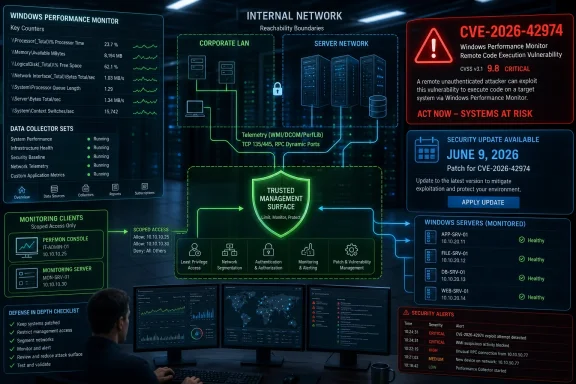
Performance Monitor Becomes the Sort of Boring Component Attackers Love
Windows Performance Monitor is not glamorous software. It is the workhorse behind counters, logs, Data Collector Sets, and the kind of operational visibility that lets administrators answer basic questions about CPU pressure, disk latency, memory behavior, and application health. In many environments, it is treated less like a service that needs hardening and more like a diagnostic utility that has simply always been there.
That is exactly why a remote code execution flaw in this area deserves attention. Attackers do not need a component to be fashionable; they need it to be reachable, trusted, and poorly watched. Performance tooling often meets all three conditions, especially on servers where administrators have enabled remote collection or where monitoring stacks reach across subnets to gather health data.
The advisory label also changes the way defenders should think about the bug. A denial-of-service issue in a monitoring component is operationally annoying. An elevation-of-privilege issue might matter after initial access. A remote code execution vulnerability, by contrast, raises the possibility that the management plane itself can become an entry point.
Microsoft has not publicly filled in every exploit detail, and that matters. But the absence of a full root-cause narrative should not be mistaken for reassurance. The vulnerability has been acknowledged by the vendor, assigned a CVE, scored as high severity, and associated with supported Windows client and server products. That is enough to move it out of the category of rumor and into the patch queue.
The Confidence Signal Is Doing More Work Than the CVSS Number
The user-supplied metric text is essentially about confidence: how certain we are that a vulnerability exists and how credible the available technical details are. That distinction is more useful than it may sound. CVSS tells administrators how bad a vulnerability could be under modeled conditions; confidence tells them how much faith to place in the underlying claim.
For CVE-2026-42974, the confidence case is stronger than it would be for a speculative researcher blog post or a vague exploit-market rumor. Microsoft has published the advisory entry through its Security Update Guide, and public vulnerability feeds have mirrored the basic metadata. That does not mean defenders know everything attackers might know, but it does mean the vulnerability is vendor-recognized and tied to a real update cycle.
This is where Patch Tuesday triage often goes wrong. Teams sometimes over-index on whether exploit code is public, whether exploitation has been observed, or whether a vulnerability has a perfect 9.8 or 10.0 score. Those are useful signals, but they are not the whole story. A high-confidence RCE in a Windows management component can be worth acting on quickly even before exploit writeups appear.
The practical reading is simple: the vulnerability is real, but the public technical picture is incomplete. That combination should push administrators toward remediation rather than speculative reverse-engineering. Waiting for a proof of concept to make the risk feel concrete is a habit attackers have learned to exploit.
Remote Code Execution in a Management Surface Is Not Just Another Patch Tuesday Line Item
Windows Performance Monitor belongs to the class of components administrators use to observe systems rather than to serve end users. That distinction can create a false sense of safety. A web server feels exposed. A database listener feels sensitive. A performance counter interface feels internal, mundane, and benign.
But management surfaces are often high-value precisely because they sit near privileged workflows. They are used by administrators, integrated into monitoring suites, allowed through internal firewalls, and exempted from the suspicion applied to internet-facing applications. Once an attacker reaches the internal network, these “boring” services become attractive pivot points.
The risk is especially relevant for Windows Server 2022 and Windows Server 2025 estates. Servers are more likely than desktops to participate in centralized monitoring, remote administration, and automated health checks. If vulnerable code paths are reachable through those arrangements, the exposure will not be evenly distributed across every Windows machine; it will cluster around the systems IT cares about most.
Windows 11 being listed matters for a different reason. Modern endpoint fleets are no longer passive clients sitting behind a neat perimeter. Developer workstations, admin laptops, jump boxes, and hybrid-joined devices can all carry privileged credentials and network reach. A Windows 11 machine with the right administrative role can be a better target than a generic server.
The Advisory’s Silence Is Itself a Deployment Problem
Microsoft advisories often walk a narrow line. Too little detail frustrates defenders; too much detail can accelerate exploitation. CVE-2026-42974 appears, at least publicly, to sit on the sparse side of that trade-off. The title names the component and impact, the severity gives a prioritization clue, and the affected products establish the blast radius. The mechanics remain largely unstated.
That ambiguity creates a familiar problem for enterprise IT. Security teams want to know whether a compensating control buys time. Infrastructure teams want to know whether a particular service configuration is exposed. Change managers want to know whether emergency deployment is justified. Without root-cause detail, those conversations tend to collapse back into a blunt question: do we trust the vendor’s severity rating?
In this case, the answer should mostly be yes. A high-severity RCE in Windows Performance Monitor is not the sort of issue to leave hanging because the advisory is short. The right posture is to patch supported systems first, then refine exposure analysis afterward as more details emerge.
There is also a lesson for asset management. If a team cannot quickly identify where remote performance monitoring is enabled, which systems are collecting counters from which servers, and what firewall rules permit those flows, the vulnerability has already exposed a process weakness. The bug is the headline; the inventory gap is the recurring disease.
The Blast Radius Runs Through Monitoring, Not Just Windows Versions
The affected-product list tells administrators where to install updates, but it does not fully describe operational exposure. A Windows 11 workstation and a Windows Server 2025 host may both be affected, yet they sit in very different threat contexts. What matters is not only whether the vulnerable code exists, but whether it is reachable and useful to an attacker.
Performance monitoring is commonly centralized. Enterprises use Microsoft tooling, third-party observability platforms, scripts, agents, and remote counter collection to keep track of infrastructure health. Over time, those systems accumulate firewall exceptions and service permissions that are rarely reviewed with the same rigor as public application ingress.
That creates an awkward inversion. The more mature and observable an environment is, the more likely it is to have legitimate monitoring pathways. Those pathways are necessary, but they also become part of the attack surface. Security teams should resist the temptation to frame this as a reason to reduce visibility; the real answer is to treat visibility infrastructure as privileged infrastructure.
Administrators should also remember that remote code execution does not always mean internet-exposed, unauthenticated, wormable compromise. The phrase covers a range of conditions. Some RCE vulnerabilities require authentication, user interaction, adjacent access, or a particular configuration. The public metadata for CVE-2026-42974 does not justify worst-case theatrical claims. It does justify disciplined urgency.
Server 2025’s Inclusion Is a Reminder That New Does Not Mean Settled
Windows Server 2025 appearing in the affected set is notable because many organizations still treat the newest server release as a controlled rollout item. The early adopters tend to be labs, pilot clusters, greenfield deployments, and teams chasing specific platform features. Those environments can fall between operational categories: too new for mature baselines, too important to ignore.
That matters for vulnerability response. A long-lived Windows Server 2022 fleet may already have monthly update rings, maintenance windows, rollback procedures, and monitoring for patch failures. A newer Server 2025 deployment may not yet be fully folded into the same governance. Security debt often accumulates at the edge of modernization projects, where teams are moving fast and assuming the platform’s novelty buys them safety.
It does not. Supported, modern Windows is still a vast codebase with old subsystems, compatibility layers, management interfaces, and inherited assumptions. Performance Monitor is precisely the sort of component that spans generations. New releases carry forward administrative affordances because enterprises demand continuity.
For Windows 11, the same principle applies in endpoint form. New builds, new hardware, and modern management do not eliminate the need for aggressive update hygiene. A vulnerability in a built-in Windows component can cross the artificial boundary between “legacy risk” and “modern platform.”
Patch Priority Should Follow Function, Not Just Severity
For most organizations, the remediation answer begins with Microsoft’s June 2026 security updates. The harder question is sequencing. When everything is important, patching becomes a negotiation among outage risk, exploit risk, staffing, and business tolerance.
CVE-2026-42974 should rise in environments where Performance Monitor or related remote monitoring capabilities are used across trust boundaries. Domain controllers, management servers, monitoring collectors, application servers, and administrative workstations deserve early attention. So do systems reachable from less-trusted network segments, such as branch offices, development networks, lab environments, and vendor-connected subnets.
The vulnerability should also prompt a review of who can query performance data remotely. Monitoring access often expands quietly. A service account is granted rights for a dashboard; a firewall rule is opened for a migration; a collector is deployed for an incident and never retired. Those decisions may have been reasonable at the time, but an RCE in the surrounding component changes their risk profile.
This is not an argument for panic-patching every laptop before testing server updates. It is an argument for risk-aware deployment. Patch the systems that expose the management surface first, validate business-critical workloads, and then complete the fleet. The worst response is to treat a high-confidence RCE as a routine low-context monthly chore.
Attackers Read Patch Tuesday Differently Than Administrators Do
Administrators read Patch Tuesday as a workload. Attackers read it as a map. Every advisory title, severity score, affected product, and update diff becomes a clue about where to look. Even sparse advisories can be enough to start the process, because attackers can compare patched and unpatched binaries, trace changed functions, and search for reachable code paths.
That is why “no public exploit” should be a temporary comfort at best. The gap between patch release and exploit development has narrowed across the industry, especially for bugs in widely deployed platforms. Skilled attackers do not require Microsoft to publish a step-by-step exploit narrative. They require a target, a patch, and enough time.
Performance Monitor’s administrative role may make that reverse-engineering process especially interesting. If an attacker can find a remotely reachable parsing flaw, memory corruption path, authentication bypass, or unsafe call pattern inside a monitoring workflow, the payoff could be significant. The public record does not establish which of those applies here, and defenders should not pretend otherwise. But RCE is the category attackers most like to investigate.
The defensive implication is that patch latency matters. A vulnerability published on June 9, 2026, should not still be sitting unaddressed on critical monitoring-connected servers weeks later. The longer the delay, the more the organization’s exposure shifts from theoretical to opportunistic.
The Real Control Plane Is Identity Plus Reachability
Windows vulnerability response too often collapses into binary patch status: vulnerable or fixed. That view is necessary but incomplete. For a management-surface RCE, the more meaningful control plane is identity plus reachability. Who can talk to the component, from where, using which credentials, and through which intermediary systems?
If performance data collection is allowed broadly inside the network, a compromised endpoint may have more room to maneuver. If monitoring collectors run with excessive privileges, an attacker who compromises the collector or abuses its trust relationships may gain a better launch position. If administrative workstations are not isolated, they can become both targets and conduits.
Network segmentation remains relevant, even in an era of identity-centric security. Internal services should not be reachable merely because they are internal. Performance monitoring traffic should be documented, scoped, and justified. Where remote collection is required, it should be limited to known collectors and managed hosts rather than permitted across broad address ranges.
Identity hygiene is equally important. Service accounts used for monitoring should have the minimum rights required, should not be reused casually, and should be monitored for unusual behavior. A vulnerability in a component may provide code execution, but the post-exploitation value depends heavily on the privileges and network position around it.
The Metric Microsoft Does Not Publish Is Operational Trust
The provided metric language gets at a broader truth: vulnerability management is not only about severity; it is about trust in the information. Sometimes defenders are asked to act on fragments. A vendor confirms a flaw but withholds details. A researcher publishes a crash but not a working exploit. A threat-intel firm reports exploitation but cannot disclose indicators. Administrators must make decisions inside that fog.
CVE-2026-42974 sits in a relatively clean part of that spectrum. The vulnerability is publicly named, vendor-tracked, and associated with supported Microsoft products. The available technical detail is limited, but the existence of the issue is not seriously in doubt. That should be enough to satisfy the threshold for action in most organizations.
The more difficult question is whether teams have a process that can handle this kind of advisory. Many patch programs are optimized for fully described risks: critical Exchange exploit, actively exploited browser zero-day, public proof-of-concept for a kernel flaw. A high-severity RCE in an internal Windows component can be less dramatic but still operationally important.
That is where mature vulnerability management separates itself from dashboard compliance. The goal is not to memorize every CVE. The goal is to translate sparse but credible advisories into sensible changes: update, restrict reachability, review privileges, watch logs, and close inventory gaps.
The Windows Admin’s June 2026 Checklist Writes Itself
The immediate story of CVE-2026-42974 is a Windows Performance Monitor RCE. The larger story is that operational tooling has become part of the attack surface, and administrators need to treat it accordingly. The fix starts with updates, but the lesson extends into monitoring architecture, firewall policy, service-account design, and the uncomfortable places where “temporary” admin exceptions become permanent infrastructure.
- Organizations should prioritize the June 2026 Microsoft security updates on Windows Server 2022, Windows Server 2025, and Windows 11 systems that participate in remote monitoring or administrative workflows.
- Teams should identify where Windows Performance Monitor data is collected remotely and verify that only approved collectors and management hosts can reach those systems.
- Administrators should review monitoring service accounts to ensure they are not overprivileged, reused across unrelated systems, or excluded from normal security monitoring.
- Security teams should treat the absence of public exploit code as a short-lived condition, not as evidence that the vulnerability is unimportant.
- Environments with newer Windows Server 2025 deployments should confirm that those systems are included in the same patch rings and vulnerability reporting as older production servers.
- Any compensating controls should be documented as temporary risk reduction, not as a substitute for applying Microsoft’s security update.
The Boring Parts of Windows Are Now the Front Line
The most useful way to read CVE-2026-42974 is not as an isolated Windows bug, but as another reminder that enterprise attack surfaces are increasingly made of trusted internal machinery. Monitoring, logging, updating, inventory, remote support, and configuration management all exist to make Windows estates governable. That same governability gives attackers structure to abuse when one of those components fails.
For WindowsForum readers, the practical message is familiar but still urgent: patch quickly, but do not stop at patching. Look at the management paths around Performance Monitor. Ask whether remote observability is scoped or sprawling. Check whether your newest Windows deployments are actually inside your oldest security disciplines. The vulnerability may be fixed by an update, but the exposure pattern it reveals will outlive June’s Patch Tuesday.