

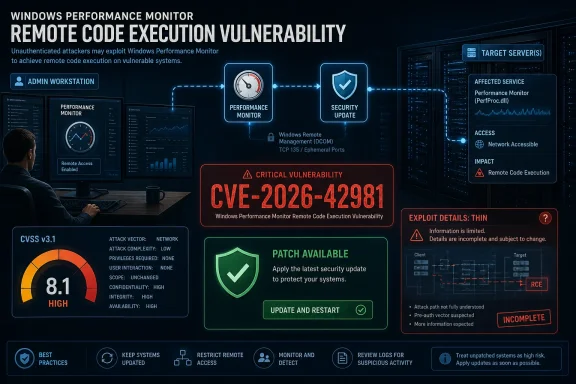
Microsoft disclosed CVE-2026-42981 on June 9, 2026 as a high-severity Windows Performance Monitor remote code execution vulnerability affecting Windows 11, Windows Server 2022, and Windows Server 2025, with public listings assigning it a CVSS 3.1 score of 8.1 and Microsoft as the source. The interesting part is not merely that Performance Monitor has an RCE-class bug; it is that the public record remains thin enough to make confidence, not just severity, the operational question. For defenders, this is a familiar Patch Tuesday problem in sharper form: the score says “move,” while the available technical detail says “do not pretend you know more than you do.”
CVE-2026-42981 arrives with the kind of title that gets attention in any Windows shop: Windows Performance Monitor Remote Code Execution Vulnerability. Performance Monitor is not an obscure third-party add-on. It is a built-in Windows component used by administrators, support teams, and monitoring workflows to inspect system counters, logs, and performance data.
That makes the label uncomfortable. A remote code execution vulnerability in a Windows management surface carries a different kind of risk than a flaw in a feature most organizations never touch. It suggests a potential path from observation tooling to execution, which is exactly the sort of boundary security teams do not like to see blurred.
But the public disclosure, at least at this early stage, does not provide a neat story about root cause, exploit path, authentication requirements, or operational preconditions. Third-party CVE trackers mirror the basic Microsoft-origin metadata: high severity, CVSS 8.1, published June 9, and affected Windows client and server families. They do not yet supply the missing anatomy.
That gap matters. In vulnerability management, a CVSS score is a triage signal, not a complete incident plan. A high score tells administrators that the issue belongs near the front of the queue; it does not tell them whether the realistic threat is wormable exploitation, a niche authenticated abuse path, a malformed file opened through a management console, or a remote procedure that only exists under specific configurations.
That invisibility is exactly why vulnerabilities in management components deserve attention. Administrative tools often sit at the intersection of privilege, remote access, service discovery, and trusted data parsing. They may not be internet-facing by design, but they frequently operate in networks where authenticated administrators and monitoring systems pull information from many machines at once.
A flaw in such a component can matter even if it never becomes a mass-exploitation event. Enterprise risk is not only about anonymous attackers scanning the open internet. It is also about lateral movement, compromised helpdesk accounts, poisoned telemetry, malicious counter data, and attacker-controlled systems interacting with tools that administrators trust.
The phrase “remote code execution” is therefore useful but incomplete. It identifies the worst-case impact class, not the full exploitation story. For Performance Monitor, the practical questions are narrower and more important: what has to be reachable, who has to initiate the interaction, what privileges are required, and whether exploitation targets the monitored machine, the monitoring machine, or both.
In this case, the existence of the vulnerability appears to have a strong baseline because Microsoft is the source of the advisory metadata. Vendor acknowledgement is a meaningful signal. It means the issue is not merely rumor, a speculative blog post, or an unverified scanner result.
The weaker part is not existence; it is exploit detail. Public information currently does not appear to explain the vulnerable code path, the vulnerable protocol or file format, the interaction model, or whether exploitation has been observed in the wild. That leaves defenders with a lopsided picture: high confidence that Microsoft shipped a fix for something real, lower confidence about how attackers would operationalize it.
That imbalance should shape response. It argues against panic-driven claims about wormability or active exploitation unless Microsoft or another credible source says so. It also argues against complacency. A vendor-confirmed RCE in a Windows component with a high CVSS score is not something to park in a quarterly maintenance window merely because the public write-up is sparse.
The trouble is that CVSS compresses a lot of context into a single number. Two vulnerabilities with similar scores can demand very different responses. One might be a pre-authentication network exploit against a default service. Another might require local network proximity, prior credentials, or a victim opening a malicious object in a specialized tool.
That is why mature teams treat CVSS as one input rather than the whole answer. They ask whether the affected component is enabled, exposed, reachable across trust boundaries, and used in privileged workflows. They also check whether the vulnerability appears in exploitation catalogs, whether proof-of-concept code has emerged, and whether endpoint or network telemetry can see the relevant behavior.
For CVE-2026-42981, the prudent posture is to prioritize patching while avoiding unfounded claims. The title and score justify urgency. The lack of public exploit mechanics justifies humility.
Performance Monitor is also more likely to be used against servers than against ordinary desktops. Administrators collect counters from database servers, domain controllers, application hosts, file servers, and virtualization infrastructure. Monitoring products may rely on Windows performance counters as part of routine observability.
That does not mean every server is equally exposed. Many environments restrict remote administration, segment management networks, and limit who can query performance data. Others still have broad internal reachability because old operational habits outlived the threat model that justified them.
The lesson is not “turn off Performance Monitor.” It is to inventory how performance data is collected and who can initiate those connections. If a vulnerability touches a management surface, the blast radius is partly determined by years of administrative convenience.
But the public timeline often works against defenders. Microsoft advisories may begin sparse, third-party analysis may lag, and exploit researchers may fill in the blanks faster than corporate patch cycles can move. By the time a clean proof of concept appears, the window for quiet, orderly remediation may already be closing.
That is especially true for bugs in familiar Windows components. Attackers do not need an official root-cause essay to start diffing patches, comparing binaries, and testing hypotheses. A high-severity RCE with a patch available is not just an advisory; it is a roadmap signal to people who know how to reverse engineer Windows updates.
The right operational move is therefore boring: validate the relevant June 2026 security updates, deploy them through normal accelerated channels, watch for failed installations, and verify coverage on systems that are easy to forget. The absence of exploit detail should reduce speculation, not reduce urgency.
If Performance Monitor exploitation requires a user to connect to a malicious or compromised system, then the administrator’s workstation may become the target. If exploitation happens through data returned from a monitored machine, a compromised low-value host could become a lure for a higher-value operator. Those are hypothetical paths, but they illustrate why management tools complicate simple client-versus-server thinking.
Even without confirmed exploit mechanics, hardened admin endpoints are the safer assumption. They should receive security updates promptly, run with least privilege where possible, and avoid casual browsing, email, and general productivity work. The old concept of a privileged access workstation remains relevant precisely because administrative tools create privileged interaction patterns.
Organizations that still allow broad administrative activity from ordinary laptops should treat this class of vulnerability as another warning. The risk is not just the bug of the month. It is the habit of putting powerful credentials on machines that also live in the messiest part of the network.
There is a defensible logic there. Full root-cause transparency on day one can accelerate exploitation, especially when affected systems are widely deployed and patching takes time. Security disclosure is always a trade between defender knowledge and attacker enablement.
Still, sparse advisories push cost onto administrators. They have to prioritize with incomplete information, brief leadership without overclaiming, and decide whether mitigations are meaningful when the vulnerable path is unclear. The less detail a vendor provides, the more weight falls on the score, affected products, and exploitation-status fields.
That is where confidence metrics become valuable. They remind us that not all unknowns are equal. A vendor-confirmed issue with limited mechanics is different from a rumor with a dramatic name. CVE-2026-42981 currently looks like the former: real enough to patch, under-described enough to discuss carefully.
For a Windows Performance Monitor vulnerability, internal exposure may be the more plausible concern. Performance monitoring and remote administration are commonly constrained to domain networks, management VLANs, VPN-connected operators, or monitoring servers. That does not make the risk small; it makes it an enterprise network problem rather than a pure perimeter problem.
Internal-only vulnerabilities can still be serious. Modern intrusions often begin with one foothold and then depend on lateral movement. A vulnerability in a trusted Windows management surface can become valuable after the attacker has obtained limited internal access.
This is why segmentation and administrative boundaries matter. If every workstation can talk to every server’s management interfaces, a “not internet-facing” bug remains operationally dangerous. If management traffic is isolated, authenticated, monitored, and limited to known systems, the same bug has less room to breathe.
The broader lesson is about attack surface inside the Windows management plane. Performance counters, remote event logs, WMI, PowerShell Remoting, RPC, SMB, and related services form the nervous system of enterprise Windows administration. They are powerful because they make fleets manageable. They are risky for the same reason.
Security teams should use CVE-2026-42981 as an excuse to revisit who can query what, from where, and with which credentials. If monitoring requires broad rights across the estate, those rights should be isolated and audited. If administrator workstations initiate privileged connections to untrusted or poorly managed hosts, that practice deserves scrutiny.
This is not a call to disable observability. Blind systems are insecure systems. The point is to make observability deliberate rather than ambient, with management paths treated as privileged infrastructure instead of harmless background traffic.
The usual patching cautions apply. Snapshot or back up critical systems before broad deployment. Confirm that monitoring, backup, endpoint security, and line-of-business services behave normally after installation. Track machines that fail to update instead of assuming a green dashboard means universal coverage.
Administrators should also watch for updated advisory text. Microsoft sometimes revises vulnerability pages with clarified exploitability, affected builds, FAQs, or mitigation notes. A thin advisory on publication day may not remain thin.
The worst response is theatrical urgency without follow-through. The best response is measured acceleration: patch the systems that matter, verify the result, and keep an eye on whether the public understanding of the bug changes.
For now, the vulnerability should be treated as confirmed but not fully explained in public. That combination is common, but it demands precision. Security teams should avoid both exaggeration and delay.
 The Score Is Loud, but the Disclosure Is Quiet
CVE-2026-42981 arrives with the kind of title that gets attention in any Windows shop: Windows Performance Monitor Remote Code Execution Vulnerability. Performance Monitor is not an obscure third-party add-on. It is a built-in Windows component used by administrators, support teams, and monitoring workflows to inspect system counters, logs, and performance data.That makes the label uncomfortable. A remote code execution vulnerability in a Windows management surface carries a different kind of risk than a flaw in a feature most organizations never touch. It suggests a potential path from observation tooling to execution, which is exactly the sort of boundary security teams do not like to see blurred.
But the public disclosure, at least at this early stage, does not provide a neat story about root cause, exploit path, authentication requirements, or operational preconditions. Third-party CVE trackers mirror the basic Microsoft-origin metadata: high severity, CVSS 8.1, published June 9, and affected Windows client and server families. They do not yet supply the missing anatomy.
That gap matters. In vulnerability management, a CVSS score is a triage signal, not a complete incident plan. A high score tells administrators that the issue belongs near the front of the queue; it does not tell them whether the realistic threat is wormable exploitation, a niche authenticated abuse path, a malformed file opened through a management console, or a remote procedure that only exists under specific configurations.
Performance Monitor Is Boring Until It Isn’t
Windows Performance Monitor has spent decades as one of those utilities that only becomes interesting when something is already wrong. It collects counters, displays graphs, reads logs, and gives administrators a structured way to observe what Windows is doing. It is plumbing, and good plumbing is usually invisible.That invisibility is exactly why vulnerabilities in management components deserve attention. Administrative tools often sit at the intersection of privilege, remote access, service discovery, and trusted data parsing. They may not be internet-facing by design, but they frequently operate in networks where authenticated administrators and monitoring systems pull information from many machines at once.
A flaw in such a component can matter even if it never becomes a mass-exploitation event. Enterprise risk is not only about anonymous attackers scanning the open internet. It is also about lateral movement, compromised helpdesk accounts, poisoned telemetry, malicious counter data, and attacker-controlled systems interacting with tools that administrators trust.
The phrase “remote code execution” is therefore useful but incomplete. It identifies the worst-case impact class, not the full exploitation story. For Performance Monitor, the practical questions are narrower and more important: what has to be reachable, who has to initiate the interaction, what privileges are required, and whether exploitation targets the monitored machine, the monitoring machine, or both.
Confidence Is the Metric Defenders Actually Need
The user-supplied metric description gets to the heart of the issue: confidence measures how certain the industry is that a vulnerability exists and how credible the available technical details are. That is not academic bookkeeping. It is the difference between patching against a known exploit path and patching against a vendor-confirmed but still opaque risk.In this case, the existence of the vulnerability appears to have a strong baseline because Microsoft is the source of the advisory metadata. Vendor acknowledgement is a meaningful signal. It means the issue is not merely rumor, a speculative blog post, or an unverified scanner result.
The weaker part is not existence; it is exploit detail. Public information currently does not appear to explain the vulnerable code path, the vulnerable protocol or file format, the interaction model, or whether exploitation has been observed in the wild. That leaves defenders with a lopsided picture: high confidence that Microsoft shipped a fix for something real, lower confidence about how attackers would operationalize it.
That imbalance should shape response. It argues against panic-driven claims about wormability or active exploitation unless Microsoft or another credible source says so. It also argues against complacency. A vendor-confirmed RCE in a Windows component with a high CVSS score is not something to park in a quarterly maintenance window merely because the public write-up is sparse.
A High CVSS Score Is a Starting Gun, Not a Map
An 8.1 CVSS 3.1 score places CVE-2026-42981 in the high-severity band. For most patch programs, that is enough to trigger accelerated testing and deployment, especially on servers and administrator workstations. The score says the potential impact is serious.The trouble is that CVSS compresses a lot of context into a single number. Two vulnerabilities with similar scores can demand very different responses. One might be a pre-authentication network exploit against a default service. Another might require local network proximity, prior credentials, or a victim opening a malicious object in a specialized tool.
That is why mature teams treat CVSS as one input rather than the whole answer. They ask whether the affected component is enabled, exposed, reachable across trust boundaries, and used in privileged workflows. They also check whether the vulnerability appears in exploitation catalogs, whether proof-of-concept code has emerged, and whether endpoint or network telemetry can see the relevant behavior.
For CVE-2026-42981, the prudent posture is to prioritize patching while avoiding unfounded claims. The title and score justify urgency. The lack of public exploit mechanics justifies humility.
Windows Server Exposure Changes the Stakes
The affected-product list matters because it includes Windows Server 2022 and Windows Server 2025 as well as Windows 11. Client exposure is important, especially for admin workstations, but server exposure is where vulnerability management becomes more politically expensive. Servers carry uptime requirements, application dependencies, maintenance windows, and rollback procedures.Performance Monitor is also more likely to be used against servers than against ordinary desktops. Administrators collect counters from database servers, domain controllers, application hosts, file servers, and virtualization infrastructure. Monitoring products may rely on Windows performance counters as part of routine observability.
That does not mean every server is equally exposed. Many environments restrict remote administration, segment management networks, and limit who can query performance data. Others still have broad internal reachability because old operational habits outlived the threat model that justified them.
The lesson is not “turn off Performance Monitor.” It is to inventory how performance data is collected and who can initiate those connections. If a vulnerability touches a management surface, the blast radius is partly determined by years of administrative convenience.
The Patch Pipeline Has to Move Before the Exploit Write-Up Arrives
There is a recurring trap in Windows vulnerability response: waiting for technical detail before acting on a vendor-confirmed high-severity issue. That instinct is understandable. Administrators want to know what they are fixing, whether their systems are truly affected, and whether compensating controls buy time.But the public timeline often works against defenders. Microsoft advisories may begin sparse, third-party analysis may lag, and exploit researchers may fill in the blanks faster than corporate patch cycles can move. By the time a clean proof of concept appears, the window for quiet, orderly remediation may already be closing.
That is especially true for bugs in familiar Windows components. Attackers do not need an official root-cause essay to start diffing patches, comparing binaries, and testing hypotheses. A high-severity RCE with a patch available is not just an advisory; it is a roadmap signal to people who know how to reverse engineer Windows updates.
The right operational move is therefore boring: validate the relevant June 2026 security updates, deploy them through normal accelerated channels, watch for failed installations, and verify coverage on systems that are easy to forget. The absence of exploit detail should reduce speculation, not reduce urgency.
Admin Workstations Deserve a Place Near the Front
Security teams often patch servers first because servers are shared assets and high-value targets. That instinct is sound, but CVE-2026-42981 should also put admin workstations high on the list. Machines used by domain admins, infrastructure engineers, helpdesk leads, and monitoring operators are attractive because they concentrate credentials and trust.If Performance Monitor exploitation requires a user to connect to a malicious or compromised system, then the administrator’s workstation may become the target. If exploitation happens through data returned from a monitored machine, a compromised low-value host could become a lure for a higher-value operator. Those are hypothetical paths, but they illustrate why management tools complicate simple client-versus-server thinking.
Even without confirmed exploit mechanics, hardened admin endpoints are the safer assumption. They should receive security updates promptly, run with least privilege where possible, and avoid casual browsing, email, and general productivity work. The old concept of a privileged access workstation remains relevant precisely because administrative tools create privileged interaction patterns.
Organizations that still allow broad administrative activity from ordinary laptops should treat this class of vulnerability as another warning. The risk is not just the bug of the month. It is the habit of putting powerful credentials on machines that also live in the messiest part of the network.
Sparse Advisories Are a Feature and a Frustration
Microsoft’s Security Update Guide often gives defenders enough to act but not always enough to understand. That is not unique to Microsoft. Vendors routinely limit early technical detail to avoid handing attackers a recipe before patches have propagated.There is a defensible logic there. Full root-cause transparency on day one can accelerate exploitation, especially when affected systems are widely deployed and patching takes time. Security disclosure is always a trade between defender knowledge and attacker enablement.
Still, sparse advisories push cost onto administrators. They have to prioritize with incomplete information, brief leadership without overclaiming, and decide whether mitigations are meaningful when the vulnerable path is unclear. The less detail a vendor provides, the more weight falls on the score, affected products, and exploitation-status fields.
That is where confidence metrics become valuable. They remind us that not all unknowns are equal. A vendor-confirmed issue with limited mechanics is different from a rumor with a dramatic name. CVE-2026-42981 currently looks like the former: real enough to patch, under-described enough to discuss carefully.
The Threat Model Is Internal Before It Is Internet-Scale
Nothing in the currently visible public metadata establishes that CVE-2026-42981 is broadly internet-exploitable. That distinction matters. Too many vulnerability discussions flatten “remote” into “anyone on the internet can own every machine,” which is often wrong and usually unhelpful.For a Windows Performance Monitor vulnerability, internal exposure may be the more plausible concern. Performance monitoring and remote administration are commonly constrained to domain networks, management VLANs, VPN-connected operators, or monitoring servers. That does not make the risk small; it makes it an enterprise network problem rather than a pure perimeter problem.
Internal-only vulnerabilities can still be serious. Modern intrusions often begin with one foothold and then depend on lateral movement. A vulnerability in a trusted Windows management surface can become valuable after the attacker has obtained limited internal access.
This is why segmentation and administrative boundaries matter. If every workstation can talk to every server’s management interfaces, a “not internet-facing” bug remains operationally dangerous. If management traffic is isolated, authenticated, monitored, and limited to known systems, the same bug has less room to breathe.
The Fix Is Patch Management, but the Lesson Is Attack Surface
The immediate answer is to apply Microsoft’s security updates for affected Windows versions. That is not glamorous, but it is the control Microsoft can actually ship and the one defenders can verify. For most organizations, compensating controls should be considered temporary and secondary unless Microsoft publishes specific mitigation guidance.The broader lesson is about attack surface inside the Windows management plane. Performance counters, remote event logs, WMI, PowerShell Remoting, RPC, SMB, and related services form the nervous system of enterprise Windows administration. They are powerful because they make fleets manageable. They are risky for the same reason.
Security teams should use CVE-2026-42981 as an excuse to revisit who can query what, from where, and with which credentials. If monitoring requires broad rights across the estate, those rights should be isolated and audited. If administrator workstations initiate privileged connections to untrusted or poorly managed hosts, that practice deserves scrutiny.
This is not a call to disable observability. Blind systems are insecure systems. The point is to make observability deliberate rather than ambient, with management paths treated as privileged infrastructure instead of harmless background traffic.
The Calendar Now Belongs to Testing Rings
For WindowsForum readers running home labs, small businesses, or enterprise fleets, the next few days should be about disciplined deployment. Windows 11 systems should receive the relevant cumulative update once it is available through the appropriate servicing channel. Windows Server 2022 and Windows Server 2025 systems should move through test rings quickly, with special attention to monitoring agents and performance-counter-dependent applications.The usual patching cautions apply. Snapshot or back up critical systems before broad deployment. Confirm that monitoring, backup, endpoint security, and line-of-business services behave normally after installation. Track machines that fail to update instead of assuming a green dashboard means universal coverage.
Administrators should also watch for updated advisory text. Microsoft sometimes revises vulnerability pages with clarified exploitability, affected builds, FAQs, or mitigation notes. A thin advisory on publication day may not remain thin.
The worst response is theatrical urgency without follow-through. The best response is measured acceleration: patch the systems that matter, verify the result, and keep an eye on whether the public understanding of the bug changes.
What This CVE Says Between the Lines
CVE-2026-42981 is not just another entry in the June 2026 vulnerability ledger. It is a reminder that Windows security risk increasingly lives in trusted operational surfaces, not only in browsers, document formats, or exposed servers. The tools administrators use to make Windows manageable are part of the attack surface.For now, the vulnerability should be treated as confirmed but not fully explained in public. That combination is common, but it demands precision. Security teams should avoid both exaggeration and delay.
The Practical Reading for Windows Shops
This is the point where the advisory becomes an action plan. The facts are limited, but they are sufficient to set priorities.- Microsoft disclosed CVE-2026-42981 on June 9, 2026 as a Windows Performance Monitor remote code execution vulnerability with high severity.
- Public vulnerability listings identify Windows 11, Windows Server 2022, and Windows Server 2025 among affected products.
- The reported CVSS 3.1 score of 8.1 justifies accelerated patching, especially for servers, monitoring systems, and administrator workstations.
- The currently public technical detail does not establish the exact exploit path, so defenders should not assume wormability, active exploitation, or a specific network exposure model without further evidence.
- The most sensible near-term response is to deploy Microsoft’s security updates, verify installation success, and review how performance monitoring and administrative access are segmented inside the network.
References
- Primary source: MSRC
Published: 2026-06-09T07:00:00-07:00
Security Update Guide - Microsoft Security Response Center
 msrc.microsoft.com
- Related coverage: datacomm.com
- Official source: microsoft.com
MSRC - Microsoft Security Response Center
The Microsoft Security Response Center is part of the defender community and on the front line of security response evolution. For over twenty years, we have been engaged with security researchers working to protect customers and the broader ecosystem.www.microsoft.com
- Related coverage: rapid7.com
Rapid7 Vulnerability Database
Rapid7's VulnDB is curated repository of vetted computer software exploits and exploitable vulnerabilities.www.rapid7.com - Related coverage: sentinelone.com
CVE-2022-24528: Windows 10 RPC Runtime RCE Vulnerability
CVE-2022-24528 is a remote code execution vulnerability in Microsoft Windows 10 RPC Runtime. Learn about its impact, affected versions, and mitigation methods.www.sentinelone.com
- Related coverage: unit42.paloaltonetworks.com
Microsoft WSUS Remote Code Execution (CVE-2025-59287) Actively Exploited in the Wild (Updated November 3)
CVE-2025-59287 is a critical RCE vulnerability identified in Microsoft’s WSUS. Our observations from cases show a consistent methodology.unit42.paloaltonetworks.com
- Related coverage: wiz.io
CVE-2025-42981 Impact, Exploitability, and Mitigation Steps | Wiz
Understand the critical aspects of CVE-2025-42981 with a detailed vulnerability assessment, exploitation potential, affected technologies, and remediation guidance.www.wiz.io - Related coverage: thehackerwire.com
CVE-2026-40981 - High Vulnerability
CVE-2026-40981 is a High severity vulnerability (CVSS 7.5). When using Google Secrets Manager as a backend for the Spring Cloud Config server a client can craft a request...www.thehackerwire.com
- Related coverage: miggo.io
CVE-2026-40981: Spring Config GCP Auth Bypass | Miggo
Spring Cloud Config auth bypass via crafted requests with user-controlled keys exposes secrets from unintended GCP projects in Google Secrets Manager backend.www.miggo.io
- Related coverage: dbugs.ptsecurity.com
CVE-2026-42581 — DoS in Netty+3 Netty+3 | dbugs
Details on CVE-2026-42581: DoS in Netty+3 Netty+3. Exploited in the wild. Includes CVSS score, affected versions, and references.dbugs.ptsecurity.com
