

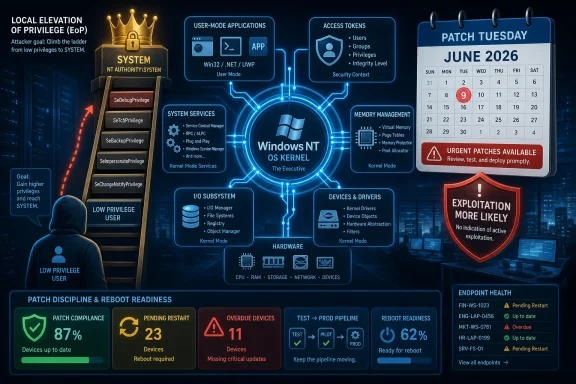
Microsoft published CVE-2026-42980 on June 9, 2026 as an NT OS Kernel elevation-of-privilege vulnerability affecting supported Windows client and server releases, rating it Important with a CVSS 3.1 base score of 7.8 and marking exploitation as more likely. That combination is the story: not a wormable headline-grabber, not a remote-code-execution fire drill, but a local privilege escalation bug in the part of Windows defenders can least afford to underestimate. In practical terms, this is the kind of flaw that turns an initial foothold into a full system compromise. The patch should be treated less like routine hygiene and more like a closing door that attackers will immediately start testing.
A 7.8 CVSS score can sound almost ordinary in a month when Microsoft’s update guide also contains 9.8 and even higher-rated issues. But CVSS was never a perfect urgency meter, especially for Windows kernel vulnerabilities. It is a structured way of describing conditions, not a crystal ball for adversary interest.
CVE-2026-42980’s vector tells a familiar story: local attack vector, low attack complexity, low privileges required, no user interaction, unchanged scope, and high confidentiality, integrity, and availability impact. Translated from scoring grammar into operational English, an attacker already running code as a low-privileged user may be able to climb to the kind of authority that lets them own the box.
That is why Microsoft’s “Exploitation More Likely” label matters. Microsoft is not saying the bug is being used in the wild, and the advisory does not list it as publicly disclosed or exploited at publication. But the company is saying enough about the shape of the vulnerability to suggest that reliable exploitation is a realistic concern.
The kernel is also not just another component in the Windows stack. It is the traffic controller between user-mode software, memory, devices, tokens, drivers, and the mechanisms that decide what every process is allowed to do. When a bug in that space earns a local-low-privilege-no-interaction vector, defenders should assume exploit writers will give it serious attention.
Once that first step succeeds, the attacker’s problem changes. They need to persist, disable tools, dump credentials, tamper with logs, move laterally, and access data that the original user account should not be able to touch. Kernel elevation bugs are the machinery that can make those next steps easier.
CVE-2026-42980 should be read in that context. The advisory does not describe a remote unauthenticated path into Windows from the internet. It describes a way for someone with a local foothold to potentially move from limited execution to high-impact control.
That distinction matters for prioritization, but it should not become an excuse for delay. In endpoint-heavy environments, “local” is often exactly where the attacker already is by the time defenders notice. Malware operators care deeply about local elevation because it closes the gap between compromise and dominance.
For CVE-2026-42980, the important point is that Microsoft has published the advisory and shipped fixes as part of the June 2026 security release. That gives defenders a high-confidence action path even when the public technical description remains sparse. You do not need a proof-of-concept to know whether to patch.
The flip side is that sparse public detail does not equal low risk. Microsoft’s update guide often withholds root-cause specifics at initial release, especially for vulnerabilities where extra detail could accelerate weaponization. Attackers, however, can diff patched and unpatched binaries, study changed code paths, and build their own understanding from the update itself.
This is one of the uncomfortable truths of Patch Tuesday. The same update that protects patched systems also gives researchers and adversaries a roadmap for understanding what changed. For a vulnerability Microsoft already marks as more likely to be exploited, the window between patch publication and practical exploit development deserves respect.
That is exactly the kind of signal enterprises should fold into patch triage. A local privilege escalation flaw with no user interaction and low complexity is useful to commodity malware, ransomware crews, red teams, and post-exploitation frameworks. The absence of active exploitation on day one is not a comfort blanket; it is a countdown.
There is also a difference between public exploit availability and private exploit utility. Kernel EoP bugs may circulate in closed criminal ecosystems or be reserved for targeted operations long before administrators see a polished proof-of-concept on GitHub. The more valuable the primitive, the less incentive sophisticated actors have to advertise it.
For home users, the answer is simpler: install the cumulative update when offered and reboot. For enterprise IT, the answer is more complicated but no less urgent: test quickly, deploy in rings, watch for known issues, and do not let the word “local” push this behind noisy but less useful vulnerabilities.
The advisory’s product mapping points across client and server builds rather than a narrow subsystem. Desktop fleets, VDI pools, jump boxes, domain-joined workstations, developer machines, and general-purpose servers all deserve attention. Kernel bugs rarely care whether a device is glamorous.
Server exposure should be viewed through the lens of post-compromise impact. A low-privilege account on a workstation is bad; a low-privilege foothold on a management server, build machine, backup host, or remote access server is much worse. If CVE-2026-42980 can be used to reach SYSTEM, then the asset value of the machine becomes the real severity multiplier.
Older supported platforms also complicate the operational picture. Windows Server 2012 and 2012 R2 environments under Extended Security Updates, legacy Windows 10 estates, and long-lived Server Core deployments tend to be exactly the places where patch windows are harder to negotiate. They are also the places attackers hope remain behind.
The practical task is to identify which cumulative update applies to each estate segment and ensure systems reach the fixed build level. For Windows 11 23H2, Windows 11 24H2, Windows 11 25H2, Windows 10 22H2, Windows Server 2019, Windows Server 2022, Windows Server 2025, and ESU-covered older servers, the answer is not one universal KB. It is the correct June 2026 package for that branch.
The advisory also indicates restarts are required for the Windows security updates. That should surprise no one for kernel fixes, but it matters for administrators who rely on maintenance windows that quietly defer reboots for days. A downloaded but unrebooted kernel patch is often a promise rather than protection.
Hotpatching may reduce pain in some Windows Server Azure Edition scenarios, but it is not a magic wand for every Windows deployment. Enterprises should verify whether their specific systems are actually covered by hotpatch servicing before assuming reboot pressure has disappeared. In most mixed estates, the old rule still holds: inventory, deploy, reboot, verify.
That does not mean every kernel bug becomes a reliable exploit overnight. Modern Windows has meaningful mitigations: kernel address protections, virtualization-based security, driver signing requirements, exploit mitigations, token protections, and increasingly restrictive defaults. But those mitigations raise cost; they do not erase the value of a good privilege escalation.
The absence of user interaction is particularly important. Bugs that require a victim to click, open, mount, preview, or accept a prompt give defenders more opportunities to reduce exposure through policy and user behavior. CVE-2026-42980’s vector points elsewhere: once the attacker has low privileges locally, the path does not depend on a second user mistake.
That is why exploit writers like these bugs. They can be chained behind phishing payloads, malicious installers, stolen remote-access sessions, browser escapes, and application sandbox breaks. A privilege escalation vulnerability is often not the first domino; it is the one that makes the rest fall faster.
The right prioritization model is not “sort by CVSS and patch downward.” It is “sort by exploitability, exposure, asset value, and blast radius.” On that basis, an NT OS Kernel local privilege escalation marked more likely to be exploited belongs near the top for endpoint and server teams.
Workstations used by administrators deserve special urgency. If an attacker can compromise a browser session or user app on an admin workstation and then elevate locally, credential theft and privileged lateral movement become much easier. Privileged Access Workstations, jump hosts, helpdesk machines, and developer endpoints should not be treated as ordinary desktops in the rollout plan.
So should internet-adjacent and identity-adjacent systems. Even though CVE-2026-42980 is not a remote network bug, machines that already face higher initial-compromise probability are better candidates for rapid patching. VPN portals, RDP gateways, bastions, management servers, CI/CD runners, and security tooling hosts all deserve an accelerated ring.
That does not mean administrators are powerless before the reboot. Least privilege, application control, EDR tamper protection, credential isolation, attack surface reduction rules, and local administrator hygiene all reduce the chance that a local exploit becomes a business-ending incident. But none of those measures should be mistaken for a fix.
Organizations should also watch for the usual post-Patch Tuesday traps. A cumulative update may be approved in a console but not installed on devices that are offline, bandwidth-constrained, paused, or managed by conflicting policies. Security teams need evidence of installation and reboot completion, not just a green approval state.
The known-issues side of Windows servicing also matters. Microsoft’s June release notes include known-issue tracking for some Windows packages. The existence of known issues is not a reason to ignore a kernel EoP marked more likely to be exploited; it is a reason to test rings intelligently and communicate risk clearly.
Legacy fleets are not merely harder to patch; they are harder to reason about. They often include older hardware, specialized applications, fragile drivers, and business exceptions that were supposed to be temporary. Kernel vulnerabilities expose the cost of carrying that complexity.
The same is true for older server platforms. Extended Security Updates keep some systems alive from a patching standpoint, but they do not make them modern. Administrators still have to deploy the monthly rollups, verify fixed builds, and accept that older platforms tend to accumulate operational exceptions.
The strategic lesson is not that every organization can move instantly. It is that every deferred migration should be counted as a security liability with a known monthly tax. CVE-2026-42980 is one of the bills.
A mature response starts with asset inventory. Which Windows versions are present? Which servers are ESU-covered? Which machines are excluded from normal patch cadence? Which devices are waiting on manual reboots? The advisory answers the vulnerability question; administrators still have to answer the estate question.
It also requires good exception governance. If a critical production server cannot take the June update this week, that exception should have an owner, compensating controls, an expiration date, and a risk sign-off. “We will get to it later” is not a control.
Security teams should also monitor for suspicious local privilege escalation behavior after publication. Look for unexpected child processes from low-privilege contexts, tampering with security tools, anomalous service creation, token manipulation, driver-loading attempts, and sudden privilege transitions on endpoints that have not yet been patched. Detection is not a substitute for the update, but it is the safety net during rollout.
 Microsoft’s Quiet Kernel Warning Is Louder Than the Score
A 7.8 CVSS score can sound almost ordinary in a month when Microsoft’s update guide also contains 9.8 and even higher-rated issues. But CVSS was never a perfect urgency meter, especially for Windows kernel vulnerabilities. It is a structured way of describing conditions, not a crystal ball for adversary interest.CVE-2026-42980’s vector tells a familiar story: local attack vector, low attack complexity, low privileges required, no user interaction, unchanged scope, and high confidentiality, integrity, and availability impact. Translated from scoring grammar into operational English, an attacker already running code as a low-privileged user may be able to climb to the kind of authority that lets them own the box.
That is why Microsoft’s “Exploitation More Likely” label matters. Microsoft is not saying the bug is being used in the wild, and the advisory does not list it as publicly disclosed or exploited at publication. But the company is saying enough about the shape of the vulnerability to suggest that reliable exploitation is a realistic concern.
The kernel is also not just another component in the Windows stack. It is the traffic controller between user-mode software, memory, devices, tokens, drivers, and the mechanisms that decide what every process is allowed to do. When a bug in that space earns a local-low-privilege-no-interaction vector, defenders should assume exploit writers will give it serious attention.
The Attack Starts After the First Compromise
The phrase “local privilege escalation” often lulls non-specialists into thinking the vulnerability is less urgent than remote execution. That is a mistake. Most intrusions already begin with something else: a stolen credential, a malicious attachment, a browser exploit, a VPN account, a helpdesk social-engineering hit, or a user tricked into running a loader.Once that first step succeeds, the attacker’s problem changes. They need to persist, disable tools, dump credentials, tamper with logs, move laterally, and access data that the original user account should not be able to touch. Kernel elevation bugs are the machinery that can make those next steps easier.
CVE-2026-42980 should be read in that context. The advisory does not describe a remote unauthenticated path into Windows from the internet. It describes a way for someone with a local foothold to potentially move from limited execution to high-impact control.
That distinction matters for prioritization, but it should not become an excuse for delay. In endpoint-heavy environments, “local” is often exactly where the attacker already is by the time defenders notice. Malware operators care deeply about local elevation because it closes the gap between compromise and dominance.
The Confidence Signal Cuts Both Ways
The user-facing explanation attached to this vulnerability metric is worth slowing down over: confidence is not merely a bureaucratic CVSS field. It describes how solidly the vulnerability is known to exist and how much trustworthy technical detail is available. In other words, it asks whether defenders and attackers are dealing with rumor, partial theory, or a confirmed vendor-acknowledged bug.For CVE-2026-42980, the important point is that Microsoft has published the advisory and shipped fixes as part of the June 2026 security release. That gives defenders a high-confidence action path even when the public technical description remains sparse. You do not need a proof-of-concept to know whether to patch.
The flip side is that sparse public detail does not equal low risk. Microsoft’s update guide often withholds root-cause specifics at initial release, especially for vulnerabilities where extra detail could accelerate weaponization. Attackers, however, can diff patched and unpatched binaries, study changed code paths, and build their own understanding from the update itself.
This is one of the uncomfortable truths of Patch Tuesday. The same update that protects patched systems also gives researchers and adversaries a roadmap for understanding what changed. For a vulnerability Microsoft already marks as more likely to be exploited, the window between patch publication and practical exploit development deserves respect.
“More Likely” Is Not “Exploited,” But It Is Not Background Noise
Microsoft’s exploitability assessment is easy to misread. “Exploitation More Likely” does not mean a zero-day campaign is already underway. It means Microsoft believes attackers are more likely to build reliable exploit code within a relevant time horizon based on factors such as attack complexity, exploit conditions, target value, and historical patterns.That is exactly the kind of signal enterprises should fold into patch triage. A local privilege escalation flaw with no user interaction and low complexity is useful to commodity malware, ransomware crews, red teams, and post-exploitation frameworks. The absence of active exploitation on day one is not a comfort blanket; it is a countdown.
There is also a difference between public exploit availability and private exploit utility. Kernel EoP bugs may circulate in closed criminal ecosystems or be reserved for targeted operations long before administrators see a polished proof-of-concept on GitHub. The more valuable the primitive, the less incentive sophisticated actors have to advertise it.
For home users, the answer is simpler: install the cumulative update when offered and reboot. For enterprise IT, the answer is more complicated but no less urgent: test quickly, deploy in rings, watch for known issues, and do not let the word “local” push this behind noisy but less useful vulnerabilities.
The Affected Surface Is Broad Because the Kernel Is Everywhere
CVE-2026-42980 sits under the NT OS Kernel label, which means the affected population spans far more than one feature toggle or optional app. Microsoft’s June 2026 release covers Windows 10, Windows 11, and multiple Windows Server generations, including still-supported and extended-security-update scenarios. That breadth is typical for core OS vulnerabilities, and it is precisely why they matter.The advisory’s product mapping points across client and server builds rather than a narrow subsystem. Desktop fleets, VDI pools, jump boxes, domain-joined workstations, developer machines, and general-purpose servers all deserve attention. Kernel bugs rarely care whether a device is glamorous.
Server exposure should be viewed through the lens of post-compromise impact. A low-privilege account on a workstation is bad; a low-privilege foothold on a management server, build machine, backup host, or remote access server is much worse. If CVE-2026-42980 can be used to reach SYSTEM, then the asset value of the machine becomes the real severity multiplier.
Older supported platforms also complicate the operational picture. Windows Server 2012 and 2012 R2 environments under Extended Security Updates, legacy Windows 10 estates, and long-lived Server Core deployments tend to be exactly the places where patch windows are harder to negotiate. They are also the places attackers hope remain behind.
The Patch Is Cumulative, but the Risk Is Specific
One advantage of modern Windows servicing is that administrators are not usually hunting for a one-off binary fix for a single CVE. The June cumulative updates carry the security fixes for supported Windows releases. That makes deployment mechanically simpler, even if organizational change control remains painful.The practical task is to identify which cumulative update applies to each estate segment and ensure systems reach the fixed build level. For Windows 11 23H2, Windows 11 24H2, Windows 11 25H2, Windows 10 22H2, Windows Server 2019, Windows Server 2022, Windows Server 2025, and ESU-covered older servers, the answer is not one universal KB. It is the correct June 2026 package for that branch.
The advisory also indicates restarts are required for the Windows security updates. That should surprise no one for kernel fixes, but it matters for administrators who rely on maintenance windows that quietly defer reboots for days. A downloaded but unrebooted kernel patch is often a promise rather than protection.
Hotpatching may reduce pain in some Windows Server Azure Edition scenarios, but it is not a magic wand for every Windows deployment. Enterprises should verify whether their specific systems are actually covered by hotpatch servicing before assuming reboot pressure has disappeared. In most mixed estates, the old rule still holds: inventory, deploy, reboot, verify.
Kernel Bugs Reward Fast Patch Diffing
Attackers do not need Microsoft to publish a detailed root-cause essay. Once a patch lands, the before-and-after comparison begins. Security researchers and adversaries can diff kernel binaries, inspect changed functions, watch for modified validation logic, and narrow the likely vulnerability class without waiting for a public advisory expansion.That does not mean every kernel bug becomes a reliable exploit overnight. Modern Windows has meaningful mitigations: kernel address protections, virtualization-based security, driver signing requirements, exploit mitigations, token protections, and increasingly restrictive defaults. But those mitigations raise cost; they do not erase the value of a good privilege escalation.
The absence of user interaction is particularly important. Bugs that require a victim to click, open, mount, preview, or accept a prompt give defenders more opportunities to reduce exposure through policy and user behavior. CVE-2026-42980’s vector points elsewhere: once the attacker has low privileges locally, the path does not depend on a second user mistake.
That is why exploit writers like these bugs. They can be chained behind phishing payloads, malicious installers, stolen remote-access sessions, browser escapes, and application sandbox breaks. A privilege escalation vulnerability is often not the first domino; it is the one that makes the rest fall faster.
Where Administrators Should Put It in the Queue
CVE-2026-42980 should sit high in June’s Windows patch queue, but not in isolation. Microsoft’s June 2026 release includes a large number of CVEs across Windows, Office, Exchange, .NET, Azure-related services, Visual Studio Code, Edge, and other products. Some carry higher base scores, some have remote attack vectors, and some may matter more in specific environments.The right prioritization model is not “sort by CVSS and patch downward.” It is “sort by exploitability, exposure, asset value, and blast radius.” On that basis, an NT OS Kernel local privilege escalation marked more likely to be exploited belongs near the top for endpoint and server teams.
Workstations used by administrators deserve special urgency. If an attacker can compromise a browser session or user app on an admin workstation and then elevate locally, credential theft and privileged lateral movement become much easier. Privileged Access Workstations, jump hosts, helpdesk machines, and developer endpoints should not be treated as ordinary desktops in the rollout plan.
So should internet-adjacent and identity-adjacent systems. Even though CVE-2026-42980 is not a remote network bug, machines that already face higher initial-compromise probability are better candidates for rapid patching. VPN portals, RDP gateways, bastions, management servers, CI/CD runners, and security tooling hosts all deserve an accelerated ring.
The Lack of a Workaround Makes Process the Mitigation
Microsoft’s listing for CVE-2026-42980 does not advertise a workaround or mitigation. That is common for kernel vulnerabilities, and it sharpens the operational message. If there is no supported registry key, service disablement, feature toggle, or configuration hardening step to neutralize the flaw, patching is the mitigation.That does not mean administrators are powerless before the reboot. Least privilege, application control, EDR tamper protection, credential isolation, attack surface reduction rules, and local administrator hygiene all reduce the chance that a local exploit becomes a business-ending incident. But none of those measures should be mistaken for a fix.
Organizations should also watch for the usual post-Patch Tuesday traps. A cumulative update may be approved in a console but not installed on devices that are offline, bandwidth-constrained, paused, or managed by conflicting policies. Security teams need evidence of installation and reboot completion, not just a green approval state.
The known-issues side of Windows servicing also matters. Microsoft’s June release notes include known-issue tracking for some Windows packages. The existence of known issues is not a reason to ignore a kernel EoP marked more likely to be exploited; it is a reason to test rings intelligently and communicate risk clearly.
Windows 10’s Long Goodbye Raises the Stakes
The 2026 timing is awkward for many Windows estates because Windows 10 is now deep into its post-mainstream reality for many organizations. Some machines remain on Windows 10 22H2 under extended arrangements, while others should already have moved to Windows 11. Either way, CVE-2026-42980 is a reminder that operating system lifecycle is not an accounting footnote.Legacy fleets are not merely harder to patch; they are harder to reason about. They often include older hardware, specialized applications, fragile drivers, and business exceptions that were supposed to be temporary. Kernel vulnerabilities expose the cost of carrying that complexity.
The same is true for older server platforms. Extended Security Updates keep some systems alive from a patching standpoint, but they do not make them modern. Administrators still have to deploy the monthly rollups, verify fixed builds, and accept that older platforms tend to accumulate operational exceptions.
The strategic lesson is not that every organization can move instantly. It is that every deferred migration should be counted as a security liability with a known monthly tax. CVE-2026-42980 is one of the bills.
The Real Test Is Patch Discipline, Not Advisory Reading
The Windows community has become very good at reading Patch Tuesday tables and very uneven at turning them into completed deployment. CVE-2026-42980 is a test of the gap between awareness and execution. Everyone can see “NT OS Kernel,” “Elevation of Privilege,” and “Exploitation More Likely.” The question is whether fleets actually move to fixed builds before exploit code matures.A mature response starts with asset inventory. Which Windows versions are present? Which servers are ESU-covered? Which machines are excluded from normal patch cadence? Which devices are waiting on manual reboots? The advisory answers the vulnerability question; administrators still have to answer the estate question.
It also requires good exception governance. If a critical production server cannot take the June update this week, that exception should have an owner, compensating controls, an expiration date, and a risk sign-off. “We will get to it later” is not a control.
Security teams should also monitor for suspicious local privilege escalation behavior after publication. Look for unexpected child processes from low-privilege contexts, tampering with security tools, anomalous service creation, token manipulation, driver-loading attempts, and sudden privilege transitions on endpoints that have not yet been patched. Detection is not a substitute for the update, but it is the safety net during rollout.
What This Kernel Fix Should Change This Week
CVE-2026-42980 is not the only June 2026 issue administrators need to care about, but it is a clean example of the kind of Windows vulnerability that deserves disciplined urgency. It is local, high-impact, broadly applicable, and judged more likely to be exploited. That should put it on the short list for immediate validation and deployment.- Organizations should deploy the applicable June 2026 Windows cumulative updates for affected client and server versions and verify that systems reboot into the fixed builds.
- Administrators should prioritize endpoints and servers where an initial foothold would carry outsized risk, including admin workstations, jump hosts, developer machines, management servers, and identity-adjacent infrastructure.
- Teams should not treat the lack of known exploitation at publication as a reason to defer, because Microsoft’s exploitability assessment indicates attackers are likely to find the vulnerability useful.
- Environments with Windows 10, Server 2012, or Server 2012 R2 under extended servicing should confirm that they are actually receiving and installing the relevant ESU updates.
- Security monitoring should focus on signs of post-compromise elevation while patch rollout is underway, especially on systems that cannot be updated immediately.
References
- Primary source: MSRC
Published: 2026-06-09T07:00:00-07:00
Security Update Guide - Microsoft Security Response Center
 msrc.microsoft.com
