

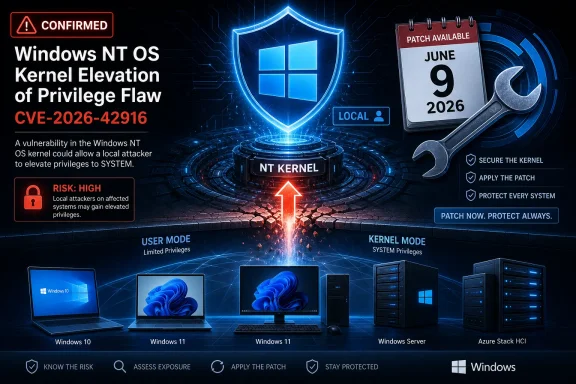
Microsoft Confirms the Kernel Bug, but Leaves the Playbook Blank
CVE-2026-42916 arrives with the familiar austerity of a Microsoft Security Response Center entry: a CVE number, a product family, an impact category, a severity rating, and very little narrative. The title says “NT OS Kernel Elevation of Privilege Vulnerability,” which is concise to the point of being almost opaque. That sparseness is not unusual for Patch Tuesday kernel fixes, but it creates a dangerous temptation to underrate the issue because the advisory does not hand defenders a colorful exploit story.
The important fact is that Microsoft has acknowledged the vulnerability in the Windows kernel. In vulnerability-scoring language, that matters because report confidence is not a decorative metric; it is a measure of whether defenders are dealing with rumor, partial research, or vendor-confirmed weakness. In this case, the vendor’s own publication moves the issue out of the gray zone. We may not know every code path involved, but we know enough to treat the flaw as a real security defect in a privileged Windows component.
Public aggregators list the issue as high severity with a CVSS 3.1 score of 7.8. They also describe the weakness as an integer underflow or wraparound condition in the Windows NT OS Kernel that allows an authorized attacker to elevate privileges locally. That combination is telling. A local, authenticated attacker is not the same as an unauthenticated Internet attacker, but “local” should not be read as “low risk” in 2026, when phishing, stolen credentials, browser escapes, malicious installers, compromised software updates, and living-off-the-land tradecraft routinely provide the initial execution attackers need.
The absence of published exploit details is therefore a mixed blessing. It reduces immediate copy-and-paste exploitability for low-skill actors, but it does not eliminate the risk for capable teams. Once a patch ships, the diff becomes a map. For kernel elevation bugs, the period after disclosure can be the moment when the vulnerability becomes more legible to attackers, not less.
Local Privilege Escalation Is the Second Step That Makes the First Step Matter
Windows security discussions often overvalue the first door and undervalue what happens after it opens. A remote code execution bug is obviously urgent because it can provide entry. But an elevation-of-privilege bug in the kernel is what can turn a limited entry into durable control.
Most modern Windows compromises are chains. An attacker may begin with a user-level process, a macro, a malicious shortcut, a stolen VPN credential, a vulnerable service account, or a browser-rendered payload running in a constrained context. The first foothold may not have administrative rights. It may be boxed in by user permissions, endpoint controls, application control, sandboxing, or virtualization-based protections.
Kernel elevation changes that equation. If the attacker can execute code locally and exploit the kernel, the prize is no longer the user’s account; it is the operating system’s trust boundary. A successful kernel EoP can enable tampering with security tools, dumping credentials, injecting into privileged processes, disabling protections, installing rootkit-like components, or staging lateral movement with far fewer constraints.
That is why “requires local access” should not calm administrators too much. In enterprise reality, local code execution is often the part attackers already have by the time defenders see the case. The kernel bug is the escalator, and escalators matter most in buildings where intruders already know how to get through the lobby.
The NT Kernel Remains Windows’ Most Consequential Attack Surface
The Windows NT OS Kernel is not just another component in the monthly patch ledger. It is the privileged core that mediates memory, scheduling, process isolation, system calls, security tokens, object management, and the boundary between user mode and kernel mode. Bugs here carry strategic value because the kernel sits beneath the mechanisms administrators rely on to contain user-level compromise.
The specific weakness class reportedly associated with CVE-2026-42916, integer underflow or wraparound, is a classic low-level failure mode. In plain English, the system performs arithmetic that produces a value smaller, larger, or otherwise different from what the surrounding logic assumes. In kernel code, that kind of mismatch can become dangerous when it feeds buffer sizes, object lengths, allocation calculations, reference counts, offsets, or access checks.
The exact exploitability depends on implementation details Microsoft has not fully laid out publicly. Some integer bugs are dead ends. Others become memory corruption primitives. Still others become authorization bypasses because the system believes it is handling one size, range, or object state while reality has shifted underneath it.
That ambiguity is why defenders should avoid both extremes. It is not responsible to claim that CVE-2026-42916 is already a turnkey SYSTEM exploit without public evidence. It is equally irresponsible to dismiss it because the advisory is short. The kernel is where modest-sounding arithmetic errors can have outsized consequences.
The Affected Product List Makes This a Fleet Problem, Not a Niche Patch
The affected product range is broad enough to matter across ordinary Windows estates. Public vulnerability listings associate CVE-2026-42916 with Windows 10, Windows 11, Windows Server 2012, Windows Server 2016, Windows Server 2019, Windows Server 2022, and Windows Server 2025. That spans consumer endpoints, corporate laptops, legacy servers, current data-center builds, and systems that may be stuck in extended-support or compatibility-driven maintenance patterns.
For home users, the answer is straightforward: take the cumulative update when offered. For managed environments, the question is sequencing. Kernel fixes have a long history of forcing administrators to balance security urgency against reboot coordination, driver compatibility, endpoint security hooks, VDI images, line-of-business software, and server maintenance windows.
The operational risk is not evenly distributed. A domain controller, Remote Desktop Session Host, jump server, developer workstation, build agent, hypervisor management host, or security tooling server deserves more attention than a lightly used kiosk. The vulnerability may be local, but the value of local privilege depends on where the attacker lands.
Server administrators should pay particular attention to systems that process untrusted files, expose remote login paths, run third-party agents, or host workloads for multiple users. A local kernel EoP on a single-user machine is serious; on a multi-user or high-trust server, it can become a pivot point.
Report Confidence Is the Quiet Metric That Changes the Patch Conversation
The user-supplied definition of report confidence gets to the heart of this advisory. Vulnerability management is not only about severity; it is about certainty. A theoretical issue with uncertain provenance is handled differently from a vendor-confirmed flaw with a shipped fix, even when both carry similar severity language.
For CVE-2026-42916, the confidence story is relatively strong. Microsoft’s own advisory confirms the vulnerability’s existence, assigns it to the NT OS Kernel, classifies the impact as elevation of privilege, and provides security update guidance through the normal channel. That does not mean defenders know every technical detail. It means the uncertainty is about exploitation mechanics, not about whether the flaw exists.
This distinction matters because CVE feeds are now consumed by automation at industrial scale. Security teams ingest advisory data, map it to assets, generate tickets, trigger patch rings, and score urgency through vulnerability-management platforms. When public detail is thin, those systems can either overreact to every high-severity CVE or underreact because the exploit narrative is not yet vivid.
A confirmed kernel EoP should fall into the middle path: no panic, no complacency. It deserves accelerated testing and deployment in environments where attackers are likely to achieve local code execution. It also deserves monitoring for post-disclosure exploit chatter, proof-of-concept publication, and any later change in Microsoft’s exploitability assessment.
The Patch Is the Mitigation Because the Boundary Is Too Low-Level for Comfort
Some vulnerabilities come with practical workarounds: disable a service, block a port, turn off a feature, change a registry key, restrict a protocol, or remove an optional component. Kernel elevation-of-privilege bugs rarely offer defenders that luxury. The vulnerable behavior is usually inside the operating system’s core execution environment, and the reliable fix is the updated binary.
That puts pressure on patch hygiene. Organizations that delay cumulative Windows updates because of testing debt are effectively carrying a growing set of local privilege-escalation opportunities. One kernel EoP may not be the compromise. A backlog of them becomes attacker optionality.
Endpoint detection and response tools can help detect exploitation attempts or post-exploitation behavior, but they should not be mistaken for a substitute patch. If the vulnerability allows code to reach kernel-level privilege, the attacker may be operating at a layer where user-mode monitoring is disadvantaged. Modern EDR products have kernel components of their own, but that simply reinforces the point: the kernel is the contested terrain.
Application control, least privilege, credential hygiene, and attack-surface reduction still matter because they make it harder to reach the starting line. But once Microsoft ships a kernel fix, the durable mitigation is to install it. Everything else is risk reduction around the edges.
Attackers Love Boring Bugs Because Enterprises Patch Boring Bugs Slowly
CVE-2026-42916 is not flashy. It has no marketing name, no logo, no public exploit write-up from a major research team, and no obvious remote attack path in the advisory. That is precisely why it may be mishandled.
Security teams are conditioned by scarcity. They cannot treat every advisory as a five-alarm fire, so they prioritize based on exploitation, exposure, asset criticality, and business impact. That is rational. The failure mode is letting “not remotely exploitable” become shorthand for “can wait until the next broad maintenance cycle,” regardless of where the vulnerable machines sit.
Attackers do not need every machine patched slowly. They need one path through the environment. A developer workstation with cached credentials, a help desk machine with remote-management tooling, a shared server with multiple interactive users, or an RDS host with exposed authentication can be enough. A local kernel EoP is most dangerous when paired with systems where local access is plausible and the resulting privilege has broad reach.
The boringness also helps attackers operationally. A defender may hunt aggressively for exploitation of a famous remote code execution flaw while missing the quieter privilege jump that followed a routine phishing incident. In incident response, the local privilege escalation stage is often the hinge between “contained user compromise” and “domain problem.”
Windows 10’s Long Goodbye Raises the Stakes for Stragglers
The presence of Windows 10 in the affected product set lands awkwardly in 2026. Windows 10’s mainstream support story has already moved into its late-life phase, and many organizations are still managing the friction between hardware eligibility, application compatibility, user disruption, and Windows 11 migration timelines. A kernel vulnerability that spans Windows 10 and Windows 11 is a reminder that migration does not remove the need for disciplined monthly servicing.
For systems still on Windows 10 under extended servicing arrangements or specialized support channels, CVE-2026-42916 should be treated as part of a broader risk ledger. The longer a platform approaches or passes its general support horizon, the more patching becomes an exercise in exception management. Exceptions are where attackers look for stale controls, inconsistent coverage, and forgotten machines.
Windows Server complicates the picture further. Server 2012 and older operational patterns persist in many environments because business systems outlive the enthusiasm of the teams that deployed them. When a vulnerability affects old and new server generations alike, administrators must avoid the comforting fiction that only legacy systems are exposed. Newer servers need the patch too; older servers need both the patch and a retirement plan.
The strategic point is that kernel vulnerabilities punish fragmented estate management. If inventory is incomplete, patch reporting is unreliable, or reboot compliance is treated as optional, a confirmed kernel EoP becomes a test of operational maturity.
The Advisory’s Silence Is Not a Defender’s Permission Slip
Microsoft’s sparse disclosure style is partly defensive. Publishing full exploit mechanics on day one would help attackers as well as administrators. But sparse advisories shift more interpretive burden onto defenders, who must make decisions from severity, affected products, exploitability signals, and their own asset context.
That burden is especially heavy for small businesses and smaller IT teams. They may not have exploit-intelligence feeds, test labs, staged deployment rings, or dedicated vulnerability analysts. For them, the practical answer is simpler: install the June 2026 Windows security updates as soon as operationally feasible, and do not let this one drift just because the advisory lacks drama.
Larger organizations should do more than patch eventually. They should confirm whether all affected Windows client and server versions are represented in asset inventory, whether update compliance reports reflect post-reboot state, and whether high-risk systems receive priority. A Windows update reported as installed before reboot may not deliver the same assurance as a fully restarted machine running the fixed build.
The silence also argues for monitoring. If public proof-of-concept code appears, if Microsoft revises the advisory, if CISA adds the vulnerability to a known-exploited list, or if security vendors observe exploitation, the urgency changes. Vulnerability management should be able to absorb that new signal quickly instead of waiting for the next committee meeting.
Kernel Fixes Test the Trust Between Security and Operations
Every Windows administrator knows the tension. Security wants fast patching. Operations wants stability. Kernel updates sit at the fault line because they touch the code most likely to interact with drivers, endpoint agents, virtualization layers, storage filters, and legacy software.
That does not make delay inherently irresponsible. It makes blind delay irresponsible. The right process is staged urgency: test quickly, deploy first to representative rings, monitor for regressions, then expand. For servers, maintenance windows may be unavoidable, but the window should be chosen with the vulnerability in mind rather than whatever cadence happens to be convenient.
Driver-heavy endpoints deserve special attention. Security products, VPN clients, backup agents, disk encryption tools, anti-cheat software, hardware management utilities, and virtualization components all live close to the kernel boundary. A well-run patch process identifies the machines most likely to experience compatibility problems without allowing that subset to stall the entire fleet.
There is also a communications task. Users understand emergency patching when the news says “remote code execution.” They may not understand why a local privilege-escalation bug requires a reboot during a busy week. IT teams should explain that the fix protects the layer attackers try to reach after they compromise an account or application. That framing turns an abstract kernel flaw into a concrete business risk.
The Real Risk Is the Chain, Not the Single CVE
CVE-2026-42916 should not be evaluated in isolation. Modern intrusions are modular. One vulnerability gets execution, another gets privilege, a misconfiguration exposes credentials, a weak segmentation rule enables movement, and a cloud token opens a second front. The kernel EoP is one link, but it can be the link that makes the rest of the chain viable.
This is why defenders should resist CVSS tunnel vision. A 7.8 high-severity score may seem less urgent than a 9.8 network worm candidate. But the most damaging incidents often use “merely high” vulnerabilities after an initial compromise. The score describes general technical severity; it does not know whether the affected machine is a domain admin workstation or a disposable test box.
The exploitability assumptions also deserve nuance. “Authorized attacker” does not necessarily mean a malicious insider with a badge and a grudge. It can mean malware running under a phished user’s context. It can mean a compromised low-privilege service account. It can mean a foothold obtained through a different vulnerability entirely.
That is the uncomfortable truth of local privilege escalation: by the time it matters, the attacker may already be inside. The question is whether your controls can keep that foothold from becoming authority.
The June Patch Should Force a Review of Old Assumptions
CVE-2026-42916 is a good excuse to revisit several assumptions that often go stale in Windows environments. The first is that standard users are safe enough by default. Standard user rights are valuable, but they are not a magic shield against kernel bugs that exist precisely to cross privilege boundaries.
The second is that servers without public-facing services are low priority. Internal servers can be more valuable to an attacker than Internet-facing systems because they often hold credentials, data, management roles, or lateral-movement opportunities. If users or services can execute code locally, a local EoP remains relevant.
The third is that vulnerability management can be outsourced entirely to scoring feeds. Scores help triage, but they do not know your architecture. A kernel EoP on a machine used by a domain administrator is not equivalent to the same CVE on a locked-down lab endpoint.
The fourth is that reboot compliance is bookkeeping. For Windows kernel updates, reboot state is security state. Until the fixed kernel is actually loaded, the estate may still be exposed even if a dashboard shows update installation activity.
The Patch Queue Has a Memory, and Attackers Read It
One of the most underappreciated realities of monthly patching is that attackers benefit from defender delay after the patch. Once Microsoft releases an update, researchers and adversaries can compare binaries, identify changed code paths, and infer the bug class. This does not happen instantly for every vulnerability, but the economics favor analysis when the affected component is valuable and widely deployed.
Kernel bugs are valuable. Windows is widely deployed. That should be enough to assume that CVE-2026-42916 will receive attention beyond the defenders reading the advisory.
The patch queue therefore has a kind of memory. A vulnerability that seems quiet on disclosure day can become noisier after reverse engineering, proof-of-concept development, or exploit integration into intrusion tooling. Organizations that defer patching for weeks are not standing still; they are moving into a period where attacker knowledge may be increasing.
This dynamic is particularly harsh for organizations with slow change control. The longer it takes to approve routine Windows security updates, the more likely the environment is to be exposed during the window when exploit details mature. The goal is not reckless same-day deployment everywhere. The goal is a patch process fast enough that attackers do not get a comfortable research lead.
The Kernel Bug Belongs at the Front of June’s Windows Work
CVE-2026-42916 is not the only vulnerability administrators will handle this month, and it may not be the loudest. But it deserves a prominent place in June’s Windows patch planning because it affects the operating-system core, has high severity, and sits in the privilege-escalation category attackers routinely need.
For WindowsForum readers, the practical path is familiar but worth spelling out. Check Windows Update on personal machines. Validate enterprise update rings. Confirm server patch baselines. Watch for known issues with the relevant cumulative updates. Verify reboots. Keep an eye on exploit intelligence in the days after release.
Most importantly, do not confuse limited public detail with limited impact. Microsoft has confirmed enough for defenders to act. The remaining uncertainty is about how attackers may exploit the flaw, not whether the flaw is a fiction.
The June 2026 Kernel Fix Leaves Little Room for Theater
CVE-2026-42916 is a measured-risk patching problem, not a panic event. The facts that matter are concrete enough to drive action.
- Microsoft disclosed CVE-2026-42916 on June 9, 2026 as an NT OS Kernel elevation-of-privilege vulnerability.
- Public vulnerability data rates the issue as high severity with a CVSS 3.1 score of 7.8.
- The vulnerability is local privilege escalation, meaning attackers generally need some form of local code execution or authorized access before it becomes useful.
- The affected Windows family reportedly spans Windows 10, Windows 11, and Windows Server releases from Server 2012 through Server 2025.
- The most sensible mitigation is to apply the relevant June 2026 Windows security updates and verify that machines have rebooted into the fixed build.
- The advisory’s sparse detail should reduce public exploit handholding, but it should not reduce patch priority for high-value endpoints and servers.
CVE-2026-42916 is the kind of Windows vulnerability that rewards mature operations rather than dramatic reaction. It asks whether an organization can recognize a confirmed kernel flaw, map it to real assets, prioritize the machines where local compromise would hurt most, and patch quickly enough that attacker curiosity does not become attacker advantage. The next few weeks will not be defined by whether this CVE gets a catchy name; they will be defined by whether Windows estates quietly close a kernel-level door before someone else learns how to walk through it.