

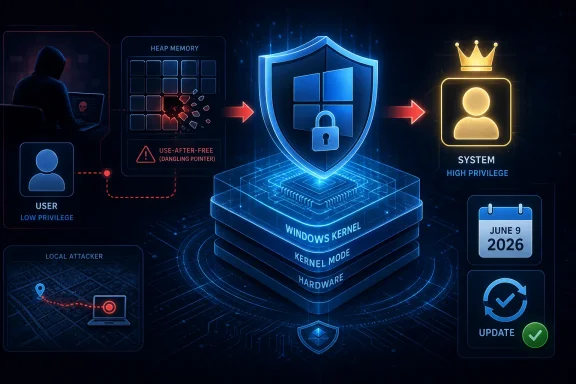
Microsoft’s Sparse Entry Still Says Enough
CVE-2026-48583 arrives in Microsoft’s June 2026 Patch Tuesday release as one of several Windows kernel-class fixes in a very large security drop. The public description is short, but it is not empty: Windows Kernel, elevation of privilege, local attack, authorized attacker, use after free, high severity by CVSS scoring, Important by Microsoft’s severity label.
That combination is familiar to anyone who has triaged Windows updates for a living. A local attacker requirement lowers the immediate panic level compared with a network-reachable remote code execution bug, but it does not make the issue minor. Most modern Windows compromises are staged, and local privilege escalation is what often separates “malware running as a user” from “malware owning the box.”
The wording also matters because Microsoft is not describing a speculative weakness. The flaw has a CVE, a product assignment, a severity rating, and a patch path. In vulnerability management terms, that pushes the issue out of rumor territory and into the operational queue.
The user-supplied text about confidence in vulnerability existence maps neatly to the real-world problem here. Sometimes defenders are asked to prioritize ghosts: vague advisories, unverified exploit chatter, half-published research, or vendor silence. CVE-2026-48583 is different. The existence of the vulnerability is vendor-acknowledged, and the technical shape is specific enough to guide prioritization without handing attackers a full exploit recipe.
The Kernel Is Where “Local” Stops Sounding Harmless
Security teams have spent years teaching executives not to panic over every “local” vulnerability. That lesson is useful, but only up to a point. Local access is not a meaningful barrier once phishing, browser exploitation, stolen credentials, malicious documents, exposed RDP, helpdesk social engineering, and software supply-chain footholds are already in the threat model.
Kernel privilege escalation is valuable because Windows draws its strongest boundary between user mode and kernel mode. A bug in the Windows Kernel can let code escape the limits of a standard or low-privileged account and operate with far greater authority. That can mean disabling security tools, reading protected memory, tampering with logs, installing persistence, dumping credentials, or making cleanup harder.
This is why EoP bugs so often appear in exploit chains. A remote code execution vulnerability may get an attacker onto a system, but it may land them in a constrained process. A kernel EoP can turn that beachhead into administrator- or SYSTEM-level leverage. In practice, attackers do not need every bug to be remote if they can combine one remote foothold with one local escalation.
CVE-2026-48583 is therefore best understood as an amplifier. It does not begin the attack from across the internet, at least according to the public description, but it can make an existing local foothold more consequential. That is precisely why kernel EoP vulnerabilities receive serious attention even when they lack the headline appeal of a wormable service flaw.
Use-After-Free Is a Small Phrase With a Long Exploit History
Microsoft’s public characterization points to a use-after-free issue, commonly associated with memory lifetime mistakes. In simple terms, software frees a chunk of memory but later continues to use a reference to it. If an attacker can influence what occupies that memory afterward, the stale reference can become a pathway to controlled behavior.
In kernel code, that class of mistake is especially dangerous. The kernel manages privileged structures, hardware interactions, process state, access control decisions, memory mappings, and security boundaries that ordinary applications are not supposed to touch. A memory corruption flaw there may be harder to exploit than a simple logic bug, but the payoff is bigger.
The phrase “dangling pointer” often appears around these issues because that is the core failure mode: a pointer remains after the object it pointed to is no longer valid. From a defender’s standpoint, the exact exploit engineering is less important than the security consequence. If Microsoft says the issue allows local privilege elevation, the operational question is whether unpatched systems remain exposed to code that can cross the privilege boundary.
There is also a reason Microsoft’s public advisory does not provide step-by-step exploitation details. The Security Update Guide is designed to let defenders act while limiting immediate attacker enablement. That leaves administrators with a familiar asymmetry: enough information to patch, not enough to fully model exploitability in their own environment without reverse engineering the update.
“Important” Is Not a Synonym for “Later”
Microsoft’s severity vocabulary can be misleading outside the security world. “Critical” is the siren, but “Important” is where much of the enterprise pain lives. Important vulnerabilities frequently require authenticated access, local execution, user interaction, or some other precondition, yet they still become indispensable pieces of attack chains.
A 7.8 CVSS score reinforces that reading. It is high, not catastrophic, and it reflects a local vector with low attack complexity, low privileges required, no user interaction, unchanged scope, and high impact across confidentiality, integrity, and availability. Those ingredients describe a bug that may not open the front door, but can make a breached endpoint dramatically more useful to an intruder.
This is the patching trap. Organizations often sort first by Critical severity and internet exposure, which is sensible during triage. But if Important local EoP bugs keep slipping into the “next cycle” bucket, attackers inherit a population of machines where initial access is easier to convert into durable control.
For home users, the advice is simpler: install the cumulative update. For IT departments, the decision is not whether this matters; it is where it sits among the rest of June’s large Microsoft release. Kernel EoP bugs should not automatically outrank every remote code execution flaw, but they should rarely be treated as background noise.
Patch Tuesday’s Volume Is Now Part of the Risk
The June 2026 Patch Tuesday release is not small. Reporting on the release counted roughly 200 Microsoft flaws addressed that day, including multiple Critical vulnerabilities, dozens of elevation-of-privilege issues, and several publicly disclosed zero-days. CVE-2026-48583 is one entry in a crowded table.
That crowding changes how vulnerabilities are perceived. A single kernel EoP in a quiet month would receive more attention. In a month with BitLocker, Secure Boot, Remote Desktop, Kerberos, Hyper-V, graphics, HTTP/2, and other Windows components in the mix, even serious bugs can become line items.
This is where mature patch management matters. The right response is not to read every CVE as equal, nor to chase only the most frightening headline. It is to group updates by exploit path, asset exposure, business criticality, and the likelihood that a bug becomes useful inside a broader intrusion.
CVE-2026-48583 belongs in the endpoint and server privilege-escalation bucket. It matters most on systems where untrusted users can run code, where malware exposure is realistic, where multiple users share infrastructure, or where compromise of a single host can lead to domain or cloud identity consequences. That means workstations, jump boxes, terminal servers, developer machines, and broadly deployed Windows Server fleets all deserve attention.
The Confidence Signal Is Stronger Than the Detail Signal
The metric described in the prompt is essentially about epistemology: how sure are we that the vulnerability exists, and how much technical detail is known? CVE-2026-48583 scores well on the first part and modestly on the second. Microsoft has acknowledged the issue, assigned it to the Windows Kernel, published severity and exploitability attributes, and shipped updates. That is high confidence.
The second part is more constrained. Publicly available details do not appear to include a proof of concept, a vulnerable code path, a researcher write-up, or a full exploitation narrative. That reduces the amount of technical knowledge available to would-be attackers from public sources, at least initially.
But that should not be confused with low attacker interest. Patch diffing is real. Once Microsoft ships a fix, skilled researchers and offensive teams can compare changed binaries, inspect kernel behavior, and work backward toward the flaw. The clock does not start when a proof of concept appears on GitHub. It starts when the patch lands.
This is the uncomfortable bargain of Patch Tuesday. Microsoft must fix vulnerabilities publicly, defenders must deploy those fixes, and attackers can study the same update stream. Sparse disclosure buys time; it does not buy safety forever.
Administrators Should Read This as an Endpoint Control Test
For enterprise IT, CVE-2026-48583 is not only a patching event. It is a test of whether endpoint controls still matter after initial access. A kernel EoP assumes the attacker already has some local execution context, so the practical question becomes: how easily can that happen in your environment?
Application control, least privilege, macro restrictions, browser isolation, EDR tamper protection, credential guardrails, and software update hygiene all influence whether a local EoP becomes a meaningful path. None of those controls replaces patching. But they reduce the number of places where an attacker can bring exploit code to bear.
The most exposed systems are often not the obvious ones. Developer workstations may run complex toolchains, local services, unsigned utilities, virtualization stacks, and privileged scripts. Helpdesk machines often have access to management consoles. Shared servers may run user workloads that blur the line between “authorized local user” and “trusted local user.”
The phrase “authorized attacker” should therefore be read carefully. It does not necessarily mean a trusted employee with malicious intent. It can mean malware running under a compromised account. It can mean a low-privilege foothold obtained through an entirely different vulnerability. It can mean a user session that should never have had the power to become a system compromise.
Windows 10’s Late-Life Reality Makes the Timing Sharper
The June 2026 timing lands in a Windows ecosystem still dealing with the long tail of Windows 10 and the continuing migration to Windows 11. For organizations on supported Windows 10 editions or paid extended security arrangements, the patch question remains straightforward. For unsupported or poorly managed machines, each new kernel EoP is another reminder that the threat model does not retire just because hardware and application compatibility plans lag.
Windows 11 does not make kernel vulnerabilities disappear, but newer platform defaults and security features can change exploit reliability and post-exploitation options. Virtualization-based security, memory integrity, stronger driver policies, and modern credential protections all matter. Their effectiveness depends on configuration, hardware support, and whether organizations have disabled them to preserve compatibility.
That is the hard part for admins: the safest Windows design is often not the one running in production. Old drivers, endpoint agents, VPN clients, line-of-business software, and performance-sensitive workloads all create pressure to weaken platform protections. Kernel EoP bugs expose the cost of those compromises.
CVE-2026-48583 is a patchable vulnerability, not a referendum on every Windows hardening decision. But it fits the broader pattern: Microsoft keeps raising the floor, attackers keep hunting below it, and organizations stuck on legacy assumptions keep paying the tax.
The Absence of Known Exploitation Is Useful, Not Comforting
There is no public indication from the June Patch Tuesday reporting that CVE-2026-48583 was one of the publicly disclosed or actively exploited zero-days. That distinction matters. A vulnerability known to be exploited in the wild deserves emergency handling; one without known exploitation can usually move through a disciplined accelerated patch process.
But “not known exploited” is not the same as “not exploitable.” It can mean no exploitation has been observed, no exploitation has been disclosed, or no exploitation has been tied to the CVE yet. Defenders should treat that as a prioritization input, not a permission slip.
The early period after a patch is also a strange interval. Defensive teams are reading advisories and scheduling maintenance windows. Offensive teams are doing the same, but with debuggers. Public exploit availability may lag behind patch release, especially for kernel bugs, but history has repeatedly shown that the lag can shrink quickly when a vulnerability looks useful.
That is why the right posture is urgency without panic. Push updates first to high-risk endpoint populations and systems where privilege escalation would have outsized consequences. Monitor for update regressions, but do not let regression anxiety become indefinite deferral.
The Real Risk Is the Chain, Not the Single CVE
Treating CVE-2026-48583 as a standalone bug understates its role. A local kernel EoP typically becomes dangerous in combination: phishing plus EoP, browser escape plus EoP, malicious installer plus EoP, exposed service plus EoP, stolen VPN credential plus EoP. The vulnerability’s practical value is measured by what it enables after something else has already gone wrong.
This is where Windows defenders must think like attackers. The first step of an intrusion is often noisy, unreliable, or constrained. The privilege escalation step is what makes the compromise cleaner. Once an attacker gains higher privileges, they can interfere with security tooling, access secrets, create persistence, and move laterally with more confidence.
It also changes incident response. A compromised standard user account and a compromised kernel-level host are very different containment problems. The former might be remediated through credential resets, profile cleanup, and targeted malware removal. The latter raises harder questions about trust, persistence, forensic completeness, and whether the system can be safely recovered without reimaging.
That is why kernel EoP bugs deserve a structural place in patch prioritization. They are not always the first domino, but they are often the domino that makes the rest fall faster.
Microsoft’s Disclosure Style Leaves Defenders Filling in the Gaps
Microsoft’s modern Security Update Guide is built for scale: CVE identifiers, severity, affected products, CVSS vectors, exploitability notes, FAQs where needed, and links into deployment artifacts. It is efficient, machine-readable enough for tooling, and far better than the era when administrators had to parse monolithic bulletins by hand.
But the format also encourages a false sense of precision. A CVSS score can tell you that CVE-2026-48583 is high severity. It cannot tell you whether your EDR blocks likely exploit behavior, whether your custom driver stack changes exposure, whether your VDI pools are most at risk, or whether your patch ring will collide with a business-critical workload.
The sparse advisory therefore shifts interpretation onto defenders. Kernel EoP plus use-after-free plus local authorized attacker is enough to act, but not enough to model every consequence. That is frustrating, but it is also normal for Windows kernel vulnerabilities.
Administrators should resist the temptation to wait for perfect detail. By the time exploit write-ups clarify everything, the defender’s advantage from early patching may already be gone. In this case, confidence in the vulnerability’s existence is high enough that the absence of granular public detail should accelerate patching rather than delay it.
Home Users Get the Easy Version of a Hard Problem
For individual Windows users, the practical answer is blessedly dull: let Windows Update install the June 2026 cumulative update and reboot. Most home users do not need to track CVSS vectors or compare kernel exploit classes. They need to avoid becoming the unpatched endpoint that malware can turn into a full compromise.
The complication is the reboot. Windows security updates still compete with user impatience, laptop sleep states, metered connections, gaming sessions, and the universal desire to postpone disruption. Local privilege escalation vulnerabilities are exactly the kind of bug that makes postponement risky because users may not notice the initial foothold that makes the EoP useful.
Security-minded enthusiasts should also check whether platform protections are enabled. Memory integrity, firmware updates, secure boot health, driver hygiene, and removal of abandoned utilities all contribute to a less forgiving environment for kernel exploitation. Patching is the main fix, but hardening reduces the blast radius when the next bug appears.
For WindowsForum readers who support family machines, this is one of those months where “just run updates” is not lazy advice. It is the right advice.
Enterprise Patch Rings Need a Faster Lane for Kernel EoP
The standard enterprise patching model often moves through pilot, broad validation, staged deployment, and final enforcement. That process exists for good reasons. Bad updates can break printing, VPN clients, line-of-business applications, authentication flows, and server workloads. Nobody wants security policy to become self-inflicted downtime.
Still, a kernel EoP deserves a faster lane than routine quality fixes. The question is not whether to abandon testing. The question is whether the organization can test quickly enough to preserve the security value of the patch.
Good patch rings should already distinguish between domain controllers, exposed servers, user workstations, privileged access workstations, developer systems, kiosks, and shared infrastructure. CVE-2026-48583 pushes priority toward places where attackers are most likely to obtain local execution and where escalation would matter most. That usually means endpoints before obscure back-office systems, but every environment has its own topology.
The worst approach is flat deployment by convenience. If the same 30-day patch timeline applies to a receptionist’s PC, a domain admin jump host, a developer workstation with production credentials, and a lightly used lab machine, the organization is not doing risk-based patching. It is doing calendar-based hope.
The June Release Is a Reminder That Security Debt Compounds
One kernel EoP is manageable. Several months of deferred kernel EoPs are a problem. Add browser flaws, Office bugs, RDP issues, boot-chain bypasses, identity vulnerabilities, and third-party driver weaknesses, and the endpoint becomes a layered stack of old assumptions.
Attackers do not need every vulnerability to work. They need one viable chain against one valuable target. Security debt increases the probability that some combination of bugs, misconfigurations, weak credentials, and user behavior will line up.
CVE-2026-48583 should therefore be used as a forcing function. If patch compliance dashboards show missing cumulative updates from prior months, the June release is not merely another deployment. It is an opportunity to close old gaps before new exploit tooling arrives.
This is especially important for small businesses and lightly managed environments. They may not face nation-state operators, but commodity malware increasingly borrows techniques once reserved for more capable actors. A high-value local privilege escalation primitive does not stay boutique forever if exploit code becomes reliable and reusable.
The Evidence Points to Action, Not Alarm
CVE-2026-48583 is serious because Microsoft confirmed a high-severity Windows Kernel elevation-of-privilege flaw on June 9, 2026, not because public exploit details are abundant. The public record says enough to prioritize it: local attacker, low privileges, no user interaction, use-after-free, high impact, and an official fix. That is the kind of vulnerability that turns access into authority.
Defenders should keep the response proportional. This is not described as wormable, remotely reachable, or known exploited at publication time. It should not eclipse every Critical remote code execution flaw in the June release. But it should sit high in the workstation and privileged-system patch queue.
The confidence metric in the prompt cuts through the noise. Confidence in existence is high because the vendor has acknowledged and patched it. Confidence in fine-grained exploitation details is lower because the public disclosure is intentionally limited. Urgency remains meaningful because attackers can learn from patches faster than many organizations deploy them.
The Patch Window Is the Battleground This Time
CVE-2026-48583 gives Windows admins a familiar but unforgiving set of facts, and the operational lesson is concrete.
- Microsoft disclosed and patched CVE-2026-48583 on June 9, 2026, as a Windows Kernel elevation-of-privilege vulnerability.
- The flaw is rated Important by Microsoft and carries a high CVSS score of 7.8.
- The public technical description points to a use-after-free condition that can allow an authorized local attacker to elevate privileges.
- The vulnerability is best treated as an attack-chain enabler rather than a standalone internet-facing emergency.
- Workstations, developer machines, privileged access systems, shared servers, and other environments where local code execution is plausible should move early in patch deployment.
- The lack of public exploit detail should not be mistaken for safety, because patch diffing can turn sparse disclosure into actionable knowledge over time.
CVE-2026-48583 is not the loudest kind of Windows vulnerability, but it is one of the most operationally important kinds: a kernel flaw that rewards attackers who have already found a way onto the machine. The organizations that do best with this class of bug will not be the ones that wait for exploit drama; they will be the ones that treat confirmed privilege-escalation fixes as part of the same defensive tempo as phishing resistance, identity hygiene, endpoint hardening, and incident containment. June’s patch is available now, and the next race is not between Microsoft and attackers — it is between attackers studying the fix and defenders deploying it before the gap becomes useful.