

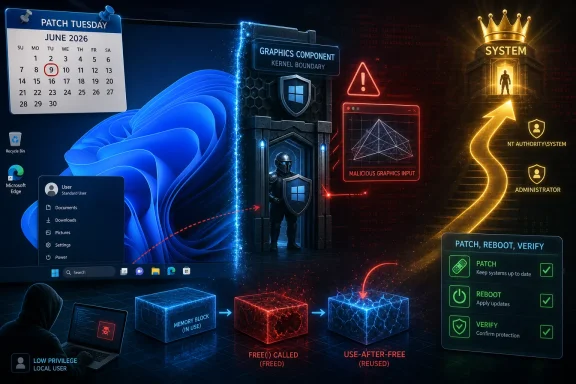
Microsoft’s Graphics Stack Still Sits Too Close to the Crown Jewels
The phrase “Microsoft Graphics Component” sounds almost generic enough to disappear into the monthly patch pile. That is the problem. Graphics is not a niche subsystem used only by games, creative apps, or GPU-tuned workstations; it is part of the daily execution environment of Windows itself.
Every interactive Windows system is constantly asking the graphics stack to draw, compose, scale, render fonts, manage windows, decode surfaces, and mediate between user-mode applications, drivers, and kernel-facing components. That ubiquity gives graphics vulnerabilities a familiar security profile: they may not be remotely reachable on their own, but once an attacker has any foothold on a machine, they can become the ladder.
CVE-2026-42986 is an elevation-of-privilege vulnerability, not a remote-code-execution vulnerability. In plain English, Microsoft is not saying that a random attacker on the Internet can send a packet to a Windows PC and immediately take it over through this flaw. Microsoft is saying that someone who can already run code locally as an authorized, lower-privileged user may be able to move upward.
That distinction matters, but it should not comfort administrators too much. Modern compromises are chains, not single dramatic movie-scene exploits. Phishing gets code execution. A browser bug gets sandboxed code execution. A stolen password gets a user session. Then a local privilege escalation turns that beachhead into administrative control.
The graphics component has been part of that story for years because it is exposed to user-controlled inputs while being close to privileged execution paths. A bug in memory lifetime management inside such a subsystem does not have to be elegant to be dangerous. It only has to be reliable enough.
A High CVSS Score Hides a Very Specific Threat Model
The public scoring attached to CVE-2026-42986 lands at 7.8 under CVSS 3.1, which puts it in the “high” category. The vector is the classic local privilege-escalation pattern: local attack vector, low attack complexity, low privileges required, no user interaction, unchanged scope, and high impact to confidentiality, integrity, and availability. That is security shorthand for a bug that is not directly remote but could be very consequential once reached.
The most important part of that vector is not the final number. It is the combination of low attack complexity and no user interaction. A local exploit that requires an exotic race, a rare hardware configuration, or a victim to open a very specific file is one kind of risk. A local exploit that can be attempted by a low-privileged user without further user participation is another.
Microsoft’s description says the flaw is a use-after-free in the Microsoft Graphics Component. In memory-safety terms, a use-after-free happens when software continues to reference memory after it has been released. If an attacker can influence what occupies that freed memory later, the program may read or act on data the attacker effectively controls.
That is the tidy explanation. The messy reality is that reliable exploitation depends on allocator behavior, object lifetime, timing, mitigations, kernel boundaries, and the exact code path involved. Microsoft has not published that level of detail, which is normal, but the broad class is serious enough that defenders should not wait for proof-of-concept code before acting.
The “local” label also deserves translation. Local does not necessarily mean a person sitting at a keyboard. It can mean malware already running in a user context, a malicious insider with limited rights, a compromised remote desktop session, a low-privileged service account, or an attacker who has landed inside a virtual desktop environment. In enterprise security, “local” is often the second stage of a remote compromise.
The Report Confidence Trap Cuts Both Ways
The user-provided text about report confidence is useful because it points to a recurring problem in vulnerability triage: not every CVE arrives with the same evidentiary weight. Sometimes a vulnerability is merely rumored. Sometimes a vendor confirms the issue but withholds details. Sometimes independent research confirms the root cause, exploitability, and affected versions.
CVE-2026-42986 sits in the category that administrators see most often from Microsoft: the vendor has acknowledged the vulnerability, assigned it a CVE, described its impact class, published a severity score, identified affected Windows families, and released or associated it with security updates. That gives defenders a high degree of confidence that the vulnerability exists, even though the public technical detail remains sparse.
This is where security teams can misread the situation. A lack of exploit narrative is not the same as a lack of exploitability. Microsoft’s advisories are deliberately conservative in what they reveal, particularly for memory-corruption bugs in privileged components. The missing exploit walkthrough is a disclosure choice, not a safety signal.
At the same time, sparse detail limits what defenders can do beyond patch management and exposure reduction. You cannot easily write a targeted detection rule for “use-after-free in Microsoft Graphics Component” without knowing the triggering interface, call pattern, crash signature, or exploit artifacts. In practice, that means organizations should focus less on clever compensating controls and more on update compliance, least privilege, endpoint telemetry, and post-exploitation detection.
The report-confidence lesson, then, is not “panic because Microsoft confirmed it.” It is act because the vendor-confirmed floor is already high enough. Waiting for the vulnerability to be “interesting” on exploit forums is how local privilege-escalation bugs become incident-response problems instead of maintenance windows.
The Affected Surface Is Broader Than the Name Suggests
Public vulnerability trackers list CVE-2026-42986 across Windows 10, Windows 11, and multiple Windows Server generations, including older server branches and current releases. That spread is not surprising. Graphics code is shared, refactored, backported, and serviced across a long tail of Windows builds.
The affected-version lists include Windows 10 1607, 1809, 21H2, and 22H2; Windows 11 23H2, 24H2, 25H2, and 26H1; Windows Server 2012 and 2012 R2; Windows Server 2016, 2019, 2022, and 2025; and Server Core variants where applicable. For administrators, the important point is not memorizing build numbers from third-party mirrors. It is recognizing that this is not confined to one awkward Insider-era branch or one consumer-only Windows SKU.
Server exposure is especially easy to underestimate. A headless or Server Core deployment may feel far removed from “graphics,” but Windows graphics components are not just about a monitor plugged into a workstation. Rendering, session management, remote administration, printer and document workflows, application compatibility, and GUI-capable roles can keep graphics code relevant on systems that nobody thinks of as desktops.
That does not mean every server is equally exposed. A locked-down domain controller with minimal interactive logons is not the same as a Remote Desktop Session Host, a jump server, a VDI host, or a multi-user application server. The risk rises where untrusted or semi-trusted users can run code locally, even if they start without administrative privileges.
This is why CVE-2026-42986 belongs near the front of the Windows patch queue for shared-use systems. A single-user laptop has one risk profile. A terminal server used by contractors, help desk technicians, or line-of-business staff has another. A developer workstation running untrusted builds, containers, debuggers, and graphics-heavy tooling has yet another.
Use-After-Free Bugs Are Old, Boring, and Still Productive
Use-after-free is one of those vulnerability classes that has been explained to death and yet refuses to die. The reason is simple: large software systems constantly allocate, release, reference, cache, and hand off objects across boundaries. The more asynchronous and performance-sensitive the code, the harder it is to reason perfectly about lifetime.
Graphics code is full of the conditions that make lifetime bugs plausible. Objects may represent surfaces, handles, buffers, windows, contexts, fonts, bitmaps, shaders, or composition resources. They may be referenced by multiple layers. They may be touched by threads running at different times. They may cross user-mode and privileged boundaries, or move through driver-adjacent code that prizes speed.
Modern Windows has extensive mitigations, and Microsoft has spent years hardening memory handling. But mitigations change exploit engineering; they do not abolish bug classes. A use-after-free that only crashes a process is annoying. A use-after-free that can be shaped into controlled memory corruption in a privileged path is a security vulnerability.
The notable part of CVE-2026-42986 is that Microsoft’s public impact assessment gives high marks to confidentiality, integrity, and availability. That is the scoring language used when successful exploitation can plausibly give the attacker serious control over the affected system. In other words, this is not being framed as a mere denial-of-service crash wearing an EoP label.
For defenders, the memory-corruption category also suggests that exploit reliability may evolve. A bug that is difficult to exploit on day one can become easier once researchers diff patches, identify the changed function, reproduce the crash, and refine heap grooming. The window between patch release and exploit understanding is not theoretical; it is the recurring rhythm of Windows vulnerability research.
Patch Tuesday Is a Race Against Reverse Engineering
Microsoft’s monthly security release model gives administrators predictability, but it also gives attackers a calendar. Once a fix ships, researchers and exploit developers can compare patched and unpatched binaries. For widely deployed Windows components, that patch-diffing process can turn vague advisories into concrete technical knowledge.
That does not mean every high-severity EoP becomes a working exploit. Many do not. Some are brittle, require obscure preconditions, or die under modern mitigations. Others become reliable building blocks because they target code reachable from ordinary user contexts and deliver a powerful privilege boundary crossing.
CVE-2026-42986 has the ingredients that make patch diffing worth someone’s time. It affects core Windows families. It is local with low attack complexity. It requires low privileges. It does not require user interaction. It is a memory-safety bug in a historically attractive subsystem.
The public record available immediately after publication does not indicate that CVE-2026-42986 is already being exploited in the wild. That is good news, but it is not the same as durable safety. For defenders, the relevant question is whether the organization can patch before the advisory becomes a recipe.
This is particularly true for machines that lag monthly updates because of application compatibility testing. The longer an unpatched Windows build sits in production after a security update, the more the defender’s advantage evaporates. The attacker gets more time, more community analysis, and more exploit attempts against machines that are increasingly identifiable by build number.
Consumer PCs Face a Different Risk Than Enterprise Fleets
For home users, CVE-2026-42986 is a reminder to install the June 2026 Windows security updates rather than a reason to change daily behavior overnight. If Windows Update is enabled and the machine is rebooted promptly, the risk should fall with the usual monthly servicing cycle. The average consumer is more likely to encounter this kind of bug as part of a malware chain than as a standalone attack.
The consumer danger is complacency around reboots. Windows can download updates in the background, but the protection often does not fully arrive until the system restarts and the patched binaries are in use. A laptop that “has updates” but has not rebooted is not the same thing as a patched laptop.
For enterprise administrators, the question is less whether to patch and more where to compress the testing window. The first priority should be machines where low-privileged users are expected to execute code and where privilege escalation would produce outsized harm. That includes shared workstations, VDI pools, RDS hosts, developer endpoints, help desk machines, and servers that allow interactive logon.
Domain controllers, certificate authorities, management servers, and backup infrastructure should already be aggressively protected from interactive use, but they still belong in the update plan. A local EoP is less useful if attackers cannot get local code execution there. It becomes far more useful if sloppy administration has normalized browsing, scripting, or troubleshooting sessions on crown-jewel systems.
Security teams should also watch for the indirect effect of patching. Graphics updates can touch components that line-of-business applications depend on, especially in environments with remote display software, GPU acceleration, CAD tools, medical imaging, kiosk shells, or older application frameworks. That is not an argument against patching; it is an argument for testing the right workloads quickly instead of letting generic compatibility anxiety stall deployment.
Server Core Is Not a Magical Escape Hatch
One of the more persistent myths in Windows administration is that Server Core immunizes systems from anything that sounds graphical. Server Core reduces attack surface, and that reduction is valuable. But it does not turn Windows Server into a completely different operating system with no shared graphics or rendering components.
The safer statement is narrower: systems with fewer interactive features, fewer local users, and fewer GUI workloads may have fewer reachable paths to a graphics-component bug. That is meaningful, but it is not the same as “not affected.” If Microsoft’s servicing metadata offers an update for a Server Core installation, administrators should assume the component is relevant enough to patch.
This distinction matters in environments that run mixed server roles. A Server Core machine hosting infrastructure services may have little practical exposure to a local graphics EoP if nobody logs on and no untrusted code runs there. A Server Core machine used in automation pipelines, remote administration chains, or multi-tenant workloads may present a different story.
The same goes for virtual machines. Virtualization does not eliminate local privilege escalation within the guest. An attacker who compromises a low-privileged account inside a Windows VM may still want administrator or SYSTEM-level privileges inside that VM to dump secrets, disable tools, pivot laterally, or persist.
The right mental model is layered. Server Core, least privilege, remote management discipline, and application control all reduce the chances that CVE-2026-42986 becomes useful. The update removes the known bug. The two strategies are complements, not substitutes.
Microsoft’s Sparse Advisory Is a Feature and a Frustration
Microsoft’s modern Security Update Guide is built for machine-readable triage more than narrative clarity. It gives CVE IDs, affected products, severity, exploitability markers, CVSS vectors, and links into updates. It often does not give the kind of root-cause explanation that engineers and defenders would like.
That restraint is defensible. Publishing a detailed trigger path for a fresh memory-corruption vulnerability in a Windows component would help defenders understand the bug, but it would also help attackers reproduce it. The advisory has to serve millions of machines, not just the most mature security teams.
Still, the result is a familiar frustration. Administrators are asked to make business-risk decisions on terse labels: Microsoft Graphics Component, elevation of privilege, use-after-free, high severity. That is enough for a patching decision, but not enough for detailed compensating controls or precise detection.
The industry’s workaround has been an ecosystem of secondary analysis: vulnerability databases, Patch Tuesday roundups, reverse-engineering blogs, vendor advisories, endpoint telemetry, and exploit-intelligence feeds. Those sources can be useful, but they can also amplify uncertainty. Third-party affected-version tables may lag or differ from Microsoft’s own update metadata, and early write-ups may infer more than they know.
For CVE-2026-42986, the conservative path is to anchor on Microsoft’s advisory and update guidance, while treating third-party details as helpful context rather than canonical truth. If a scanner reports exposure, verify against installed Windows build, cumulative update status, and the specific servicing channel. If an asset inventory says a system is patched, confirm that the machine has actually rebooted into the updated build.
The Real Blast Radius Is Identity, Not Pixels
An elevation-of-privilege vulnerability becomes dangerous because of what privileged access unlocks. On Windows, that often means credentials, tokens, services, security tools, protected files, scheduled tasks, drivers, and lateral-movement opportunities. The graphics component may be the doorway, but identity is the prize.
A successful local escalation can let an attacker tamper with endpoint defenses, dump sensitive material from memory, install persistence mechanisms, access data belonging to other users, or move from a constrained foothold to full system control. In a domain environment, that system control may expose cached credentials, Kerberos tickets, service-account secrets, or management tooling.
This is why EoP bugs often matter more than their headlines suggest. Remote-code-execution vulnerabilities get the attention because they sound like the front door being kicked in. Local privilege-escalation vulnerabilities are the lock picks used after someone slips through a side entrance.
CVE-2026-42986’s CVSS impact ratings imply that the worst-case outcome is not limited to a local crash or a narrow permission bypass. If exploited successfully, the attacker’s capabilities could include reading sensitive information, modifying system state, and disrupting availability. That is the profile of a useful post-compromise primitive.
Organizations with mature endpoint detection should therefore look beyond the patch itself. They should examine whether low-privileged users can run arbitrary code, whether application control is enforced, whether local administrator rights are still over-granted, whether EDR tamper protection is active, and whether privileged sessions are isolated from ordinary browsing and email.
The Exploitability Signal Is Not the Whole Story
Microsoft’s advisories often include exploitability assessments, but those signals can be misinterpreted. “Exploitation less likely” does not mean impossible. “No exploitation detected” does not mean nobody is working on it. “Local” does not mean irrelevant. “Important” does not mean optional.
The right triage model combines exploitability with asset value and exposure. A local EoP on a locked-down kiosk with rapid reimaging may be less urgent than the same bug on a jump host used by administrators. A flaw requiring low privileges is more concerning on systems where many users, scripts, jobs, or service accounts can execute code.
CVE-2026-42986 also lands in the broader reality that Windows environments accumulate patch debt unevenly. Consumer PCs may update automatically. Enterprise laptops may wait for rings. Servers may depend on maintenance windows. Legacy systems under extended support may rely on separate servicing arrangements. Attackers only need the weak part of that patch topology.
There is also a timing problem. Security teams often focus first on internet-facing remote-code-execution bugs, and rightly so. But once those emergency patches are handled, local EoP vulnerabilities like CVE-2026-42986 should not drift into the indefinite backlog. They are exactly the vulnerabilities attackers pair with initial-access techniques that defenders failed to prevent.
A useful rule of thumb is this: if a system is important enough that administrator compromise would be a serious incident, then a high-severity local EoP affecting that system deserves prompt remediation. The exploit may be local, but the consequences rarely stay local.
The June Patch Queue Should Put Shared Windows Systems First
Administrators do not patch in a vacuum. They patch around uptime requirements, reboot windows, application owners, compliance deadlines, and the occasional printer driver that still behaves like it was written during the Windows XP era. The art is choosing which systems cannot wait for the slowest part of the process.
For CVE-2026-42986, the first wave should include systems where untrusted or less-trusted users can get code execution. That means RDS farms, VDI images, classroom and lab PCs, shared engineering workstations, call-center desktops, contractor-access machines, and developer endpoints. If an attacker can start as “just a user” on those systems, a local EoP is directly relevant.
The second wave should cover privileged workstations and administrative infrastructure. Even if those devices are tightly controlled, their value makes them poor candidates for slow patching. A compromised admin workstation can become the fulcrum for a much larger breach.
The third wave is the broader fleet, including ordinary user endpoints and servers with limited interactive exposure. These should still be patched, but the rollout can follow normal rings if compatibility testing is disciplined and fast. The danger is not using rings; the danger is letting rings become a polite name for indefinite deferral.
Administrators should also update golden images, offline templates, recovery media where applicable, and VDI base images. Patching live machines while leaving the deployment pipeline vulnerable is how old CVEs reappear after every rebuild.
The Patch Notes Are Thin, but the Operational Message Is Not
CVE-2026-42986 does not currently come with a dramatic public exploit story, and that makes it easy to bury beneath louder Patch Tuesday items. That would be a mistake. Its risk is not theatrical; it is operational.
The facts available now are enough to drive action:
- CVE-2026-42986 is a high-severity local elevation-of-privilege vulnerability in the Microsoft Graphics Component published on June 9, 2026.
- Microsoft describes the underlying weakness as a use-after-free that can allow an authorized attacker to elevate privileges locally.
- The CVSS 3.1 score of 7.8 reflects low attack complexity, low privileges required, no user interaction, and high confidentiality, integrity, and availability impact.
- The affected Windows footprint spans major client and server families, so administrators should validate exposure by installed build and cumulative update status rather than by product name alone.
- Shared systems, RDS and VDI environments, developer workstations, privileged-access devices, and servers permitting interactive logon deserve accelerated patching.
- The absence of public exploit details should be treated as a temporary information gap, not as evidence that the vulnerability is harmless.
That list is deliberately practical because the defense here is not exotic. Patch. Reboot. Verify. Prioritize the systems where a low-privileged foothold is most plausible and most damaging.
CVE-2026-42986 is the kind of Windows vulnerability that rewards disciplined operations rather than clever panic: a local graphics-component memory bug, confirmed by the vendor, broad enough to matter, and quiet enough to be ignored until someone turns the patch into a map. The future of Windows security will keep moving toward stronger isolation, memory-safe rewrites, and more aggressive exploit mitigation, but today’s lesson is older and less glamorous: in a chained-attack world, the second bug is often the one that hands over the machine.