

Google’s CVE-2026-11680 entry describes a high-severity use-after-free flaw in Chrome’s Media component on Windows before version 149.0.7827.103, published by NVD on June 8, 2026, with CISA-ADP scoring it 8.8 under CVSS 3.1. The interesting part is not merely that Chrome has another memory-safety bug. It is that the record frames this as a Windows-specific Chrome exposure, while the public metadata still leaves administrators doing interpretive work. For defenders, the question is less “is there a CPE missing?” than “does this CPE tell me enough to patch with confidence?”
CVE-2026-11680 is straightforward on its face: a remote attacker could use a crafted HTML page to trigger arbitrary code execution inside Chrome’s sandbox. The flaw sits in Media, a browser subsystem that handles exactly the kind of rich, attacker-supplied content users encounter without thinking. The weakness class, CWE-416, is the familiar and dangerous use after free, a memory lifetime bug that can turn stale object references into exploit primitives.
The NVD configuration listed in the supplied record is also unusually explicit. It models vulnerable software as Google Chrome versions before 149.0.7827.103 and pairs that with Microsoft Windows as the platform. That is not a missing-product problem; it is a platform-scoped product problem.
Where the confusion starts is the CPE grammar. NVD’s configuration uses an AND structure: Chrome below the fixed version, running on Windows. The Windows CPE is marked as the platform condition, not as vulnerable operating-system software in its own right. In plain English, Microsoft Windows is part of the affected environment, while Google Chrome is the vulnerable application.
That distinction matters. A vulnerability scanner that flattens the record too aggressively may make it look as if “Windows” is vulnerable, when the remediation is to update Chrome. Conversely, a scanner that only looks for the Chrome CPE but ignores the platform condition may report exposure on non-Windows systems even when this specific CVE description is Windows-bound.
That is the expected shape for an application vulnerability constrained to a platform. The application CPE identifies the software to patch. The operating-system CPE narrows the environment in which the vulnerability applies.
There are still caveats. Chrome’s versioning can differ subtly by channel and platform, and Google’s desktop release posts often ship
The more legitimate metadata question is not whether Edge, Brave, Vivaldi, Opera, or other Chromium-derived browsers need separate CPEs in this CVE. They generally should not be attached unless the downstream vendor confirms that its product is affected under its own package and version scheme. Chromium bugs can propagate widely, but CVE records are not supposed to become speculative dependency maps.
That is why the CVSS vector matters. The CISA-ADP score of 8.8 reflects a network-reachable attack, low complexity, no privileges required, and required user interaction. In practice, that interaction could be as ordinary as visiting a malicious page, clicking a link in a message, or being redirected through an advertising or compromised-site chain.
The scope remains unchanged in the CVSS vector, which is consistent with code execution remaining inside the browser’s security boundary rather than automatically crossing into the operating system. But attackers do not need every bug to be a full chain by itself. A reliable browser memory-corruption bug is valuable because it can be paired with a second vulnerability, abused for data theft within the browser context, or used against users whose environments weaken isolation through extensions, policies, or legacy configurations.
For Windows administrators, this lands in a familiar risk category: not a reason to panic, but not a reason to wait for the next monthly patch window either. Browser vulnerabilities sit on the front line of modern endpoint exposure because the browser is the most exposed application on the machine.
A crafted HTML page is a low-friction delivery mechanism. The attacker does not need to persuade a target to install software or open an exotic document format. The browser is the document viewer, the runtime, the media player, and the network client all at once.
This is also why browser hardening has become a moving target. Sandboxing, site isolation, memory allocators, control-flow protections, and rapid updates have all raised the cost of exploitation. But they have not changed the fundamental fact that Chrome must parse hostile input at extraordinary scale.
Use-after-free flaws are especially stubborn because they arise from object lifetime mistakes. One part of the code believes an object is gone; another still has a pointer to it. If an attacker can influence what memory is reallocated in that space, a crash can become controlled execution.
That distinction is important in enterprise communications. If a help desk tells users “Windows has a vulnerability,” they will look for Windows Update. If administrators tell asset owners “Chrome on Windows must be updated,” the remediation path is clear.
Platform-specific browser CVEs can happen for several reasons. The vulnerable code path may depend on Windows media APIs, build flags, GPU behavior, sandbox process models, or platform-specific integration layers. The public CVE text does not give enough detail to say which one applies here, and the Chromium issue reference is restricted, as is common shortly after a security fix.
For now, the operational conclusion is enough: Windows endpoints running Chrome below the fixed version should be treated as exposed. The absence of macOS or Linux in this CVE’s description should not be stretched into a broad claim about the underlying code without vendor confirmation.
Chrome’s built-in updater is fast for consumer users, but enterprises live in a messier world. Updates can be delayed by software distribution rings, frozen VDI images, app-control policies, browser relaunch deferrals, and users who never close the application. A Chrome version can be “installed” and still not be “running” until the browser restarts.
That last point is where many browser patch programs fail. The binary on disk may be staged, but the active process can remain old. Endpoint management tools need to verify the running version or force a relaunch after an appropriate grace period.
The fix should also be checked across all Chrome channels present in the estate. Stable is the main concern, but Beta, Dev, Canary, and embedded Chromium runtimes can complicate the inventory. CVE-2026-11680 is a Chrome record, not a universal Chromium downstream advisory, but defenders should still use it as a prompt to look for browser sprawl.
The record’s change history is useful because it shows chronology. Chrome submitted the CVE on June 8, 2026. CISA-ADP added the CVSS vector later that day. NIST added the CPE configuration and references on June 9. That is a fast-moving enrichment path, not a fully settled dossier.
This matters for vulnerability-management dashboards. A ticket generated on June 8 may have lacked CPE data. A ticket generated on June 9 may have platform scoping. A ticket generated later may include additional enrichment. If a security team sees inconsistent scanner output, the cause may be timing rather than disagreement.
The best practice is to bind policy to remediation facts: product, platform, vulnerable version range, fixed version, and exploitability conditions. CVSS is useful for prioritization, but it should not be the only trigger for action when the vulnerable application is a browser.
A crafted HTML page can arrive through phishing, malvertising, compromised websites, malicious redirects, forum posts, webmail, collaboration tools, or support portals. The attack surface is not a weird corner of the enterprise; it is the default workflow.
This is why high-severity browser bugs often deserve urgent treatment even without public exploit code. The gap between “a user must visit a page” and “an attacker can plausibly reach targets” is small. In many organizations, it is effectively nonexistent.
There is no public indication in the supplied CVE text that CVE-2026-11680 was exploited in the wild. That is an important line to keep clean. Another Chrome vulnerability in the same general release window, CVE-2026-11645, was reported as exploited, but that does not automatically transfer active-exploitation status to CVE-2026-11680.
Some tools will key off the Chrome CPE and the version boundary. Others will require the operating-system platform condition. Some will report the CVE only after NVD enrichment, while others ingest Google’s advisory directly. None of that changes the practical answer: update Chrome on Windows to a fixed build.
There is also the downstream Chromium question. Microsoft Edge, Brave, Opera, Vivaldi, and Electron-based applications may share Chromium code, but their exposure depends on how and when they incorporate the relevant fix. Treat Chrome’s CVE as a signal to check downstream advisories, not as proof that every Chromium-based product has the same CVE assignment.
For WindowsForum readers, the most immediate local check is simple: open Chrome’s About page and verify the version. For fleet admins, the check belongs in Intune, Configuration Manager, Group Policy reporting, EDR inventory, or whatever asset platform actually knows which browser build is running.
That gap is tolerable for low-risk feature updates. It is less tolerable for a high-severity memory-corruption bug reachable through web content. Enterprises should decide in advance how much grace time users get before a forced browser restart, because deciding during a live vulnerability cycle guarantees delay.
Google’s enterprise policies provide controls for update cadence and relaunch notifications, but they require administrative intent. If the organization has never tuned them, the default user experience may prioritize convenience over closure. That is not irrational, but it is a tradeoff.
The sharper lesson is that browsers need to be managed like critical infrastructure. They are updated more often than operating systems, exposed more directly than most desktop applications, and abused more routinely than almost anything else on the endpoint.
That does not mean every organization needs an all-hands incident bridge. It does mean Chrome version compliance should be visible within hours, not days. If the estate cannot answer “how many Windows endpoints are running Chrome below 149.0.7827.103?” the vulnerability has exposed an asset-management problem as much as a browser problem.
Security teams should also watch for false comfort from sandbox language. Sandboxes reduce blast radius; they do not erase the exploit. Attackers often build chains, and defenders should not assume a single CVE record describes the full operational risk.
The better response is disciplined and boring: identify affected systems, push the update, force or strongly prompt relaunch, verify the running version, and monitor for downstream Chromium updates. That is the difference between patching as ritual and patching as risk reduction.
That still leaves room for cautious interpretation. If a scanner complains about missing CPE data, security teams should compare its logic with NVD’s AND configuration rather than assuming the vulnerability record is wrong. If another tool flags all Chrome installations regardless of OS, decide whether to suppress non-Windows findings or keep them as conservative noise until vendor data settles.
The operational danger is not that admins will misunderstand CWE-416. It is that they will get lost in metadata and delay the only fix that matters. Browser patching should not wait for perfect enrichment.
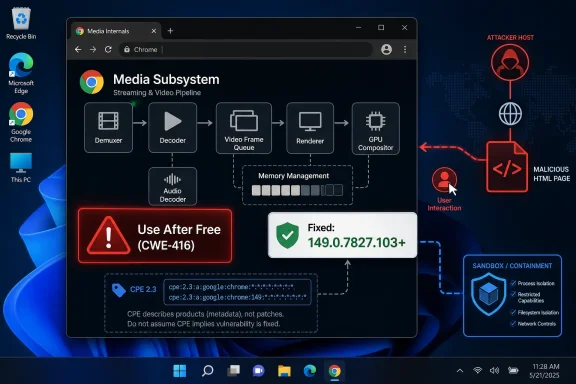 The Vulnerability Record Says Windows, but the Patch Story Says Chrome
CVE-2026-11680 is straightforward on its face: a remote attacker could use a crafted HTML page to trigger arbitrary code execution inside Chrome’s sandbox. The flaw sits in Media, a browser subsystem that handles exactly the kind of rich, attacker-supplied content users encounter without thinking. The weakness class, CWE-416, is the familiar and dangerous use after free, a memory lifetime bug that can turn stale object references into exploit primitives.The NVD configuration listed in the supplied record is also unusually explicit. It models vulnerable software as Google Chrome versions before 149.0.7827.103 and pairs that with Microsoft Windows as the platform. That is not a missing-product problem; it is a platform-scoped product problem.
Where the confusion starts is the CPE grammar. NVD’s configuration uses an AND structure: Chrome below the fixed version, running on Windows. The Windows CPE is marked as the platform condition, not as vulnerable operating-system software in its own right. In plain English, Microsoft Windows is part of the affected environment, while Google Chrome is the vulnerable application.
That distinction matters. A vulnerability scanner that flattens the record too aggressively may make it look as if “Windows” is vulnerable, when the remediation is to update Chrome. Conversely, a scanner that only looks for the Chrome CPE but ignores the platform condition may report exposure on non-Windows systems even when this specific CVE description is Windows-bound.
The CPE Is Probably Not Missing — It Is Doing a Narrow Job
The user-facing NVD text asks, “Are we missing a CPE here?” That line appears frequently on NVD pages and should not be read as evidence that the record is incomplete. In this case, the supplied change history says NIST added a configuration containingcpe:2.3:a:google:chrome:* up to, but excluding, 149.0.7827.103, together with cpe:2.3:o:microsoft:windows:-.That is the expected shape for an application vulnerability constrained to a platform. The application CPE identifies the software to patch. The operating-system CPE narrows the environment in which the vulnerability applies.
There are still caveats. Chrome’s versioning can differ subtly by channel and platform, and Google’s desktop release posts often ship
.102 and .103 variants across Windows, macOS, and Linux. If a vendor advisory says Windows was fixed at one build while NVD says “prior to 149.0.7827.103,” security teams should treat the higher version threshold as the safer compliance floor unless their tooling has more precise vendor-channel logic.The more legitimate metadata question is not whether Edge, Brave, Vivaldi, Opera, or other Chromium-derived browsers need separate CPEs in this CVE. They generally should not be attached unless the downstream vendor confirms that its product is affected under its own package and version scheme. Chromium bugs can propagate widely, but CVE records are not supposed to become speculative dependency maps.
A Sandbox Escape Is Not Required for This to Matter
The phrase “inside a sandbox” can sound reassuring, but it should not. Chrome’s sandbox is a containment layer, not a magical eraser for code execution. Arbitrary code running inside the renderer or a media-handling process may still expose browser data, interact with web content, and serve as the first stage in a chained compromise.That is why the CVSS vector matters. The CISA-ADP score of 8.8 reflects a network-reachable attack, low complexity, no privileges required, and required user interaction. In practice, that interaction could be as ordinary as visiting a malicious page, clicking a link in a message, or being redirected through an advertising or compromised-site chain.
The scope remains unchanged in the CVSS vector, which is consistent with code execution remaining inside the browser’s security boundary rather than automatically crossing into the operating system. But attackers do not need every bug to be a full chain by itself. A reliable browser memory-corruption bug is valuable because it can be paired with a second vulnerability, abused for data theft within the browser context, or used against users whose environments weaken isolation through extensions, policies, or legacy configurations.
For Windows administrators, this lands in a familiar risk category: not a reason to panic, but not a reason to wait for the next monthly patch window either. Browser vulnerabilities sit on the front line of modern endpoint exposure because the browser is the most exposed application on the machine.
Media Bugs Keep Showing Why Browsers Are Operating Systems in Disguise
Chrome’s Media component is not a decorative feature. It is part of the machinery that lets the modern web play video, process streams, handle codecs, render embedded content, and negotiate a swarm of formats that users never see. That complexity is precisely why attackers and researchers keep finding memory-safety issues in media stacks.A crafted HTML page is a low-friction delivery mechanism. The attacker does not need to persuade a target to install software or open an exotic document format. The browser is the document viewer, the runtime, the media player, and the network client all at once.
This is also why browser hardening has become a moving target. Sandboxing, site isolation, memory allocators, control-flow protections, and rapid updates have all raised the cost of exploitation. But they have not changed the fundamental fact that Chrome must parse hostile input at extraordinary scale.
Use-after-free flaws are especially stubborn because they arise from object lifetime mistakes. One part of the code believes an object is gone; another still has a pointer to it. If an attacker can influence what memory is reallocated in that space, a crash can become controlled execution.
Windows-Only Does Not Mean Windows-Caused
The supplied CVE description says Chrome on Windows was affected. That does not mean Windows caused the vulnerability. It means the observable affected configuration is Chrome running on Windows before the fixed version.That distinction is important in enterprise communications. If a help desk tells users “Windows has a vulnerability,” they will look for Windows Update. If administrators tell asset owners “Chrome on Windows must be updated,” the remediation path is clear.
Platform-specific browser CVEs can happen for several reasons. The vulnerable code path may depend on Windows media APIs, build flags, GPU behavior, sandbox process models, or platform-specific integration layers. The public CVE text does not give enough detail to say which one applies here, and the Chromium issue reference is restricted, as is common shortly after a security fix.
For now, the operational conclusion is enough: Windows endpoints running Chrome below the fixed version should be treated as exposed. The absence of macOS or Linux in this CVE’s description should not be stretched into a broad claim about the underlying code without vendor confirmation.
The Patch Threshold Is the Only Number That Really Matters
The fixed-version boundary in the CVE is 149.0.7827.103. Anything below that on the affected Windows configuration should be considered vulnerable for CVE-2026-11680. For admins, that number should become the detection rule, the compliance query, and the help-desk script.Chrome’s built-in updater is fast for consumer users, but enterprises live in a messier world. Updates can be delayed by software distribution rings, frozen VDI images, app-control policies, browser relaunch deferrals, and users who never close the application. A Chrome version can be “installed” and still not be “running” until the browser restarts.
That last point is where many browser patch programs fail. The binary on disk may be staged, but the active process can remain old. Endpoint management tools need to verify the running version or force a relaunch after an appropriate grace period.
The fix should also be checked across all Chrome channels present in the estate. Stable is the main concern, but Beta, Dev, Canary, and embedded Chromium runtimes can complicate the inventory. CVE-2026-11680 is a Chrome record, not a universal Chromium downstream advisory, but defenders should still use it as a prompt to look for browser sprawl.
NVD Metadata Is a Starting Point, Not a Patch Strategy
NVD enrichment is invaluable, but it is not the same as a vendor’s remediation playbook. In this record, NVD had not yet provided its own CVSS assessment in the supplied text, while CISA-ADP had supplied a CVSS 3.1 score. That is normal enough, but it means teams should be careful about treating a single field as canonical.The record’s change history is useful because it shows chronology. Chrome submitted the CVE on June 8, 2026. CISA-ADP added the CVSS vector later that day. NIST added the CPE configuration and references on June 9. That is a fast-moving enrichment path, not a fully settled dossier.
This matters for vulnerability-management dashboards. A ticket generated on June 8 may have lacked CPE data. A ticket generated on June 9 may have platform scoping. A ticket generated later may include additional enrichment. If a security team sees inconsistent scanner output, the cause may be timing rather than disagreement.
The best practice is to bind policy to remediation facts: product, platform, vulnerable version range, fixed version, and exploitability conditions. CVSS is useful for prioritization, but it should not be the only trigger for action when the vulnerable application is a browser.
The “Remote Attacker” Still Needs the User, but That Is a Low Bar
The CVSS vector includes user interaction. That lowers the theoretical severity compared with a wormable network service, but browsers invert the usual meaning of “user-assisted.” Users interact with untrusted web content all day because that is what browsers are for.A crafted HTML page can arrive through phishing, malvertising, compromised websites, malicious redirects, forum posts, webmail, collaboration tools, or support portals. The attack surface is not a weird corner of the enterprise; it is the default workflow.
This is why high-severity browser bugs often deserve urgent treatment even without public exploit code. The gap between “a user must visit a page” and “an attacker can plausibly reach targets” is small. In many organizations, it is effectively nonexistent.
There is no public indication in the supplied CVE text that CVE-2026-11680 was exploited in the wild. That is an important line to keep clean. Another Chrome vulnerability in the same general release window, CVE-2026-11645, was reported as exploited, but that does not automatically transfer active-exploitation status to CVE-2026-11680.
Scanner Output Will Be Messy Until Vendors and Downstreams Catch Up
Security teams should expect uneven findings for a few days after a Chrome security update. NVD data, vendor advisories, endpoint agents, software inventory databases, and patch catalogs rarely converge instantly. The user’s CPE question is exactly the sort of symptom that appears during that convergence window.Some tools will key off the Chrome CPE and the version boundary. Others will require the operating-system platform condition. Some will report the CVE only after NVD enrichment, while others ingest Google’s advisory directly. None of that changes the practical answer: update Chrome on Windows to a fixed build.
There is also the downstream Chromium question. Microsoft Edge, Brave, Opera, Vivaldi, and Electron-based applications may share Chromium code, but their exposure depends on how and when they incorporate the relevant fix. Treat Chrome’s CVE as a signal to check downstream advisories, not as proof that every Chromium-based product has the same CVE assignment.
For WindowsForum readers, the most immediate local check is simple: open Chrome’s About page and verify the version. For fleet admins, the check belongs in Intune, Configuration Manager, Group Policy reporting, EDR inventory, or whatever asset platform actually knows which browser build is running.
Enterprise Risk Lives in the Relaunch Gap
The quiet enemy of Chrome patching is not download speed. It is the relaunch gap. Chrome can fetch and stage updates automatically, but the vulnerable code may persist in memory until every relevant process exits.That gap is tolerable for low-risk feature updates. It is less tolerable for a high-severity memory-corruption bug reachable through web content. Enterprises should decide in advance how much grace time users get before a forced browser restart, because deciding during a live vulnerability cycle guarantees delay.
Google’s enterprise policies provide controls for update cadence and relaunch notifications, but they require administrative intent. If the organization has never tuned them, the default user experience may prioritize convenience over closure. That is not irrational, but it is a tradeoff.
The sharper lesson is that browsers need to be managed like critical infrastructure. They are updated more often than operating systems, exposed more directly than most desktop applications, and abused more routinely than almost anything else on the endpoint.
Security Teams Should Read “High” as “Patch Now, Verify Later”
A CVSS 8.8 browser bug is not automatically an emergency, but it belongs near the front of the queue. The combination of network reachability, low attack complexity, no privileges, and high impact across confidentiality, integrity, and availability is enough to justify accelerated handling. The required user interaction is not a strong mitigating factor in web exploitation.That does not mean every organization needs an all-hands incident bridge. It does mean Chrome version compliance should be visible within hours, not days. If the estate cannot answer “how many Windows endpoints are running Chrome below 149.0.7827.103?” the vulnerability has exposed an asset-management problem as much as a browser problem.
Security teams should also watch for false comfort from sandbox language. Sandboxes reduce blast radius; they do not erase the exploit. Attackers often build chains, and defenders should not assume a single CVE record describes the full operational risk.
The better response is disciplined and boring: identify affected systems, push the update, force or strongly prompt relaunch, verify the running version, and monitor for downstream Chromium updates. That is the difference between patching as ritual and patching as risk reduction.
The Chrome Record Leaves Administrators With a Narrow but Actionable Mandate
The concrete reading of CVE-2026-11680 is this: the vulnerable product CPE is Google Chrome, the affected platform is Windows, and the safe version line is 149.0.7827.103 or later. The Windows CPE in the NVD configuration is not a missing Microsoft patch indicator. It is the platform scope for a Chrome application flaw.That still leaves room for cautious interpretation. If a scanner complains about missing CPE data, security teams should compare its logic with NVD’s AND configuration rather than assuming the vulnerability record is wrong. If another tool flags all Chrome installations regardless of OS, decide whether to suppress non-Windows findings or keep them as conservative noise until vendor data settles.
The operational danger is not that admins will misunderstand CWE-416. It is that they will get lost in metadata and delay the only fix that matters. Browser patching should not wait for perfect enrichment.
The Version Number Is the Message
CVE-2026-11680 is a reminder that modern vulnerability management often turns on a few characters in a version string. The exploit narrative is complicated, the browser internals are complex, and the CPE structure can be awkward. But the remediation line is crisp.- Windows systems running Google Chrome below 149.0.7827.103 should be treated as affected by CVE-2026-11680.
- The CPE configuration identifies Chrome as the vulnerable application and Windows as the affected platform condition.
- The vulnerability is a high-severity use-after-free issue in Chrome’s Media component, mapped to CWE-416.
- The attack requires user interaction, but visiting a crafted web page is a realistic and common browser threat model.
- Administrators should verify the running Chrome process version after update deployment, not merely the installed package version.
- Other Chromium-based browsers should be checked through their own vendor advisories rather than inferred automatically from this Chrome CVE.
References
- Primary source: NVD / Chromium
Published: 2026-06-15T19:14:41-07:00
NVD - CVE-2026-11680
 nvd.nist.gov
- Security advisory: MSRC
Published: 2026-06-15T19:14:41-07:00
Original feed URL
Security Update Guide - Microsoft Security Response Center
 msrc.microsoft.com
- Related coverage: vulnerability.circl.lu
Vulnerability-Lookup
Vulnerability-Lookup - Fast vulnerability lookup correlation from different sources.vulnerability.circl.lu - Related coverage: vuldb.com
CVE-2026-11680 Google Chrome Media повреждение памяти
Обнаружена уязвимость в Google Chrome на Windows. Эта уязвимость продается как CVE-2026-11680. Рекомендуется обновить затронутый компонент.vuldb.com
