

The Browser Patch Is Now an Operating-System Event
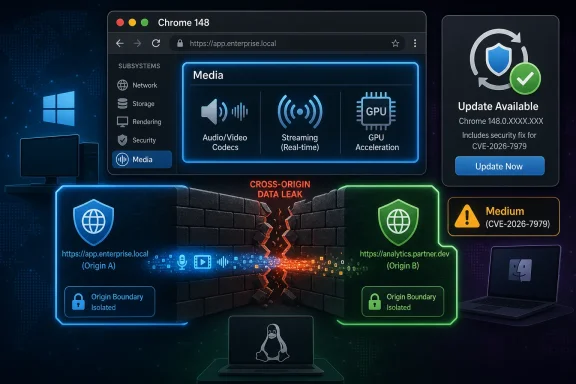
CVE-2026-7979 is described with the bland language security teams have learned not to ignore: “inappropriate implementation in Media.” That phrase does not tell a user much, but the rest of the description does. A remote attacker could leak cross-origin data by persuading a user to open a crafted HTML page.
The important word is not “Media.” It is “cross-origin.” Browser security rests on the assumption that one site cannot casually read data belonging to another site. When that boundary weakens, even partially, the problem moves beyond a broken video player or a crash-prone tab.
This is why the fix matters even though the assigned CVSS 3.1 score from CISA’s ADP enrichment is 4.3, firmly in medium territory. The vector requires user interaction, does not require privileges, is remotely reachable over the network, and affects confidentiality rather than integrity or availability. That is not an instant remote-code-execution disaster, but it is also not background noise.
The modern browser is where identity providers, internal dashboards, cloud consoles, password managers, collaboration tools, and personal accounts all meet. A bug that leaks cross-origin data is a bug in the walls between those rooms. If the leak is narrow, the house still stands; if attackers find a useful angle, the same weakness can become part of a much larger intrusion chain.
“Medium” Severity Hides the Real Risk Model
The security industry has trained people to sort vulnerabilities by color and number. Critical means move now. High means move soon. Medium means put it in the next cycle unless someone yells. CVE-2026-7979 is a reminder that browser bugs do not always obey that hierarchy cleanly.
The CVSS vector tells us the attack needs a victim to load a crafted page. For consumer software, that sounds like a meaningful barrier. For browsers, it is the default operating condition. The browser’s job is to load pages all day, including pages found through ads, redirects, compromised sites, chat links, search results, QR codes, and embedded webviews.
The impact is listed as low confidentiality loss, with no integrity or availability effect. That helps explain the medium rating. But confidentiality bugs are context-sensitive in a way crash bugs are not. A small leak from the wrong origin, at the wrong time, in the wrong session, can expose tokens, user state, internal resource names, or fragments of data that help an attacker plan the next move.
There is no public indication from the available advisories that CVE-2026-7979 is being actively exploited in the wild. That matters, and it should keep the response proportionate. But the absence of known exploitation is not the same thing as the absence of exploitability. Chrome’s bug tracker entry is permission-restricted, which is common for newly fixed vulnerabilities while updates propagate.
That restricted visibility creates the familiar browser-security tension. Defenders get enough information to know they should patch, but not enough to model the bug in detail. Attackers, meanwhile, can diff Chromium code, watch the patch, and try to infer the flaw. The clock starts when the update ships, not when every endpoint has installed it.
The Media Stack Is a High-Traffic Attack Surface
Browser media code is not decorative. It touches codecs, containers, GPU acceleration paths, autoplay policies, permissions, device APIs, streaming protocols, and site isolation boundaries. It is also exercised constantly by ordinary web use.
That makes “Media” a more interesting component than its name suggests. A crafted HTML page does not need to look like malware to interact with media features. It can be a normal-looking page with embedded audio, video, canvas operations, previews, streaming elements, or scripts that probe edge cases in how the browser loads and isolates resources.
The web platform’s security model depends heavily on origin separation. Sites are supposed to be able to embed, link, display, and request many kinds of resources without gaining the right to read private data from a different origin. That distinction — you may show it, but you may not inspect it — is one of the web’s oldest compromises.
Media features complicate that compromise. Browsers must decode content from many sources, optimize playback, enforce CORS rules, support encrypted media, respect user gestures, and interact with process isolation. A bug in implementation does not need to be spectacular to matter. It only needs to create a measurable difference that a malicious page can observe.
Cross-origin leaks can be subtle. Sometimes the leaked information is direct content; sometimes it is metadata, timing behavior, dimensions, error states, response characteristics, or other side channels. The public CVE text does not specify which pattern applies here, and responsible coverage should not pretend otherwise. The point is simpler: the Media subsystem had a flaw that weakened a cross-origin boundary, and the fix is already in the stable channel.
Chrome 148 Is Bigger Than This One CVE
The fix for CVE-2026-7979 arrived with the Chrome 148 stable release, promoted on May 5, 2026. Google’s desktop builds moved to 148.0.7778.96 on Linux and 148.0.7778.96 or 148.0.7778.97 on Windows and macOS. The release is rolling out over the usual staged period.
CVE-2026-7979 is one item in a much larger security update. Public reporting on Chrome 148 has counted more than 100 security fixes, including several critical vulnerabilities elsewhere in the browser. That context cuts both ways. On the one hand, CVE-2026-7979 is not the headline-grabbing critical flaw of the release. On the other hand, it is part of a browser patch train large enough that delaying it over one “medium” label misses the point.
Chrome’s rapid release process has made this normal. Every few weeks, the world’s most widely used browser absorbs a bundle of fixes spanning rendering, JavaScript, media, extensions, networking, UI, and platform integration. The update is routine only because the machinery around it has become routine.
For IT departments, that routine can become complacency. Browsers update automatically in many environments, but enterprise controls, testing rings, VDI images, app compatibility requirements, and change freezes often slow reality down. The version number in the vendor advisory is not the same thing as the version number on every endpoint.
The practical question is not whether Google shipped the fix. It is whether your fleet has consumed it.
Edge Inherits the Chromium Clock
Microsoft’s presence in the advisory chain is not incidental. Microsoft Edge is Chromium-based, and MSRC tracks Chromium vulnerabilities that apply to Edge. When Chromium fixes a bug in shared code, Microsoft has to evaluate, integrate, and ship that protection through Edge’s channel.
This is one of the tradeoffs Microsoft accepted when it rebuilt Edge on Chromium. The move gave Windows users a modern, compatible browser and spared Microsoft the lonely burden of maintaining a separate rendering engine for the mainstream web. It also tied Edge security to the Chromium ecosystem’s discovery and patch cadence.
For Windows administrators, that means Chrome advisories are often Edge advisories by another route. A vulnerability in Chromium Media is not automatically exploitable in every Chromium-derived browser in the exact same way, but it is relevant until the downstream vendor says otherwise or ships a fixed build. MSRC’s listing is the signal that Windows shops should not treat this as a Google-only concern.
The old mental model — Windows Update handles Microsoft risk, browser vendors handle browser risk — has been obsolete for years. Edge has its own updater, Chrome has its own updater, WebView2 rides through Microsoft’s ecosystem, and third-party Chromium browsers each have their own lag. A fully patched Windows machine can still carry browser exposure if the browser layer is stale.
That matters because Edge is not merely a browser icon on the taskbar. It underpins enterprise workflows, identity prompts, web apps, PDF handling, progressive web apps, and in some cases embedded web experiences. Chromium vulnerabilities therefore sit close to the Windows desktop experience even when they are not Windows vulnerabilities in the classic sense.
The NVD Entry Tells a Story About Modern Disclosure
The NVD record for CVE-2026-7979 is still sparse in the way newly published CVEs often are. NIST has not yet provided its own CVSS assessment, and the weakness is listed as insufficient information. CISA’s ADP enrichment supplies the CVSS 3.1 vector and score.
That division of labor is increasingly common. Vendor CNAs publish the initial record, enrichment programs add scoring or metadata, and NVD analysis catches up later. For practitioners, the result can look messy: one source has the description, another has the score, another has the affected configuration, and the most interesting technical details remain locked away.
The CPE configuration shown in the NVD history is also worth reading carefully. It describes Google Chrome versions prior to 148.0.7778.96, with platform context including Windows, Linux, and macOS. That kind of CPE expression can be confusing because it combines application and operating-system entries in a way that vulnerability scanners must interpret correctly.
The user-facing question — “are we missing a CPE here?” — is the right one, but it has a broader answer. The immediate affected product is Chrome, not “Windows” as a vulnerable OS component. The operating systems are relevant because they are platforms on which vulnerable Chrome builds run. For Edge and other Chromium derivatives, separate vendor advisories and product identifiers may be needed for clean asset matching.
This is not academic. Scanner coverage depends on accurate CPE mapping, installed-version detection, and vendor-specific product logic. If an organization relies only on a generic CPE match for Chrome, it may miss Edge. If it treats the OS CPE as the vulnerable object, it may generate confusing remediation tickets. The metadata is supposed to make patching easier, but it often exposes how complicated software identity has become.
The Real Exposure Is Version Drift
For home users, the fix path is usually simple: let the browser update, restart it, and verify the version. For enterprises, the hard part is not knowing the patched number. It is finding every copy of Chromium code that matters.
Chrome stable is obvious. Edge stable is obvious. The less obvious inventory includes portable browsers, unmanaged user installs, dev and beta channels, kiosk systems, stale VDI base images, app packaging repositories, remote desktops, lab machines, jump boxes, and legacy systems that someone excluded from automatic updates years ago because a line-of-business app once broke.
Then there is WebView2. Many Windows applications use Microsoft’s Chromium-based WebView2 runtime to render web content inside desktop apps. CVEs in Chromium do not always translate neatly to WebView2 exposure, because exploitability depends on how the runtime is used, what content it loads, and what version is installed. But from an asset-management perspective, it is another reason “patch the browser” is not a single action anymore.
The right operational response is disciplined rather than dramatic. Security teams should verify Chrome 148.0.7778.96 or later where Chrome is installed, confirm the corresponding fixed Edge build when Microsoft ships or lists it for the relevant channel, and check whether any Chromium-based third-party browsers are lagging. Managed environments should force relaunches where policy allows, because a downloaded browser update often does not protect a session until the browser restarts.
That last point remains one of the most stubborn browser-patching failures. Automatic update systems can stage new binaries silently, but users keep browsers open for days or weeks. The vulnerable code may remain resident while the UI cheerfully insists an update is waiting. In practical terms, a patch that requires a restart is only a promise until the restart happens.
Cross-Origin Leaks Belong in the Same Conversation as Identity
The phrase “leak cross-origin data” can sound narrow, but it sits close to the identity layer of the modern web. Most users are constantly authenticated somewhere: Microsoft 365, Google Workspace, Okta, GitHub, Slack, Salesforce, AWS, Azure, internal portals, banking sites, healthcare systems, school platforms. The browser is the session container.
Same-origin policy and related isolation mechanisms are what keep those sessions from bleeding into one another. If a malicious site can learn something it should not about another origin, the severity depends on what can be learned and how reliably. Sometimes that is merely a privacy blemish. Sometimes it is a stepping stone to targeted phishing, token theft, account probing, or data inference.
We should be careful not to overstate CVE-2026-7979. The public description does not say attackers can steal cookies, dump mailboxes, bypass MFA, or execute code. It says cross-origin data could leak through a crafted HTML page. That is enough to justify urgency, not enough to justify sensationalism.
The deeper lesson is that browser confidentiality bugs are increasingly identity bugs by proximity. The web has consolidated work and personal life into a handful of long-lived browser profiles. When the walls between origins crack, the value of whatever leaks is determined by the user’s active sessions, not by the CVE score alone.
This is why security teams should resist treating medium browser CVEs as low-value maintenance. A medium renderer or media leak in a browser used only for casual browsing is one thing. The same flaw in a privileged admin workstation, a help-desk machine, a developer laptop, or a finance user’s browser may deserve a faster lane.
Attackers Do Not Need Every Bug to Be a Zero-Day
The industry tends to narrate browser security through zero-days. Those stories are dramatic: exploit in the wild, emergency update, government spyware, critical patch. CVE-2026-7979 does not appear to be that story.
But attackers do not need every useful browser bug to be a zero-day. They can use recently patched vulnerabilities against slow-moving targets. They can combine a medium information leak with social engineering, site compromise, extension abuse, or credential phishing. They can target organizations where browser restarts are rare and unmanaged installs are common.
Patch latency is the exploitable condition. Once a fix is public, the vulnerability begins moving from unknown risk to known differential. Skilled researchers and attackers can study code changes, regression tests, commit messages, and behavior changes. Even when bug details remain restricted, the patch itself can become a map.
That does not mean every Chromium CVE becomes weaponized. Most do not, at least not publicly. But the defender’s job is to reduce the window in which a known-fixed bug remains available. That is especially true for browsers because the attack delivery mechanism is built into ordinary work.
A crafted HTML page is not an exotic payload. It is the web.
Where Windows Shops Should Tighten the Loop
The Windows endpoint estate has become a layered patching problem. Monthly cumulative updates still matter. So do Office updates, driver updates, firmware updates, VPN clients, collaboration tools, EDR agents, and browsers. Chromium now cuts across several of those layers.
For CVE-2026-7979, the immediate technical remediation is straightforward: get to a fixed Chromium build. The strategic remediation is to ensure that browser and WebView update status is visible in the same operational dashboard as OS patch status. If a security team cannot answer which browser versions are currently running across managed Windows endpoints, it is flying partly blind.
Group Policy, cloud management, MDM, and enterprise browser management tools can all help, but only if they are configured to close the last mile. Update policies should define channel, target version behavior, relaunch notification timing, and forced relaunch windows. Exceptions should be rare, documented, and time-limited.
The balance is real. Enterprises cannot blindly force every browser restart in the middle of a trading day, hospital shift, call-center queue, or production deployment. But the opposite extreme — letting users defer browser restarts indefinitely — is an implicit decision to extend exposure after patches are available.
CVE-2026-7979 is a good candidate for a measured policy test. It is not a five-alarm fire, so organizations can observe whether their normal browser-patching process actually works. If fixed builds do not reach most endpoints quickly, the problem is not this CVE. The problem is the patch pipeline.
The Scanner Result May Be Right and Still Incomplete
Vulnerability scanners will likely flag Chrome versions prior to 148.0.7778.96 as affected. That is useful. It is not complete.
A scanner can miss user-installed browsers if it lacks visibility into user profiles. It can miss dormant systems that have not checked in. It can miss nonstandard Chromium derivatives. It can report stale findings after an update is staged but before restart. It can also create noisy tickets if it interprets CPE platform logic poorly.
Security teams should therefore treat scanner output as an input rather than a verdict. Confirm installed versions through endpoint management data where possible. Check browser process versions, not only package versions, on systems that delay restart. Watch for the difference between Windows/macOS build numbering and Linux build numbering in Chrome 148.
The CPE question in the NVD entry matters here because product identity is the foundation of automated remediation. If the CPE mapping is too narrow, exposure hides. If it is too broad, teams waste time chasing false positives. Neither outcome is harmless when patch volume is already high.
There is also a communication problem. A ticket that says “CVE-2026-7979 on Windows” may confuse admins into looking for a Windows Update fix. A better ticket says the vulnerable application is Google Chrome prior to 148.0.7778.96, with Edge and other Chromium-based products handled through their own vendor update channels. Precision lowers friction.
The Patch Is Easy; the Habit Is Hard
Browser vendors have made updating astonishingly painless compared with the software maintenance norms of 20 years ago. Chrome and Edge can update in the background. Users do not need to download installers from sketchy mirrors. Enterprises can manage policies centrally. The technical distribution problem is mostly solved.
The human and organizational problem remains. Users do not restart. Teams defer changes. Asset inventories drift. Security exceptions become permanent. Browser variants multiply because one department needs one plugin, another wants one privacy fork, and a developer installed three channels for testing.
CVE-2026-7979 exposes that habit gap. The fix exists. The affected version boundary is clear. The exploit requires user interaction, but user interaction is what browsers do. The vulnerability is medium, but the browser’s role in enterprise identity and data access magnifies the operational importance of getting patched.
This is also why security messaging should be boringly specific. “Update Chrome” is not enough. “Verify Chrome is at 148.0.7778.96 or later, restart open sessions, and confirm Edge/Chromium derivatives through their vendor channels” is better. It turns anxiety into an action plan.
Good browser security is not a heroic emergency response every time a CVE appears. It is a habit: inventory, update, restart, verify, repeat. CVE-2026-7979 is another test of whether that habit exists.
The Version Number Is the Security Boundary This Week
The practical lessons from CVE-2026-7979 are narrow enough to act on and broad enough to matter beyond this single flaw. Treat this as a browser-boundary vulnerability with a clear patch target, not as an abstract entry in a vulnerability database.
- Organizations should verify that Google Chrome is updated to 148.0.7778.96 or later on Linux and to the fixed 148.0.7778.96/97 line on Windows and macOS.
- Windows administrators should track Microsoft Edge separately, because Chromium fixes become Edge responsibilities only when Microsoft ships and documents the corresponding browser update.
- Security teams should force or strongly prompt browser relaunches after updates, because staged patches do not fully protect long-running sessions.
- Vulnerability-management teams should review scanner logic carefully, since CPE mappings for Chromium flaws can blur the distinction between vulnerable applications and the operating systems they run on.
- Higher-risk users, including administrators, developers, finance staff, and help-desk operators, should receive faster browser patch enforcement than low-risk browsing-only endpoints.
- Third-party Chromium browsers, portable installs, VDI images, kiosks, and WebView2-dependent applications should be part of the inventory conversation rather than afterthoughts.
CVE-2026-7979 will probably disappear quickly into the churn of Chromium security updates, overshadowed by flashier critical bugs and the next emergency patch cycle. That is precisely why it is useful. It shows the real state of endpoint security in 2026: not a single monthly ritual, but a continuous negotiation between fast-moving browser code, identity-heavy web sessions, and fleets that are never quite as current as dashboards suggest. The organizations that handle this well will not be the ones that panic over every medium CVE; they will be the ones that make the patched browser version the normal state of the Windows desktop, not the exception waiting for the next audit.
References
- Security Update Guide - Microsoft Security Response Center NVD / Chromium