

CVE-2026-7957 is a medium-severity Chromium Media out-of-bounds write flaw disclosed by Chrome on May 6, 2026, affecting Google Chrome on Mac and iOS before version 148.0.7778.96 and incorporated into Microsoft’s May 7 Edge security update stream. The short version is simple: patch the browser, but don’t misread “medium” as “minor.” This is the kind of bug that looks conditional on paper and still matters in real endpoint fleets because browsers are where sandbox boundaries, media parsing, and user interaction collide. For WindowsForum readers, the important story is not just one CVE; it is how Chromium’s security conveyor belt now dictates risk timing for Chrome, Edge, and every organization that treats the browser as infrastructure.
The description of CVE-2026-7957 is almost aggressively unglamorous: an out-of-bounds write in Media, triggered through a crafted HTML page, after an attacker has already compromised the renderer process. That “already compromised” clause is doing a lot of work. It is why Chromium labels the issue medium, and it is also why defenders should resist the temptation to wave it away.
Modern browser exploitation is rarely a single heroic bug anymore. The days when one memory corruption flaw reliably took a browser from innocent page load to native-code execution are mostly gone, at least against fully patched mainstream browsers with sandboxing, site isolation, control-flow hardening, and exploit mitigations layered on top. The more common pattern is a chain: a renderer bug gets code running in a constrained process, then another bug stretches that foothold toward more meaningful control.
CVE-2026-7957 sits in that second category. On its own, it is not described as a drive-by full-system compromise. But paired with a renderer compromise, it can allow arbitrary code execution inside a sandbox. In other words, it may not be the first domino, but it is the kind of domino that makes the chain worth building.
That distinction matters for patch prioritization. A vulnerability that requires a preexisting renderer compromise may sound less urgent than a critical Blink or V8 bug, but attackers do not rank bugs the way vulnerability scanners do. They rank them by whether a working chain gets them closer to persistence, data theft, surveillance, credential access, or a reliable crash-to-control path.
The irony is that a “medium” Chromium vulnerability can be more operationally important than a “high” bug in some obscure enterprise component. Chrome and Edge are installed everywhere, exposed to untrusted content all day, and updated constantly because they have to be. Scale changes the meaning of severity.
That model has served the industry well. Site isolation, process separation, and OS-level sandboxing have made browser exploitation harder and more expensive. But they also changed the shape of vulnerabilities. A bug that executes code inside a sandbox may be less catastrophic than a sandbox escape, yet it can still be meaningful because sandboxed code can interact with browser subsystems, trigger additional bugs, manipulate page state, and become one stage in a larger exploit.
Media bugs are especially interesting because media handling is one of the browser’s most complex trust boundaries. The web promised that users could click a page and play video, audio, conferencing streams, protected content, and camera input without installing a codec pack from a shady site. That convenience required browsers to absorb a zoo of parsers, codecs, hardware acceleration paths, buffering models, and platform-specific integrations.
Every one of those paths is a potential place where attacker-controlled data meets memory management. An out-of-bounds write is one of the classic dangerous memory-corruption patterns because it can mean writing data outside the intended buffer. Depending on the surrounding code, that may corrupt adjacent memory, alter program state, crash a process, or become part of an exploit primitive.
CVE-2026-7957 is not described publicly with a proof of concept, and the associated Chromium issue is permission-restricted, as is typical while users are still updating. That leaves defenders with the sparse public facts: the bug is in Media, affects Chrome on Mac and iOS before 148.0.7778.96, requires a crafted HTML page, and assumes the attacker has compromised the renderer process. Sparse does not mean trivial. It means the public is seeing the outline while the exploit-relevant detail remains locked down.
That is exactly why it matters to enterprise IT. Patch cycles do not happen one CVE at a time in the real world. They happen as browser trains: Chrome ships, Edge follows with Chromium updates and its own fixes, Linux distros package Chromium builds or mark snap-based channels as not directly affected, and vulnerability platforms ingest partial metadata while administrators try to map the result to actual devices.
The NVD record for CVE-2026-7957 illustrates the messiness. At publication, NVD had not assigned its own CVSS score, while CISA’s ADP enrichment listed a CVSS 3.1 base score of 8.8, high, with network attack vector, low complexity, no privileges required, user interaction required, and high confidentiality, integrity, and availability impact. Meanwhile, Chromium’s own severity is medium.
Those are not necessarily contradictions. They are different lenses. Chromium’s severity reflects the project’s exploitation model and assumptions about sandbox layering. CVSS compresses impact and exploitability into a standardized vector that may not fully express exploit-chain prerequisites in the way browser engineers talk about them. Security teams should read both, then make a decision based on exposure.
For a home user, that decision is painless: update Chrome or Edge and restart the browser. For a managed Windows estate, it is still relatively straightforward, but only if browser updating has not been quietly undermined by policy drift, frozen VDI images, kiosk configurations, blocked updater services, or legacy compatibility exceptions. The boring places are where browser vulnerabilities linger.
That is the browser era in one sentence: Microsoft can add enterprise controls, security modes, identity hooks, PDF behavior, and Windows integration, but the underlying web engine security drumbeat is still Chromium. When Chromium moves, Edge has to move. When Chrome fixes a large batch of memory bugs, Edge administrators need to care even if nobody in the organization uses Chrome as the default browser.
This is particularly true on Windows 10 and Windows 11 fleets where Edge is present by default, deeply integrated into workflows, and used by applications even when users think they are “not using Edge.” WebView2, embedded browser surfaces, single sign-on prompts, admin portals, cloud dashboards, and helpdesk workflows all expand the practical browser attack surface. The browser is no longer just the icon an employee clicks.
Microsoft’s update cadence has become a quiet operational dependency. Edge Stable receives frequent security releases that incorporate Chromium fixes, while Extended Stable and mobile channels operate on their own schedules. The May 7 release did what administrators want it to do: absorb the upstream Chromium security train quickly. The remaining question is whether endpoints actually received it.
That is where telemetry beats assumptions. If your patch dashboard says Windows is current but does not break out browser versions, you do not have a browser patch dashboard. If your EDR inventory can show Edge and Chrome version distribution by device, user group, and update channel, you are in a much better position to treat CVE-2026-7957 as part of a measurable risk reduction exercise rather than a vague advisory.
But the lesson is broader than Apple endpoints. Chromium is a cross-platform codebase with platform-specific build, sandbox, media, and OS integration behavior. A Media bug may be reachable or exploitable differently on macOS, iOS, Windows, Linux, Android, and ChromeOS because those platforms differ in codec plumbing, GPU acceleration, process models, and sandbox enforcement.
On iOS, browser architecture is constrained by Apple’s platform rules, and Chrome is not the same beast it is on desktop. On macOS, Chrome’s media stack interacts with Apple’s frameworks and hardware paths in ways Windows administrators may not think about. The CVE’s Apple-platform framing probably reflects where the issue exists, where it was fixed, or where it was assessed as security-relevant for the Chrome product.
For mixed fleets, that means two things. First, Mac and iOS Chrome users should be brought to 148.0.7778.96 or later without delay. Second, Windows administrators should still validate Edge and Chrome update health because the same Chrome 148 release family carried many other security fixes, including critical Chromium issues outside this specific CVE.
Security programs often fail by overfitting to the narrowest wording of an advisory. The better posture is to use the advisory as a trigger to verify the whole browser layer. If the process finds stale Chrome on Macs, stale Edge on Windows, unmanaged Brave installs, or Chromium embedded in developer tools, the CVE has done you a favor.
CPEs are supposed to help map vulnerabilities to products. In practice, browser CPEs can be awkward because Chrome, Chromium, Edge, distro packages, snaps, mobile apps, embedded frameworks, and vendor-specific rebuilds do not always line up cleanly. A record can be technically correct and still fail to catch the way software exists in your environment.
That is why “Are we missing a CPE?” should not be treated as NVD housekeeping alone. It is a reminder that vulnerability feeds are not asset inventories. They are signals that need normalization against what is actually installed, how it is updated, and which users can run it.
The CPE listed for Google Chrome prior to 148.0.7778.96 is the obvious anchor. The operating-system qualifiers for iPhone OS and macOS reflect the public affected platform language. But an enterprise scanner that only keys off a neat CPE may miss portable installs, user-level Chrome installs, nonstandard channels, developer builds, or browser variants outside the standard package path.
That is especially true in organizations that allow local admin rights, developer workstations, or bring-your-own-device access. The browser you secured with group policy may not be the browser the employee is using to access production dashboards. CVE-2026-7957 is a small reminder that browser risk management starts with knowing which browsers exist.
Neither framing is useless. Chromium’s severity tells browser engineers and exploit analysts that this is not a straightforward unauthenticated, one-click, full-chain browser takeover by itself. CVSS tells enterprise risk systems that a remotely triggerable memory-corruption issue with potential code execution impact should not be buried in a backlog because someone saw the word “medium.”
The problem is that many patch programs turn severity into a compliance deadline without context. Critical gets seven days, high gets 14 days, medium gets 30 or 60 days, and the spreadsheet looks mature. Browser vulnerabilities punish that model because the browser is both ubiquitous and constantly exposed.
A more sensible model treats mainstream browser security updates as fast-lane updates by default. You do not need to prove that every individual CVE is catastrophic. You need to prove that delaying a browser train is safer than taking it, and that is a much harder argument to make in 2026.
There are exceptions: regulated kiosk systems, brittle line-of-business apps, lab machines, and controlled VDI pools may require staged testing. But even there, the answer is not indefinite delay. The answer is a small pilot ring, rapid rollback confidence, and enough telemetry to know when the rollout is complete.
Users visit untrusted pages all day. They open links from email, chat, search results, documentation, ads, SaaS dashboards, support portals, social media, and supplier sites. Even cautious users rely on the browser to make risky content safe enough to view. “Requires a crafted HTML page” is not a high bar when the entire web is a distribution mechanism for crafted HTML pages.
The real mitigations are not telling users to be smarter. They are keeping the browser current, reducing unnecessary exposure to risky content, isolating sessions where appropriate, and limiting what a compromised browser process can reach. User education helps against phishing, but it is not a substitute for memory-safety patches.
This is also why the renderer-compromise prerequisite should not lull anyone into complacency. Browser exploit chains are assembled from available parts. If a separate renderer bug exists in the same patch batch, in an older version, or in a related component, the attacker’s problem becomes engineering rather than magic.
The public record for CVE-2026-7957 does not say it is being exploited in the wild. That is good news. It also means defenders have the best kind of vulnerability: one they can patch before it becomes a confirmed campaign artifact. Waiting for exploitation proof is a bad strategy for software that updates as quickly as browsers do.
Media code must parse complex formats that were not all designed with hostile input in mind. It must juggle buffers, timestamps, codecs, device capabilities, GPU resources, and platform APIs. It must do so quickly enough that users do not blame the browser for dropped frames. Performance pressure and memory safety are not natural allies.
Out-of-bounds writes in media components are therefore not surprising. They are exactly the class of bug you expect in code that handles structured binary data at speed. What has changed is the defensive architecture around them: fuzzing, sandboxing, site isolation, memory allocators, compiler hardening, and rapid updates turn many would-be disasters into contained, patchable events.
But contained does not mean harmless. If a media bug can be reached from HTML, it belongs in the threat model for malicious pages, malvertising, compromised sites, and targeted lures. If it requires a renderer compromise, it belongs in the model for exploit chains. In either case, the response is the same: update first, debate severity second.
This is where browser vendors deserve some credit and continued scrutiny. Chrome’s release machinery can push fixes at enormous scale. Microsoft’s Edge release machinery can absorb Chromium updates quickly. But the industry is still shipping a large amount of memory-unsafe code in the hottest attack surface on the endpoint.
Edge is usually easier to govern in Microsoft-centric environments because policy, update channels, and reporting can be integrated into the broader management stack. Chrome can also be managed well, but only if Chrome Enterprise policies and update controls are actually deployed rather than assumed. The hard part is not the existence of tools; it is closing the gap between intended policy and endpoint reality.
The first thing administrators should check after a Chromium security release is version distribution. How many systems have Edge 148.0.3967.54 or later? How many Chrome installations on macOS or iOS are at least 148.0.7778.96? How many devices have not checked in? How many users are running unsupported or unmanaged browsers?
The second thing is restart behavior. Browsers can download updates and remain vulnerable until restart. Enterprise users are notorious for keeping browser sessions alive for days or weeks because tabs have become a personal knowledge-management system. A patch that waits behind a relaunch prompt is a patch only in the most optimistic reading.
The third thing is channel hygiene. Stable, Extended Stable, Beta, Dev, Canary, ESR-like vendor channels, distro packages, and mobile app stores all move differently. If you do not know which channels are allowed, you cannot know whether a CVE is truly fixed everywhere it matters.
CVE-2026-7957 is not the scariest vulnerability in the Chrome 148 wave, but it is a useful marker of that dependency. A flaw in a Chromium component becomes a Google advisory, a Microsoft Edge update, a distro package concern, a scanner plugin, a SOC ticket, and a helpdesk nudge to restart. The same underlying fix ripples through many branded products.
This is why browser diversity debates can feel academic until patch day. Enterprises often standardize on one or two browsers for manageability, and that is reasonable. But they should not mistake standardization for simplicity. Even a “single browser” policy can leave Edge WebView2, Chrome for specific apps, mobile browsers, and developer-installed Chromium derivatives scattered across the environment.
The monoculture concern is not that Chromium is bad. It is that Chromium is critical infrastructure without always being managed like critical infrastructure. We would not tolerate a core VPN client updating whenever it feels like it, without reporting, restart enforcement, or exception review. Browsers deserve the same operational seriousness.
The counterargument is that browsers update so frequently that treating every release like a major infrastructure change is impractical. Correct. The answer is not heavyweight change control for every browser build. The answer is automated trust: rings, telemetry, rollback, policy enforcement, and a presumption that security updates move quickly unless evidence says otherwise.
That does not mean every CVE becomes an exploit overnight. It means defenders should stop designing workflows as if advisories age slowly. Browser CVEs are born into a world of automated diffing, patch analysis, bug bounty write-ups, private exploit markets, and public proof-of-concept culture. Even when a Chromium issue remains restricted, attackers can compare patches and reason about changed code.
For CVE-2026-7957, the renderer-compromise condition may reduce immediate mass-exploitation value. But in a patch batch with many fixes, attackers are not limited to one bug. They can look across the release and ask which combination is most promising. Defenders should do the same in reverse: treat the browser update as the security unit, not the individual CVE.
This is where organizations with strong update plumbing quietly win. They do not need emergency meetings for every browser advisory because the machinery is already built. A stable-channel update hits a pilot ring, telemetry watches crashes and compatibility regressions, rollout expands, and stale devices get chased. The CVE becomes an input to a process, not a crisis.
Organizations without that machinery end up debating severity labels while endpoints remain old. That is the wrong order of operations. Patch first where safe, investigate edge cases in parallel, and reserve prolonged exceptions for systems that can prove both business need and compensating controls.
Those numbers matter because “latest” is a moving target. By the time a user opens a browser settings page, a newer build may already exist. The safe operational check is not “is it exactly this number?” but “is it this fixed version or later on the relevant channel?” Anything older deserves attention.
On Chrome desktop, users can generally force an update check through the About Chrome page, then relaunch. On Edge, the About Microsoft Edge page performs the same role for unmanaged systems, while managed devices should receive updates through Edge Update according to policy. On iOS, the App Store update path controls Chrome distribution, with the usual caveat that mobile fleets need MDM visibility rather than trust in user behavior.
There is a subtle difference between patched and protected. A browser may have downloaded the update but not restarted. A managed device may be assigned the correct policy but not checked in. A scanner may flag a stale binary that is no longer used. A compliance report may show an updated package while a user-level install remains vulnerable. Version validation has to account for those realities.
If that sounds tedious, it is. Browser security is tedious in the way backups are tedious: it only becomes exciting when the routine work failed. CVE-2026-7957 is a good excuse to verify that the routine work is actually routine.
Source: NVD / Chromium Security Update Guide - Microsoft Security Response Center
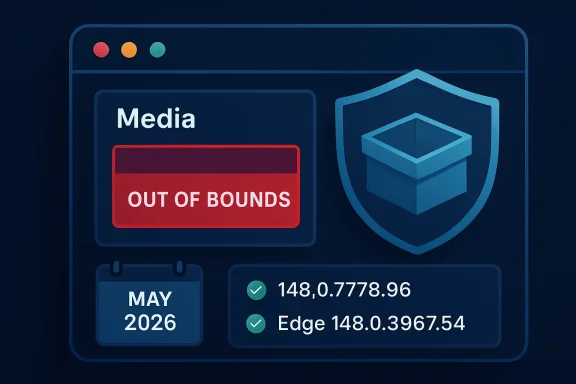 A Medium Bug With High Consequences Hiding in the Fine Print
The description of CVE-2026-7957 is almost aggressively unglamorous: an out-of-bounds write in Media, triggered through a crafted HTML page, after an attacker has already compromised the renderer process. That “already compromised” clause is doing a lot of work. It is why Chromium labels the issue medium, and it is also why defenders should resist the temptation to wave it away.Modern browser exploitation is rarely a single heroic bug anymore. The days when one memory corruption flaw reliably took a browser from innocent page load to native-code execution are mostly gone, at least against fully patched mainstream browsers with sandboxing, site isolation, control-flow hardening, and exploit mitigations layered on top. The more common pattern is a chain: a renderer bug gets code running in a constrained process, then another bug stretches that foothold toward more meaningful control.
CVE-2026-7957 sits in that second category. On its own, it is not described as a drive-by full-system compromise. But paired with a renderer compromise, it can allow arbitrary code execution inside a sandbox. In other words, it may not be the first domino, but it is the kind of domino that makes the chain worth building.
That distinction matters for patch prioritization. A vulnerability that requires a preexisting renderer compromise may sound less urgent than a critical Blink or V8 bug, but attackers do not rank bugs the way vulnerability scanners do. They rank them by whether a working chain gets them closer to persistence, data theft, surveillance, credential access, or a reliable crash-to-control path.
The irony is that a “medium” Chromium vulnerability can be more operationally important than a “high” bug in some obscure enterprise component. Chrome and Edge are installed everywhere, exposed to untrusted content all day, and updated constantly because they have to be. Scale changes the meaning of severity.
The Browser Sandbox Is a Contract, Not a Wall
The phrase inside a sandbox sounds reassuring until you remember what a sandbox is designed to do. It is not a magic prohibition against malicious computation. It is a containment contract: the browser assumes hostile code may run in a renderer and tries to limit what that code can touch.That model has served the industry well. Site isolation, process separation, and OS-level sandboxing have made browser exploitation harder and more expensive. But they also changed the shape of vulnerabilities. A bug that executes code inside a sandbox may be less catastrophic than a sandbox escape, yet it can still be meaningful because sandboxed code can interact with browser subsystems, trigger additional bugs, manipulate page state, and become one stage in a larger exploit.
Media bugs are especially interesting because media handling is one of the browser’s most complex trust boundaries. The web promised that users could click a page and play video, audio, conferencing streams, protected content, and camera input without installing a codec pack from a shady site. That convenience required browsers to absorb a zoo of parsers, codecs, hardware acceleration paths, buffering models, and platform-specific integrations.
Every one of those paths is a potential place where attacker-controlled data meets memory management. An out-of-bounds write is one of the classic dangerous memory-corruption patterns because it can mean writing data outside the intended buffer. Depending on the surrounding code, that may corrupt adjacent memory, alter program state, crash a process, or become part of an exploit primitive.
CVE-2026-7957 is not described publicly with a proof of concept, and the associated Chromium issue is permission-restricted, as is typical while users are still updating. That leaves defenders with the sparse public facts: the bug is in Media, affects Chrome on Mac and iOS before 148.0.7778.96, requires a crafted HTML page, and assumes the attacker has compromised the renderer process. Sparse does not mean trivial. It means the public is seeing the outline while the exploit-relevant detail remains locked down.
Chrome 148 Turned One CVE Into a Fleet Problem
Google’s Chrome 148 stable release landed as a much larger security event than a single CVE. The release line around 148.0.7778.96 and 148.0.7778.97 fixed more than a hundred security issues, with reporting at the time noting 127 vulnerabilities addressed and several critical flaws among them. CVE-2026-7957 is one tile in that mosaic, not the headline act.That is exactly why it matters to enterprise IT. Patch cycles do not happen one CVE at a time in the real world. They happen as browser trains: Chrome ships, Edge follows with Chromium updates and its own fixes, Linux distros package Chromium builds or mark snap-based channels as not directly affected, and vulnerability platforms ingest partial metadata while administrators try to map the result to actual devices.
The NVD record for CVE-2026-7957 illustrates the messiness. At publication, NVD had not assigned its own CVSS score, while CISA’s ADP enrichment listed a CVSS 3.1 base score of 8.8, high, with network attack vector, low complexity, no privileges required, user interaction required, and high confidentiality, integrity, and availability impact. Meanwhile, Chromium’s own severity is medium.
Those are not necessarily contradictions. They are different lenses. Chromium’s severity reflects the project’s exploitation model and assumptions about sandbox layering. CVSS compresses impact and exploitability into a standardized vector that may not fully express exploit-chain prerequisites in the way browser engineers talk about them. Security teams should read both, then make a decision based on exposure.
For a home user, that decision is painless: update Chrome or Edge and restart the browser. For a managed Windows estate, it is still relatively straightforward, but only if browser updating has not been quietly undermined by policy drift, frozen VDI images, kiosk configurations, blocked updater services, or legacy compatibility exceptions. The boring places are where browser vulnerabilities linger.
Microsoft Edge Inherits the Chromium Clock
The Windows angle is not that CVE-2026-7957 directly targets Windows Chrome in the public description. It is that Microsoft Edge lives on Chromium’s schedule, and Windows shops live with Edge whether they consider themselves Chrome shops or not. Microsoft’s May 7, 2026 Edge Stable Channel release, version 148.0.3967.54, incorporated the latest Chromium security updates and also listed Microsoft Edge-specific fixes.That is the browser era in one sentence: Microsoft can add enterprise controls, security modes, identity hooks, PDF behavior, and Windows integration, but the underlying web engine security drumbeat is still Chromium. When Chromium moves, Edge has to move. When Chrome fixes a large batch of memory bugs, Edge administrators need to care even if nobody in the organization uses Chrome as the default browser.
This is particularly true on Windows 10 and Windows 11 fleets where Edge is present by default, deeply integrated into workflows, and used by applications even when users think they are “not using Edge.” WebView2, embedded browser surfaces, single sign-on prompts, admin portals, cloud dashboards, and helpdesk workflows all expand the practical browser attack surface. The browser is no longer just the icon an employee clicks.
Microsoft’s update cadence has become a quiet operational dependency. Edge Stable receives frequent security releases that incorporate Chromium fixes, while Extended Stable and mobile channels operate on their own schedules. The May 7 release did what administrators want it to do: absorb the upstream Chromium security train quickly. The remaining question is whether endpoints actually received it.
That is where telemetry beats assumptions. If your patch dashboard says Windows is current but does not break out browser versions, you do not have a browser patch dashboard. If your EDR inventory can show Edge and Chrome version distribution by device, user group, and update channel, you are in a much better position to treat CVE-2026-7957 as part of a measurable risk reduction exercise rather than a vague advisory.
Apple Platforms Make the Scope Look Narrower Than the Lesson
The public CVE language calls out Chrome on Mac and iOS before 148.0.7778.96. That platform focus is worth respecting. Defenders should not broaden a vulnerability beyond the vendor’s affected-product statement just to make it sound scarier.But the lesson is broader than Apple endpoints. Chromium is a cross-platform codebase with platform-specific build, sandbox, media, and OS integration behavior. A Media bug may be reachable or exploitable differently on macOS, iOS, Windows, Linux, Android, and ChromeOS because those platforms differ in codec plumbing, GPU acceleration, process models, and sandbox enforcement.
On iOS, browser architecture is constrained by Apple’s platform rules, and Chrome is not the same beast it is on desktop. On macOS, Chrome’s media stack interacts with Apple’s frameworks and hardware paths in ways Windows administrators may not think about. The CVE’s Apple-platform framing probably reflects where the issue exists, where it was fixed, or where it was assessed as security-relevant for the Chrome product.
For mixed fleets, that means two things. First, Mac and iOS Chrome users should be brought to 148.0.7778.96 or later without delay. Second, Windows administrators should still validate Edge and Chrome update health because the same Chrome 148 release family carried many other security fixes, including critical Chromium issues outside this specific CVE.
Security programs often fail by overfitting to the narrowest wording of an advisory. The better posture is to use the advisory as a trigger to verify the whole browser layer. If the process finds stale Chrome on Macs, stale Edge on Windows, unmanaged Brave installs, or Chromium embedded in developer tools, the CVE has done you a favor.
The CPE Question Is Really an Asset-Inventory Question
The user-facing NVD detail includes an “Are we missing a CPE?” prompt, and the change history shows a configuration added for Google Chrome versions before 148.0.7778.96 with Apple iPhone OS and macOS as operating-system context. That may look like a bureaucratic footnote. For vulnerability management teams, it is the difference between accurate exposure and scanner theater.CPEs are supposed to help map vulnerabilities to products. In practice, browser CPEs can be awkward because Chrome, Chromium, Edge, distro packages, snaps, mobile apps, embedded frameworks, and vendor-specific rebuilds do not always line up cleanly. A record can be technically correct and still fail to catch the way software exists in your environment.
That is why “Are we missing a CPE?” should not be treated as NVD housekeeping alone. It is a reminder that vulnerability feeds are not asset inventories. They are signals that need normalization against what is actually installed, how it is updated, and which users can run it.
The CPE listed for Google Chrome prior to 148.0.7778.96 is the obvious anchor. The operating-system qualifiers for iPhone OS and macOS reflect the public affected platform language. But an enterprise scanner that only keys off a neat CPE may miss portable installs, user-level Chrome installs, nonstandard channels, developer builds, or browser variants outside the standard package path.
That is especially true in organizations that allow local admin rights, developer workstations, or bring-your-own-device access. The browser you secured with group policy may not be the browser the employee is using to access production dashboards. CVE-2026-7957 is a small reminder that browser risk management starts with knowing which browsers exist.
CVSS Says High, Chromium Says Medium, and Both Can Be Right
The severity split around CVE-2026-7957 is a good case study in why IT teams should not outsource judgment to a single number. Chromium’s medium rating likely reflects the requirement that the attacker first compromise the renderer process. CISA’s CVSS 3.1 enrichment, by contrast, scores the issue as high based on network reachability, low complexity, no required privileges, user interaction, unchanged scope, and high impact.Neither framing is useless. Chromium’s severity tells browser engineers and exploit analysts that this is not a straightforward unauthenticated, one-click, full-chain browser takeover by itself. CVSS tells enterprise risk systems that a remotely triggerable memory-corruption issue with potential code execution impact should not be buried in a backlog because someone saw the word “medium.”
The problem is that many patch programs turn severity into a compliance deadline without context. Critical gets seven days, high gets 14 days, medium gets 30 or 60 days, and the spreadsheet looks mature. Browser vulnerabilities punish that model because the browser is both ubiquitous and constantly exposed.
A more sensible model treats mainstream browser security updates as fast-lane updates by default. You do not need to prove that every individual CVE is catastrophic. You need to prove that delaying a browser train is safer than taking it, and that is a much harder argument to make in 2026.
There are exceptions: regulated kiosk systems, brittle line-of-business apps, lab machines, and controlled VDI pools may require staged testing. But even there, the answer is not indefinite delay. The answer is a small pilot ring, rapid rollback confidence, and enough telemetry to know when the rollout is complete.
User Interaction Is Not Much Comfort on the Open Web
CISA’s vector for CVE-2026-7957 includes user interaction required. In browser land, that usually means the victim has to visit or interact with a crafted page rather than being compromised by a packet hitting a listening service. That sounds reassuring until you consider what the browser is for.Users visit untrusted pages all day. They open links from email, chat, search results, documentation, ads, SaaS dashboards, support portals, social media, and supplier sites. Even cautious users rely on the browser to make risky content safe enough to view. “Requires a crafted HTML page” is not a high bar when the entire web is a distribution mechanism for crafted HTML pages.
The real mitigations are not telling users to be smarter. They are keeping the browser current, reducing unnecessary exposure to risky content, isolating sessions where appropriate, and limiting what a compromised browser process can reach. User education helps against phishing, but it is not a substitute for memory-safety patches.
This is also why the renderer-compromise prerequisite should not lull anyone into complacency. Browser exploit chains are assembled from available parts. If a separate renderer bug exists in the same patch batch, in an older version, or in a related component, the attacker’s problem becomes engineering rather than magic.
The public record for CVE-2026-7957 does not say it is being exploited in the wild. That is good news. It also means defenders have the best kind of vulnerability: one they can patch before it becomes a confirmed campaign artifact. Waiting for exploitation proof is a bad strategy for software that updates as quickly as browsers do.
Media Parsing Remains the Web’s Necessary Danger Zone
The web’s media stack is one of its great success stories. We click a link and expect high-definition video, low-latency conferencing, screen sharing, captions, encrypted streams, animated previews, and hardware acceleration to work across devices. That expectation is a security burden disguised as a feature.Media code must parse complex formats that were not all designed with hostile input in mind. It must juggle buffers, timestamps, codecs, device capabilities, GPU resources, and platform APIs. It must do so quickly enough that users do not blame the browser for dropped frames. Performance pressure and memory safety are not natural allies.
Out-of-bounds writes in media components are therefore not surprising. They are exactly the class of bug you expect in code that handles structured binary data at speed. What has changed is the defensive architecture around them: fuzzing, sandboxing, site isolation, memory allocators, compiler hardening, and rapid updates turn many would-be disasters into contained, patchable events.
But contained does not mean harmless. If a media bug can be reached from HTML, it belongs in the threat model for malicious pages, malvertising, compromised sites, and targeted lures. If it requires a renderer compromise, it belongs in the model for exploit chains. In either case, the response is the same: update first, debate severity second.
This is where browser vendors deserve some credit and continued scrutiny. Chrome’s release machinery can push fixes at enormous scale. Microsoft’s Edge release machinery can absorb Chromium updates quickly. But the industry is still shipping a large amount of memory-unsafe code in the hottest attack surface on the endpoint.
Windows Admins Should Treat Browser Patching as Its Own Discipline
For WindowsForum’s core audience, the practical lesson is that browser patching should not be hidden inside the general OS patch process. Windows Update, Edge Update, Google Update, enterprise policies, Intune, ConfigMgr, third-party patch tools, and application control all overlap. That overlap can create confidence or confusion.Edge is usually easier to govern in Microsoft-centric environments because policy, update channels, and reporting can be integrated into the broader management stack. Chrome can also be managed well, but only if Chrome Enterprise policies and update controls are actually deployed rather than assumed. The hard part is not the existence of tools; it is closing the gap between intended policy and endpoint reality.
The first thing administrators should check after a Chromium security release is version distribution. How many systems have Edge 148.0.3967.54 or later? How many Chrome installations on macOS or iOS are at least 148.0.7778.96? How many devices have not checked in? How many users are running unsupported or unmanaged browsers?
The second thing is restart behavior. Browsers can download updates and remain vulnerable until restart. Enterprise users are notorious for keeping browser sessions alive for days or weeks because tabs have become a personal knowledge-management system. A patch that waits behind a relaunch prompt is a patch only in the most optimistic reading.
The third thing is channel hygiene. Stable, Extended Stable, Beta, Dev, Canary, ESR-like vendor channels, distro packages, and mobile app stores all move differently. If you do not know which channels are allowed, you cannot know whether a CVE is truly fixed everywhere it matters.
The May 2026 Patch Tells a Bigger Story About Chromium Monoculture
Chromium’s success is a security achievement and a systemic risk. A single engine family receiving intense scrutiny, frequent fuzzing, and rapid patching is better than a graveyard of neglected engines. At the same time, when Chromium ships a large security update, the blast radius includes Chrome, Edge, Brave, Opera, Vivaldi, Electron apps, embedded browsers, and countless derivative builds.CVE-2026-7957 is not the scariest vulnerability in the Chrome 148 wave, but it is a useful marker of that dependency. A flaw in a Chromium component becomes a Google advisory, a Microsoft Edge update, a distro package concern, a scanner plugin, a SOC ticket, and a helpdesk nudge to restart. The same underlying fix ripples through many branded products.
This is why browser diversity debates can feel academic until patch day. Enterprises often standardize on one or two browsers for manageability, and that is reasonable. But they should not mistake standardization for simplicity. Even a “single browser” policy can leave Edge WebView2, Chrome for specific apps, mobile browsers, and developer-installed Chromium derivatives scattered across the environment.
The monoculture concern is not that Chromium is bad. It is that Chromium is critical infrastructure without always being managed like critical infrastructure. We would not tolerate a core VPN client updating whenever it feels like it, without reporting, restart enforcement, or exception review. Browsers deserve the same operational seriousness.
The counterargument is that browsers update so frequently that treating every release like a major infrastructure change is impractical. Correct. The answer is not heavyweight change control for every browser build. The answer is automated trust: rings, telemetry, rollback, policy enforcement, and a presumption that security updates move quickly unless evidence says otherwise.
The Patch Window Is Shorter Than the Meeting Cycle
One uncomfortable truth about browser security is that the exploit economy moves faster than many corporate approval processes. A vulnerability disclosed on May 6 can be repackaged into scanner signatures, attacker triage, exploit research, and opportunistic targeting before a weekly change advisory board meets. Chrome and Edge have already moved by then.That does not mean every CVE becomes an exploit overnight. It means defenders should stop designing workflows as if advisories age slowly. Browser CVEs are born into a world of automated diffing, patch analysis, bug bounty write-ups, private exploit markets, and public proof-of-concept culture. Even when a Chromium issue remains restricted, attackers can compare patches and reason about changed code.
For CVE-2026-7957, the renderer-compromise condition may reduce immediate mass-exploitation value. But in a patch batch with many fixes, attackers are not limited to one bug. They can look across the release and ask which combination is most promising. Defenders should do the same in reverse: treat the browser update as the security unit, not the individual CVE.
This is where organizations with strong update plumbing quietly win. They do not need emergency meetings for every browser advisory because the machinery is already built. A stable-channel update hits a pilot ring, telemetry watches crashes and compatibility regressions, rollout expands, and stale devices get chased. The CVE becomes an input to a process, not a crisis.
Organizations without that machinery end up debating severity labels while endpoints remain old. That is the wrong order of operations. Patch first where safe, investigate edge cases in parallel, and reserve prolonged exceptions for systems that can prove both business need and compensating controls.
The Practical Meaning of 148.0.7778.96
For Chrome on Mac and iOS, the relevant public fixed version for CVE-2026-7957 is 148.0.7778.96. For Chrome on Windows and macOS in the wider Chrome 148 stable release, reporting also referenced 148.0.7778.96 and 148.0.7778.97 variants depending on platform. For Microsoft Edge Stable, the May 7 security release is 148.0.3967.54.Those numbers matter because “latest” is a moving target. By the time a user opens a browser settings page, a newer build may already exist. The safe operational check is not “is it exactly this number?” but “is it this fixed version or later on the relevant channel?” Anything older deserves attention.
On Chrome desktop, users can generally force an update check through the About Chrome page, then relaunch. On Edge, the About Microsoft Edge page performs the same role for unmanaged systems, while managed devices should receive updates through Edge Update according to policy. On iOS, the App Store update path controls Chrome distribution, with the usual caveat that mobile fleets need MDM visibility rather than trust in user behavior.
There is a subtle difference between patched and protected. A browser may have downloaded the update but not restarted. A managed device may be assigned the correct policy but not checked in. A scanner may flag a stale binary that is no longer used. A compliance report may show an updated package while a user-level install remains vulnerable. Version validation has to account for those realities.
If that sounds tedious, it is. Browser security is tedious in the way backups are tedious: it only becomes exciting when the routine work failed. CVE-2026-7957 is a good excuse to verify that the routine work is actually routine.
The CVE Is Small, the Habit It Tests Is Large
The immediate action list is mercifully short, but the strategic lesson is larger. CVE-2026-7957 should not cause panic, yet it should trigger a clean browser-update sweep and a check of the assumptions behind your vulnerability-management program.- Chrome users on Mac and iOS should be on version 148.0.7778.96 or later to address the publicly identified affected versions.
- Microsoft Edge Stable users should receive the May 7, 2026 release, version 148.0.3967.54 or later, because it incorporates the relevant Chromium security updates along with Edge-specific fixes.
- Administrators should verify browser restart completion, because downloaded browser updates do not fully protect users until the running process has been relaunched.
- Vulnerability teams should treat the CPE record as a starting point, not a complete inventory of every Chromium-derived browser or embedded runtime in the environment.
- Severity labels should not delay mainstream browser security updates, especially when a “medium” Chromium issue can still participate in a multi-bug exploit chain.
- Mixed Windows, macOS, and mobile fleets should measure browser version distribution directly rather than assuming OS patch compliance implies browser patch compliance.
Source: NVD / Chromium Security Update Guide - Microsoft Security Response Center
