

Google and Microsoft disclosed CVE-2026-7933 on May 6, 2026, as a medium-severity Chromium WebCodecs out-of-bounds read flaw fixed in Google Chrome before version 148.0.7778.96 and tracked by Microsoft for Chromium-based Edge users through MSRC. The bug is not a headline-grabbing browser apocalypse, and that is precisely why it deserves attention. Modern browser risk is increasingly made of small, media-facing parsing defects that sit one click, one attachment, or one embedded file away from enterprise desktops. CVE-2026-7933 is a reminder that the browser is no longer just an app; it is the operating system’s most exposed media runtime.
CVE-2026-7933 is described as an out-of-bounds read in WebCodecs, Chrome’s low-level API for giving web applications direct access to audio and video encoding and decoding workflows. In plain English, a specially crafted video file could cause Chrome to read memory it should not read. The published impact is limited to information disclosure rather than code execution, which explains the medium severity rating.
That does not make it unimportant. Memory disclosure vulnerabilities often sound tame because they do not immediately hand an attacker a shell. But in browser exploitation, leaked memory can be the missing ingredient that turns a more serious bug from unreliable theory into working exploit code.
The key detail is the attack path: a remote attacker, crafted video, user interaction required. That phrase will lead some administrators to mentally file the issue under “patch when convenient.” They should resist the temptation. User interaction in browser CVEs often means little more than persuading someone to open a page, preview content, or load media in a context where the browser does exactly what users expect browsers to do.
WebCodecs is also not an obscure corner in the old sense of the word. It exists because the modern web is a video production stack, conferencing client, streaming platform, surveillance dashboard, training portal, and AI-assisted media tool all at once. The more capable the browser becomes, the more valuable its media plumbing becomes to attackers.
That is good engineering for legitimate use cases. Real-time collaboration tools, cloud video editors, game streaming services, and browser-based capture tools all benefit from avoiding unnecessary layers of abstraction. The browser becomes faster and more flexible because web developers can work closer to the metal.
Security, however, rarely gives away performance for free. Codecs are historically unforgiving software: dense binary formats, hardware acceleration paths, platform-specific behavior, and enormous compatibility demands. A video file is not just entertainment; it is a structured input language interpreted by complicated parsers and decoders.
That is why a “crafted video file” should make defenders sit up. The word “file” can sound like a local attachment problem, but video reaches users through web pages, collaboration platforms, chat clients, cloud storage previews, social feeds, and internal learning systems. In many organizations, video is not an exception path. It is a normal business object.
That rollout model is sensible at Google scale, but it creates a familiar enterprise problem. The vendor has shipped the fix, the CVE is public, security scanners begin flagging exposure, and yet some endpoints will sit in the gray zone between “auto-update should handle it” and “this system actually updated.” In a consumer setting, that gap is annoying. In managed fleets, it is measurable risk.
Microsoft’s involvement matters because Edge is Chromium-based and Windows shops often treat Edge as part of the platform rather than a separate browser estate. MSRC tracking for a Chromium CVE is not the same thing as a Windows kernel patch, but it lands in the same operational universe: inventory, compliance, update rings, reboot politics, and executive questions after vulnerability reports light up dashboards.
The CVE metadata is also still in the early-life phase. NVD had not yet provided its own CVSS assessment in the material supplied, while CISA-ADP listed a CVSS 3.1 base score of 4.3 with network attack vector, low attack complexity, no privileges required, user interaction required, unchanged scope, and low confidentiality impact. That is a reasonable shape for the public description, but administrators should not confuse “medium” with “optional.”
Chromium bugs do not stay neatly inside Google Chrome. They flow downstream into Edge, Brave, Vivaldi, Opera, Electron-based apps, embedded browsers, kiosk shells, and vendor appliances that borrow Chromium components on their own schedules. A CPE entry that names Chrome is necessary, but it is rarely sufficient for understanding real exposure.
This is where enterprise vulnerability management often undercounts browser risk. A scanner may identify Chrome cleanly, Edge separately, and then miss bundled Chromium runtimes inside line-of-business applications. The result is a comforting dashboard that says the official browsers are patched while a forgotten app ships an older engine behind a login screen.
CVE-2026-7933 is not known from the public description as a broad ecosystem crisis, and there is no public indication in the supplied data that it is being actively exploited. But the accounting problem is structural. If a flaw sits in a Chromium component that processes media, defenders should ask not only “which Chrome versions are vulnerable?” but “where else do we run this code?”
Security teams have spent years teaching people not to open suspicious attachments, and attackers have spent the same years moving malicious interaction into places that feel routine. A video embedded in a webpage, a preview in a collaboration tool, a training clip, a shared support recording, or a media-heavy phishing page can all satisfy the psychological requirement. The user does not need to think they are “opening a file” for the browser to parse attacker-controlled media.
This is especially true in Windows environments where the browser is tightly woven into identity, productivity, and help desk workflows. Edge is used for Microsoft 365, admin portals, cloud consoles, SaaS dashboards, and internal apps. Chrome remains common across development teams, marketing departments, and cross-platform fleets. The target surface is not a niche population of risky users; it is nearly everyone.
A medium WebCodecs flaw therefore belongs in the class of vulnerabilities that are easy to underrate individually and dangerous in aggregate. One bug leaks a bit of memory. Another bug corrupts memory. A third bypasses a mitigation. Browser exploit chains are assembled from precisely these parts.
Chrome 148 included fixes across multiple severity levels, including critical vulnerabilities unrelated to WebCodecs. That makes the operational argument easier: even if CVE-2026-7933 alone does not trigger emergency-change procedures in your organization, the broader Chrome 148 update likely should trigger accelerated validation and deployment.
The browser patch cadence is now its own security calendar, parallel to Patch Tuesday but not subordinate to it. Google ships when Chrome needs to ship. Microsoft follows Chromium security fixes into Edge on its own release channels. Mozilla, Apple, and other vendors operate on their own rhythms. Administrators who only think in monthly operating system patch windows are managing yesterday’s threat model.
For WindowsForum readers, the lesson is familiar but worth repeating: Windows endpoint security depends on more than Windows Update. Browsers, WebView components, Office integrations, PDF handlers, Teams, Slack, Zoom, developer tools, and endpoint agents all maintain their own update machinery. The OS may be patched while the riskiest user-facing parser on the machine is not.
When Chromium fixes a vulnerability, Edge administrators need to know when Microsoft has incorporated the relevant update into the Stable and Extended Stable channels. MSRC entries help, but they do not eliminate the need for fleet verification. In practice, the question is not “did Microsoft acknowledge the CVE?” It is “which Edge build is installed on actual endpoints this morning?”
That distinction becomes important for organizations using update rings. A fast ring may pick up the fix quickly, while a broad production ring waits for validation. Extended Stable reduces change velocity but also changes the rhythm of security adoption. Neither model is wrong, but both require intentional exceptions when the browser engine is carrying fresh security fixes.
There is also a communications problem. Users recognize “Windows update” as something that may require patience and reboots. Browser updates are quieter, and that quietness is both a blessing and a liability. If the browser needs a restart to complete patching, a user with 147 open tabs can unknowingly preserve exposure long after the update has downloaded.
But browser hardening has made memory disclosure more strategically valuable, not less. Modern exploit mitigations depend on secrecy: randomized memory layouts, pointer integrity assumptions, process isolation boundaries, and sandbox constraints all become weaker when attackers can learn something they were not supposed to know. A leak does not have to spill passwords to matter.
In some exploit chains, an information disclosure bug is used to defeat address-space layout randomization. In others, it may expose object layout, heap state, or sensitive fragments that help refine a second-stage attack. The public CVE text for CVE-2026-7933 does not claim any such chain, and defenders should avoid inventing one. The point is that the class of bug has a role in real exploitation beyond the tidy CVSS label.
This is why medium browser bugs deserve faster handling than medium bugs in less exposed software. A medium vulnerability in a rarely used internal tool and a medium vulnerability in a default browser media path are not operationally equivalent, even if a scoring system compresses them into the same color band.
This creates an awkward information asymmetry. Administrators must act without knowing the full mechanics of the vulnerability. Security teams may not have proof-of-concept code, crash traces, or detailed affected-function analysis. Procurement and management may ask for evidence of exploitability that responsible disclosure deliberately withholds.
The correct response is not to wait for the bug to become public enough to be dangerous. Browser vendors restrict details precisely because the patch gap is exploitable time. Once the CVE exists, attackers can diff code, study commits, and search for the vulnerable logic even if the issue tracker is closed.
That does not mean every medium Chrome CVE should trigger panic. It means the absence of details should not be mistaken for absence of risk. In browser security, silence often means the vendor is trying to buy defenders time.
A mature endpoint program should know the minimum acceptable Chrome and Edge versions within hours of a security release. It should have reporting that distinguishes installed version, pending update, and update requiring restart. It should also have a way to push restarts or at least nag aggressively when browser processes remain open after patch installation.
The same applies to unmanaged or lightly managed machines. Bring-your-own-device policies, contractor laptops, lab systems, and developer workstations can all fall outside the neat compliance perimeter. If those systems authenticate to corporate services, their browser patch state matters.
CVE-2026-7933 is a useful test case because it is not a catastrophic zero-day that forces everyone into emergency mode. It is the kind of ordinary browser vulnerability that reveals whether an organization has a sustainable patch muscle. If you need a war room for every medium Chrome media bug, your process is too brittle. If you need three weeks to patch it, your process is too slow.
Security teams should also look at browser restart behavior. A patched binary that is waiting for relaunch is better than nothing, but it is not the same as a running fixed browser. In many environments, the last mile of browser security is not download bandwidth or vendor availability; it is the human reluctance to close tabs.
The broader lesson is that vulnerability management needs to treat media APIs as first-class attack surface. WebCodecs, WebRTC, graphics libraries, font handling, GPU acceleration, and image parsing have all become part of the browser’s exposed machinery. These are not add-ons. They are central to what users expect the web to do.
Source: NVD / Chromium Security Update Guide - Microsoft Security Response Center
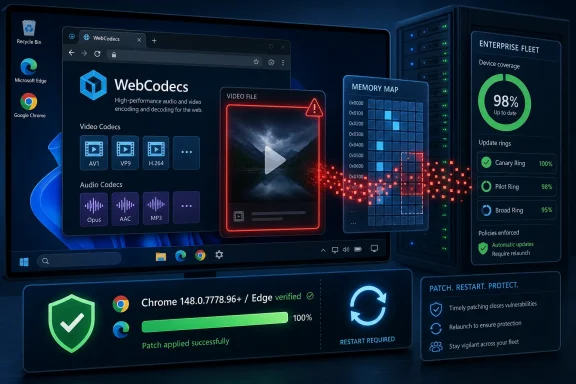 A Medium Bug in the Most Dangerous Part of the Desktop
CVE-2026-7933 is described as an out-of-bounds read in WebCodecs, Chrome’s low-level API for giving web applications direct access to audio and video encoding and decoding workflows. In plain English, a specially crafted video file could cause Chrome to read memory it should not read. The published impact is limited to information disclosure rather than code execution, which explains the medium severity rating.That does not make it unimportant. Memory disclosure vulnerabilities often sound tame because they do not immediately hand an attacker a shell. But in browser exploitation, leaked memory can be the missing ingredient that turns a more serious bug from unreliable theory into working exploit code.
The key detail is the attack path: a remote attacker, crafted video, user interaction required. That phrase will lead some administrators to mentally file the issue under “patch when convenient.” They should resist the temptation. User interaction in browser CVEs often means little more than persuading someone to open a page, preview content, or load media in a context where the browser does exactly what users expect browsers to do.
WebCodecs is also not an obscure corner in the old sense of the word. It exists because the modern web is a video production stack, conferencing client, streaming platform, surveillance dashboard, training portal, and AI-assisted media tool all at once. The more capable the browser becomes, the more valuable its media plumbing becomes to attackers.
WebCodecs Brought Native Media Power to the Web, and Native Media Risk Came With It
The old web mostly asked the browser to display content. The modern web asks it to process content. WebCodecs fits that shift by exposing efficient codec primitives to web applications that need lower-level control than the traditional video tag provides.That is good engineering for legitimate use cases. Real-time collaboration tools, cloud video editors, game streaming services, and browser-based capture tools all benefit from avoiding unnecessary layers of abstraction. The browser becomes faster and more flexible because web developers can work closer to the metal.
Security, however, rarely gives away performance for free. Codecs are historically unforgiving software: dense binary formats, hardware acceleration paths, platform-specific behavior, and enormous compatibility demands. A video file is not just entertainment; it is a structured input language interpreted by complicated parsers and decoders.
That is why a “crafted video file” should make defenders sit up. The word “file” can sound like a local attachment problem, but video reaches users through web pages, collaboration platforms, chat clients, cloud storage previews, social feeds, and internal learning systems. In many organizations, video is not an exception path. It is a normal business object.
The Patch Number Matters More Than the Acronym Soup
For Chrome, the important operational line is simple: desktop users need Chrome 148.0.7778.96 or later on Linux, and Chrome 148.0.7778.96 or 148.0.7778.97 or later on Windows and macOS, depending on channel and rollout. Google promoted Chrome 148 to the stable desktop channel on May 5, 2026, with the usual staged deployment language that updates roll out over days or weeks.That rollout model is sensible at Google scale, but it creates a familiar enterprise problem. The vendor has shipped the fix, the CVE is public, security scanners begin flagging exposure, and yet some endpoints will sit in the gray zone between “auto-update should handle it” and “this system actually updated.” In a consumer setting, that gap is annoying. In managed fleets, it is measurable risk.
Microsoft’s involvement matters because Edge is Chromium-based and Windows shops often treat Edge as part of the platform rather than a separate browser estate. MSRC tracking for a Chromium CVE is not the same thing as a Windows kernel patch, but it lands in the same operational universe: inventory, compliance, update rings, reboot politics, and executive questions after vulnerability reports light up dashboards.
The CVE metadata is also still in the early-life phase. NVD had not yet provided its own CVSS assessment in the material supplied, while CISA-ADP listed a CVSS 3.1 base score of 4.3 with network attack vector, low attack complexity, no privileges required, user interaction required, unchanged scope, and low confidentiality impact. That is a reasonable shape for the public description, but administrators should not confuse “medium” with “optional.”
The CPE Entry Tells a Bigger Story About Browser Vulnerability Accounting
The NVD change history shows a CPE configuration for Google Chrome versions before 148.0.7778.96, combined with operating system entries for Windows, Linux, and macOS. The “are we missing a CPE?” prompt is more than bureaucratic decoration. It reflects the messy reality of Chromium vulnerability tracking in a browser ecosystem where Chrome is only the reference point.Chromium bugs do not stay neatly inside Google Chrome. They flow downstream into Edge, Brave, Vivaldi, Opera, Electron-based apps, embedded browsers, kiosk shells, and vendor appliances that borrow Chromium components on their own schedules. A CPE entry that names Chrome is necessary, but it is rarely sufficient for understanding real exposure.
This is where enterprise vulnerability management often undercounts browser risk. A scanner may identify Chrome cleanly, Edge separately, and then miss bundled Chromium runtimes inside line-of-business applications. The result is a comforting dashboard that says the official browsers are patched while a forgotten app ships an older engine behind a login screen.
CVE-2026-7933 is not known from the public description as a broad ecosystem crisis, and there is no public indication in the supplied data that it is being actively exploited. But the accounting problem is structural. If a flaw sits in a Chromium component that processes media, defenders should ask not only “which Chrome versions are vulnerable?” but “where else do we run this code?”
User Interaction Is Not the Safety Blanket It Used to Be
The CVSS vector includes user interaction, and that will lower the score. In theory, the user has to do something. In practice, the user’s job is to do things in a browser all day.Security teams have spent years teaching people not to open suspicious attachments, and attackers have spent the same years moving malicious interaction into places that feel routine. A video embedded in a webpage, a preview in a collaboration tool, a training clip, a shared support recording, or a media-heavy phishing page can all satisfy the psychological requirement. The user does not need to think they are “opening a file” for the browser to parse attacker-controlled media.
This is especially true in Windows environments where the browser is tightly woven into identity, productivity, and help desk workflows. Edge is used for Microsoft 365, admin portals, cloud consoles, SaaS dashboards, and internal apps. Chrome remains common across development teams, marketing departments, and cross-platform fleets. The target surface is not a niche population of risky users; it is nearly everyone.
A medium WebCodecs flaw therefore belongs in the class of vulnerabilities that are easy to underrate individually and dangerous in aggregate. One bug leaks a bit of memory. Another bug corrupts memory. A third bypasses a mitigation. Browser exploit chains are assembled from precisely these parts.
The Chrome 148 Release Was Not a One-Bug Patch
CVE-2026-7933 arrived as part of the much larger Chrome 148 security update, which public reporting and Google’s release material characterize as a substantial stable-channel release with many fixes. That context matters because defenders rarely patch one CVE at a time in browsers. They patch release trains.Chrome 148 included fixes across multiple severity levels, including critical vulnerabilities unrelated to WebCodecs. That makes the operational argument easier: even if CVE-2026-7933 alone does not trigger emergency-change procedures in your organization, the broader Chrome 148 update likely should trigger accelerated validation and deployment.
The browser patch cadence is now its own security calendar, parallel to Patch Tuesday but not subordinate to it. Google ships when Chrome needs to ship. Microsoft follows Chromium security fixes into Edge on its own release channels. Mozilla, Apple, and other vendors operate on their own rhythms. Administrators who only think in monthly operating system patch windows are managing yesterday’s threat model.
For WindowsForum readers, the lesson is familiar but worth repeating: Windows endpoint security depends on more than Windows Update. Browsers, WebView components, Office integrations, PDF handlers, Teams, Slack, Zoom, developer tools, and endpoint agents all maintain their own update machinery. The OS may be patched while the riskiest user-facing parser on the machine is not.
Edge Administrators Should Watch the Chromium Lag, Not Just the Microsoft Brand
Microsoft Edge’s Chromium foundation is a pragmatic success. It gives Windows users a modern browser engine with strong compatibility and lets Microsoft focus on enterprise controls, identity integration, and platform features rather than maintaining a wholly separate rendering stack. The trade-off is dependency.When Chromium fixes a vulnerability, Edge administrators need to know when Microsoft has incorporated the relevant update into the Stable and Extended Stable channels. MSRC entries help, but they do not eliminate the need for fleet verification. In practice, the question is not “did Microsoft acknowledge the CVE?” It is “which Edge build is installed on actual endpoints this morning?”
That distinction becomes important for organizations using update rings. A fast ring may pick up the fix quickly, while a broad production ring waits for validation. Extended Stable reduces change velocity but also changes the rhythm of security adoption. Neither model is wrong, but both require intentional exceptions when the browser engine is carrying fresh security fixes.
There is also a communications problem. Users recognize “Windows update” as something that may require patience and reboots. Browser updates are quieter, and that quietness is both a blessing and a liability. If the browser needs a restart to complete patching, a user with 147 open tabs can unknowingly preserve exposure long after the update has downloaded.
Information Disclosure Is the Exploit Writer’s Favorite Supporting Actor
Out-of-bounds read vulnerabilities are often treated as lower drama because they disclose data instead of modifying it. That distinction is real. A confidentiality-only bug is not equivalent to remote code execution.But browser hardening has made memory disclosure more strategically valuable, not less. Modern exploit mitigations depend on secrecy: randomized memory layouts, pointer integrity assumptions, process isolation boundaries, and sandbox constraints all become weaker when attackers can learn something they were not supposed to know. A leak does not have to spill passwords to matter.
In some exploit chains, an information disclosure bug is used to defeat address-space layout randomization. In others, it may expose object layout, heap state, or sensitive fragments that help refine a second-stage attack. The public CVE text for CVE-2026-7933 does not claim any such chain, and defenders should avoid inventing one. The point is that the class of bug has a role in real exploitation beyond the tidy CVSS label.
This is why medium browser bugs deserve faster handling than medium bugs in less exposed software. A medium vulnerability in a rarely used internal tool and a medium vulnerability in a default browser media path are not operationally equivalent, even if a scoring system compresses them into the same color band.
The Restricted Bug Tracker Is a Feature, Not a Cover-Up
The Chromium issue linked for CVE-2026-7933 is permission-restricted, which is normal for freshly patched browser vulnerabilities. Google often limits access to bug details until a majority of users have received the fix. That frustrates researchers and defenders who want full technical detail, but it also denies attackers a ready-made exploit roadmap during the rollout window.This creates an awkward information asymmetry. Administrators must act without knowing the full mechanics of the vulnerability. Security teams may not have proof-of-concept code, crash traces, or detailed affected-function analysis. Procurement and management may ask for evidence of exploitability that responsible disclosure deliberately withholds.
The correct response is not to wait for the bug to become public enough to be dangerous. Browser vendors restrict details precisely because the patch gap is exploitable time. Once the CVE exists, attackers can diff code, study commits, and search for the vulnerable logic even if the issue tracker is closed.
That does not mean every medium Chrome CVE should trigger panic. It means the absence of details should not be mistaken for absence of risk. In browser security, silence often means the vendor is trying to buy defenders time.
Windows Shops Need Browser Patch SLAs That Match Browser Reality
Many organizations still have crisp service-level agreements for operating system patches and vague hopes for browser updates. That inversion is hard to defend in 2026. The browser is often the first complex codebase to touch hostile input, and it updates too frequently to be governed by informal processes.A mature endpoint program should know the minimum acceptable Chrome and Edge versions within hours of a security release. It should have reporting that distinguishes installed version, pending update, and update requiring restart. It should also have a way to push restarts or at least nag aggressively when browser processes remain open after patch installation.
The same applies to unmanaged or lightly managed machines. Bring-your-own-device policies, contractor laptops, lab systems, and developer workstations can all fall outside the neat compliance perimeter. If those systems authenticate to corporate services, their browser patch state matters.
CVE-2026-7933 is a useful test case because it is not a catastrophic zero-day that forces everyone into emergency mode. It is the kind of ordinary browser vulnerability that reveals whether an organization has a sustainable patch muscle. If you need a war room for every medium Chrome media bug, your process is too brittle. If you need three weeks to patch it, your process is too slow.
The Practical Signal Hidden in the Noise
The concrete action is straightforward: verify Chrome and Chromium-based Edge builds, prioritize updating systems below the fixed Chrome 148 line, and pay special attention to endpoints that routinely handle untrusted media. That includes not only creative teams and communications departments, but also support desks, incident responders, educators, recruiters, and anyone who receives files from the public.Security teams should also look at browser restart behavior. A patched binary that is waiting for relaunch is better than nothing, but it is not the same as a running fixed browser. In many environments, the last mile of browser security is not download bandwidth or vendor availability; it is the human reluctance to close tabs.
The broader lesson is that vulnerability management needs to treat media APIs as first-class attack surface. WebCodecs, WebRTC, graphics libraries, font handling, GPU acceleration, and image parsing have all become part of the browser’s exposed machinery. These are not add-ons. They are central to what users expect the web to do.
The Patch Window Is Where the Real Story Lives
CVE-2026-7933 is a medium-severity WebCodecs memory-read flaw fixed in Chrome 148, but the more important story is the shrinking tolerance for slow browser hygiene.- Systems running Google Chrome before 148.0.7778.96 should be treated as exposed to CVE-2026-7933 until updated and relaunched.
- Windows and macOS Chrome fleets may see 148.0.7778.96 or 148.0.7778.97 depending on channel, while Linux is fixed at 148.0.7778.96 or later.
- The public impact is information disclosure through a crafted video file, with no public indication in the supplied material that the flaw is being actively exploited.
- Edge administrators should track the corresponding Chromium security uptake through Microsoft’s Edge release channels rather than assuming Windows Update alone settles the issue.
- Vulnerability teams should search beyond Chrome itself for Chromium-based browsers and embedded runtimes that may inherit the same class of media-processing exposure.
- Browser patch SLAs should account for relaunch delays, because an update that has downloaded but not restarted may leave the vulnerable code path in memory.
Source: NVD / Chromium Security Update Guide - Microsoft Security Response Center
