

Microsoft disclosed CVE-2026-40404 on June 9, 2026, as a Windows Universal Disk Format File System Driver elevation-of-privilege vulnerability affecting supported Windows systems through the UDFS component that parses and mounts UDF-formatted media and images. The dry title hides the important part: this is not another browser bug or cloud-side mishap, but a flaw in a legacy-facing file-system driver that still sits inside modern Windows. For defenders, the practical question is not whether UDF sounds obscure; it is whether a local attacker can turn access to a machine into deeper control by passing Windows a filesystem it mishandles.
The advisory language around CVE-2026-40404 also highlights a subtler problem with Patch Tuesday triage. Microsoft is not merely telling administrators that a bug exists; it is signaling how much confidence the industry should have in the claim, how mature the available technical knowledge may be, and how much attackers can infer from the public record. That makes this vulnerability less about optical discs and more about the continuing security tax of backward compatibility.
UDF, the Universal Disk Format, is one of those technologies most users stopped thinking about when laptops lost optical drives. It was designed for optical media and became familiar through DVDs, rewritable discs, and later media that needed a more capable format than ISO 9660. Windows, however, does not remove old plumbing just because consumer habits move on.
Microsoft’s own documentation treats UDF as one of the main Windows-supported file systems alongside NTFS, FAT32, and exFAT. Windows 7 and later support read/write behavior across UDF revisions up to UDF 2.60, which means this code path is not a museum piece. It remains part of the operating system’s storage stack.
That matters because file-system drivers live in a privileged neighborhood. They parse complex on-disk structures, expose files and metadata to user mode, and cooperate with the kernel, memory manager, cache manager, filter drivers, antivirus engines, backup tools, and storage subsystems. A malformed filesystem is not just “data”; it is data that asks kernel-mode code to make decisions.
This is why file-system vulnerabilities have an unusually long half-life. A web bug might require a vulnerable service to be exposed to the internet, but a filesystem parser may be reachable through removable media, mounted images, enterprise imaging workflows, forensic tooling, virtual machine disks, or automated scanning. The attack surface is local, but “local” does not mean “irrelevant.”
A phishing attachment, stolen credential, malicious insider account, compromised browser renderer, or abused help-desk tool may get an attacker onto a Windows system with limited rights. The next goal is to escape those limits. A kernel-adjacent elevation path is attractive because it can turn a foothold into the ability to disable security tools, dump credentials, tamper with logs, install persistence, or move laterally with more authority.
That is the real security story here. CVE-2026-40404 is not scary because UDF is fashionable. It is scary because Windows has to trust file-system drivers to interpret hostile-looking input without confusing bytes on disk for safe internal structures.
The distinction matters for patch prioritization. Organizations sometimes push remote-code-execution bugs to the front and defer local privilege bugs until the next maintenance window. That can be rational when exploitation is theoretical or chained conditions are difficult. But in modern intrusions, privilege escalation is often the difference between a contained incident and a domain-wide recovery project.
Not every CVE arrives with a proof-of-concept exploit, a root-cause write-up, a crash trace, and a researcher blog post. Sometimes the public record only establishes that a vendor has acknowledged a defect and issued a fix. In other cases, outside research may narrow the bug to a subsystem without fully proving the root cause. A higher-confidence entry means defenders should treat the vulnerability as real, not speculative.
For attackers, the same metric can be useful in a darker way. A confirmed vendor advisory says there is something worth diffing. Once patches ship, researchers and criminals alike can compare changed binaries, inspect code paths, and infer what input previously caused unsafe behavior. That is why vague advisories can still create urgency.
The awkward truth is that Patch Tuesday starts a race. Microsoft ships remediation; administrators test and deploy; attackers reverse-engineer. The public advisory may be sparse, but the patch itself is often the most detailed document in the room.
That does not mean every malformed UDF image becomes an exploit. Modern Windows has mitigations, and many parser crashes stop at denial of service. But an elevation-of-privilege rating means Microsoft believes the bug can cross a more serious line under the right conditions.
Administrators should therefore think beyond physical DVDs. UDF can appear in disk images, archival workflows, lab environments, deployment pipelines, and removable media controls. Security teams that have spent years focusing on USB device control may still miss the broader point: the file format itself is the payload surface.
There is also a defender’s paradox here. File systems are supposed to be boring. They work best when nobody thinks about them. But the less visible a subsystem is, the more likely it is to be underrepresented in asset inventories, hardening guides, and threat models.
A local privilege escalation in a driver may be less urgent than an actively exploited internet-facing RCE on a public server. It may also be more urgent than a higher-scored bug in a component your organization does not use. The right answer depends on exposure, endpoint population, removable media policy, virtualization practices, and how quickly an attacker with ordinary user rights could reach the vulnerable path.
Enterprises should also watch for signals that change after release. If Microsoft updates the advisory to mark public exploitation, if exploit code appears, if security vendors add detections, or if researchers publish technical analysis, the priority changes. Patch management is not a single decision made at noon on Patch Tuesday; it is a rolling assessment.
For home users, the guidance is simpler. Install the cumulative update. Windows Update’s bundling model means the UDFS fix will generally arrive with other security and quality changes, not as a standalone decision about whether you personally use optical media. That is one of the strengths of cumulative servicing, even when it frustrates those who prefer surgical patches.
Think of malware sandboxes, help-desk diagnostic systems, forensic workstations, file ingestion servers, shared lab machines, virtual desktop hosts, and developer environments. These systems often touch unusual files as part of their job. They may also run with elevated tooling, broad network access, or relaxed controls because they are considered “internal.”
That is where a local bug can develop enterprise reach. A low-privilege account on a shared system may be enough to stage an attack. A mounted image in a build or analysis pipeline may expose a parser path no one associated with a user double-clicking a disc. A removable media exception granted for one operational reason may become the opening for another.
Security teams should resist the temptation to classify UDFS as irrelevant based on hardware alone. The absence of DVD drives does not eliminate filesystem parsing. Windows is full of ways to attach, inspect, mount, scan, copy, and index storage-like objects.
The cost is attack surface. Every supported file system, protocol handler, legacy parser, codec, device class, and compatibility shim must be maintained as if an attacker will eventually treat it as an input processor. Because attackers do.
This does not mean Microsoft should simply rip UDF out of Windows. Compatibility has real value, and enterprises do not appreciate surprise removals of storage functionality. But it does mean that optional or rarely used components deserve stronger isolation, clearer administrative controls, and more aggressive hardening over time.
The future of Windows security is not just faster patching. It is reducing the number of privileged parsers that must safely interpret untrusted complexity inside the kernel.
The advisory language around CVE-2026-40404 also highlights a subtler problem with Patch Tuesday triage. Microsoft is not merely telling administrators that a bug exists; it is signaling how much confidence the industry should have in the claim, how mature the available technical knowledge may be, and how much attackers can infer from the public record. That makes this vulnerability less about optical discs and more about the continuing security tax of backward compatibility.
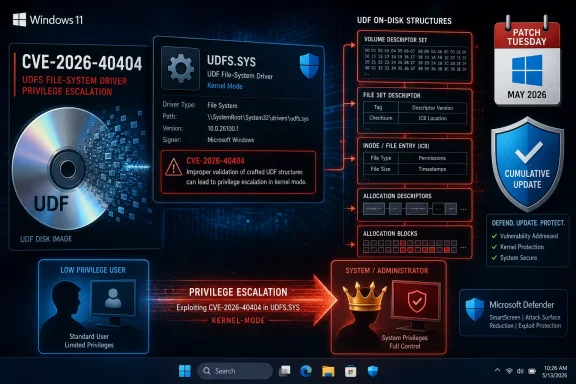 The Old Filesystem Still Has a Seat in the Kernel
UDF, the Universal Disk Format, is one of those technologies most users stopped thinking about when laptops lost optical drives. It was designed for optical media and became familiar through DVDs, rewritable discs, and later media that needed a more capable format than ISO 9660. Windows, however, does not remove old plumbing just because consumer habits move on.Microsoft’s own documentation treats UDF as one of the main Windows-supported file systems alongside NTFS, FAT32, and exFAT. Windows 7 and later support read/write behavior across UDF revisions up to UDF 2.60, which means this code path is not a museum piece. It remains part of the operating system’s storage stack.
That matters because file-system drivers live in a privileged neighborhood. They parse complex on-disk structures, expose files and metadata to user mode, and cooperate with the kernel, memory manager, cache manager, filter drivers, antivirus engines, backup tools, and storage subsystems. A malformed filesystem is not just “data”; it is data that asks kernel-mode code to make decisions.
This is why file-system vulnerabilities have an unusually long half-life. A web bug might require a vulnerable service to be exposed to the internet, but a filesystem parser may be reachable through removable media, mounted images, enterprise imaging workflows, forensic tooling, virtual machine disks, or automated scanning. The attack surface is local, but “local” does not mean “irrelevant.”
Elevation of Privilege Is the Second Act, Not the Opening Scene
CVE-2026-40404 is categorized as an elevation-of-privilege vulnerability, and that classification can lull casual readers into underestimating it. EoP bugs usually do not begin the intrusion. They make the intrusion matter.A phishing attachment, stolen credential, malicious insider account, compromised browser renderer, or abused help-desk tool may get an attacker onto a Windows system with limited rights. The next goal is to escape those limits. A kernel-adjacent elevation path is attractive because it can turn a foothold into the ability to disable security tools, dump credentials, tamper with logs, install persistence, or move laterally with more authority.
That is the real security story here. CVE-2026-40404 is not scary because UDF is fashionable. It is scary because Windows has to trust file-system drivers to interpret hostile-looking input without confusing bytes on disk for safe internal structures.
The distinction matters for patch prioritization. Organizations sometimes push remote-code-execution bugs to the front and defer local privilege bugs until the next maintenance window. That can be rational when exploitation is theoretical or chained conditions are difficult. But in modern intrusions, privilege escalation is often the difference between a contained incident and a domain-wide recovery project.
Microsoft’s Confidence Metric Is a Warning About the Information Gap
The user-facing description attached to this vulnerability points to a metric that measures confidence in the existence of a vulnerability and the credibility of known technical details. That language is important because it tells defenders how to read silence.Not every CVE arrives with a proof-of-concept exploit, a root-cause write-up, a crash trace, and a researcher blog post. Sometimes the public record only establishes that a vendor has acknowledged a defect and issued a fix. In other cases, outside research may narrow the bug to a subsystem without fully proving the root cause. A higher-confidence entry means defenders should treat the vulnerability as real, not speculative.
For attackers, the same metric can be useful in a darker way. A confirmed vendor advisory says there is something worth diffing. Once patches ship, researchers and criminals alike can compare changed binaries, inspect code paths, and infer what input previously caused unsafe behavior. That is why vague advisories can still create urgency.
The awkward truth is that Patch Tuesday starts a race. Microsoft ships remediation; administrators test and deploy; attackers reverse-engineer. The public advisory may be sparse, but the patch itself is often the most detailed document in the room.
The UDFS Angle Makes This a Parsing Problem With Administrative Consequences
The most likely danger zone in any UDFS vulnerability is parsing. UDF volumes contain descriptors, allocation structures, metadata, filenames, attributes, and revision-specific behavior that must be interpreted precisely. A small validation failure in kernel code can become a large security problem because the parser operates on attacker-supplied structures.That does not mean every malformed UDF image becomes an exploit. Modern Windows has mitigations, and many parser crashes stop at denial of service. But an elevation-of-privilege rating means Microsoft believes the bug can cross a more serious line under the right conditions.
Administrators should therefore think beyond physical DVDs. UDF can appear in disk images, archival workflows, lab environments, deployment pipelines, and removable media controls. Security teams that have spent years focusing on USB device control may still miss the broader point: the file format itself is the payload surface.
There is also a defender’s paradox here. File systems are supposed to be boring. They work best when nobody thinks about them. But the less visible a subsystem is, the more likely it is to be underrepresented in asset inventories, hardening guides, and threat models.
Patch Tuesday Triage Should Not Stop at the CVSS Number
The predictable response to a vulnerability like this is to ask for the score. That is necessary, but insufficient. CVSS can describe impact and exploitability in a structured way, yet it cannot capture how a flaw fits into a real attacker’s playbook.A local privilege escalation in a driver may be less urgent than an actively exploited internet-facing RCE on a public server. It may also be more urgent than a higher-scored bug in a component your organization does not use. The right answer depends on exposure, endpoint population, removable media policy, virtualization practices, and how quickly an attacker with ordinary user rights could reach the vulnerable path.
Enterprises should also watch for signals that change after release. If Microsoft updates the advisory to mark public exploitation, if exploit code appears, if security vendors add detections, or if researchers publish technical analysis, the priority changes. Patch management is not a single decision made at noon on Patch Tuesday; it is a rolling assessment.
For home users, the guidance is simpler. Install the cumulative update. Windows Update’s bundling model means the UDFS fix will generally arrive with other security and quality changes, not as a standalone decision about whether you personally use optical media. That is one of the strengths of cumulative servicing, even when it frustrates those who prefer surgical patches.
The Enterprise Risk Is in the Weird Corners
The obvious vulnerable machine is a workstation where a user can mount or open a crafted UDF image. The more interesting cases are the machines that process untrusted files automatically.Think of malware sandboxes, help-desk diagnostic systems, forensic workstations, file ingestion servers, shared lab machines, virtual desktop hosts, and developer environments. These systems often touch unusual files as part of their job. They may also run with elevated tooling, broad network access, or relaxed controls because they are considered “internal.”
That is where a local bug can develop enterprise reach. A low-privilege account on a shared system may be enough to stage an attack. A mounted image in a build or analysis pipeline may expose a parser path no one associated with a user double-clicking a disc. A removable media exception granted for one operational reason may become the opening for another.
Security teams should resist the temptation to classify UDFS as irrelevant based on hardware alone. The absence of DVD drives does not eliminate filesystem parsing. Windows is full of ways to attach, inspect, mount, scan, copy, and index storage-like objects.
Backward Compatibility Keeps Winning the Argument
CVE-2026-40404 is another reminder that Windows’ greatest commercial strength is also one of its deepest security burdens. Microsoft has spent decades preserving compatibility with old applications, old media, old workflows, and old assumptions. That is why Windows can run in hospitals, factories, schools, banks, living rooms, and government offices with wildly different technology eras stacked on top of one another.The cost is attack surface. Every supported file system, protocol handler, legacy parser, codec, device class, and compatibility shim must be maintained as if an attacker will eventually treat it as an input processor. Because attackers do.
This does not mean Microsoft should simply rip UDF out of Windows. Compatibility has real value, and enterprises do not appreciate surprise removals of storage functionality. But it does mean that optional or rarely used components deserve stronger isolation, clearer administrative controls, and more aggressive hardening over time.
The future of Windows security is not just faster patching. It is reducing the number of privileged parsers that must safely interpret untrusted complexity inside the kernel.
The Practical Reading for WindowsForum Readers
CVE-2026-40404 is not the kind of vulnerability that should trigger panic on its name alone. It should trigger disciplined patching, careful exposure review, and skepticism toward the comforting idea that “local” means “low priority.” The concrete lesson is that obscure storage code can still be part of a modern attack chain.- Microsoft disclosed CVE-2026-40404 on June 9, 2026, as an elevation-of-privilege flaw in the Windows UDFS driver.
- The affected component handles Universal Disk Format volumes, a file system historically associated with optical media but still supported by modern Windows.
- The main practical risk is post-compromise privilege escalation, where an attacker with limited local access attempts to gain higher rights.
- Administrators should prioritize cumulative Windows updates on endpoints and systems that process untrusted files, disk images, or removable media.
- The confidence metric matters because it separates speculative vulnerability chatter from vendor-acknowledged risk with enough technical substance to guide attackers and defenders.
- Organizations should treat file-system parsing as an attack surface, even when the related media format feels outdated.
References
- Primary source: MSRC
Published: 2026-06-09T07:00:00-07:00
Security Update Guide - Microsoft Security Response Center
 msrc.microsoft.com
- Related coverage: rapid7.com
Rapid7 Vulnerability Database
Rapid7's VulnDB is curated repository of vetted computer software exploits and exploitable vulnerabilities.www.rapid7.com - Related coverage: thewindowsupdate.com
- Related coverage: windowsforum.com
Patch Tuesday: Microsoft fixes Windows UDFS CVE-2026-23672 Elevation of Privilege | Windows Forum
Microsoft shipped an urgent fix on Patch Tuesday for a newly catalogued elevation-of-privilege flaw in the Windows Universal Disk Format File System Driver...windowsforum.com - Related coverage: bleepingcomputer.com
- Related coverage: sentinelone.com
CVE-2026-23672: Windows 10 1607 Privilege Escalation Flaw
CVE-2026-23672 is a privilege escalation vulnerability in Windows 10 1607 UDFS driver. Learn about its impact, affected versions, and mitigation methods.www.sentinelone.com

- Related coverage: mindray.com
- Related coverage: absolute.com
- Related coverage: talos-intelligence.com
- Related coverage: talosintelligence.com
Vulnerability Reports - Latest network security threats and zeroday discoveries || Cisco Talos Intelligence Group - Comprehensive Threat Intelligence
Talos investigates software and operating system vulnerabilities in order to discover them before malicious threat actors do. We provide this information to vendors so that they can create patches and protect their customers as soon as possible.talosintelligence.com
- Related coverage: vulnerability.circl.lu
Vulnerability-Lookup
Vulnerability-Lookup - Fast vulnerability lookup correlation from different sources.vulnerability.circl.lu - Official source: microsoft.com
MSRC - Microsoft Security Response Center
The Microsoft Security Response Center is part of the defender community and on the front line of security response evolution. For over twenty years, we have been engaged with security researchers working to protect customers and the broader ecosystem.www.microsoft.com
- Related coverage: datacomm.com
- Related coverage: sra.io
- Related coverage: cirt.gy
