

Microsoft disclosed CVE-2026-45600 on June 9, 2026, as an Important-rated Windows Kernel-Mode Driver elevation-of-privilege vulnerability in its June Patch Tuesday release, affecting Windows systems through a local privilege-escalation path rather than a remote, unauthenticated network attack. The bug sits in the unglamorous but consequential class of Windows flaws that rarely make splashy headlines until they become the second stage of an intrusion. The public record is thin, but that thinness is itself part of the story: Microsoft is telling administrators enough to patch, not enough to teach attackers. For defenders, the practical reading is straightforward: treat this as a credible kernel-adjacent privilege bug, not as background noise in a crowded Patch Tuesday spreadsheet.
The phrase “Windows Kernel-Mode Driver Elevation of Privilege Vulnerability” sounds almost generic because Microsoft has used variations of it for years. That familiarity is dangerous. Kernel-mode driver bugs are not exotic edge cases in Windows security; they are one of the recurring ways a foothold becomes control.
An elevation-of-privilege vulnerability does not usually give an attacker initial access by itself. It typically requires that the attacker already have some ability to run code on the target machine, whether through phishing, a malicious document, a browser compromise, stolen credentials, an exposed management tool, or a compromised user account. But once that condition is met, the distinction between “ordinary user” and “SYSTEM” becomes the difference between a contained incident and a fully compromised endpoint.
That is why local privilege escalation bugs matter so much in real intrusions. The first exploit gets attention because it crosses the perimeter. The second exploit often decides how expensive the cleanup becomes.
CVE-2026-45600 belongs to that second category. Its value is not that it lets an attacker shout across the internet and instantly own a server. Its value is that it may let an attacker who has already landed on a Windows machine break out of the permission box that was supposed to limit the damage.
The important metric in the prompt is Report Confidence. In CVSS terms, this measures how much confidence exists that the vulnerability is real and that the known technical details are credible. A confirmed vulnerability is different from a rumor, a crash report, or an uncorroborated researcher claim.
For defenders, high report confidence changes the triage conversation. It means the vulnerability is not merely speculative. Even if Microsoft has not published the root cause in detail, the vendor has acknowledged enough to ship a security fix and attach the bug to the affected Windows servicing train.
That distinction matters because IT teams are often forced to decide under uncertainty. If a vulnerability is rumored but unpatched, the priority may be monitoring and exposure reduction. If a vulnerability is confirmed and patched, the priority becomes deployment, validation, and exception handling.
That is exactly why it deserves attention from administrators. Patch Tuesday triage tends to privilege the spectacular: remote code execution, active exploitation, public disclosure, wormable services, and internet-facing enterprise products. Local privilege escalation often gets shoved down the queue unless it is already being exploited in the wild.
Attackers do not rank vulnerabilities by headline value. They rank them by utility. A reliable local privilege escalation in Windows can be useful for ransomware crews, espionage operators, commodity malware authors, red teams, and anyone trying to disable security tools or dump credentials after gaining an initial shell.
The absence of a public exploit notice should lower panic, not priority. It means defenders may have a window in which patching can get ahead of weaponization. That window is worth using.
A mistake in a driver can be qualitatively worse than a mistake in an ordinary desktop app. Kernel-mode code runs with high privilege and touches shared structures that define the integrity of the machine. A bug that would merely crash a user process in application land can become privilege escalation, information disclosure, or arbitrary code execution when it appears in kernel territory.
Microsoft has spent years trying to make this terrain safer. Driver signing, virtualization-based security, kernel-mode code integrity, memory protections, exploit mitigations, and Windows Defender Application Control all raise the bar. But Windows remains a vast compatibility platform, and compatibility is where old assumptions go to survive.
Kernel-mode driver vulnerabilities persist because the surface area is enormous. Windows supports decades of hardware expectations, multiple driver models, enterprise management hooks, third-party security software, gaming peripherals, storage stacks, GPU acceleration, print paths, and virtualization layers. The OS can be hardened, but it cannot be made small.
That is the architectural backdrop for CVE-2026-45600. The advisory may be brief, but the class is familiar: a lower-privileged local actor finds a way to make privileged kernel-adjacent code do something it should not.
That makes severity labels useful but insufficient. A local privilege escalation vulnerability on a kiosk system, developer workstation, jump box, domain admin workstation, or server used for management can be more operationally dangerous than a theoretical remote bug in a disabled feature. Context beats adjectives.
For WindowsForum readers, the lesson is to map the vulnerability to real estate. Where do untrusted users sign in? Where do developers run experimental code? Where do help desk tools execute scripts? Where are security agents installed? Which machines hold tokens, secrets, browser sessions, or administrative credentials?
Those are the systems where a local privilege escalation is not merely local. It becomes a bridge from a compromised identity to a compromised platform.
The phrase local privilege escalation can lull people into thinking “the attacker already has to be there.” In modern enterprise environments, attackers are often already there somewhere. The question is whether they can turn that somewhere into everywhere.
For CVE-2026-45600, Microsoft’s publication gives the vulnerability the weight of vendor acknowledgement. That does not mean every technical detail is public. It means enough is known to justify a security update and enough confidence exists for administrators to act.
This is where defenders and attackers read the same metadata differently. Defenders see confirmed existence and patch availability. Attackers see a narrowed research target: Windows kernel-mode drivers changed in a particular update window, attached to an elevation-of-privilege impact.
The more detailed the advisory, the faster attackers can sometimes reproduce the bug. The less detailed the advisory, the more administrators complain that they lack enough information for risk scoring. MSRC has to balance those pressures every month, and CVE-2026-45600 is a textbook example of the compromise.
The practical answer is not to wait for exploit write-ups. By the time a proof of concept appears, the risk model has already changed. A confirmed Microsoft kernel-mode privilege bug should be treated as actionable at publication, even if the public root-cause narrative arrives later or never arrives at all.
A phishing payload that runs as a standard user is annoying. The same payload paired with a working kernel-mode elevation bug is materially worse. Suddenly the attacker can try to tamper with endpoint protection, access protected memory, implant services, manipulate logs, or extract credentials that were supposed to be beyond the reach of a low-privileged session.
This is also why desktop fleets matter as much as servers. Security teams often focus on domain controllers, Exchange, VPNs, and internet-facing servers, but workstations are where initial access frequently starts. A workstation privilege escalation can become the prelude to cloud token theft, remote management abuse, or privileged session hijacking.
The danger is not that every CVE-2026-45600-affected system will be instantly compromised. The danger is that unpatched machines become more useful to attackers who have already solved the first step.
That is the quiet economics of Windows exploitation. Initial-access bugs get the auction prices. Privilege-escalation bugs keep the operation alive.
The right response starts with inventory. If you do not know which Windows builds are in service, which update rings they belong to, and which systems are routinely deferred, a kernel-mode driver fix becomes another blind spot. Patch compliance is not a dashboard color; it is an assertion about actual machines that attackers can touch.
Consumer Windows users should install the June 2026 cumulative updates through Windows Update and reboot when prompted. Enthusiasts who delay updates for gaming, driver stability, or customization reasons should still treat security updates differently from feature churn. A privilege escalation bug does not care that a machine is “just a home PC” if that PC stores passwords, browser sessions, crypto wallets, personal documents, or remote-work credentials.
Enterprise administrators need the usual staged rollout, but staged should not become stagnant. Pilot rings should validate line-of-business apps, VPN clients, endpoint agents, disk encryption, and specialized drivers. Production rings should follow promptly once there are no blocking regressions.
For servers, the calculus depends on role. Domain controllers, management servers, Remote Desktop Session Hosts, virtualization hosts, and systems exposed to many interactive users deserve faster attention than isolated machines with no local logon surface. But “isolated” should be proven, not assumed.
Security tools, hardware utilities, RGB controllers, storage accelerators, anti-cheat systems, printer packages, VPN clients, backup agents, and management tools have all contributed to driver attack surface over the years. Microsoft’s driver policies have tightened, but enterprises still carry long tails of vendor software that runs close to the kernel.
CVE-2026-45600 should therefore prompt a wider audit question: what code do you allow to run in kernel mode, and why? Patching Windows is necessary, but it does not remove the need to retire obsolete drivers, update vendor packages, and block known-vulnerable driver abuse where possible.
Attackers increasingly treat vulnerable drivers as bring-your-own tools. If they can load or abuse a signed-but-vulnerable driver, they may not need a fresh Windows zero-day at all. That reality makes kernel hardening a policy problem as much as a patch problem.
The Windows platform has improved substantially here, especially with stronger code integrity features and vulnerable-driver blocklisting. But optional protections only protect systems where they are actually enabled, compatible, and monitored.
Developer workstations deserve special mention. They often run compilers, package managers, containers, emulators, local databases, debugging tools, and scripts from many sources. They also frequently hold credentials that reach into source control, CI/CD systems, cloud platforms, and production telemetry.
VDI and Remote Desktop environments have a different risk profile. A local privilege escalation on a multi-user host can threaten separation boundaries that administrators rely on for cost and manageability. Even if the vulnerability does not directly cross user sessions, SYSTEM-level control on a shared host is a bad day.
Managed service providers should also pay attention. Their workstations and management servers are high-leverage targets. A local privilege escalation there can amplify an already serious breach across customer environments.
The same is true for security operations boxes. Machines used for incident response, EDR administration, SIEM access, and privileged remote tooling should be patched aggressively because compromising the defender’s console is one of the cleanest ways to make a breach worse.
Routine is not safe. Routine is where attackers expect lag. The average enterprise does not get breached only by cinematic zero-days; it gets breached by combinations of credential theft, exposed services, misconfiguration, delayed patching, and privilege escalation.
That makes CVE-2026-45600 a test of patch discipline. Can an organization patch an Important local privilege bug before it becomes fashionable? Can it do so while also handling the more obvious remote and publicly disclosed items in the same monthly release? Can it measure deployment by asset criticality rather than by severity label alone?
The best security teams do not wait for exploit chatter to make every decision. They use exploit chatter to accelerate, not to initiate, action.
For smaller shops, this is where automation earns its keep. Windows Update for Business, Intune, WSUS, Configuration Manager, and third-party patch platforms all exist to turn confirmed vendor fixes into deployed reality. The hard part is not knowing that patching matters. The hard part is removing the exceptions that quietly become permanent.
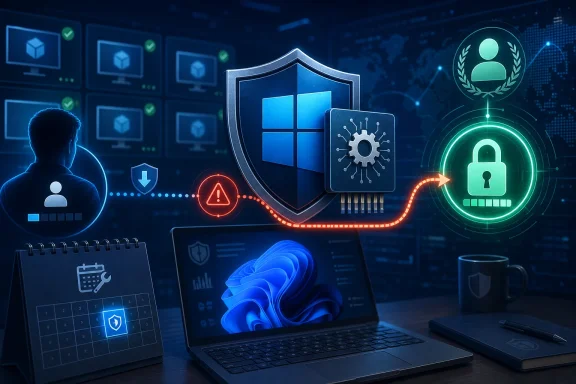 A Local Bug Still Has Enterprise Reach
The phrase “Windows Kernel-Mode Driver Elevation of Privilege Vulnerability” sounds almost generic because Microsoft has used variations of it for years. That familiarity is dangerous. Kernel-mode driver bugs are not exotic edge cases in Windows security; they are one of the recurring ways a foothold becomes control.An elevation-of-privilege vulnerability does not usually give an attacker initial access by itself. It typically requires that the attacker already have some ability to run code on the target machine, whether through phishing, a malicious document, a browser compromise, stolen credentials, an exposed management tool, or a compromised user account. But once that condition is met, the distinction between “ordinary user” and “SYSTEM” becomes the difference between a contained incident and a fully compromised endpoint.
That is why local privilege escalation bugs matter so much in real intrusions. The first exploit gets attention because it crosses the perimeter. The second exploit often decides how expensive the cleanup becomes.
CVE-2026-45600 belongs to that second category. Its value is not that it lets an attacker shout across the internet and instantly own a server. Its value is that it may let an attacker who has already landed on a Windows machine break out of the permission box that was supposed to limit the damage.
Microsoft’s Sparse Disclosure Is a Security Signal, Not an Omission
The user-facing MSRC entry for this vulnerability is not a reverse-engineering paper. It gives administrators a product area, an impact category, severity, and scoring metadata, but it does not publicly explain the driver path, memory-corruption primitive, object-lifetime mistake, or access-control failure that produced the bug. That restraint is normal for Patch Tuesday, especially when exploit details are not already widely circulating.The important metric in the prompt is Report Confidence. In CVSS terms, this measures how much confidence exists that the vulnerability is real and that the known technical details are credible. A confirmed vulnerability is different from a rumor, a crash report, or an uncorroborated researcher claim.
For defenders, high report confidence changes the triage conversation. It means the vulnerability is not merely speculative. Even if Microsoft has not published the root cause in detail, the vendor has acknowledged enough to ship a security fix and attach the bug to the affected Windows servicing train.
That distinction matters because IT teams are often forced to decide under uncertainty. If a vulnerability is rumored but unpatched, the priority may be monitoring and exposure reduction. If a vulnerability is confirmed and patched, the priority becomes deployment, validation, and exception handling.
The Patch Tuesday Crowd Hides the Kernel Bugs That Matter Later
June 2026 Patch Tuesday was a large release, with hundreds of Microsoft CVEs and a broad spread of flaws across Windows, Office, Exchange, Azure-connected services, Visual Studio Code, Secure Boot, BitLocker, RDP, HTTP.sys, and other components. In that crowd, CVE-2026-45600 is easy to miss. It is not the only Windows kernel-related item, and it is not framed as the marquee zero-day of the month.That is exactly why it deserves attention from administrators. Patch Tuesday triage tends to privilege the spectacular: remote code execution, active exploitation, public disclosure, wormable services, and internet-facing enterprise products. Local privilege escalation often gets shoved down the queue unless it is already being exploited in the wild.
Attackers do not rank vulnerabilities by headline value. They rank them by utility. A reliable local privilege escalation in Windows can be useful for ransomware crews, espionage operators, commodity malware authors, red teams, and anyone trying to disable security tools or dump credentials after gaining an initial shell.
The absence of a public exploit notice should lower panic, not priority. It means defenders may have a window in which patching can get ahead of weaponization. That window is worth using.
Kernel-Mode Drivers Remain Windows’ Oldest Modern Problem
Windows kernel-mode drivers occupy a privileged, risky layer of the operating system. They exist to let hardware, filesystems, security products, graphics stacks, networking components, storage systems, virtualization features, and other low-level services do work that user-mode software cannot safely or efficiently do alone. That power is also the problem.A mistake in a driver can be qualitatively worse than a mistake in an ordinary desktop app. Kernel-mode code runs with high privilege and touches shared structures that define the integrity of the machine. A bug that would merely crash a user process in application land can become privilege escalation, information disclosure, or arbitrary code execution when it appears in kernel territory.
Microsoft has spent years trying to make this terrain safer. Driver signing, virtualization-based security, kernel-mode code integrity, memory protections, exploit mitigations, and Windows Defender Application Control all raise the bar. But Windows remains a vast compatibility platform, and compatibility is where old assumptions go to survive.
Kernel-mode driver vulnerabilities persist because the surface area is enormous. Windows supports decades of hardware expectations, multiple driver models, enterprise management hooks, third-party security software, gaming peripherals, storage stacks, GPU acceleration, print paths, and virtualization layers. The OS can be hardened, but it cannot be made small.
That is the architectural backdrop for CVE-2026-45600. The advisory may be brief, but the class is familiar: a lower-privileged local actor finds a way to make privileged kernel-adjacent code do something it should not.
“Important” Does Not Mean Optional
Microsoft’s “Important” severity label can be misunderstood by organizations that reserve emergency treatment for “Critical” vulnerabilities. In Microsoft’s taxonomy, Critical often signals remote code execution without meaningful user interaction or similarly severe exposure. Important can still describe bugs that lead to complete local compromise after an attacker gains a foothold.That makes severity labels useful but insufficient. A local privilege escalation vulnerability on a kiosk system, developer workstation, jump box, domain admin workstation, or server used for management can be more operationally dangerous than a theoretical remote bug in a disabled feature. Context beats adjectives.
For WindowsForum readers, the lesson is to map the vulnerability to real estate. Where do untrusted users sign in? Where do developers run experimental code? Where do help desk tools execute scripts? Where are security agents installed? Which machines hold tokens, secrets, browser sessions, or administrative credentials?
Those are the systems where a local privilege escalation is not merely local. It becomes a bridge from a compromised identity to a compromised platform.
The phrase local privilege escalation can lull people into thinking “the attacker already has to be there.” In modern enterprise environments, attackers are often already there somewhere. The question is whether they can turn that somewhere into everywhere.
The Confidence Metric Cuts Both Ways
The Report Confidence language in the prompt is unusually revealing because it forces defenders to think about uncertainty as part of vulnerability management. A vulnerability can be public but vague. It can be technically plausible but unconfirmed. It can be acknowledged by a vendor but not explained in depth. Each state has a different operational meaning.For CVE-2026-45600, Microsoft’s publication gives the vulnerability the weight of vendor acknowledgement. That does not mean every technical detail is public. It means enough is known to justify a security update and enough confidence exists for administrators to act.
This is where defenders and attackers read the same metadata differently. Defenders see confirmed existence and patch availability. Attackers see a narrowed research target: Windows kernel-mode drivers changed in a particular update window, attached to an elevation-of-privilege impact.
The more detailed the advisory, the faster attackers can sometimes reproduce the bug. The less detailed the advisory, the more administrators complain that they lack enough information for risk scoring. MSRC has to balance those pressures every month, and CVE-2026-45600 is a textbook example of the compromise.
The practical answer is not to wait for exploit write-ups. By the time a proof of concept appears, the risk model has already changed. A confirmed Microsoft kernel-mode privilege bug should be treated as actionable at publication, even if the public root-cause narrative arrives later or never arrives at all.
Exploitability Lives in Chains, Not Individual CVEs
A single CVE is a filing cabinet label. Real attacks are workflows. CVE-2026-45600 should be understood as one possible link in a chain that begins with access and ends with persistence, credential theft, lateral movement, or defense evasion.A phishing payload that runs as a standard user is annoying. The same payload paired with a working kernel-mode elevation bug is materially worse. Suddenly the attacker can try to tamper with endpoint protection, access protected memory, implant services, manipulate logs, or extract credentials that were supposed to be beyond the reach of a low-privileged session.
This is also why desktop fleets matter as much as servers. Security teams often focus on domain controllers, Exchange, VPNs, and internet-facing servers, but workstations are where initial access frequently starts. A workstation privilege escalation can become the prelude to cloud token theft, remote management abuse, or privileged session hijacking.
The danger is not that every CVE-2026-45600-affected system will be instantly compromised. The danger is that unpatched machines become more useful to attackers who have already solved the first step.
That is the quiet economics of Windows exploitation. Initial-access bugs get the auction prices. Privilege-escalation bugs keep the operation alive.
The Admin Playbook Is Boring Because It Works
There is no public indication that CVE-2026-45600 requires a special configuration workaround beyond applying Microsoft’s June 2026 security updates. That is both reassuring and frustrating. Reassuring, because the fix is in the normal servicing channel. Frustrating, because normal servicing is exactly where many organizations accumulate exceptions.The right response starts with inventory. If you do not know which Windows builds are in service, which update rings they belong to, and which systems are routinely deferred, a kernel-mode driver fix becomes another blind spot. Patch compliance is not a dashboard color; it is an assertion about actual machines that attackers can touch.
Consumer Windows users should install the June 2026 cumulative updates through Windows Update and reboot when prompted. Enthusiasts who delay updates for gaming, driver stability, or customization reasons should still treat security updates differently from feature churn. A privilege escalation bug does not care that a machine is “just a home PC” if that PC stores passwords, browser sessions, crypto wallets, personal documents, or remote-work credentials.
Enterprise administrators need the usual staged rollout, but staged should not become stagnant. Pilot rings should validate line-of-business apps, VPN clients, endpoint agents, disk encryption, and specialized drivers. Production rings should follow promptly once there are no blocking regressions.
For servers, the calculus depends on role. Domain controllers, management servers, Remote Desktop Session Hosts, virtualization hosts, and systems exposed to many interactive users deserve faster attention than isolated machines with no local logon surface. But “isolated” should be proven, not assumed.
Driver Risk Is Also Third-Party Risk
Even when a CVE is assigned to Microsoft’s Windows kernel-mode driver area, the broader lesson reaches into the third-party driver ecosystem. Windows security is not just the NT kernel and Microsoft binaries. It is also the signed code that vendors persuade Windows to load at high privilege.Security tools, hardware utilities, RGB controllers, storage accelerators, anti-cheat systems, printer packages, VPN clients, backup agents, and management tools have all contributed to driver attack surface over the years. Microsoft’s driver policies have tightened, but enterprises still carry long tails of vendor software that runs close to the kernel.
CVE-2026-45600 should therefore prompt a wider audit question: what code do you allow to run in kernel mode, and why? Patching Windows is necessary, but it does not remove the need to retire obsolete drivers, update vendor packages, and block known-vulnerable driver abuse where possible.
Attackers increasingly treat vulnerable drivers as bring-your-own tools. If they can load or abuse a signed-but-vulnerable driver, they may not need a fresh Windows zero-day at all. That reality makes kernel hardening a policy problem as much as a patch problem.
The Windows platform has improved substantially here, especially with stronger code integrity features and vulnerable-driver blocklisting. But optional protections only protect systems where they are actually enabled, compatible, and monitored.
Where the Real Risk Lands First
The most exposed environments are not necessarily the ones with the most Windows machines. They are the ones with the most ways for a low-privileged actor to execute code locally. Shared workstations, developer endpoints, VDI pools, terminal servers, lab systems, and help desk machines all raise the value of a privilege escalation bug.Developer workstations deserve special mention. They often run compilers, package managers, containers, emulators, local databases, debugging tools, and scripts from many sources. They also frequently hold credentials that reach into source control, CI/CD systems, cloud platforms, and production telemetry.
VDI and Remote Desktop environments have a different risk profile. A local privilege escalation on a multi-user host can threaten separation boundaries that administrators rely on for cost and manageability. Even if the vulnerability does not directly cross user sessions, SYSTEM-level control on a shared host is a bad day.
Managed service providers should also pay attention. Their workstations and management servers are high-leverage targets. A local privilege escalation there can amplify an already serious breach across customer environments.
The same is true for security operations boxes. Machines used for incident response, EDR administration, SIEM access, and privileged remote tooling should be patched aggressively because compromising the defender’s console is one of the cleanest ways to make a breach worse.
The Zero-Day Label Is Not the Only Trigger for Urgency
June 2026’s Patch Tuesday included publicly disclosed zero-days, and those naturally attract attention. CVE-2026-45600 does not need that label to matter. The industry’s fixation on zero-days can distort patching priorities by making everything else feel routine.Routine is not safe. Routine is where attackers expect lag. The average enterprise does not get breached only by cinematic zero-days; it gets breached by combinations of credential theft, exposed services, misconfiguration, delayed patching, and privilege escalation.
That makes CVE-2026-45600 a test of patch discipline. Can an organization patch an Important local privilege bug before it becomes fashionable? Can it do so while also handling the more obvious remote and publicly disclosed items in the same monthly release? Can it measure deployment by asset criticality rather than by severity label alone?
The best security teams do not wait for exploit chatter to make every decision. They use exploit chatter to accelerate, not to initiate, action.
For smaller shops, this is where automation earns its keep. Windows Update for Business, Intune, WSUS, Configuration Manager, and third-party patch platforms all exist to turn confirmed vendor fixes into deployed reality. The hard part is not knowing that patching matters. The hard part is removing the exceptions that quietly become permanent.
A June Kernel Bug Should Change the Week’s Patch Order
CVE-2026-45600 is not the loudest vulnerability in Microsoft’s June 2026 release, but it is the kind of flaw administrators should make sure does not disappear into the monthly pile. Its concrete implications are narrow enough to act on and broad enough to matter.- Organizations should deploy the June 2026 Windows security updates to affected endpoints and servers through their normal patch rings, with faster treatment for systems that allow interactive logon or run privileged administration tools.
- Security teams should treat the Microsoft acknowledgement and patch availability as sufficient confirmation for action, even without public root-cause details or proof-of-concept exploit code.
- Administrators should prioritize workstations, VDI hosts, Remote Desktop Session Hosts, developer machines, and management servers because local privilege escalation has the most value where attackers can already run code.
- Patch triage should not rely only on the Critical versus Important label, because an Important elevation-of-privilege flaw can materially worsen a breach once initial access exists.
- Kernel-mode driver exposure should prompt a broader review of third-party drivers, vulnerable-driver blocking, endpoint hardening, and whether older vendor utilities still deserve kernel-level trust.
- Teams should monitor post-deployment stability, but they should not let testing rings become indefinite deferral for a confirmed Windows privilege-escalation vulnerability.
The Old Windows Lesson Returns in a New CVE Number
Every Patch Tuesday forces administrators to make peace with an uncomfortable truth: the Windows security model is strongest when it is current, and weakest where compatibility, delay, and local privilege collide. CVE-2026-45600 is not a panic button, but it is a reminder that attackers do not need every bug to be remote, critical, or publicly exploited on day one. A confirmed kernel-mode driver elevation flaw is useful precisely because it fits into the messy middle of real compromise chains. The organizations that handle it well will not be the ones that write the longest risk memo; they will be the ones that patch the right machines first, verify the rollout, and keep reducing the kernel-level trust they never needed in the first place.References
- Primary source: MSRC
Published: 2026-06-09T07:00:00-07:00
Security Update Guide - Microsoft Security Response Center
 msrc.microsoft.com
- Related coverage: datacomm.com
- Related coverage: aha.org
- Related coverage: thewindowsupdate.com
- Related coverage: bleepingcomputer.com
- Official source: microsoft.com
MSRC - Microsoft Security Response Center
The Microsoft Security Response Center is part of the defender community and on the front line of security response evolution. For over twenty years, we have been engaged with security researchers working to protect customers and the broader ecosystem.www.microsoft.com
- Official source: msrc-ppe.microsoft.com
- Official source: learn.microsoft.com
Security Advisories and Bulletins | Microsoft Learn
learn.microsoft.com - Related coverage: api.urlscan.io

api.msrc.microsoft.com - urlscan.io
urlscan.io - Website scanner for suspicious and malicious URLs
api.urlscan.io
- Related coverage: deepwiki.com
MSRC API Reference | microsoft/MSRC-Microsoft-Security-Updates-API | DeepWiki
This document provides technical reference information for the Microsoft Security Response Center (MSRC) CVRF API that underlies the MsrcSecurityUpdates PowerShell module. This covers the REST API enddeepwiki.com - Related coverage: stackoverflow.com
security - Microsoft CVRF API - Stack Overflow
It has come to my attention that, starting from February 9, 2021,
Microsoft Security Response Center has removed registrations requirements to their CVRF API.
That could be a nice way tostackoverflow.com
- Related coverage: sra.io
- Related coverage: redos.red-soft.ru

Уязвимость kernel-lt (CVE-2023-6546) 12.01.2026 — обновление безопасности РЕД ОС 7.3
Бюллетень безопасности РЕД ОС 7.3: Уязвимость kernel-lt (CVE-2023-6546) 12.01.2026. Описание уязвимости, затронутые пакеты и доступные пакеты обновлений.
redos.red-soft.ru
- Related coverage: elevenforum.com
Microsoft June / July 2026 Security Updates | Windows 11 Forum
June 2026 Security Updates This release consists of the following 206 Microsoft CVEs: Tag CVE Base Score CVSS Vector Exploitability FAQs? Workarounds...www.elevenforum.com
