

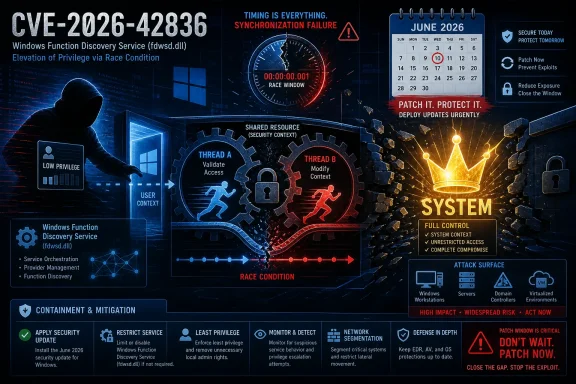
Microsoft disclosed CVE-2026-42836 on June 9, 2026, as an Important Windows Function Discovery Service elevation-of-privilege flaw in fdwsd.dll that can let a low-privileged, authorized local attacker win a race condition and gain SYSTEM privileges across supported Windows client and server releases. That is the sort of vulnerability that rarely makes headlines on its own but matters enormously once an attacker already has a foothold. The bug is not Microsoft’s scariest June security item by exploitability, but it is a reminder that Windows privilege boundaries often fail in the quiet plumbing below the desktop. For administrators, the right response is not panic; it is treating this as a practical post-compromise accelerator and patching accordingly.
The most important fact about CVE-2026-42836 is not that Microsoft rated it Important rather than Critical. It is that successful exploitation can produce SYSTEM privileges, the highest practical level of control on a Windows machine and the difference between “a compromised user account” and “the attacker owns the box.”
Microsoft describes the flaw as concurrent execution using a shared resource with improper synchronization in the Windows Function Discovery Service component fdwsd.dll. In plainer English, the vulnerable code appears to mishandle timing around a shared object or state, allowing an attacker who can already run code locally with low privileges to race the service into an unsafe condition.
That matters because privilege escalation bugs are rarely the first move in an intrusion. They are usually the second or third move: after phishing, stolen credentials, exposed remote access, or a malicious document has placed an attacker inside a user context. Once there, a local EoP turns a constrained beachhead into a durable platform for credential theft, tampering, lateral movement, persistence, and defense evasion.
The score tells the same story with less drama. CVE-2026-42836 carries a CVSS 3.1 base score of 7.0 and a temporal score of 6.1, with local attack vector, low privileges required, no user interaction, unchanged scope, and high impact to confidentiality, integrity, and availability. The catch is attack complexity: Microsoft marks it High because exploitation requires winning a race condition.
That does not make every laptop a remotely exploitable target for this CVE. Microsoft’s vector is local, not network. But it does mean the vulnerable component sits in a layer of Windows that tends to be broadly present, historically compatible, and easy for administrators to forget because it is neither a flashy app nor a clearly isolated server role.
The Function Discovery Provider Host service, commonly surfaced as fdPHost, hosts discovery providers used by Windows for network discovery. Function Discovery Resource Publication, FDResPub, publishes the computer and its attached resources so other machines can discover them. In desktop and mixed office networks, these services can be part of the everyday machinery behind “why can I see that printer, NAS, or workstation?”
That boringness is precisely why service-layer EoP bugs deserve respect. They live below the user’s attention and inside the trust model of the operating system. If an attacker can coerce a service into unsafe memory or synchronization behavior, the exploit does not need to look like malware smashing through the front door; it can look like an unprivileged process exercising a local system interface at exactly the wrong moment.
Race conditions are timing flaws. The attacker is trying to make two or more operations interleave in a way the developer did not intend, often around memory lifetime, shared state, object references, or permission checks. When Microsoft also maps the weakness to concurrent execution over a shared resource and use-after-free, the outline becomes familiar: something is being accessed after it should no longer be trusted, or while another thread is changing its state.
This is not the same as a simple input-validation bug where an attacker sends one malformed blob and reliably gets a shell. Race-condition exploitation can be finicky, machine-dependent, and sensitive to scheduling, processor load, service state, and build differences. That is why Microsoft’s exploitability assessment says exploitation is less likely and why there is no public disclosure or known exploitation listed at publication.
But “less likely” is not “not exploitable.” In local privilege escalation, attackers often have the luxury of repetition. A malicious process can try the race again and again, tune timing loops, observe failures, and adapt to target hardware. If the prize is SYSTEM and the target is a workstation or server already reached by another technique, even an unreliable exploit may be operationally useful.
That distinction is easy to miss. CVSS temporal metrics compress very different ideas into one string: whether exploitation is mature, whether remediation is available, and whether the report is credible. For CVE-2026-42836, the exploit maturity is Unproven, the remediation level is Official Fix, and report confidence is Confirmed.
Those three values together create the real risk picture. The vulnerability is real, the vendor has shipped fixes, but public exploit capability had not been demonstrated at the time Microsoft published the advisory. A defender should not treat Confirmed as a reason to fear active mass exploitation; they should treat it as a reason to stop debating whether the flaw exists.
The practical reading is simple: this is not rumorware. It is not a vague third-party claim waiting for vendor validation. It is a Microsoft-confirmed Windows bug in a privileged path, and the available mitigation is to install the relevant June 2026 security update for the affected Windows version.
On the server side, the patch matrix reaches Windows Server 2012 and 2012 R2, Windows Server 2016, 2019, 2022, and 2025, including Server Core installations where applicable. That breadth is not surprising for a core Windows component, but it is exactly what makes patch logistics more painful in real environments.
The June update set includes different KBs and fixed build numbers depending on the platform. Windows Server 2025 moves to build 10.0.26100.32995 under KB5094125. Windows 11 24H2 and 25H2 move to build 10.0.26100.8655 and 10.0.26200.8655 respectively under KB5094126, while Windows 11 23H2 moves to 10.0.22631.7219 under KB5093998.
Windows 10 22H2 moves to 10.0.19045.7417 and Windows 10 21H2 to 10.0.19044.7417 under KB5094127. Older server lines have their own entries: Windows Server 2022 moves to 10.0.20348.5256 with KB5094128, Windows Server 2019 and Windows 10 1809 move to 10.0.17763.8880 with KB5094123, and Windows Server 2016 and Windows 10 1607 move to 10.0.14393.9234 with KB5094122.
For administrators, this is where the story leaves the CVE page and enters inventory reality. If your asset management can’t tell you which machines are on which Windows branch, which ones are missing June cumulative updates, and which legacy servers remain in extended servicing arrangements, the vulnerability is less a single bug than a test of operational maturity.
A low-privileged attacker on Windows is often boxed in by user account control, service permissions, endpoint protection, credential isolation, and file ACLs. SYSTEM changes that equation. With SYSTEM, malware can tamper with services, interact with protected parts of the OS, dump sensitive material from memory in many configurations, disable security tools where tamper protection fails, and establish persistence that survives user logoff.
The no-user-interaction component is especially relevant. Once a malicious process is running under the attacker’s control, the exploit does not need a second victim to click a prompt or open another file. The attacker’s problem becomes reliability, not social engineering.
That is why defenders should think in chains. A phishing attachment, browser exploit, exposed RMM credential, or malicious package may grant only user-level execution. CVE-2026-42836 potentially supplies the next step. In a mature attack path, the EoP is not the headline; it is the hinge.
This window is often short for attractive Windows privilege escalation bugs. Once Patch Tuesday lands, attackers and researchers can diff patched and unpatched binaries, inspect changed code paths, and build hypotheses around what Microsoft fixed. Race conditions are not always easy to weaponize quickly, but the public patch itself becomes a roadmap for skilled reverse engineers.
The acknowledgment to an external researcher also matters. Coordinated disclosure is the healthy path, but it confirms that at least someone outside Microsoft had enough insight to report the issue. That does not imply irresponsible disclosure or active exploitation; it simply means the bug did not emerge from a purely internal audit that no outsider can reproduce.
For security teams, the correct posture is to use Microsoft’s “exploitation less likely” assessment as a sequencing signal, not a deferral slip. Patch the internet-facing and remote-access crisis items first if June’s batch contains them in your environment. Then move quickly through workstation fleets, admin workstations, jump boxes, RDS hosts, developer machines, and servers where local compromise would be especially costly.
But disabling services is not equivalent to installing the security update. First, the vulnerability is tied to fdwsd.dll and the Function Discovery Service component, while the visible Windows services around discovery vary by role, edition, startup state, and dependency. Second, enterprise environments often rely on discovery behavior in subtle ways, including printers, device discovery, management workflows, and user expectations around local network resources.
A hardening team can absolutely review whether fdPHost and FDResPub are necessary on servers, kiosks, virtual desktop images, and locked-down workstations. That is good hygiene. But it should be framed as attack-surface reduction, not as the primary remediation for a confirmed CVE with official fixes.
The safer operational path is familiar: patch first where you can, reduce service exposure where you should, and document exceptions where business requirements force delay. If a server cannot take the June update promptly, then service review, segmentation, application control, EDR monitoring, and strict local logon controls become compensating measures. They do not erase the bug.
Admin workstations are particularly sensitive. If an attacker lands in a standard user context on a machine where privileged sessions occur, elevating to SYSTEM can improve the chances of harvesting tokens, tampering with tools, or waiting for a higher-value credential event. The machine’s role matters more than the CVSS score.
RDS and multi-user systems also change the math. A local privilege escalation on a shared host can collapse boundaries between users and services if an attacker can reach a low-privileged session. Even when the specific exploit is hard, the potential blast radius on a shared Windows host is larger than on a single-user laptop.
Server Core being listed should also catch the eye of infrastructure teams. Core installations reduce GUI attack surface, but they are not immune to flaws in shared OS components. If the vulnerable service or code path exists on Core, the lack of Explorer does not save you.
CVE-2026-42836 does not demand reckless deployment. The exploitability assessment gives organizations room to test. But it does demand calendar discipline. A race-condition EoP with SYSTEM impact should not sit unpatched for months because it is “only local.”
A sensible rollout starts with representative pilot rings: current Windows 11 builds, Windows 10 22H2, Server 2022, Server 2025, and whatever legacy server branches remain in production. IT should verify service startup, network discovery behavior where relevant, printing and device discovery workflows, RDS login behavior, endpoint agent health, and application compatibility. Then the deployment should move through user workstations and high-value servers with clear exception handling.
The worst outcome is not a delayed patch after documented testing. The worst outcome is silent noncompliance: endpoints missing the June build, orphaned servers outside normal maintenance windows, VDI images not updated before recomposition, or offline systems returning to the network months later still vulnerable.
For WindowsForum readers, the best response is concrete rather than theatrical.
 Microsoft’s “Important” Label Still Hides a SYSTEM Prize
The most important fact about CVE-2026-42836 is not that Microsoft rated it Important rather than Critical. It is that successful exploitation can produce SYSTEM privileges, the highest practical level of control on a Windows machine and the difference between “a compromised user account” and “the attacker owns the box.”Microsoft describes the flaw as concurrent execution using a shared resource with improper synchronization in the Windows Function Discovery Service component fdwsd.dll. In plainer English, the vulnerable code appears to mishandle timing around a shared object or state, allowing an attacker who can already run code locally with low privileges to race the service into an unsafe condition.
That matters because privilege escalation bugs are rarely the first move in an intrusion. They are usually the second or third move: after phishing, stolen credentials, exposed remote access, or a malicious document has placed an attacker inside a user context. Once there, a local EoP turns a constrained beachhead into a durable platform for credential theft, tampering, lateral movement, persistence, and defense evasion.
The score tells the same story with less drama. CVE-2026-42836 carries a CVSS 3.1 base score of 7.0 and a temporal score of 6.1, with local attack vector, low privileges required, no user interaction, unchanged scope, and high impact to confidentiality, integrity, and availability. The catch is attack complexity: Microsoft marks it High because exploitation requires winning a race condition.
Function Discovery Is Boring Until It Becomes an Attack Surface
Function Discovery is one of those Windows subsystems most users never knowingly touch but many environments rely on indirectly. It helps Windows discover devices, services, and resources, especially around network discovery mechanisms such as WS-Discovery and related provider infrastructure.That does not make every laptop a remotely exploitable target for this CVE. Microsoft’s vector is local, not network. But it does mean the vulnerable component sits in a layer of Windows that tends to be broadly present, historically compatible, and easy for administrators to forget because it is neither a flashy app nor a clearly isolated server role.
The Function Discovery Provider Host service, commonly surfaced as fdPHost, hosts discovery providers used by Windows for network discovery. Function Discovery Resource Publication, FDResPub, publishes the computer and its attached resources so other machines can discover them. In desktop and mixed office networks, these services can be part of the everyday machinery behind “why can I see that printer, NAS, or workstation?”
That boringness is precisely why service-layer EoP bugs deserve respect. They live below the user’s attention and inside the trust model of the operating system. If an attacker can coerce a service into unsafe memory or synchronization behavior, the exploit does not need to look like malware smashing through the front door; it can look like an unprivileged process exercising a local system interface at exactly the wrong moment.
The Race Condition Is the Risk and the Restraint
Microsoft’s own explanation of the High attack complexity is unusually direct: successful exploitation requires the attacker to win a race condition. That single sentence should shape how defenders prioritize the bug.Race conditions are timing flaws. The attacker is trying to make two or more operations interleave in a way the developer did not intend, often around memory lifetime, shared state, object references, or permission checks. When Microsoft also maps the weakness to concurrent execution over a shared resource and use-after-free, the outline becomes familiar: something is being accessed after it should no longer be trusted, or while another thread is changing its state.
This is not the same as a simple input-validation bug where an attacker sends one malformed blob and reliably gets a shell. Race-condition exploitation can be finicky, machine-dependent, and sensitive to scheduling, processor load, service state, and build differences. That is why Microsoft’s exploitability assessment says exploitation is less likely and why there is no public disclosure or known exploitation listed at publication.
But “less likely” is not “not exploitable.” In local privilege escalation, attackers often have the luxury of repetition. A malicious process can try the race again and again, tune timing loops, observe failures, and adapt to target hardware. If the prize is SYSTEM and the target is a workstation or server already reached by another technique, even an unreliable exploit may be operationally useful.
Report Confidence Is Not the Comfort Metric Some Readers Think It Is
The user-facing CVSS metric that prompted this discussion, Report Confidence, is marked Confirmed for CVE-2026-42836. That does not mean exploit code is public. It does not mean the bug is being used in the wild. It means Microsoft, as the assigning CNA and affected vendor, has enough confidence in the vulnerability and its technical details to stand behind the report.That distinction is easy to miss. CVSS temporal metrics compress very different ideas into one string: whether exploitation is mature, whether remediation is available, and whether the report is credible. For CVE-2026-42836, the exploit maturity is Unproven, the remediation level is Official Fix, and report confidence is Confirmed.
Those three values together create the real risk picture. The vulnerability is real, the vendor has shipped fixes, but public exploit capability had not been demonstrated at the time Microsoft published the advisory. A defender should not treat Confirmed as a reason to fear active mass exploitation; they should treat it as a reason to stop debating whether the flaw exists.
The practical reading is simple: this is not rumorware. It is not a vague third-party claim waiting for vendor validation. It is a Microsoft-confirmed Windows bug in a privileged path, and the available mitigation is to install the relevant June 2026 security update for the affected Windows version.
The Affected List Shows a Windows-Wide Maintenance Problem
CVE-2026-42836 spans a wide swath of supported Windows releases, from older long-term server and Windows 10 branches through current Windows 11 and Windows Server 2025 lines. Microsoft lists affected client versions including Windows 10 1607, 1809, 21H2, and 22H2, plus Windows 11 23H2, 24H2, 25H2, and 26H1 across supported architectures.On the server side, the patch matrix reaches Windows Server 2012 and 2012 R2, Windows Server 2016, 2019, 2022, and 2025, including Server Core installations where applicable. That breadth is not surprising for a core Windows component, but it is exactly what makes patch logistics more painful in real environments.
The June update set includes different KBs and fixed build numbers depending on the platform. Windows Server 2025 moves to build 10.0.26100.32995 under KB5094125. Windows 11 24H2 and 25H2 move to build 10.0.26100.8655 and 10.0.26200.8655 respectively under KB5094126, while Windows 11 23H2 moves to 10.0.22631.7219 under KB5093998.
Windows 10 22H2 moves to 10.0.19045.7417 and Windows 10 21H2 to 10.0.19044.7417 under KB5094127. Older server lines have their own entries: Windows Server 2022 moves to 10.0.20348.5256 with KB5094128, Windows Server 2019 and Windows 10 1809 move to 10.0.17763.8880 with KB5094123, and Windows Server 2016 and Windows 10 1607 move to 10.0.14393.9234 with KB5094122.
For administrators, this is where the story leaves the CVE page and enters inventory reality. If your asset management can’t tell you which machines are on which Windows branch, which ones are missing June cumulative updates, and which legacy servers remain in extended servicing arrangements, the vulnerability is less a single bug than a test of operational maturity.
Local Does Not Mean Low Priority
Security teams sometimes downgrade local privilege escalation flaws too aggressively because they require prior access. That instinct is understandable; remote code execution and wormable network bugs deserve immediate oxygen. But local EoP vulnerabilities are the connective tissue of real intrusions.A low-privileged attacker on Windows is often boxed in by user account control, service permissions, endpoint protection, credential isolation, and file ACLs. SYSTEM changes that equation. With SYSTEM, malware can tamper with services, interact with protected parts of the OS, dump sensitive material from memory in many configurations, disable security tools where tamper protection fails, and establish persistence that survives user logoff.
The no-user-interaction component is especially relevant. Once a malicious process is running under the attacker’s control, the exploit does not need a second victim to click a prompt or open another file. The attacker’s problem becomes reliability, not social engineering.
That is why defenders should think in chains. A phishing attachment, browser exploit, exposed RMM credential, or malicious package may grant only user-level execution. CVE-2026-42836 potentially supplies the next step. In a mature attack path, the EoP is not the headline; it is the hinge.
The Absence of Exploitation Is a Window, Not a Verdict
Microsoft says CVE-2026-42836 was not publicly disclosed and had not been exploited when published. That is welcome. It also means defenders are in the best phase of vulnerability management: after a fix exists and before public exploitation becomes known.This window is often short for attractive Windows privilege escalation bugs. Once Patch Tuesday lands, attackers and researchers can diff patched and unpatched binaries, inspect changed code paths, and build hypotheses around what Microsoft fixed. Race conditions are not always easy to weaponize quickly, but the public patch itself becomes a roadmap for skilled reverse engineers.
The acknowledgment to an external researcher also matters. Coordinated disclosure is the healthy path, but it confirms that at least someone outside Microsoft had enough insight to report the issue. That does not imply irresponsible disclosure or active exploitation; it simply means the bug did not emerge from a purely internal audit that no outsider can reproduce.
For security teams, the correct posture is to use Microsoft’s “exploitation less likely” assessment as a sequencing signal, not a deferral slip. Patch the internet-facing and remote-access crisis items first if June’s batch contains them in your environment. Then move quickly through workstation fleets, admin workstations, jump boxes, RDS hosts, developer machines, and servers where local compromise would be especially costly.
Disabling Discovery Services Is Not a Patch Strategy
Some administrators will ask whether disabling Function Discovery services can reduce exposure. In narrow environments, it may. Microsoft’s service guidance has long treated some Function Discovery services as candidates for disabling where network discovery is not needed, especially in hardened or appliance-like scenarios.But disabling services is not equivalent to installing the security update. First, the vulnerability is tied to fdwsd.dll and the Function Discovery Service component, while the visible Windows services around discovery vary by role, edition, startup state, and dependency. Second, enterprise environments often rely on discovery behavior in subtle ways, including printers, device discovery, management workflows, and user expectations around local network resources.
A hardening team can absolutely review whether fdPHost and FDResPub are necessary on servers, kiosks, virtual desktop images, and locked-down workstations. That is good hygiene. But it should be framed as attack-surface reduction, not as the primary remediation for a confirmed CVE with official fixes.
The safer operational path is familiar: patch first where you can, reduce service exposure where you should, and document exceptions where business requirements force delay. If a server cannot take the June update promptly, then service review, segmentation, application control, EDR monitoring, and strict local logon controls become compensating measures. They do not erase the bug.
The Quietest Targets May Be the Most Valuable
Workstations deserve attention because local EoP bugs are frequently used after initial user compromise. But the highest-value systems are often not ordinary desktops. They are admin workstations, build servers, jump hosts, RDS systems, VDI gold images, file servers, and legacy application hosts where a low-privileged foothold can become enterprise leverage.Admin workstations are particularly sensitive. If an attacker lands in a standard user context on a machine where privileged sessions occur, elevating to SYSTEM can improve the chances of harvesting tokens, tampering with tools, or waiting for a higher-value credential event. The machine’s role matters more than the CVSS score.
RDS and multi-user systems also change the math. A local privilege escalation on a shared host can collapse boundaries between users and services if an attacker can reach a low-privileged session. Even when the specific exploit is hard, the potential blast radius on a shared Windows host is larger than on a single-user laptop.
Server Core being listed should also catch the eye of infrastructure teams. Core installations reduce GUI attack surface, but they are not immune to flaws in shared OS components. If the vulnerable service or code path exists on Core, the lack of Explorer does not save you.
Patch Testing Still Has to Respect the Calendar
The eternal Patch Tuesday problem is that the same update that fixes a privilege escalation bug can also change enough system behavior to worry administrators. That is especially true for legacy servers and line-of-business systems where cumulative updates are treated like controlled substances.CVE-2026-42836 does not demand reckless deployment. The exploitability assessment gives organizations room to test. But it does demand calendar discipline. A race-condition EoP with SYSTEM impact should not sit unpatched for months because it is “only local.”
A sensible rollout starts with representative pilot rings: current Windows 11 builds, Windows 10 22H2, Server 2022, Server 2025, and whatever legacy server branches remain in production. IT should verify service startup, network discovery behavior where relevant, printing and device discovery workflows, RDS login behavior, endpoint agent health, and application compatibility. Then the deployment should move through user workstations and high-value servers with clear exception handling.
The worst outcome is not a delayed patch after documented testing. The worst outcome is silent noncompliance: endpoints missing the June build, orphaned servers outside normal maintenance windows, VDI images not updated before recomposition, or offline systems returning to the network months later still vulnerable.
The June Fix Turns a Timing Bug Into an Inventory Audit
The practical lesson of CVE-2026-42836 is that Windows security work still depends on knowing exactly what you run. Microsoft has provided enough information to act: the vulnerability is confirmed, the fix is official, exploitation was not known at release, and successful exploitation can yield SYSTEM.For WindowsForum readers, the best response is concrete rather than theatrical.
- Confirm that June 2026 cumulative updates are deployed to Windows client and server versions affected by CVE-2026-42836.
- Prioritize systems where local compromise would be unusually damaging, including administrator workstations, RDS hosts, jump servers, build systems, and shared application servers.
- Treat Microsoft’s “exploitation less likely” assessment as a reasoned prioritization input, not as permission to ignore the update.
- Review Function Discovery service exposure where network discovery is unnecessary, but do not substitute service hardening for the vendor fix.
- Track fixed build numbers rather than assuming a machine is safe because it belongs to a broad OS family.
- Watch for later changes in exploit maturity, because post-patch reverse engineering can change the risk picture after the first advisory lands.
References
- Primary source: MSRC
Published: 2026-06-09T07:00:00-07:00
Security Update Guide - Microsoft Security Response Center
 msrc.microsoft.com
