

Microsoft’s Quiet Win32k Fix Still Lands in a Dangerous Neighborhood
Win32k vulnerabilities occupy a peculiar place in Windows security. They are usually local, often fussy to exploit, and rarely as headline-friendly as a wormable network bug. Yet for attackers who already have a foothold, they can be the difference between a contained user context and full machine control.
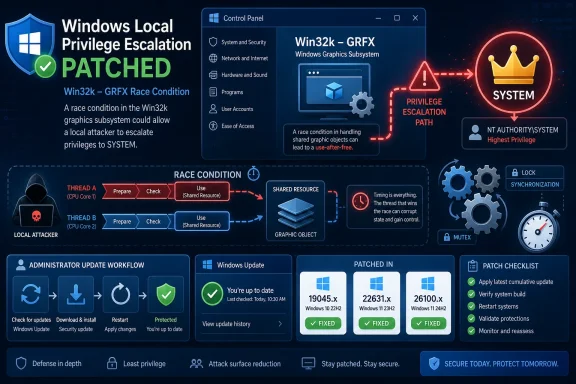
CVE-2026-33839 is a textbook example of that uncomfortable middle ground. Microsoft describes it as concurrent execution using a shared resource with improper synchronization — in plainer English, a race condition — in Windows Win32K - GRFX. Successful exploitation requires an attacker to win that race, and Microsoft explicitly rates the attack complexity as high.
That high complexity matters, but it should not lull administrators into treating the issue as theoretical. Microsoft’s own scoring still assigns the vulnerability a CVSS 3.1 base score of 7.0, with high impact to confidentiality, integrity, and availability if exploitation succeeds. The exploit path is local and requires low privileges, but the prize is SYSTEM.
That is why this patch deserves a careful read. The bulletin does not say the bug has been publicly disclosed, does not say it is being exploited in the wild, and does not suggest drive-by compromise. It says a confirmed kernel-adjacent flaw exists, official fixes are available, and an authenticated attacker could use it to climb the privilege ladder.
The “Important” Label Hides the Shape of the Risk
Microsoft’s “Important” severity rating is easy to misread as a reassurance. In Microsoft’s taxonomy, Important often covers vulnerabilities that require some precondition: local access, authentication, user interaction, or a less reliable exploitation technique. CVE-2026-33839 checks several of those boxes.
The vulnerability is local rather than network-facing. An attacker needs low privileges before attempting exploitation. The attack does not require user interaction, but it does require the attacker to manipulate timing well enough to win a race condition. That is a very different risk profile from a remote service bug that can be sprayed across the internet.
But enterprise risk is not measured only by initial access. In real intrusions, local privilege escalation is often the second act. Phishing, stolen credentials, malicious installers, abused remote access tools, exposed developer boxes, and compromised third-party software all create situations where an attacker may already be running code as a normal user.
From that position, SYSTEM privileges are a major escalation. SYSTEM can tamper with security tooling, dump sensitive material, modify protected areas, install persistent services, and move laterally with far fewer guardrails. The “Important” label therefore describes the entry conditions, not the blast radius after success.
That distinction is especially relevant for Win32k. The subsystem has a long history as a target for local privilege escalation because it sits close to the boundary between user-mode graphical operations and privileged kernel-mode behavior. Microsoft has spent years reducing the attack surface, but compatibility and complexity remain stubborn facts of Windows life.
Race Conditions Are Hard to Exploit, Not Safe to Ignore
The most important line in Microsoft’s advisory may be the least dramatic one: successful exploitation requires an attacker to win a race condition. Race bugs depend on timing. They are often sensitive to CPU load, scheduler behavior, build differences, hardware, mitigations, and the exact path through the vulnerable code.
That is why Microsoft’s CVSS vector gives CVE-2026-33839 high attack complexity. An attacker cannot simply send a packet or run a deterministic command and expect success every time. They need to trigger two or more operations in a narrow order, against a shared resource that is not being synchronized correctly.
For defenders, that cuts both ways. High complexity tends to reduce mass exploitation, especially immediately after disclosure. It also makes proof-of-concept code less reliable across diverse fleets, which can slow opportunistic attackers.
But race conditions have a habit of improving with engineering. What begins as flaky researcher code can become a tuned exploit after enough testing, target profiling, and retry logic. Attackers do not always need perfection; a local privilege escalation that works one time out of ten may be good enough if they can run it repeatedly on a compromised host.
The more mature the target environment, the more this matters. A single workstation in a home lab may not warrant panic. A managed fleet with thousands of nearly identical endpoints gives attackers more room to test, tune, and reuse techniques.
Report Confidence Is the Signal the User Was Really Pointing At
The user-supplied excerpt focuses on the CVSS Report Confidence metric, and that is the right lens for this advisory. Microsoft rates report confidence for CVE-2026-33839 as Confirmed. That does not mean exploitation is active, and it does not mean public exploit code exists. It means the vulnerability’s existence and technical credibility are not speculative.
This is a subtle but useful distinction. A vulnerability can be confirmed while still being difficult to exploit. It can be confirmed while still lacking public technical details. It can be confirmed even when Microsoft says exploitation is unlikely.
For patch prioritization, confirmed report confidence removes one excuse from the table. Administrators are not being asked to react to rumor, a vague impact statement, or a disputed third-party claim. Microsoft, as the assigning CNA, has acknowledged the issue and shipped fixes.
That is especially important because the advisory credits an anonymous reporter. Anonymous acknowledgements are common in coordinated vulnerability disclosure, but they provide little public context about exploit maturity, researcher intent, or discovery method. In this case, the confidence comes less from the identity of the reporter and more from Microsoft’s validation and patch publication.
The absence of public disclosure and observed exploitation still matters. It means defenders can treat this as a disciplined patch-management item rather than an emergency incident-response trigger. But it should remain on the patch list because the technical fact of the bug is settled.
The Affected List Shows This Is a Platform Fix, Not a Niche Corner Case
CVE-2026-33839 is not confined to one obscure Windows edition. Microsoft lists updates across supported Windows client and server releases, including Windows 10, Windows 11, Windows Server 2019, Windows Server 2022, Windows Server 2025, and Server Core variants. That breadth is typical for Win32k-class fixes, because the vulnerable component is part of the operating system platform rather than a standalone app.
The client-side impact is straightforward. Windows 10 21H2 and 22H2, Windows 11 23H2, 24H2, 25H2, and 26H1 entries all appear in Microsoft’s affected-products table. Depending on version and architecture, the relevant updates carry different KB numbers and build targets.
The server-side impact is where administrators should pay particular attention. Windows Server 2019, Windows Server 2022, Windows Server 2022 23H2 Server Core, Windows Server 2025, and Server Core installations are all represented. Server Core’s inclusion is a reminder that “graphical” in the Win32k sense does not map cleanly to whether a server has a full desktop experience.
Microsoft also lists hotpatch updates for some newer server and Windows 11 branches. That matters operationally because hotpatching can reduce reboot pressure in eligible environments, but it does not eliminate the need to verify that the correct fixed build actually landed. The vulnerability is remediated by state, not by good intentions.
For Windows 10 Version 22H2, Microsoft lists fixed build 19045.7291. Windows 11 23H2 moves to build 22631.7079. Windows 11 24H2 moves to build 26100.8457, with a hotpatch build also listed. Windows 11 25H2 is listed with build 26200.8457, again with a hotpatch path. Windows 11 26H1 entries show build 28000.2113.
Those numbers will be more useful to administrators than the CVE name itself. In the real world, vulnerability closure is often proven by inventory: which machines report the fixed build, which machines failed install, which machines are waiting on reboot, and which systems are outside normal update rings.
SYSTEM Privileges Turn a Local Bug Into an Intrusion Multiplier
The direct answer to “what could an attacker gain?” is blunt: Microsoft says successful exploitation could grant SYSTEM privileges. That is the highest-value phrase in the advisory, and it should anchor the risk discussion.
SYSTEM is not just “administrator, but more.” It is the security context used by core Windows services and many privileged processes. Once an attacker reaches that level, endpoint defenses become harder to trust, logs become easier to manipulate, and credential access becomes more dangerous.
This is why local privilege escalation flaws are so prized in post-compromise playbooks. Attackers often enter through a weaker door: a browser session, a user-launched payload, a developer tool, a remote support agent, or a compromised account without local admin rights. A reliable EoP turns that limited access into durable machine control.
CVE-2026-33839’s high attack complexity makes it less attractive for quick-hit commodity campaigns than a low-complexity flaw would be. But for targeted intrusions, “hard” does not mean “irrelevant.” Skilled operators can afford testing time, and they often know enough about a target environment to tune an exploit to a specific Windows branch.
For defenders, the practical implication is clear. Do not rank this above actively exploited remote-code-execution vulnerabilities. Do not ignore it because it is local. Put it into the regular Patch Tuesday pipeline, validate deployment, and pay special attention to systems where low-privilege compromise is more plausible: shared workstations, developer endpoints, jump boxes, VDI pools, and internet-exposed remote-access environments.
The Absence of Exploitation Is Useful, But It Is Not a Waiver
Microsoft says CVE-2026-33839 was not publicly disclosed and was not known to be exploited at the time of publication. It also rates exploitation as unlikely. Those are meaningful signals, and security teams should use them to avoid needless panic.
They do not, however, convert the bug into background noise. “Exploitation unlikely” is a forecast at publication time, not a lifetime guarantee. It reflects Microsoft’s assessment of exploitability, known public code, attack conditions, and observed activity. Those inputs can change.
The advisory’s temporal score reflects that reality. Microsoft lists exploit code maturity as Unproven and remediation level as Official Fix. In other words, the current public exploit situation reduces urgency, while the availability of patches reduces the acceptable delay.
This is the part of vulnerability management that mature teams understand and immature dashboards often flatten. A CVSS base score of 7.0 says the underlying technical impact is serious. The temporal context says defenders have room to sequence the update rationally. Both statements can be true.
That sequencing should still favor deployment within normal security-update windows. Local EoP bugs often become more interesting after attackers reverse-engineer patches. Even when Microsoft does not publish deep technical details, update binaries can reveal changed code paths to researchers and adversaries alike.
Win32k Remains the Compatibility Tax Windows Keeps Paying
Every Win32k flaw is a reminder that Windows is not a clean-room academic operating system. It is a compatibility machine. Decades of application behavior, graphics interfaces, window management assumptions, input handling, printer paths, and desktop semantics still influence the security boundary.
Microsoft has made meaningful architectural changes over the years. Browser sandboxing, session isolation, kernel mitigations, Virtualization-Based Security, driver signing, attack surface reduction rules, and Windows Defender improvements have all made exploitation harder than it was in the Windows XP and Windows 7 eras. But Win32k persists because the Windows desktop persists.
The GRFX reference in Microsoft’s advisory points toward the graphics side of that subsystem. Microsoft does not provide a detailed root-cause walk-through, and defenders should avoid inventing one. What the advisory does say is enough: improper synchronization around shared resources allowed an authorized local attacker to elevate privileges.
That sort of bug is not surprising in complex, concurrent, performance-sensitive code. Graphics and windowing paths are full of state transitions, handles, object lifetimes, reference counts, callbacks, and interactions between user-mode callers and privileged components. The more concurrent the system, the more carefully synchronization has to be designed.
The security lesson is not that Windows is uniquely broken. It is that legacy-rich platforms accumulate risk at the seams where compatibility, performance, and privilege meet. Win32k is one of those seams.
Patch Management Has to Prove the Build, Not Just Approve the Update
For home users, the guidance is refreshingly boring: install the May 2026 Windows security updates when they are offered, reboot when required, and verify Windows Update is not stuck. The machines most at risk are not necessarily those with a visible error message; they are the ones that silently missed the cumulative update.
For administrators, this is an inventory problem. Approval in WSUS, Intune, Configuration Manager, or another patching platform is only the first step. The important question is whether endpoints and servers actually reached the fixed build listed for their branch.
The affected matrix also creates a supportability trap. Some Windows 10 and Windows Server versions remain visible in security advisories because certain editions, servicing channels, or enterprise support arrangements continue to receive updates. That does not mean every consumer or unmanaged installation of an older branch is equally supported. Teams need to map the advisory to their own licensing, edition, and servicing reality.
The server hotpatch entries deserve their own verification. Hotpatching is attractive precisely because it reduces operational friction, but the reduced friction can also encourage complacency. If a hotpatch is available and applicable, it still has to be installed, reported, and reconciled against compliance targets.
The same applies to Server Core. Its smaller footprint reduces some classes of risk, but it is not immune to platform vulnerabilities. If Win32k-related components are in the affected set for a Server Core release, treat the listed update as required rather than assuming the absence of a traditional desktop saves the machine.
Defenders Should Watch the Post-Patch Window
The most dangerous phase for a vulnerability like CVE-2026-33839 may not be disclosure day. It may be the weeks after Patch Tuesday, when defenders are still rolling out updates and attackers have had time to inspect what changed.
Patch diffing is not magic, but it is a known path from advisory to exploit research. When a vendor ships a fix, the altered binaries can narrow the search space. Researchers can compare old and new code, identify patched functions, and infer the vulnerable pattern. Attackers can do the same.
The high attack complexity remains a barrier. A race-condition EoP is not automatically weaponized just because a patch exists. But defenders should assume interest will increase after publication, especially if the vulnerable code path is reachable from common local operations.
Detection is harder than patching here. Local privilege escalation attempts may look like process crashes, abnormal handle activity, repeated calls into graphics or windowing APIs, or sudden privilege changes from a low-integrity or standard-user process. Without a public exploit, defenders should avoid overfitting detection logic to imagined behavior.
The better control is still prevention. Keep endpoints patched, limit where untrusted code can run, reduce local admin sprawl, isolate high-value workstations, monitor suspicious child processes from user-facing applications, and make sure endpoint protection can see privilege transitions. CVE-2026-33839 is not an argument for exotic mitigations; it is an argument for boring controls done consistently.
The Patch Tuesday Lesson Hidden in CVE-2026-33839
This vulnerability’s most useful message is not that every Win32k race condition should trigger emergency war rooms. It is that local privilege escalation still deserves first-class treatment in Windows risk management, especially when the outcome is SYSTEM and the affected surface spans modern client and server releases.
- Microsoft published CVE-2026-33839 on May 12, 2026, with an Important severity rating and a CVSS 3.1 base score of 7.0.
- The vulnerability is a race condition in Windows Win32K - GRFX that can allow a low-privileged local attacker to elevate privileges.
- Microsoft says exploitation requires winning a race condition, rates attack complexity as high, and assesses exploitation as unlikely at publication.
- The advisory says the vulnerability was not publicly disclosed and not known to be exploited when Microsoft released the update.
- Successful exploitation could grant SYSTEM privileges, making the bug most relevant as a post-compromise escalation tool.
- Administrators should verify fixed Windows build numbers across affected Windows 10, Windows 11, and Windows Server releases rather than relying only on update approval status.
CVE-2026-33839 is therefore not the loudest kind of Windows vulnerability, but it is a revealing one. Microsoft’s advisory gives defenders enough signal to act without drama: the flaw is confirmed, the exploit path is local and difficult, the impact is severe if successful, and official fixes are already available. The right response is neither panic nor dismissal, but the disciplined patch hygiene that keeps a local foothold from becoming a fully owned Windows system.