

Microsoft’s Graphics Stack Is Still a Security Boundary by Another Name
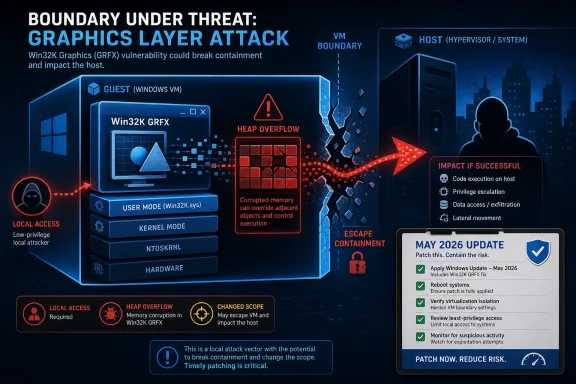
Windows graphics bugs rarely arrive with the cinematic simplicity of a wormable SMB flaw or a browser zero-day. They live in the messy middle of modern operating systems, where rendering, window management, fonts, device contexts, drivers, remoting, virtualization, and backward compatibility all meet. CVE-2026-40403 fits that tradition: a memory corruption issue in the Windows Graphics Component, scored critical, but framed around a local, low-privilege attacker and a changed security scope.
That “changed scope” is the part that should make enterprise defenders slow down. In vulnerability scoring, scope changes when exploitation crosses from one security authority into another. In plain English, Microsoft is signaling that the bug is not merely “one user can crash or compromise their own session”; it can affect something outside the original compartment.
The obvious compartment in Microsoft’s advisory language is a contained execution environment. That can include a guest VM trying to affect a host, or another local boundary where the graphics interface is exposed to code that is not supposed to reach the underlying operating system. This is why the vulnerability matters even though it does not resemble a classic unauthenticated Internet RCE.
The old mental model says “remote” means a packet from the public network. The newer Windows reality is more complicated. If an attacker can reach a local VM interface, a remote desktop session, a sandboxed workload, a developer test VM, or a cloud-hosted Windows environment, the distance between “local” and “remote” starts to shrink.
The Word “Remote” Obscures the Real Attack Path
CVE-2026-40403 is described as a remote code execution vulnerability, but the exploitability details point to a more constrained path than that label implies. The attacker needs low privileges and local access to the vulnerable interface. Microsoft also indicated that external communication to the endpoint is blocked, making the vulnerable path reachable only over the local VM interface.
That does not make the bug harmless. It means the first step is not the graphics bug itself. The attacker would already need a foothold in a guest or local environment, after which the vulnerability becomes a possible way to move into a more privileged or less isolated place.
This is precisely the kind of flaw that tends to be underweighted by organizations that sort their patch queues by exposed ports. A public-facing VPN appliance with active exploitation obviously deserves emergency treatment. But a guest-to-host escape path in a widely deployed Windows component can become just as ugly inside developer workstations, VDI estates, test labs, malware analysis sandboxes, and multi-user infrastructure.
The result is a vulnerability that looks modest from the outside and more serious from the inside. It is not the front door. It is the locked interior door that an attacker tries after getting into the building.
Heap Corruption in Win32K Is Not Just Another Memory Bug
Microsoft’s description points to a heap-based buffer overflow in Win32K-GRFX. That places CVE-2026-40403 in familiar but uncomfortable territory. Win32K has historically been a rich target because it exposes complex graphics and windowing behavior while operating close to privileged kernel-mode functionality.
Heap-based buffer overflows are dangerous because they involve writing beyond the bounds of allocated memory. In the best case, that causes a crash. In the worst case, an attacker can shape memory well enough to redirect execution or corrupt security-relevant data structures.
Modern Windows has many mitigations that make exploitation harder than it once was. Kernel ASLR, pool hardening, control-flow protections, virtualization-based security, and driver-signing requirements all raise the bar. But “harder” is not “impossible,” especially when the vulnerability exists in a feature-rich subsystem with many code paths and long compatibility obligations.
The graphics component is also one of those places where the platform cannot simply remove legacy behavior overnight. Windows is expected to run old applications, strange printer drivers, remote sessions, line-of-business software, accessibility tooling, GPU-accelerated workloads, and virtualization scenarios. Every compatibility promise adds weight to the attack surface.
The Confidence Metric Says the Bug Is Real, Not That the Exploit Is Ready
The user-provided text about confidence is important because it gets at a common Patch Tuesday misunderstanding. A high-confidence vulnerability does not necessarily mean attackers have a working exploit circulating in the wild. It means the existence of the vulnerability and the available technical details are credible enough to treat as real.
For CVE-2026-40403, Microsoft’s acknowledgement is the anchor. Vendor confirmation raises confidence substantially, even when the public advisory withholds exploit-ready detail. That is normal for memory corruption vulnerabilities in core operating system components; defenders get enough information to prioritize, while would-be exploit writers are not handed a tutorial.
Microsoft reportedly listed exploitation as less likely and exploit code maturity as unproven at publication time. Those labels should lower the temperature, but not the priority. They are temporal judgments, not guarantees.
The vulnerability was also reportedly not publicly disclosed and not exploited in the wild when released. That buys defenders time. It does not create an excuse to let the update age into the next maintenance window just because no proof-of-concept has landed on GitHub by dinner.
Virtualization Turns “Local” Into Someone Else’s Problem
The most interesting part of CVE-2026-40403 is not that it is in graphics. It is that Microsoft’s own framing includes contained environment escape. That is the phrase that should catch the eye of anyone running Windows workloads in VMs, sandboxes, hosted desktops, or developer environments.
Virtualization depends on clean boundaries. The guest can be hostile, broken, infected, misconfigured, or disposable; the host is supposed to remain in charge. When a vulnerability suggests that a guest might influence the host through a local interface, the operational risk changes.
This does not mean every Windows VM is suddenly a springboard into the host. Exploitation still requires the right conditions, access, and exploit reliability. But it does mean admins should think beyond the single affected machine and ask where untrusted or semi-trusted Windows environments share infrastructure with higher-value systems.
Developer workstations are a particularly awkward example. They often run multiple VMs, preview builds, test harnesses, sample malware, unsigned tools, old SDKs, and administrative utilities. They are also usually connected to source repositories, credentials, internal documentation, and build systems. A guest-to-host escape path on that class of device can be more consequential than the CVSS narrative alone suggests.
VDI and lab environments deserve similar attention. Anywhere users can run code in a Windows guest while the host remains a valuable management plane, the vulnerability lands closer to a boundary-break issue than a routine desktop patch.
Patch Tuesday’s Real Problem Is Prioritization, Not Awareness
By 2026, most competent IT teams know how Patch Tuesday works. The hard part is not seeing the advisory; it is deciding which of the month’s many vulnerabilities gets accelerated, which gets bundled, and which gets deferred after compatibility testing. CVE-2026-40403 is the sort of bug that can get misfiled because its attack path is not as obvious as “remote unauthenticated network RCE.”
The right prioritization lens is environment-specific. A single-user Windows laptop with no virtualization workloads is exposed differently from a Hyper-V host used for malware detonation, a developer workstation running untrusted test images, or a VDI platform hosting many users. The component is the same; the blast radius is not.
Security teams should also resist the temptation to rank solely by whether exploitation is “more likely” or “less likely” at publication. Microsoft’s exploitability assessments are useful, but attackers routinely work backward from patches. Once a fix ships, the diff becomes a research artifact.
That matters especially for memory safety flaws. The public may not have exploit code on day one, but skilled researchers and criminal groups can study the patched and unpatched behavior. The calendar after Patch Tuesday is not neutral time; it is reverse-engineering time.
The Old Boundary Debate Comes Back Through the GPU Door
Microsoft has spent years tightening Windows’ security boundaries, but the platform still carries an enormous amount of shared machinery. Graphics is one of the hardest pieces to isolate cleanly because performance and usability push in the opposite direction. Users expect smooth rendering, low latency, hardware acceleration, and compatibility across local, remote, and virtualized sessions.
Every one of those expectations creates interfaces. Interfaces are where assumptions go to die. A heap overflow in a graphics path may begin as a parser or memory-management mistake, but in practice it becomes a test of whether Windows can keep workloads separated when they all need to draw, composite, and communicate with the same underlying system.
The industry has seen this pattern before. Browser sandboxes, font parsers, image codecs, GPU drivers, printer subsystems, and kernel graphics paths have all become favorite terrain for attackers because they process complex data on behalf of less trusted code. The closer those components sit to privileged execution, the more attractive they become.
CVE-2026-40403 is not proof that Windows containment is broken. It is proof that containment is a living engineering problem, not a box vendors check once and move on from.
Home Users Should Patch, but Enterprises Should Segment Their Concern
For most home users, the advice is refreshingly dull: install the May 2026 Windows security updates. If Windows Update is enabled and functioning, CVE-2026-40403 should be handled as part of the normal cumulative update process. The typical home PC is not the most obvious target for the guest-to-host scenario described here.
That said, enthusiasts are not always typical. WindowsForum readers often run Hyper-V, VMware Workstation, VirtualBox, Windows Sandbox, dev containers, Insider builds, and old ISOs for testing. On those machines, “local” attack surface can include code copied from the Internet into a VM precisely because the user thought the VM was the safe place to run it.
For enterprises, the priority should be determined by where isolation matters most. Hosts that run untrusted guests should move up the queue. So should workstations used by developers, security researchers, help desk staff, QA teams, and administrators who routinely handle unknown files or test environments.
Server fleets need a more nuanced read. If a Windows Server installation is not exposing the relevant graphics paths to untrusted local or guest code, the practical risk may be lower than the severity label suggests. But if it participates in virtualization, remote desktop infrastructure, or shared workload hosting, delaying the update becomes harder to justify.
Testing Still Matters Because Graphics Updates Have a Long Tail
The uncomfortable truth is that graphics-related Windows updates can touch areas that admins fear breaking. Display drivers, remote sessions, GPU acceleration, multi-monitor behavior, printer-adjacent rendering, and specialized visualization software all sit near the blast radius. Nobody wants to fix a theoretical escape risk by breaking a trading desk, CAD lab, medical workstation, or VDI pool.
But compatibility anxiety should not become paralysis. The sane move is staged deployment, not indefinite delay. Pilot the update on representative systems, especially those with GPU-dependent workloads, then expand quickly if telemetry is clean.
Organizations with mature endpoint management should watch for post-update failures in remote desktop sessions, application rendering, GPU passthrough, virtual display adapters, and event logs tied to graphics subsystem crashes. That is not special pleading for this CVE; it is the cost of responsibly patching a component that sits underneath so much of the Windows experience.
The point is to compress the time between testing and deployment. A critical vulnerability with no known exploitation on release day is the best-case version of patching: defenders have warning, a vendor fix, and no active fire. Wasting that window is how best-case advisories become incident reports.
Attackers Read Patch Notes Differently Than Admins Do
Defenders read an advisory to decide whether to patch. Attackers read it to decide whether to reverse-engineer. CVE-2026-40403 contains just enough public detail to be interesting: a heap-based overflow, Win32K-GRFX, low privileges, local access, changed scope, and possible contained environment escape.
That combination narrows the search space. It does not disclose an exploit, but it gives skilled vulnerability researchers a map of where to start looking. Once binaries are patched, comparisons against older versions may reveal the vulnerable code path or at least the class of fix.
This is why “not exploited in the wild” is a perishable comfort. It is a statement about what Microsoft knew at the time of release, not a forecast for the next quarter. For high-value targets, the absence of known exploitation is often when patching is most effective.
Security teams should also remember that attackers chain vulnerabilities. A low-privilege local bug may not sound impressive until it is paired with phishing, a stolen developer credential, a malicious project file, or compromised guest image. The chain is what matters, and boundary-crossing bugs make chains more valuable.
The May 2026 Update Deserves a Boundary-First Rollout
The practical response to CVE-2026-40403 is not to treat every Windows machine as equally endangered. It is to identify where Windows graphics interfaces sit across trust boundaries and patch those systems first. That means looking for architecture, not just inventory.
Start with hosts and workstations running untrusted or semi-trusted guests. Include developer machines, security labs, build and test environments, training ranges, VDI infrastructure, and any platform where users can bring their own code into a contained Windows environment. If the host is valuable and the guest is disposable, the update belongs near the front of the queue.
Next, examine administrative workstations. Even if they do not host VMs every day, they are high-value systems with credentials that can amplify a compromise. A vulnerability that helps code escape a lower-trust context becomes more serious when the destination is a workstation used to manage servers, identity, or cloud resources.
Finally, do not ignore ordinary endpoints. Broad patch coverage is still the end state. The prioritization argument is about sequence, not exemption.
The Signal Inside the Advisory Is Stronger Than the Exploit Forecast
The most concrete read of CVE-2026-40403 is that Microsoft has confirmed a real, critical memory corruption issue in a privileged Windows graphics component, with a possible path across a containment boundary. The exploit forecast is less alarming than the severity score, but the architecture implications are more alarming than a casual reading of “local access required” would suggest.
That is the split defenders should carry into change control. If the organization has no meaningful local containment boundary exposed to untrusted code, this is still a critical Windows patch, but probably not the single scariest item in the month’s queue. If the organization relies heavily on Windows virtualization, sandboxing, or VDI, the calculus changes.
The key is to avoid both mistakes: treating the bug as a wormable network disaster, and dismissing it because the attacker needs a foothold. Most serious intrusions are built from footholds. The question is what the foothold can reach next.
The Windows Graphics Bug That Should Move These Systems First
CVE-2026-40403 is a reminder that some Windows vulnerabilities are best understood by the boundary they threaten rather than the port they expose. Before this month’s updates disappear into the usual Patch Tuesday backlog, administrators should make a short list of systems where a graphics-component escape would be more than a local nuisance.
- Systems running untrusted or semi-trusted Windows guest VMs should receive the May 2026 security update early in the deployment cycle.
- Developer and security-research workstations deserve elevated priority because they often mix valuable credentials with disposable test environments.
- VDI and lab platforms should be tested quickly for graphics, session, and display-driver regressions, then patched without waiting for the next routine window.
- Ordinary desktops should still receive the cumulative update, even if their exposure to the contained-environment scenario is lower.
- Exploitability labels such as “less likely” and “unproven” should be treated as temporary risk signals, not as reasons to skip remediation.
CVE-2026-40403 will probably not be remembered as the loudest Windows vulnerability of 2026 unless exploit code matures or real-world abuse emerges. But it is exactly the kind of flaw that separates mature patch management from checkbox compliance: not every critical bug is Internet-facing, and not every local bug stays local. The Windows estate is now full of layers that promise containment, and each layer depends on old, complicated subsystems behaving perfectly. May’s graphics fix is another reminder that the future of Windows security will be fought less at the perimeter and more at the seams between the boxes we thought were separate.