

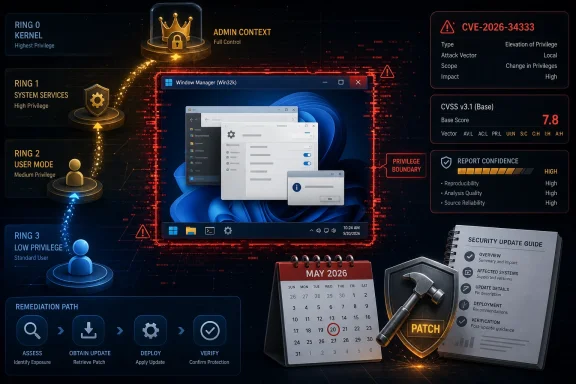
Microsoft’s Quiet Win32k Entry Carries a Loud Operational Message
The phrase “Windows Win32k Elevation of Privilege Vulnerability” is familiar enough to become background noise during Patch Tuesday triage. That familiarity is dangerous. Win32k sits in the historical blast zone between user interaction, graphics, window management, desktop objects, and kernel-mode execution paths; when a flaw there is exploitable, it can become the second stage in an attack that already has a beachhead.
Elevation-of-privilege vulnerabilities do not usually provide the initial break-in. They are the crowbar used after phishing, malicious documents, browser exploits, stolen credentials, weak remote access, or compromised software supply chains have already put an attacker on a machine. That makes them easy to underrate in a dashboard, especially when compared with remote code execution bugs that seem more cinematic.
But Windows defenders know the real intrusion chain is cumulative. The attacker who lands as a low-privileged user still has to disable defenses, dump credentials, tamper with logs, persist across reboots, or move laterally. A reliable local privilege escalation can turn a contained workstation compromise into a domain incident.
CVE-2026-34333 therefore belongs in the category of bugs that security teams should not treat as “local only” in the dismissive sense. Local does not mean harmless. Local means the attacker needs a foothold first, and in 2026 that is a condition incident responders assume will eventually be met somewhere in the fleet.
Report Confidence Is the Small Metric That Changes the Patch Conversation
The user-facing text associated with CVE-2026-34333 highlights the CVSS Report Confidence metric, which measures how certain the industry can be that a vulnerability exists and how credible the known technical details are. That sounds academic until it lands in a patch meeting. A vulnerability with vague rumors and uncertain root cause is one kind of risk; a vendor-acknowledged Windows flaw with official remediation is another.
CVSS temporal metrics are designed to capture the fact that vulnerability risk changes over time. Exploit code appears, proof-of-concept snippets are polished, mitigations improve, and official fixes become available. Report Confidence is one of the least glamorous of these fields, but it is a useful antidote to the common mistake of treating every CVE description as equally knowable.
When Microsoft acknowledges a Windows vulnerability in the Security Update Guide, defenders get more than a name and number. They get a vendor-confirmed object for inventory, scanning, compliance, patch management, and incident review. That confirmation does not mean every technical detail is public, and it certainly does not mean defenders should expect a clean exploit narrative within hours of release.
The practical consequence is straightforward: uncertainty about exploit mechanics is not a reason to delay. In a Win32k elevation-of-privilege case, lack of public exploit detail often helps defenders only briefly. Attackers can reverse patches, diff binaries, and map changed code paths faster than many enterprises can complete a staged rollout.
Win32k Remains Windows’ Old Attack Surface With Modern Consequences
Win32k is not a trendy cloud service or a newly fashionable AI component. It is older, messier, and deeply embedded in the Windows desktop experience. Its long history as an attack surface comes from the uncomfortable fact that graphical operating systems must broker a tremendous amount of interaction between applications, users, sessions, devices, windows, menus, input, and rendering.
Microsoft has spent years reducing kernel attack surface, moving pieces out of privileged contexts where possible, and hardening Windows with exploit mitigations. Yet Win32k remains a place where small mistakes can have large effects because the subsystem sits close to privilege boundaries. A vulnerability there is not automatically catastrophic, but it is rarely boring.
For attackers, Win32k-class bugs are attractive because they can pair neatly with other weaknesses. A malicious attachment or browser exploit might get code running in a constrained context. A sandbox escape, kernel bug, or Win32k privilege escalation can then supply the missing step from “we executed something” to “we control the host.”
That pairing matters for defenders because patch prioritization systems often overweight internet exposure. An unpatched Win32k elevation-of-privilege bug on a laptop may not be reachable from the open internet, but it may still be reachable by malware that arrives through email, Teams messages, browser downloads, removable media, developer tooling, or another compromised internal system. The exploit path is local; the campaign path is not.
The Security Update Guide Speaks in Metadata Because Details Are a Weapon
Microsoft’s modern advisories often frustrate readers who want root cause narratives, affected function names, proof-of-concept conditions, and exploit diagrams on day one. That frustration is understandable, especially for defenders who need to explain urgency to management. But the restraint is also deliberate.
The Security Update Guide is built to communicate enough for customers to act without necessarily handing attackers a blueprint. That is why fields such as severity, CVSS vector, exploitability assessment, public disclosure status, exploitation status, affected products, and remediation availability matter so much. The advisory is not a white paper; it is an operational signal.
In the case of CVE-2026-34333, the focus on Report Confidence should push teams to separate two ideas that are too often collapsed. One is whether the vulnerability is real. The other is whether the public knows enough to weaponize it easily. A vendor-confirmed entry with official update guidance answers the first question even if the second remains murky.
That distinction should shape communication. Security teams do not need to claim that CVE-2026-34333 is being widely exploited unless Microsoft or credible researchers say so. They do need to say that a confirmed Windows privilege-escalation flaw in Win32k has entered the patch stream, and that deferring it increases the value of any foothold an attacker already has.
Elevation of Privilege Is Where “Low Privilege” Stops Being Comforting
Enterprise risk discussions often begin with the wrong mental model: if a vulnerability requires an authenticated local attacker, it is downgraded emotionally before it is assessed technically. That made more sense in an era when local access implied a person sitting at a keyboard. It makes less sense in an era of credential theft, remote work, endpoint agents, scriptable user sessions, and malware that routinely runs with ordinary user rights first.
A local privilege escalation turns compromise quality into compromise depth. Without it, an attacker may be stuck inside the user’s permission envelope. With it, the attacker may be able to tamper with security tools, access protected data, inject into privileged processes, dump secrets, install drivers, or persist in ways that survive basic cleanup.
This is why EoP bugs often matter most after the first alert. A suspicious script, blocked payload, or contained malware event looks very different if the host is missing a patch for a known local privilege escalation in a kernel-adjacent component. The patch state becomes part of incident severity, not just hygiene.
For managed environments, that means CVE-2026-34333 should feed both vulnerability management and detection engineering. Patch the affected systems, yes. But also ask which endpoint telemetry would show suspicious local privilege behavior, unusual child processes, driver loading attempts, token manipulation, unexpected service creation, or post-exploitation tooling on machines that lag behind the update baseline.
Patch Tuesday Triage Should Not Reward the Loudest Vulnerability
One of the recurring failures of enterprise patching is that the loudest CVE wins. A remote code execution flaw with a terrifying score gets emergency meetings, while a privilege escalation flaw lands in the routine queue. Attackers understand this asymmetry and build chains around it.
The right triage model looks at exploit chains, asset roles, user exposure, and compensating controls. A Win32k EoP flaw on a kiosk, developer workstation, help-desk machine, VDI host, jump box, or administrator laptop may deserve faster handling than a higher-scored vulnerability on a less exposed system. Context should not erase CVSS; it should complete it.
There is also a timing problem. Many organizations patch servers on a slower rhythm than clients because service availability is politically expensive. But Win32k and related graphical components are not only a consumer desktop concern. Windows Server installations, Remote Desktop Session Hosts, management servers with GUI components, and administrative workstations can all become relevant depending on affected-product scope and deployment reality.
The best patch programs do not ask whether a flaw is “only local.” They ask what local code execution already exists in the environment, where users handle untrusted content, which systems hold privileged tokens, and how quickly a low-privileged foothold could become a privileged one. CVE-2026-34333 belongs in that conversation.
Home Users Get the Same Bug With Fewer Safety Nets
For home users, the operational advice is simpler but no less important. Install the Windows security update that includes the fix for CVE-2026-34333, avoid postponing cumulative updates indefinitely, and reboot when Windows asks for it. The reboot is often the part that turns a downloaded fix into an actually protected system.
Consumer Windows machines are not miniature enterprises, but they face similar exploit chains. A malicious installer, cracked game, fake utility, poisoned ad, browser-delivered payload, or phishing attachment may first run without administrator rights. A local elevation-of-privilege vulnerability can then help it escape those limits.
The danger is amplified by the way many home systems are used. The same laptop may hold browser sessions, password managers, tax documents, game launchers, work accounts, school portals, and family photos. Once malware reaches higher privileges, the difference between nuisance and disaster narrows.
Microsoft’s monthly cumulative update model helps because users do not need to hunt for a standalone CVE-specific patch. But that same bundling can obscure why a reboot matters. CVE-2026-34333 is one of the reasons the nagging update prompt should not be treated as mere operating-system housekeeping.
Administrators Should Treat the Advisory as a Starting Gun, Not a Complete Map
For IT teams, the first task is boring and essential: identify affected Windows versions, confirm the relevant cumulative updates, deploy through existing rings, and watch for installation failures. The second task is more strategic: decide which systems move faster than the normal cadence because privilege escalation changes their risk profile.
Pilot rings still matter. Windows updates can collide with drivers, line-of-business software, security agents, VPN clients, and specialized hardware. But a pilot ring is not a parking lot. It should be a fast feedback mechanism that lets the broader deployment proceed with evidence rather than fear.
Administrators should pay particular attention to systems used by privileged staff. Domain admins, cloud admins, help-desk operators, security engineers, developers with signing keys, and users with access to production data are all high-value targets. If those endpoints are missing a Win32k EoP fix, the organization is leaving a useful rung in the attacker’s ladder.
For environments with formal vulnerability SLAs, CVE-2026-34333 is a good test of whether policy can handle nuance. A blanket “local EoP equals medium urgency” rule is too crude. A rule that considers vendor confirmation, exploitability assessment, user exposure, privileged access, and asset criticality is closer to how intrusions actually unfold.
The Absence of Public Exploit Code Is Not a Comfort Blanket
At the time an advisory appears, defenders often ask the same question: is there a public exploit? It is a fair question, but it is not the finish line. Public proof-of-concept code is only the exploit evidence easiest for defenders to see.
Patch diffing has changed the economics. Once Microsoft releases a fix, attackers can compare patched and unpatched binaries, inspect changed code paths, and infer the vulnerability class. The timeline between patch publication and exploit development can be shorter than the timeline between change-management approval and full enterprise deployment.
That does not mean every Win32k CVE becomes a weapon. Many do not. Some require unusual timing, specific system state, difficult heap manipulation, or environmental conditions that make reliable exploitation hard. But the defender’s job is not to guess perfectly which bug will become fashionable; it is to reduce the number of known, vendor-confirmed escalation paths available to attackers.
Report Confidence matters here because it tells defenders they are not chasing rumor. The vulnerability’s existence has enough credibility to be represented in Microsoft’s official update machinery. The exploit may be theoretical in public, but the patch is real.
Security Teams Need Better Language Than “Apply Updates”
The standard advice to “apply updates” is correct and insufficient. It does not tell a help desk why reboots are being forced. It does not tell executives why an EoP vulnerability competes with business uptime. It does not tell incident responders how to interpret an unpatched host.
A better message is that CVE-2026-34333 potentially increases the value of any successful local code execution on affected Windows systems. That framing connects the patch to the actual attack chain. It also avoids overclaiming; the vulnerability is not described as a wormable remote takeover, and responsible communication should not pretend otherwise.
Security teams should also translate the advisory into operational checks. Are Windows Update for Business rings current? Are WSUS or Configuration Manager deployments approving the relevant cumulative update? Are Intune compliance policies flagging missing security baselines? Are EDR dashboards able to segment alerts by patch status? Are exception lists reviewed, or are they where old risk goes to hide?
The organizations that handle this well will not be the ones that write the scariest internal bulletin. They will be the ones that turn CVE-2026-34333 into a measurable closure process: affected assets identified, update deployed, reboot completed, failures remediated, high-risk exceptions documented, and detection posture adjusted until the lagging systems are gone.
The Win32k Patch Is a Test of Windows Hygiene in 2026
CVE-2026-34333 is not just a single vulnerability record; it is a small audit of how Windows estates absorb risk. Mature environments will fold it into established Patch Tuesday motion. Less mature ones will discover familiar problems: unknown assets, deferred reboots, brittle applications, unmanaged endpoints, stale servers, and privileged users whose machines somehow sit outside normal enforcement.
The most concrete lessons are practical rather than dramatic:
- CVE-2026-34333 should be treated as a confirmed Windows security issue requiring the relevant Microsoft security update, not as a speculative research note.
- Win32k elevation-of-privilege flaws deserve priority because they can strengthen an attacker’s position after an initial foothold.
- Local attack vector does not mean low business impact when affected systems are used by privileged users or exposed to untrusted content.
- Patch deployment should include reboot verification, because many Windows fixes are not fully effective until the updated components are loaded.
- Vulnerability triage should combine Microsoft’s advisory metadata with asset context, especially for administrator workstations, RDS environments, and high-value endpoints.
- The absence of public exploit details should reduce panic, not urgency, because patch diffing can narrow the attacker’s research window after release.
CVE-2026-34333 is the kind of Windows vulnerability that rewards disciplined operations over theatrical response. It does not need a flashy exploit name to matter, and it does not need public technical detail to justify action. Microsoft’s metadata tells defenders enough: a Win32k privilege boundary has been repaired, the fix belongs in the current security update flow, and every delayed endpoint preserves an avoidable escalation path. The next few years of Windows security will be shaped less by whether enterprises understand individual CVEs in perfect detail and more by whether they can turn confirmed vendor signals into fast, reliable, boring remediation.