

Microsoft’s Sparse Advisory Still Carries a Clear Operational Message
CVE-2026-35433 arrives in the familiar Microsoft format: a product family, an impact category, and enough metadata to drive vulnerability-management tooling. The label “.NET Elevation of Privilege Vulnerability” tells defenders the class of harm, but not the exploit story. Microsoft has not, based on the public advisory text available at publication time, laid out a root-cause narrative, proof-of-concept path, or step-by-step exploitation chain.
That absence should not be confused with absence of risk. Microsoft advisories often begin life as deliberately compact records, especially when publishing exploit mechanics would make life easier for attackers before patch adoption catches up. The Security Update Guide is a dispatch system, not a postmortem blog.
For Windows administrators, the important distinction is between technical curiosity and operational sufficiency. A reverse engineer may reasonably want to know whether the bug lives in runtime handling, package behavior, serialization, permissions, interop, or a hosting edge case. A patch manager has a simpler first job: identify where affected .NET versions are deployed, determine whether Microsoft has shipped the relevant updates through normal channels, and move exposed or multi-user systems up the queue.
The advisory’s classification as elevation of privilege also narrows the likely shape of the threat. This is not, on its face, a remote unauthenticated entry point into every .NET application. It is a bug that becomes dangerous after an attacker already has some foothold, some ability to run code, or some interaction with a vulnerable component under conditions Microsoft considers security-significant.
Elevation of Privilege Is the Second Act Attackers Count On
The security industry still tends to over-index on remote code execution because RCE is cinematic. A single packet, a shell, a headline — the story writes itself. Elevation of privilege vulnerabilities are less glamorous, but in real intrusions they are often the part that turns an initial compromise into durable control.
That is especially true in Windows environments where the first breach may come through phishing, stolen developer credentials, a poisoned dependency, a vulnerable web app, or a compromised build agent. Once an attacker lands as a low-privileged user or service identity, the next problem is simple: how to become more powerful without setting off every alarm in the estate. Local privilege escalation bugs are one answer.
The .NET angle is what makes CVE-2026-35433 interesting to WindowsForum readers. .NET is not just a developer framework sitting politely inside Visual Studio. It is a runtime, a deployment target, a server-side application platform, and an enterprise dependency that often sprawls across desktops, servers, CI systems, IIS boxes, scheduled tasks, internal tools, and container images.
That sprawl makes vulnerability ownership messy. Desktop teams may patch the OS and assume the job is done. Application teams may manage self-contained .NET deployments that never touch Windows Update. DevOps teams may have base images carrying runtime versions that stay frozen until a pipeline owner rebuilds them. An elevation-of-privilege flaw in that ecosystem is not just a Microsoft patch; it is an inventory test.
The Confidence Metric Is a Warning About What We Know — and What Attackers May Know
The user-supplied metric describes confidence in the existence of a vulnerability and the credibility of known technical details. In plain English, it asks: how sure are we that the bug is real, and how much reliable information exists about how it works? That is a useful lens because not every CVE starts with the same evidentiary weight.
At one end of the spectrum are vague reports. A vendor or coordinator may acknowledge that undesirable behavior exists, but the public record may not identify the exact root cause. At the other end are fully confirmed vulnerabilities with vendor acknowledgment, affected-version data, exploit conditions, and sometimes enough analysis for attackers to reconstruct the bug quickly.
CVE-2026-35433 sits closer to the confirmed side than the rumor side simply because it appears in Microsoft’s own Security Update Guide under a Microsoft product family. Vendor acknowledgment does not mean every technical detail is public. It does mean defenders should not treat the record as speculative internet chatter.
This is where the confidence metric has teeth. The less Microsoft says publicly, the more tempting it is for organizations to downgrade urgency because “there are no details.” But sparse details can mean two very different things. It can mean the bug is obscure and hard to weaponize, or it can mean the vendor is withholding details because the exploit path is sensitive and patch adoption needs time.
Public Exploit Silence Is Not the Same as Safety
One of the laziest moves in vulnerability management is to ask only whether exploit code is public. That question matters, but it is not enough. Public proof-of-concept code changes the tempo, yet attackers do not need GitHub to begin diffing patches, inspecting package changes, or searching for analogous bugs in dependent systems.
Microsoft’s patch ecosystem is particularly vulnerable to that kind of analysis because updates are broadly distributed, and the before-and-after comparison can become the attacker’s map. Once a fix lands, capable researchers — benign and hostile — can often infer what changed. That is why the period immediately after disclosure can be awkward: defenders have a patch, attackers may have a clue, and lagging systems become more attractive every day.
For .NET, the problem becomes more layered. Updating the installed runtime on a Windows host may not update every application if the organization uses self-contained deployments. Updating a developer workstation may not update a container image. Updating a build server may not update older artifacts still running in production.
That fragmentation is exactly where EoP bugs thrive. They do not need universal exposure. They need one neglected runtime in one useful place, preferably attached to a service account, build credential, application secret, or administrative workflow that expands the blast radius.
.NET’s Deployment Model Makes Patch Compliance Harder Than It Looks
The modern .NET estate is not a single thing. Some organizations run framework-dependent applications that rely on a centrally installed runtime. Others publish self-contained applications that carry their own runtime bits. Many run a mix of Windows Server workloads, Linux containers, developer desktops, Azure services, GitHub Actions runners, Azure DevOps agents, and legacy internal utilities nobody has rebuilt in years.
That flexibility is one of .NET’s strengths. It is also why a .NET security update can be deceptively hard to close out. A vulnerability scanner may flag the host runtime, while the vulnerable copy that matters sits inside an application directory. Or the scanner may bless the OS while an old container base image remains in a private registry.
The result is a gap between “patched Windows” and “patched .NET.” Windows Update can do plenty, but it cannot magically redeploy every self-contained binary your organization shipped six months ago. NuGet package updates can fix source-level dependencies, but they do not help if the deployed application is never rebuilt. Container base-image fixes matter only after images are pulled, rebuilt, promoted, and restarted.
CVE-2026-35433 is therefore a process story as much as a vulnerability story. It asks whether organizations actually know how .NET is consumed across their estate, or whether they merely know where Visual Studio is installed.
The Attack Surface Runs Through Developers as Much as Servers
When people hear “.NET vulnerability,” they often picture production servers. That is too narrow. Developer workstations and build systems deserve equal attention because they routinely hold credentials, signing keys, package tokens, source access, deployment permissions, and privileged automation paths.
A local elevation-of-privilege flaw on a developer machine can be an accelerant after phishing or dependency compromise. A malicious package, rogue test harness, compromised tool, or attacker with low-privileged access may not need to break into production directly if the developer environment can be used as a stepping stone. The prize is not always administrator on a laptop; sometimes it is the trust chain attached to that laptop.
Build agents are even more attractive. They execute code by design, often from multiple repositories, sometimes with broad network reach and secrets mounted for convenience. If a .NET EoP vulnerability can be triggered in a context relevant to build execution, the difference between “just a CI job” and “credential theft plus lateral movement” can collapse quickly.
This is why patch priority should not be based solely on internet exposure. A non-internet-facing build server may be more sensitive than a lightly used public web app, depending on what secrets it can reach. EoP bugs punish flat trust models.
Microsoft’s Minimal Detail Leaves Defenders With a Familiar Triage Problem
The lack of root-cause detail forces defenders into a risk-based posture. That phrase is often abused to mean “patch later and hope,” but real risk-based triage is more disciplined. It asks which systems combine affected software, attacker opportunity, privilege value, and operational importance.
For CVE-2026-35433, the highest-priority systems are likely to be shared, multi-user, automation-heavy, or credential-rich. Terminal servers, jump boxes, developer workstations, build agents, IIS hosts, application servers, and container nodes should draw attention before isolated single-user machines. Environments that run untrusted code — even “trusted” code from many internal teams — should be treated with particular suspicion.
Administrators should also watch for the common .NET blind spot: side-by-side runtimes. Multiple .NET versions can coexist, and applications may be pinned to older lines for compatibility. Removing or updating one runtime does not prove another vulnerable runtime is gone.
That does not mean every organization should panic-patch every machine without testing. It does mean the default assumption should be that .NET is more widely present than the CMDB claims. If the patch process starts with “we do not really use .NET,” it is probably already wrong.
CVSS Can Point at Urgency, but It Cannot Inventory Your Estate
The metric language supplied with the advisory resembles the logic behind modern vulnerability scoring: not merely how bad the impact could be, but how reliable the knowledge is. That is valuable, yet it can create false precision. A score or supplemental metric cannot know whether your build server holds production signing credentials, whether your helpdesk jump host is shared by twenty administrators, or whether an old self-contained .NET tool runs as a privileged scheduled task.
This is the permanent limitation of centralized vulnerability metadata. It can describe the bug class. It cannot describe your blast radius. The same CVE can be a routine maintenance item in one environment and a weekend incident in another.
For .NET bugs, that local context is especially important because application architecture varies wildly. One shop may run mostly managed cloud services and have little direct runtime ownership. Another may have hundreds of internal Windows services, each built at a different moment in the company’s history, maintained by teams that have since reorganized twice.
The right reading of CVE-2026-35433 is therefore not “Microsoft says EoP, assign standard SLA.” It is “Microsoft says confirmed .NET EoP, now find the places where post-compromise privilege growth would hurt most.”
The Patch Path Splits Between Hosts, Apps, and Images
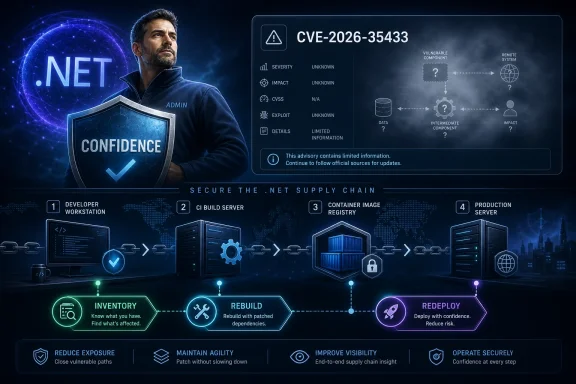
The remediation path for .NET vulnerabilities usually begins with Microsoft’s supported update channels, but it does not end there. Administrators need to distinguish between runtime updates delivered to machines, SDK updates used by developers, package updates pulled into applications, and rebuilt artifacts carrying fixed components.
On Windows endpoints and servers, that means checking Microsoft Update, enterprise patch management, WSUS, Intune, Configuration Manager, or whatever tool actually governs update compliance. On developer systems, it also means confirming SDK versions because the build environment can matter even when the runtime is patched elsewhere. On servers that host .NET applications, it means knowing whether apps are framework-dependent or self-contained.
Containers complicate the story further. A fixed base image does nothing for a running container until the image is rebuilt and redeployed. A private registry can preserve vulnerable layers long after the public base image has moved on. Kubernetes nodes and Windows containers add another layer of operational sequencing because remediation may require both image churn and host hygiene.
The safest mental model is simple: patching .NET is not a button; it is a supply chain. CVE-2026-35433 should prompt organizations to follow that chain from developer laptop to build pipeline to artifact repository to production runtime.
Older .NET Habits Still Haunt Modern Security Programs
Microsoft has spent years improving .NET’s release cadence, cross-platform story, and servicing model. But enterprise habits lag behind platform evolution. Many organizations still treat .NET as part of Windows plumbing rather than as a living application platform with its own lifecycle.
That creates uncomfortable edge cases. Unsupported runtime versions may persist because an application owner fears a breaking change. Old SDKs may remain on build hosts because nobody wants to touch a fragile pipeline. Internal tools may be published self-contained and then forgotten because they “just work.”
Security advisories expose the cost of that convenience. When a vulnerability lands, the organization discovers whether its .NET estate is managed as an asset or tolerated as sediment. The difference is not philosophical; it determines whether a security team can answer basic questions before attackers can exploit the ambiguity.
CVE-2026-35433 may not become the most dramatic Microsoft vulnerability of the year. But it is a useful audit prompt because it tests the mundane things that actually decide outcomes: inventory, ownership, rebuild discipline, and patch telemetry.
The Exploit Details Will Matter Later, but the Control Plane Matters Now
Eventually, more may be known about CVE-2026-35433. Researchers may diff patches, Microsoft may update the advisory, third-party scanners may refine detections, and exploitability assessments may become more specific. That later clarity will be useful.
But waiting for perfect clarity is not a strategy. The first wave of defense should focus on reducing obvious exposure while preserving operational stability. That means prioritizing systems where local privilege boundaries are meaningful and attacker footholds are plausible.
Security teams should resist two opposite mistakes. The first is panic, treating every .NET-labeled CVE as an immediate internet-wide worm. The second is complacency, treating elevation of privilege as low priority because it is not the initial door. Mature attackers love the second mistake.
In Microsoft-heavy environments, privilege escalation is often the bridge between a noisy low-level compromise and a quiet administrative one. Closing that bridge is rarely glamorous, but it is one of the more reliable ways to make intrusions harder.
The Real Lesson Is Hidden in the Word “Confidence”
The confidence metric attached to this discussion is more than scoring trivia. It is a reminder that vulnerability management is an information-management problem before it is a patching problem. Defenders act on partial knowledge all the time, and the question is whether their process can handle uncertainty without freezing.
A vendor-confirmed CVE with limited public technical detail deserves a different response than an unverified rumor, but also a different response than a fully weaponized, actively exploited zero-day. CVE-2026-35433 appears to occupy that middle ground: credible enough to patch with intent, opaque enough to avoid overclaiming, and broad enough in product reach to justify serious inventory work.
For WindowsForum’s audience, the danger is not misunderstanding what “elevation of privilege” means. The danger is underestimating how often privilege escalation becomes the decisive stage of an attack. Once an adversary has code running somewhere useful, the next move is almost always to become someone more important.
That is why the practical response should focus on the systems where “someone more important” is within reach. Shared Windows servers, CI runners, developer workstations, privileged automation hosts, and application servers should not wait at the back of the queue simply because the bug is not described as remote code execution.
The Patch Queue Should Follow the Privilege Map
CVE-2026-35433 is ultimately a .NET vulnerability, but the response should be mapped around privilege rather than branding. The organizations that handle it well will not be the ones that merely recognize the CVE number. They will be the ones that know where .NET runs, who owns those systems, how applications are deployed, and what an attacker could gain after a low-privileged foothold.
There are several concrete moves worth making now:
- Organizations should identify installed .NET runtimes and SDKs across endpoints, servers, build agents, and application hosts rather than relying only on Windows patch status.
- Teams running self-contained .NET applications should rebuild and redeploy affected applications because host-level runtime updates may not change bundled runtime components.
- Container users should refresh base images, rebuild application images, and remove stale vulnerable layers from private registries where practical.
- Security teams should prioritize shared, multi-user, developer, CI/CD, and credential-rich systems because elevation-of-privilege flaws become most damaging where privilege boundaries matter.
- Administrators should monitor Microsoft’s advisory for updates, but they should not postpone inventory and patch planning while waiting for exploit details.
- Vulnerability managers should treat missing public exploit code as a useful data point, not as proof that a confirmed vendor advisory can be ignored.
The larger story is that Microsoft’s ecosystem has become too modular for old patching assumptions. A .NET fix may travel through Windows Update, developer SDKs, NuGet dependencies, base images, and rebuilt applications before the risk is truly reduced. CVE-2026-35433 is a reminder that modern Windows security is no longer just about keeping the operating system current; it is about keeping the whole software supply chain honest, measurable, and ready for the next advisory that arrives with more urgency than detail.