

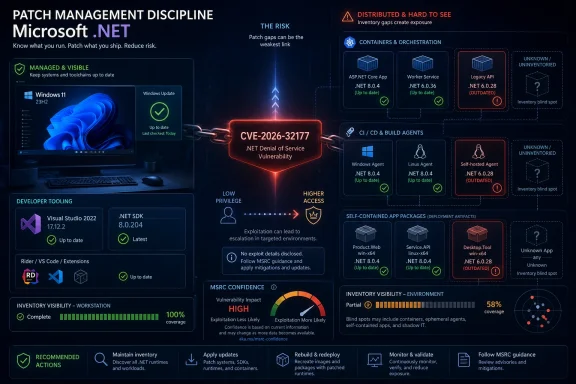
Microsoft’s Quiet .NET Bug Is Really a Test of Patch Discipline
CVE-2026-32177 lands in the awkward middle of enterprise risk: not spectacular enough to dominate news cycles, not vague enough to ignore, and close enough to the application stack that it will be discovered in places the desktop patch team does not own. .NET vulnerabilities are easy to underestimate because they do not always look like “Windows bugs” in the traditional sense. They live in runtimes, SDKs, hosting bundles, developer workstations, CI images, server fleets, container bases, and Visual Studio installations.
That breadth is why a .NET elevation-of-privilege flaw deserves more than a line item in a Patch Tuesday spreadsheet. A Windows workstation can be fully updated through Windows Update while a self-contained application still carries an older runtime. A build agent can be rebuilt weekly from a golden image that quietly pins yesterday’s SDK. A production web tier can run a patched OS while its application dependency graph tells a different story.
Microsoft’s advisory language is intentionally spare, which is normal for a vulnerability where the company wants customers to patch before the public learns too much. But the sparseness should not be confused with uncertainty. The user-provided MSRC text describes the “confidence” metric: how sure the ecosystem is that a vulnerability exists and how credible the known technical details are. For CVE-2026-32177, the practical reading is simple: this is not a speculative scanner finding or a blog-post hunch. It is a vendor-acknowledged security issue in a widely deployed platform.
Elevation of Privilege Is the Bug Class Attackers Save for Later
Remote code execution gets the headlines because it sounds like the front door being kicked in. Elevation of privilege is more often the hallway, the stairwell, or the stolen badge that turns an initial foothold into a durable compromise. In real intrusions, privilege escalation rarely arrives alone; it is chained after phishing, credential theft, exposed services, malicious packages, or abused developer tooling.
That makes .NET an uncomfortable place for this class of flaw. The runtime is not just an end-user component. It is a substrate for business applications, administrative tools, test harnesses, automation jobs, internal portals, and services whose permissions were granted years ago and rarely revisited. If an attacker can move from constrained execution to higher privileges inside that world, the blast radius depends less on the CVE title and more on how carelessly the environment grants trust to code.
This is also why “local” or “authenticated” conditions should not lull administrators to sleep. Many elevation-of-privilege bugs assume the attacker already has some level of access. Modern enterprise attacks are built around exactly that assumption. The question is not whether an adversary can magically appear on a box; it is what happens after a low-privilege account, a compromised developer laptop, or a poisoned workload identity gives them a starting point.
The value of such a bug rises sharply in environments where developer machines are treated as semi-admin zones. Visual Studio installations, SDKs, package caches, signing tools, local secrets, and privileged deployment credentials often cluster on the same systems. A vulnerability in that ecosystem can become an accelerant, even when the CVE itself does not read like a network worm.
The Confidence Metric Says Less About Drama Than About Defensibility
The MSRC language supplied with this CVE explains a metric that many patch dashboards flatten into noise. “Report confidence” is not a measure of how scary the vulnerability is. It is a measure of how much trust defenders should place in the claim that the vulnerability exists and that the technical description is credible.
That distinction matters because security teams triage hundreds of entries every month, many of which arrive with partial, duplicated, or evolving data. A vulnerability may begin as an external report with little public detail. It may later be corroborated by research. Eventually, it may be confirmed by the vendor or maintainer responsible for the affected technology. Each stage changes the defender’s posture.
For CVE-2026-32177, the presence of a Microsoft advisory is the operationally important fact. It means Microsoft has accepted the issue into its servicing pipeline and published guidance through the Security Update Guide. Even if the public advisory does not explain the root cause in exploit-ready prose, defenders should treat the vulnerability as real enough to patch and track.
There is a subtle advantage here for attackers as well. A confirmed CVE with limited detail tells them that something worth studying changed in the patched code. Once updates ship, determined researchers can diff binaries, inspect package changes, and narrow the hunt. The public may not have a working exploit on day one, but the patch itself becomes a map. That is the grim bargain of coordinated disclosure: customers need fixes, and fixes reveal clues.
.NET’s Servicing Model Makes Inventory the Real First Response
The first response to a .NET CVE should not be “install Windows updates” and move on. It should be inventory. Which versions of the .NET runtime are installed? Which SDKs are installed on developer workstations and build agents? Which applications are framework-dependent and rely on machine-level runtimes? Which applications are self-contained and ship their own runtime copy? Which containers were built from images that predate the April 2026 servicing release?
This is where many organizations discover that .NET is less centralized than their Windows patch reports suggest. Desktop teams may see Visual Studio as an application. Developers may see the SDK as tooling. Cloud teams may see runtime images as container maintenance. Application owners may see self-contained deployments as “not infrastructure.” Attackers do not respect those org-chart boundaries.
The April 2026 .NET servicing wave also arrives in a transitional moment. .NET 8 remains the long-term support workhorse for many enterprises. .NET 9, as a standard-term support release, is at the end of its supported life on May 12, 2026. .NET 10 has moved into the current supported stack for organizations already adopting the newer platform. That means a vulnerability announcement can double as a lifecycle reckoning: patching is easiest when the application is already on a supported train.
Visual Studio complicates the picture further. Developers often have multiple versions installed, sometimes with workloads and SDKs that survive long after a project has moved on. A workstation that can pull source, build production artifacts, access package feeds, and authenticate to deployment targets is not “just a client.” It is part of the software supply chain. If the vulnerable .NET components are present there, they need the same seriousness as a server runtime.
The Missing Exploit Narrative Is a Feature, Not a Gap
Security advisories increasingly frustrate technically curious readers because the most useful details are often absent. Which API is vulnerable? What precise preconditions are required? Is the flaw in runtime enforcement, file handling, deserialization, JIT behavior, authentication state, path resolution, or hosting integration? For CVE-2026-32177, Microsoft’s public framing is enough to drive action but not enough to recreate the bug.
That restraint is deliberate. The vendor’s job at publication time is not to teach exploitation; it is to get fixed bits onto vulnerable systems before the exploit window widens. The public advisory gives defenders the category, affected products, and servicing direction. It withholds the recipe.
Administrators sometimes misread that as a reason to delay. If the root cause is not public, they assume the exploitability is theoretical. In reality, limited disclosure can mean the opposite: the vendor knows enough to patch, but the ecosystem does not yet need a step-by-step public autopsy. The period between patch release and widespread reverse engineering is exactly when disciplined patching has the highest payoff.
The risk is not that every attacker instantly weaponizes a .NET elevation-of-privilege flaw. The risk is that enough skilled actors know how to mine patch diffs, and enough enterprises patch slowly, that a quietly confirmed bug becomes useful weeks later. Patch Tuesday is not just a release date; it is the starting gun for both defenders and researchers.
Windows Admins Need to Stop Treating Developer Runtimes as Someone Else’s Problem
One reason .NET vulnerabilities linger is that ownership is fragmented. Windows administrators may patch the operating system. Endpoint teams may update browsers and Office. Developers may install runtimes as needed. DevOps teams may rebuild containers only when application code changes. Security teams may scan everything and own none of the remediation paths.
CVE-2026-32177 exposes the weakness of that model. If a vulnerability affects a runtime used across workstations, servers, and application packages, then the response must cross those same boundaries. A single “compliant” Windows Update dashboard is not enough. A single package-management report is not enough. A single vulnerability scanner result is not enough.
The practical work begins with separating runtime deployment patterns. Framework-dependent applications rely on a shared runtime installed on the host. Self-contained applications carry a runtime inside the deployment. Containers inherit runtimes from base images and build layers. Visual Studio and SDK installations bring their own servicing considerations. Each path has a different owner and a different failure mode.
For sysadmins, the uncomfortable truth is that .NET has become infrastructure. It may not be a kernel driver or a domain controller, but it is part of the execution fabric for modern Windows estates. Treating it as a developer convenience leaves gaps that vulnerability management programs later rediscover under pressure.
Developers Should Read This as a Supply-Chain Maintenance Story
For developers, the lesson is not simply “update Visual Studio.” It is that runtime security is part of application maintenance, even when the application code has not changed. If a project pins an SDK, freezes a container base image, or publishes self-contained binaries, the team has accepted responsibility for refreshing those components when the platform ships security fixes.
That can be culturally difficult. Many teams avoid runtime upgrades because they fear regression risk. Some wait for a feature release. Others assume the infrastructure team will handle it. But security servicing is not the same as opportunistic modernization. A patched runtime is part of the supported operating environment.
Build pipelines are a common blind spot. A CI agent that uses an old SDK can produce artifacts that carry older dependencies forward. A container image built from a stale base can look fresh because the application layer changed yesterday. A self-contained deployment can remain vulnerable even after the host machine’s shared runtime has been updated. The version number that matters is the one actually executing code.
This is why software bills of materials and artifact provenance are no longer compliance theater. If teams cannot answer which runtime version is inside a shipped artifact, they cannot answer whether CVE-2026-32177 is fixed there. The same applies to internal tools, scheduled jobs, and administrative utilities that rarely receive the scrutiny given to customer-facing services.
The Patch Window Is Shorter Than the Enterprise Calendar Pretends
Enterprise patching still operates on calendar rituals: monthly maintenance windows, CAB approvals, pilot rings, staged deployments, emergency exceptions. Attackers operate on availability. Once a vendor ships a patch, the delta between old and new code becomes available to anyone sufficiently motivated to study it.
That does not mean every CVE deserves an emergency outage. It does mean the decision should be explicit. For a .NET elevation-of-privilege vulnerability, the priority should rise in environments where untrusted or semi-trusted users can execute .NET code, where developer workstations hold privileged credentials, where build systems have broad access, or where application hosts run workloads for multiple tenants or teams.
The patch window should also account for lifecycle reality. If .NET 9 is present, its support clock is no longer generous as of May 12, 2026. If .NET 8 is present, the organization has a longer runway but still needs current servicing releases. If .NET 10 is present, the platform may be newer but not magically immune to inherited maintenance debt. Supported does not mean patched; it means patches are available.
Risk acceptance should be written in plain language: which systems are deferred, why they are deferred, what compensating controls exist, and when they will be remediated. “No exploit observed” is not a compensating control. It is a status observation that can change overnight.
The Real Signal Is in the Systems That Cannot Be Patched Cleanly
Every Patch Tuesday reveals two inventories: the official one and the honest one. The official inventory lists assets, versions, and deployment rings. The honest inventory appears when a runtime cannot be upgraded because an abandoned application breaks, a vendor product pins an old component, a server owner has left, or a container rebuild process is undocumented.
CVE-2026-32177 is useful precisely because it forces that conversation without the panic of a famous zero-day name. If the organization cannot identify where .NET lives, it will not do better when the next vulnerability is remotely exploitable or actively abused. If it cannot rebuild application artifacts quickly, the bottleneck is not the CVE; it is the software delivery process.
For WindowsForum readers, this is the recurring theme of modern Microsoft security: the patch is often the easy part. The hard part is knowing what the patch must touch. Windows Update, Microsoft Update, Visual Studio Installer, package managers, container registries, endpoint management, and CI/CD systems all tell part of the story. None tells the whole story by default.
Security teams should use this CVE to test their assumptions. Ask whether scanners distinguish between installed shared runtimes and bundled self-contained runtimes. Ask whether developer endpoints are included in high-priority vulnerability SLAs. Ask whether base images are rebuilt after platform security releases. Ask whether application owners know that runtime updates are their responsibility when they package the runtime themselves.
Microsoft’s Sparse Advisory Leaves Defenders With a Familiar Bargain
Microsoft’s approach to CVE-2026-32177 follows the standard security-update pattern: acknowledge the vulnerability, classify the impact, identify affected products, ship fixes, and avoid publishing a technical walkthrough that would compress the exploit-development timeline. That is frustrating for analysts, but it is defensible.
The bargain works only if customers do their part. Vendor restraint buys time; it does not eliminate risk. A confirmed vulnerability with limited public detail becomes safer only when patched systems outnumber exposed ones. Otherwise, the quiet period simply becomes an attacker research period.
There is also a trust dimension. The report-confidence metric exists because not all vulnerability data is equally mature. In this case, the vendor’s own acknowledgement should be enough to end the debate over whether the issue is “real.” The remaining debate is operational: how fast to update, how broadly to search, and how much regression testing is acceptable before exposure becomes negligence.
The best security programs will not overdramatize CVE-2026-32177. They will also not bury it. They will treat it as a credible, vendor-confirmed flaw in a runtime that spans development and production, then use existing processes to move patched components through the estate with unusual attention to the places normal Windows patching cannot see.
The .NET Patch Tells IT Where Its Blind Spots Still Live
CVE-2026-32177 is not just another Patch Tuesday row; it is a prompt to verify whether .NET servicing is actually governed across workstations, servers, containers, and application artifacts. The concrete work is less glamorous than exploit analysis, but it is the work that decides whether this advisory remains a closed ticket or becomes incident context later.
- Organizations should confirm which supported .NET versions and Visual Studio channels are installed before assuming Windows Update has resolved the exposure.
- Application teams should rebuild and redeploy self-contained .NET applications because host-level runtime patches may not change the runtime bundled inside an artifact.
- Container owners should refresh base images and rebuild dependent images instead of relying on application-layer changes to imply platform freshness.
- Developer workstations and build agents should be treated as high-value systems because they often combine code execution, credentials, package access, and deployment authority.
- Security teams should record any systems that cannot be patched promptly and attach a dated remediation plan rather than accepting vague “compatibility” exceptions.
CVE-2026-32177 will probably not be remembered as the defining Microsoft vulnerability of 2026. Most CVEs are not. But it is the sort of quiet, credible platform flaw that separates mature patch programs from dashboard-driven ones: the former know where their runtimes live, who owns them, and how quickly they can be replaced; the latter discover all of that only after the advisory turns into an exploit story.