

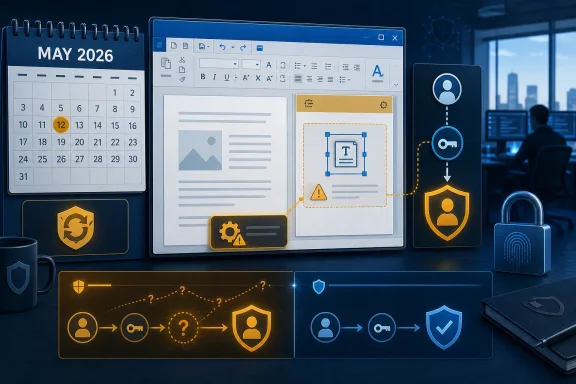
Microsoft’s Acknowledgment Turns This From Rumor Into Patch Priority
The user-supplied MSRC entry puts CVE-2026-21530 in the category administrators should treat as real, not speculative. In vulnerability-scoring language, the “confidence” question asks whether defenders are dealing with a theoretical weakness, a partially understood report, or a vendor-confirmed security flaw. Here, Microsoft’s publication of a CVE page is the decisive event: the vendor of the affected technology has acknowledged the vulnerability and issued security guidance through its normal channel.
That does not mean every technical detail is public. Microsoft often withholds exploit mechanics for Windows privilege-escalation bugs, especially when the vulnerable component is broadly deployed and the exploit path may be reusable. For defenders, that creates an uncomfortable but familiar asymmetry: the patch exists, the broad impact is known, but the fine-grained failure mode may remain undisclosed until researchers reverse-engineer the update.
That is why “confirmed” should not be confused with “fully explained.” A confirmed CVE says the vulnerability exists and was serious enough to enter Microsoft’s servicing pipeline. It does not necessarily tell administrators whether the bug is a memory corruption flaw, an access-control mistake, a race condition, or a parsing edge case hidden inside a rich text control.
The practical consequence is simple: this should be handled as a real Windows security update item, not as a curiosity attached to a legacy-sounding component.
Rich Text Edit Is Plumbing, and Plumbing Bugs Travel Quietly
The phrase “Windows Rich Text Edit” sounds like a throwback to an era of WordPad, RTF email, and dialog boxes with more fonts than restraint. But Windows components do not disappear merely because their names feel old. Rich text controls are embedded plumbing: they can appear in applications, shell surfaces, management tools, installers, and third-party software that relies on Windows-provided UI and text-handling behavior.
That is what makes this class of vulnerability awkward for enterprise risk teams. A bug in a named application has a visible perimeter. A bug in a shared Windows component has a dependency graph.
A local elevation-of-privilege vulnerability in such a component usually does not let a random attacker on the Internet compromise a machine unauthenticated. Instead, it becomes valuable after some other step has already happened: a phished user runs code, a browser escape lands in a constrained context, malware arrives with standard-user privileges, or an attacker has limited access to a workstation and wants more.
That second-stage role is easy to underrate. Many of the most damaging Windows intrusions are not single-bug stories. They are chains: initial access, code execution, privilege escalation, credential theft, lateral movement, persistence. CVE-2026-21530 belongs to the part of the chain where a small local foothold can become a much larger administrative problem.
Elevation of Privilege Is the Multiplier, Not the Opening Move
Windows administrators have learned to triage remote code execution bugs first, and for good reason. If a flaw can be hit over the network without credentials, it deserves immediate attention. But elevation-of-privilege vulnerabilities are the bugs that turn “one compromised user” into “one compromised system,” and sometimes into “one compromised domain.”
A local privilege-escalation flaw typically requires the attacker to already run something on the target. That precondition lowers the headline drama but not necessarily the operational risk. In modern attack chains, getting code execution as a normal user is often the cheap part; escaping that user’s constraints is where local Windows bugs become valuable.
This is especially true on shared endpoints, developer workstations, help-desk machines, jump boxes, and virtual desktop environments. These are systems where multiple identities, tokens, tools, or cached credentials may coexist. A privilege-escalation path on those machines can have consequences well beyond the local desktop.
For home users, the risk is more straightforward. Malware that lands under a standard account may be able to gain greater control if the system is unpatched. For organizations, the concern is not just one PC being “owned”; it is whether that PC has administrative tools, VPN access, browser sessions, secrets, or line-of-business applications that make it a stepping stone.
The CVSS Confidence Metric Says More About Disclosure Than Danger
The metric text included with the CVE is worth pausing over because it explains a common misunderstanding in vulnerability triage. Confidence is not severity. It does not tell you how bad the exploit impact is; it tells you how much trust to place in the existence and technical basis of the report.
At the lowest end, defenders may only know that somebody has claimed a bug exists. In the middle, researchers may have corroborated enough evidence to suggest where the vulnerability lies. At the high end, the author or vendor of the affected technology has confirmed it. CVE-2026-21530 is in that last practical category because Microsoft has published it through MSRC.
That matters because attackers read the same signals defenders do. A vendor-confirmed local privilege-escalation bug in Windows is a high-quality target for patch diffing. Even when Microsoft does not publish exploit code or root-cause details, the before-and-after update can become a roadmap for skilled researchers and offensive teams.
The industry sometimes treats sparse advisories as if they reduce attacker knowledge. In practice, a sparse advisory can create a race. Defenders must deploy the patch before adversaries turn the update itself into documentation.
Patch Diffing Is the Shadow Disclosure
Microsoft’s security updates do more than fix vulnerabilities; they reveal that something changed. Once a patch ships, researchers can compare binaries, inspect altered functions, and work backward toward the vulnerable condition. This is not exotic tradecraft anymore. It is a standard part of modern vulnerability research.
That is why local privilege-escalation bugs often become more dangerous after Patch Tuesday, not less, for machines that remain unpatched. The fix compresses uncertainty. Before the patch, an attacker may know only that a bug exists somewhere in a component. After the patch, the changed code narrows the search.
For defenders, this creates a clear timeline. The safest position is to test quickly and deploy within the normal security-update window, with accelerated handling for systems that are exposed to untrusted users or workloads. Waiting for public exploit code is the wrong threshold; by the time exploit code appears, the advantage has already shifted.
This is particularly relevant for Windows components used across application boundaries. If Rich Text Edit functionality can be reached by multiple programs, administrators may not be able to inventory every potential trigger path. The patch, therefore, is the control that matters most.
The Enterprise Risk Is Concentrated in Ordinary Desktops
Not every Windows vulnerability has its highest impact on servers. Some of the most useful local privilege-escalation bugs are workstation bugs because workstations are where people authenticate, browse, open documents, run collaboration tools, connect to VPNs, and administer cloud services.
A server may be more valuable, but a desktop may be easier to reach. That is the grim arithmetic behind endpoint privilege escalation. A phishing attachment, malicious installer, compromised browser session, or abused scripting environment can establish a beachhead; a local EoP bug can then help the attacker disable defenses, harvest credentials, or install persistence.
The phrase “Rich Text Edit” also raises the possibility of document-adjacent attack surfaces, though Microsoft’s public naming alone should not be stretched into a claim about exploit delivery. The safe interpretation is narrower: a Windows component involved in rich text editing has a privilege boundary problem. The broader operational lesson is that shared UI and parsing components deserve the same respect as more glamorous kernel or network services.
Security teams should also resist treating “local” as synonymous with “low priority.” In a mature environment, local privilege escalation is exactly what endpoint detection, application control, least privilege, and patch management are supposed to contain. When one of those layers fails, the others matter more.
The Consumer Story Is Boring, Which Is Good
For most Windows users, the correct response is refreshingly unromantic: install the monthly security update. If Windows Update is enabled and the machine is supported, the fix should arrive through the normal servicing path. There is no reason for ordinary users to go hunting for exploit details, registry tweaks, or unofficial mitigations.
The bigger consumer risk is delay. People postpone reboots because they are busy, because Windows updates have a reputation for inconvenience, or because the machine is used only occasionally. That delay is the window attackers care about, especially once patch details begin to circulate in security circles.
Users running unsupported Windows versions are in a different situation. If the operating system no longer receives security updates, a confirmed Windows component vulnerability is another reminder that unsupported does not mean stable; it means increasingly well-mapped. Legacy machines should be isolated, replaced, or handled with compensating controls rather than treated as normal endpoints.
Admins Should Look Past the Component Name and Patch the Exposure Pattern
The right enterprise response starts with affected assets, but it should not end there. Administrators should confirm whether the relevant May 2026 Windows security update is approved, deployed, and successfully installed across supported Windows client and server versions in their environment. Endpoint management dashboards should be checked for failures, deferrals, offline devices, and machines stuck behind maintenance windows.
The more interesting triage question is which systems deserve faster handling. Multi-user systems, VDI pools, developer machines, privileged-access workstations, help-desk endpoints, and systems used to administer identity infrastructure should move up the queue. These are machines where privilege escalation has an outsized blast radius.
Security teams should also watch for post-patch exploit chatter. A local EoP may not trigger perimeter alarms, but it can appear in endpoint telemetry as unusual child processes, token manipulation, suspicious access to protected directories, unexpected service creation, or security-tool tampering. The patch closes the known hole; monitoring helps catch machines that were already abused or that remain unpatched.
There is no public basis, from the supplied advisory text alone, to claim active exploitation. That distinction matters. “Confirmed by Microsoft” means real. It does not automatically mean exploited in the wild. But defenders should not wait for exploitation status to become a crisis label before treating the update seriously.
The Real Signal Is Vendor Confirmation With Sparse Detail
CVE-2026-21530 is a good example of the modern Windows vulnerability disclosure bargain. Microsoft gives defenders enough information to identify the affected area, impact type, and update path, but not enough to reproduce the bug. That protects customers from copycat exploitation in the short term, while also leaving security teams to make decisions without the kind of root-cause clarity they would prefer.
This is where the confidence metric becomes useful. It tells administrators that the vulnerability’s existence is not merely alleged. The vendor has put its name behind it. In a noisy CVE ecosystem full of duplicates, disputed reports, weak advisories, and third-party summaries, that confirmation has real value.
The absence of public exploit details should not be mistaken for low urgency. It may simply mean the responsible disclosure process worked as intended. Or it may mean Microsoft is deliberately limiting details because the underlying technique would be too easy to weaponize.
For WindowsForum readers, the lesson is familiar but still important: Patch Tuesday is not just a list of bugs; it is a map of where attackers will start looking next.
The Patch Queue Should Treat This as a Chain-Breaker
CVE-2026-21530 does not need to be the scariest item in the month’s release to deserve attention. Its value to attackers lies in chaining. If another bug, stolen credential, malicious macro, drive-by download, or social-engineering payload gets code running under a normal user, this kind of vulnerability can help the attacker move from presence to control.
That makes it a chain-breaker for defenders. Patching it may not stop the first click, the first download, or the first compromised account. But it can prevent the next stage from becoming dramatically easier.
A reasonable response should be concrete:
- Organizations should deploy the applicable May 2026 Windows security updates after normal compatibility testing, with priority for endpoints used by administrators, developers, help-desk staff, and shared users.
- Security teams should treat vendor confirmation as sufficient reason to patch, even if exploit code and root-cause details are not public.
- Administrators should verify installation success rather than relying only on update approval status in WSUS, Intune, Configuration Manager, or other management tooling.
- Unsupported Windows systems should be treated as exposed assets unless they receive an applicable extended security update or are isolated by design.
- Detection teams should watch for local privilege-escalation behavior on machines that were unpatched during the release window, especially attempts to create services, tamper with endpoint protection, or access protected credentials.
The enduring lesson of CVE-2026-21530 is that Windows security is often decided in the unglamorous layers: controls, parsers, shared libraries, and UI components that users never knowingly launch. Microsoft’s confirmation gives administrators enough certainty to act, even if it does not give researchers enough detail to explain the bug in full. The smart move is to patch before that explanation arrives, because once the reverse-engineering catches up, the quiet plumbing flaw becomes just another tool in the attacker’s chain.