

Microsoft’s Quiet CLFS Fix Lands in a Noisy Patch Tuesday
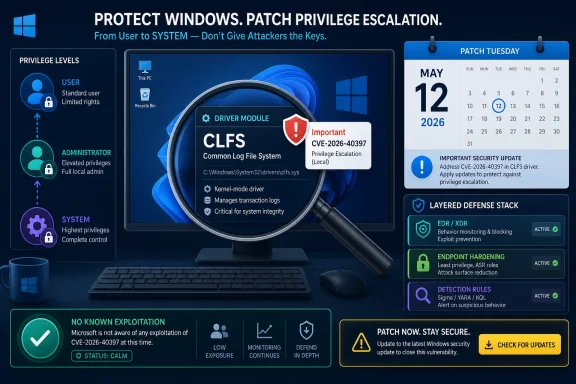
CVE-2026-40397 arrives as part of a large May security release, not as a lone emergency bulletin. That matters because the vulnerability is competing for administrator attention against remote code execution bugs, Office flaws, cloud-service CVEs, and the usual sprawl of Windows kernel and driver issues. In that crowd, an “Important” local privilege escalation flaw can look almost routine.
That would be the wrong lesson. The Windows Common Log File System driver sits in the kind of privileged plumbing attackers love after they already have a foothold. It is not the front door of an intrusion; it is one of the ways a low-privileged compromise can become a full machine compromise.
The public facts are still thin. Microsoft’s advisory names the component and impact, third-party Patch Tuesday trackers list it as not publicly disclosed and not exploited in the wild, and network-defense vendors have already moved to ship detection content around the day of release. That combination gives defenders enough to prioritize patching, but not enough to reverse-engineer the root cause from the advisory text alone.
The Report Confidence Signal Is Doing More Work Than It Seems
The user-facing metric attached to this CVE is easy to skim past: report confidence. In CVSS terms, it measures how certain the vulnerability is and how credible the technical details are. A confirmed vendor advisory is different from a rumor, a partial research note, or a theoretical class of weakness.
For CVE-2026-40397, the meaningful point is that the vulnerability exists in Microsoft’s own security release pipeline. This is not an unverified claim floating through a mailing list. It is a patched Windows vulnerability in a named kernel-adjacent component, and the advisory framework treats it as a real exposure even if public technical detail remains limited.
That distinction matters for attackers as well as defenders. Sparse public details can slow opportunistic exploitation, but the patch itself becomes a map for skilled researchers. Once binaries are available, diffing a vulnerable and fixed driver can reveal the changed code path more quickly than many enterprises can complete deployment.
CLFS Is a Privilege Escalation Repeat Offender
The Common Log File System is not glamorous Windows technology. It exists to provide a general-purpose logging subsystem used by components that need reliable transaction-style logging. Precisely because it is old, privileged, and widely present, it has become a recurring target for local elevation-of-privilege research.
This is the larger context around CVE-2026-40397. CLFS has appeared again and again in Microsoft security releases over the years, including vulnerabilities that attackers have exploited in real-world campaigns. The component has become one of those Windows subsystems defenders recognize not because they administer it directly, but because it keeps showing up in post-compromise escalation chains.
That history does not prove this new flaw is trivially exploitable. It does, however, explain why many security teams will rank it above a generic “local only” bug. A local privilege escalation is often the second move in an attack, and the second move is what turns a phished user, a browser escape, or a stolen low-privilege credential into durable control of a workstation or server.
“Local Attack” Is Not a Comforting Phrase Anymore
The phrase local privilege escalation can sound reassuring in a vulnerability table. It implies the attacker already needs access. In modern environments, that assumption is less comforting than it used to be.
Endpoint compromise is often a chain, not a single exploit. An attacker may begin with a malicious document, a stolen VPN credential, a browser exploit, or an exposed application account. Once inside the user context, the next problem is privilege. A Windows driver elevation bug is valuable because it can collapse the distance between “code running as a user” and “code running with the authority to disable defenses, dump credentials, and persist.”
That is why CVE-2026-40397 should not be dismissed simply because it is not a remote pre-authentication flaw. For a mature attacker, local elevation bugs are tools of consolidation. They are the difference between temporary access and ownership.
The Absence of Exploitation Is a Window, Not a Verdict
Current public Patch Tuesday analysis indicates that CVE-2026-40397 was not known to be exploited or publicly disclosed at release. That is useful information, but it is not a guarantee of future quiet. Patch Tuesday starts the clock for both sides.
Defenders read the advisory and schedule deployment. Attackers read the same release, obtain the changed binaries, and look for the security-relevant delta. The lag between patch publication and reliable exploit understanding varies, but the strategic pattern is familiar: once a fix exists, the bug is no longer hidden in the same way.
This is where the report confidence metric cuts both ways. A confirmed vulnerability gives defenders confidence that patching is not speculative. It also tells offensive researchers that there is something real to look for.
The Patch Burden Falls Unevenly Across Windows Estates
For home users on supported Windows 10 and Windows 11 builds, the answer is straightforward: take the cumulative update when it is offered. Windows servicing has turned many individual CVEs into a single monthly installation decision, and CVE-2026-40397 is part of that broader security package.
For enterprises, the decision is less about whether to patch and more about how fast to move through rings. CLFS is core enough that administrators will want validation, but not so exotic that it should sit for weeks awaiting special-case analysis. Workstations used by developers, administrators, finance teams, help desks, and anyone with access to privileged tooling should be high in the rollout order.
Servers deserve a more nuanced treatment. Internet-facing servers may not expose CLFS directly, but any box that processes untrusted input or hosts applications reachable by lower-privileged users has to be treated as a potential stepping stone. The worst outcome is not that CVE-2026-40397 is exploited from the network by itself; it is that it becomes the local escalation stage after another bug opens the first crack.
Detection Helps, But It Cannot Substitute for Servicing
Cisco Talos’ Snort rule update for May 12 included coverage tied to CVE-2026-40397, describing a coding deficiency in the Windows Common Log File System driver that may lead to privilege escalation. That is a useful signal that security vendors are treating the vulnerability as operationally relevant, not just as an entry in Microsoft’s database.
Still, detection for local privilege escalation is inherently limited. Network signatures may catch exploit delivery patterns, suspicious staging, or related activity, but the vulnerable behavior occurs on the endpoint. Once code is executing locally, host telemetry, EDR behavior rules, and exploit mitigation become more important than perimeter inspection.
The best posture is layered. Patch the driver, watch for suspicious token manipulation and privilege transitions, and treat failed exploitation attempts as meaningful evidence of attacker activity. But do not let the presence of signatures become an excuse to defer the update.
The May Release Makes Prioritization Harder, Not Easier
May 2026’s Microsoft release is large enough that triage becomes its own risk. Third-party analysis counted 137 Microsoft CVEs in the release, alongside a large set of Chromium-related issues affecting Microsoft Edge. In that kind of month, administrators naturally look for the obvious fires: critical remote code execution, known exploitation, public disclosure, domain-impacting services.
CVE-2026-40397 does not win that contest on headline severity. It is not the flashiest bug in the bundle. But security operations is not a headline contest; it is an attack-chain contest.
The right prioritization model asks where a vulnerability fits in the life cycle of a compromise. A remote code execution bug may get the attacker in. A CLFS elevation bug may help them stay, spread, or turn user-level execution into machine-level control. That makes it especially relevant in environments where phishing, browser exposure, and endpoint compromise are already assumed risks.
Windows Admins Should Read This as a Hygiene Test
The uncomfortable truth is that many organizations still patch privilege escalation bugs slower than remote code execution bugs. That is understandable, but it is increasingly outdated. Attackers do not need every link in the chain to be spectacular; they need enough ordinary weaknesses to compose a path.
CVE-2026-40397 is a test of whether an organization’s patch process recognizes that reality. If the only vulnerabilities that move quickly are exploited zero-days and critical remote bugs, then attackers can build around the neglected middle. Local elevation vulnerabilities live in that middle.
Administrators should also remember that cumulative updates reduce the excuse surface. On supported Windows clients and servers, the fix is generally not a bespoke one-off engineering project. The operational challenge is regression testing, maintenance windows, rollback readiness, and communication — not hunting for an obscure standalone patch.
The Real Risk Is the Chain Nobody Has Named Yet
There is no public evidence at release that CVE-2026-40397 is being used in the wild. There is also no public proof that it is easy to exploit. Those are important caveats, and defenders should resist the temptation to inflate every kernel-adjacent bug into an instant crisis.
But the more useful mental model is to imagine the vulnerability as an unnamed link in a future chain. A user clicks something. A process escapes a sandbox. A service account is abused. Then the attacker needs higher privileges, and an unpatched CLFS driver becomes the quiet mechanism that makes the rest of the intrusion possible.
This is why Windows security often feels repetitive. The names change, the CVE numbers change, the monthly tables grow and shrink, but the architectural lesson remains constant: highly privileged compatibility layers and legacy subsystems are hard to retire, hard to perfectly secure, and extremely useful to attackers when a mistake slips through.
The Practical Reading of CVE-2026-40397
CVE-2026-40397 is not a reason to unplug the network. It is a reason to make sure the May 2026 cumulative updates do not get lost in the usual post-Patch Tuesday shuffle. The most important facts are concrete enough for action, even if the root-cause details remain sparse.
- CVE-2026-40397 affects the Windows Common Log File System driver and can allow elevation of privilege.
- Public Patch Tuesday reporting lists it as Important severity with a CVSS base score of 7.8 and no known exploitation or public disclosure at release.
- The vulnerability matters because CLFS runs in a privileged Windows context and has been a recurring target for local privilege escalation research.
- The most likely operational risk is not standalone remote compromise, but use after an attacker has already gained code execution as a lower-privileged user.
- Detection content is useful, but patching supported Windows systems remains the primary mitigation.
- Enterprises should prioritize rollout to high-value workstations, admin endpoints, developer machines, and servers that process untrusted input.
CVE-2026-40397 is the kind of Windows vulnerability that rewards disciplined security programs and punishes theatrical ones. It does not demand panic, but it does demand movement: test the May updates, deploy them in sensible rings, and assume attackers are reading the same sparse advisory with more patience than your change calendar allows.