

Microsoft’s “Important” Label Hides a SYSTEM-Sized Consequence
The most tempting reading of CVE-2026-34343 is the lazy one: not remote, not wormable, not known exploited, not Critical. That reading is also the one attackers prefer defenders to make. Windows elevation-of-privilege bugs are rarely the headline-grabbing first stage of an intrusion, but they are often the stage that turns an ordinary user context into a durable machine compromise.
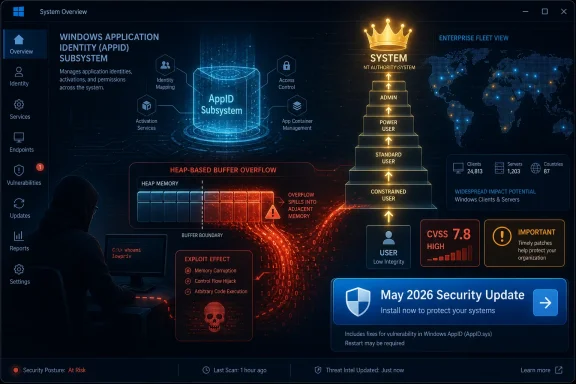
Microsoft’s own scoring tells the story in compressed form. The CVSS base score is 7.8, with a local attack vector, low attack complexity, low privileges required, no user interaction, and high impact to confidentiality, integrity, and availability. In plainer English, the attacker already needs some authorized access to the target machine, but once there, the conditions are not exotic and the prize is total control.
The FAQ answer is the line administrators should circle: successful exploitation could yield SYSTEM privileges. SYSTEM is not “a bit more access.” It is the operating system’s local crown-jewel context, the identity under which many of Windows’ most trusted services run. In incident-response terms, moving from a standard user to SYSTEM is the difference between cleaning up a nuisance and rebuilding trust in the endpoint.
The vulnerability’s root class, CWE-122 heap-based buffer overflow, also matters. Microsoft has not published exploit mechanics in detail, but heap corruption in privileged Windows components has a long history of becoming useful once researchers and adversaries understand the affected code path. The absence of public exploit code today is not a permanent condition; it is a timestamp.
AppID Is Not Glamorous, Which Is Why This Patch Deserves Attention
The Windows Application Identity service is not one of those brand-name attack surfaces that makes patch teams jump out of their chairs. It is infrastructure: part of the Windows policy machinery that helps identify applications and enforce rules such as AppLocker policies. That makes it easy to overlook and risky to underestimate.
Security-sensitive subsystems do not need to be internet-facing to matter. A component that participates in application identity and policy decisions lives close to trust boundaries. If a local attacker can corrupt memory in such a subsystem and cross into SYSTEM, the fact that the bug requires local access becomes less comforting.
This is the recurring trap in Windows security triage. Remote code execution vulnerabilities receive the emergency meetings because they appear to bring the attacker to the door. Local privilege escalations are treated as cleanup work because the attacker must already be inside. Real intrusions do not respect that neat separation; phishing, stolen VPN credentials, malicious browser extensions, help-desk abuse, exposed RDP, and supply-chain footholds all create the low-privilege beachhead that makes an elevation bug valuable.
For enterprises that use AppLocker or related policy controls, the AppID label will also raise a more specific concern. Microsoft’s advisory does not say the flaw bypasses application control policy, and defenders should not infer more than the company has stated. But a vulnerability in the subsystem associated with application identity belongs on the short list for testing in environments that rely on Windows application control as a containment layer.
The Exploitability Signals Are Reassuring, Not Exculpatory
Microsoft says CVE-2026-34343 was not publicly disclosed and was not exploited at the time of publication. It also lists exploit code maturity as unproven and assesses exploitation as less likely. Those are useful signals, especially for organizations drowning in Patch Tuesday volume.
They are not a reason to ignore the update. “Less likely” is not “won’t happen,” and “unproven” is not “uninteresting.” In Microsoft’s scoring, report confidence is confirmed, which means the vulnerability is not speculative. The vendor has acknowledged the issue, assigned the CVE, scored it, shipped fixes, and credited the coordinated disclosure work.
That combination is common in mature vulnerability handling: enough detail to let defenders act, not enough detail to hand attackers a tutorial. It creates a temporary asymmetry in favor of patching organizations. The longer patching drags on, the more that asymmetry erodes as binary diffing, crash analysis, and third-party research fill in the missing steps.
The attacker economics are straightforward. A local EoP that grants SYSTEM and affects a broad range of Windows client and server versions is useful as a link in a chain. Even if it is not the easiest privilege escalation in the current crop, it expands the menu available to operators who already have user-level code execution.
The Affected Surface Spans the Windows Estate
The update list for CVE-2026-34343 is broad. Microsoft includes supported Windows 10, Windows 11, and Windows Server releases, along with Server Core variants and older server platforms still receiving relevant security servicing. In operational terms, this is not a niche fix for a single branch.
That breadth matters because local privilege-escalation bugs age badly in mixed fleets. Workstations may update quickly through Windows Update for Business or Intune, while servers move through slower change windows. Legacy systems may depend on Extended Security Updates, maintenance exceptions, or manual catalog deployment. Attackers do not need every machine to be vulnerable; they need one useful machine in the right place.
Windows Server 2025 and Windows Server 2022 entries include both standard security update paths and hotpatch update entries in some cases. That reflects Microsoft’s larger push to reduce reboot friction, but it also complicates verification. Security teams should confirm not merely that an update was offered, but that the installed build actually matches the fixed build for the servicing model in use.
The client side is no less messy. Windows 10 22H2 remains a major deployed base, Windows 11 23H2 and 24H2 are still heavily represented in managed fleets, and newer Windows 11 branches appear in the affected list as well. The result is the usual Patch Tuesday reality: one CVE, many deployment stories.
Local Bugs Are the Glue in Modern Attack Chains
The security industry often talks about vulnerabilities as if they operate alone. They rarely do. A local privilege-escalation vulnerability is most dangerous when paired with something mundane: a stolen password, a successful lure, a misconfigured remote-access tool, an over-permissive line-of-business app, or a commodity loader running as a standard user.
That is why CVE-2026-34343 should be judged by where it fits in the kill chain. It is not the front door. It is the staircase from the lobby to the server room.
Once an attacker has SYSTEM, several defensive assumptions collapse. Endpoint protection can be tampered with more aggressively. Credentials and tokens may be more accessible. Persistence mechanisms become harder to distinguish from legitimate service configuration. Lateral movement becomes easier because the compromised machine can be used as a stronger platform for credential theft and network reconnaissance.
This is also where least privilege proves both its value and its limits. Least privilege can prevent the initial user context from doing immediate domain-wide damage. But if a local EoP provides a reliable jump to SYSTEM, the endpoint itself becomes the attacker’s workstation. The right response is not to abandon least privilege; it is to pair it with fast patching, exploit mitigation, application control, and credential isolation.
Heap Corruption Keeps Surviving the Memory-Safety Sermon
CVE-2026-34343 is another reminder that the Windows security story is still partly a memory-safety story. Heap-based buffer overflows are an old class of bug, and modern Windows has accumulated mitigations specifically designed to make exploitation harder. Yet the class persists because large operating systems carry decades of C and C++ code, complex parsing paths, service boundaries, and legacy compatibility obligations.
It is important not to overstate what we know. Microsoft has not published enough technical detail to say exactly which AppID path is affected, what input triggers the overflow, or how practical exploitation would be across builds. But the classification alone is meaningful: a heap overflow in a privileged subsystem is the kind of flaw defenders should assume researchers will study.
The good news is that modern mitigations matter. Address-space layout randomization, heap hardening, control-flow protections, sandboxing where applicable, and exploit-detection telemetry all raise attacker cost. The bad news is that privilege-escalation exploit writers are patient, and local attack scenarios allow repeated attempts, environmental probing, and version-specific tailoring.
That tension is why Microsoft’s exploitability rating should be read as a near-term deployment input, not a permanent risk verdict. Today’s “less likely” can become tomorrow’s proof of concept, especially after patches provide attackers with a before-and-after map of what changed.
The Patch Is the Workaround
Some vulnerabilities arrive with registry mitigations, service-disable guidance, or feature-level workarounds. CVE-2026-34343 is simpler and harsher: Microsoft lists an official fix. Customers are required to apply the relevant security update for their Windows version.
That is not a failure of communication. For a subsystem-level memory corruption issue, disabling the affected component may be impractical, risky, or operationally destructive. AppID-related functionality can intersect with application control and policy enforcement; casually turning it off would be a cure with its own security side effects.
The operational task, then, is standard but not trivial. Identify affected Windows versions, map them to the right cumulative update or security update, deploy through the organization’s normal rings, and verify fixed build numbers. For endpoints, that likely means the regular managed update pipeline. For servers, especially Server Core and older branches, it means disciplined maintenance windows and post-install validation.
Administrators should also resist the habit of treating local EoP fixes as safe to defer until “the next big reboot.” If a machine is important enough to avoid rebooting, it is important enough to protect. The systems with the most painful maintenance windows are often the systems whose compromise would be most painful.
Older Servers Turn Routine CVEs Into Inventory Tests
One of the more telling aspects of this advisory is how far the affected list reaches into server history. Windows Server 2012 and 2012 R2 appear alongside newer releases. That does not mean every organization still runs them, but enough do that Microsoft’s security ecosystem continues to account for them.
For IT departments, this is where vulnerability management becomes asset management by another name. A scanner finding CVE-2026-34343 on a fully managed Windows 11 laptop is a patch ticket. The same finding on an old server hosting a forgotten application may be a migration conversation, a contract conversation, and a business-risk conversation.
Older servers also create uneven defensive terrain. They may have weaker hardware support for modern protections, more fragile application dependencies, and fewer convenient maintenance opportunities. They may also sit in network segments where monitoring is less complete because “nothing changes there.” Attackers love places where nothing changes.
Server Core deserves particular attention because it is often deployed precisely to reduce attack surface and operational overhead. That design still helps, but it does not make the system immune to vulnerabilities in shared Windows components. Core installations need the same update verification as full desktop-experience installations, not a comforting assumption that minimalism handled it.
Report Confidence Is the Quiet Metric That Should Move the Queue
The user-supplied text highlights report confidence, and for this CVE that metric lands on confirmed. In CVSS terms, that is not a severity score booster in the way “network” or “no privileges required” might feel intuitive to non-specialists. In practice, it is one of the most useful signals for deciding whether a vulnerability deserves real operational attention.
Confirmed means defenders are not chasing a rumor. The vulnerability exists, the vendor has validated it, and the published technical descriptors are credible enough to support remediation. That matters in a patch ecosystem increasingly polluted by recycled CVE summaries, AI-generated vulnerability pages, and breathless claims about every flaw being the next catastrophe.
There is a second edge to report confidence. If the vendor can confirm the flaw, attackers can often confirm it too once they have the patch. A confirmed bug with an official fix becomes a target for reverse engineering. The patch closes the hole for updated systems while simultaneously documenting, indirectly, what changed.
That is why the best window for defenders is short. The ideal state is not “we will patch before exploitation is observed.” The ideal state is “we patched before exploitation became convenient.”
Credit Where It Matters, Detail Where It Does Not
Microsoft credits Erik Egsgard with Field Effect for the report. That indicates coordinated disclosure rather than a surprise public dump, and it is one of the reasons the advisory can arrive with a fix and without known exploitation. This is the vulnerability ecosystem working as designed, even if the result still creates work for administrators.
Coordinated disclosure does not make a vulnerability harmless. It makes the timeline less chaotic. Instead of defenders learning about a bug through exploit chatter, they get a vendor-confirmed advisory, affected-product matrix, and fixed builds. That is a better starting position than the alternative.
The lack of deep technical detail is similarly unsurprising. Vendors routinely withhold exploit-enabling specifics at publication, especially for flaws that affect broadly deployed platforms. Researchers may eventually publish more, but the initial advisory is built for remediation, not education.
For WindowsForum readers, the practical lesson is to separate curiosity from urgency. It is reasonable to want to know the exact vulnerable code path. It is unwise to make patching contingent on that knowledge when the vendor has already confirmed SYSTEM impact and shipped the fix.
The Real Risk Is Not Panic, It Is Patch Fatigue
Patch Tuesday has trained many organizations to perform a kind of triage theater. Critical remote flaws go to the top, actively exploited zero-days get special handling, browser bugs move quickly, and everything else waits for capacity. That model is understandable, but it can create a backlog of “merely Important” privilege-escalation bugs that collectively widen the blast radius of every later compromise.
CVE-2026-34343 is a textbook candidate for that backlog if teams read only the top-line severity. It has the ingredients that should keep it out of the long grass: low privileges required, no user interaction, high impact, confirmed report confidence, broad platform coverage, and SYSTEM as the potential destination.
The right response is not emergency panic across every Windows machine by midnight. Microsoft’s own exploitability assessment does not support that. The right response is controlled urgency: put it into the normal security-update pipeline, prioritize systems exposed to lower-trust users and shared workloads, verify deployment, and avoid indefinite deferral.
Shared Windows systems deserve special concern. Terminal servers, jump hosts, developer workstations, kiosks, lab machines, VDI pools, and multi-user administrative platforms all change the meaning of “local.” On a single-user laptop, local access may imply the user already phished themselves. On a shared host, one low-privileged account can become a pathway to a much more sensitive machine context.
The Machines That Matter Most Are the Ones Attackers Can Touch
For home users, the advice is mercifully boring: install the May 2026 Windows security updates and do not disable Windows Update in pursuit of short-term convenience. The risk profile is lower than for an enterprise server, but the fix is also easier to consume. A local privilege-escalation bug becomes relevant after malware lands, and consumer malware has no shortage of ways to land.
For small businesses, the problem is usually update visibility. Machines may be “set to automatic” without anyone checking whether updates actually installed. CVE-2026-34343 is a good excuse to review update compliance dashboards, remote-management agents, and the handful of servers that only one person remembers.
For enterprises, the priority should follow exposure and function. Systems used by many users, systems that process untrusted content, and systems that serve as administrative stepping stones should move early. Domain controllers are not listed because of their domain role; they are Windows servers running affected components if their OS version is in scope, and they should be treated with the seriousness their role demands.
Developers and security teams should also watch build pipelines and test infrastructure. Those environments often run as local administrators more often than anyone likes to admit, but they also host secrets, signing materials, deployment tokens, and source code. A local privilege escalation on a build worker can become a supply-chain problem faster than a desktop-support ticket.
May’s AppID Fix Rewards the Boring Teams
The useful reading of CVE-2026-34343 is not that Windows is uniquely broken or that every AppID installation is about to be exploited. It is that mature security operations are mostly won by doing the boring work before it becomes dramatic.
- Microsoft released CVE-2026-34343 on May 12, 2026, and identifies it as a Windows Application Identity subsystem elevation-of-privilege vulnerability.
- The flaw is a heap-based buffer overflow with a CVSS 3.1 base score of 7.8 and an Important severity rating.
- Exploitation requires local low-privileged access, does not require user interaction, and can result in SYSTEM privileges.
- Microsoft says the vulnerability was not publicly disclosed or exploited at publication and rates exploitation as less likely.
- The affected products span multiple Windows client and server releases, so administrators should verify fixed builds rather than assume a single update path covers the estate.
- The practical mitigation is to install the official May 2026 security updates through the appropriate Windows servicing channel.
The broader lesson is that Windows security is still a chain-of-trust problem. Microsoft can reduce exploitability, coordinate disclosure, and ship fixes, but the last mile belongs to the people operating the machines. CVE-2026-34343 is not the loudest vulnerability of the year; it is the kind that quietly determines whether the next ordinary foothold becomes a full-system compromise.