

Microsoft’s June 9, 2026 Security Update Guide entry for CVE-2026-45454 identifies the issue as a Microsoft SharePoint Remote Code Execution vulnerability, placing another server-side collaboration flaw into the patch-management queue for organizations still running SharePoint infrastructure outside Microsoft 365. The important part is not merely the three-letter acronym RCE. It is the confidence Microsoft is attaching to the vulnerability, the amount of technical detail now implied by the advisory, and the uncomfortable lesson for administrators: SharePoint remains a high-value Windows estate target because it sits where documents, identity, workflow, and legacy customization all collide.
A SharePoint remote code execution bug does not need a theatrical disclosure to matter. In Microsoft’s ecosystem, an MSRC advisory is itself a form of escalation: the vendor is acknowledging that a defect exists, has been assigned a CVE, and is actionable enough to appear in the Security Update Guide. That moves the issue beyond rumor, proof-of-concept chatter, or third-party speculation.
The metric described in the prompt is essentially about report confidence. It asks how sure defenders should be that the vulnerability is real and how much usable information is available to attackers. That distinction matters because security teams triage not only by theoretical severity but by certainty. A vague “possible issue” can wait behind verified exploit paths; a vendor-confirmed RCE in SharePoint generally cannot.
This is where Microsoft’s advisory format does some understated work. Even when MSRC withholds exploit details, a confirmed CVE title, impact category, affected product family, and update entry tell administrators that the flaw has crossed the threshold from suspected weakness to managed vulnerability. In practical terms, the organization no longer gets to treat the problem as speculative.
The absence of deep public technical detail should not be mistaken for safety. In the modern vulnerability economy, attackers often need less information than defenders wish they did. Patch diffing, endpoint exposure, historical SharePoint bug classes, and public hardening guidance can shrink the gap between advisory and exploit attempt.
That installed base is exactly why RCE bugs in SharePoint draw attention. A vulnerable SharePoint server is not just another web application. It is often domain-integrated, permission-rich, document-heavy, and trusted by internal users who treat it as a central nervous system for business content.
Remote code execution against that kind of platform can have cascading consequences. Depending on the bug class and server configuration, successful exploitation may give an attacker a foothold on the SharePoint server itself, access to sensitive content, or a platform for credential theft and lateral movement. Even when exploitation is constrained, SharePoint’s position inside the enterprise makes it a valuable pivot point.
Microsoft has learned this lesson repeatedly. Recent years have shown that SharePoint flaws move quickly from advisory pages to emergency boardroom conversations when exposed servers are left unpatched. The product’s power is also its liability: extensibility, authentication complexity, and deep integration create a broad surface for subtle mistakes.
For CVE-2026-45454, the Microsoft advisory context points toward the strongest end of that spectrum: the affected vendor has acknowledged the issue. That does not automatically mean exploit code is public, exploitation is active, or every SharePoint deployment is vulnerable. It does mean the existence of the flaw is no longer meaningfully in doubt.
That should alter prioritization. Security teams often waste time debating whether a vulnerability is “real” when a vendor-confirmed advisory has already answered the more important question. The better debate is about exposure, applicability, compensating controls, and how quickly the relevant SharePoint servers can be updated without breaking dependent workflows.
This is especially true for remote code execution issues. RCE is the category that collapses the distance between vulnerability management and incident response. If exploitation becomes reliable, defenders are no longer merely patching software; they are racing the possibility that untrusted input can become attacker-controlled execution.
That uncertainty is where report confidence becomes useful. If the vulnerability is confirmed but implementation details are sparse, defenders should assume attackers will work to fill in the missing pieces. The lack of public exploit detail is a temporary condition, not a control.
SharePoint is particularly vulnerable to patch-diff analysis because updates can reveal where Microsoft changed validation, serialization handling, request processing, authentication checks, or server-side logic. Attackers do not need Microsoft to publish a walkthrough if they can compare binaries, inspect changed components, and map the fix backward into a trigger.
Defenders should therefore avoid a comforting but false distinction between “known vulnerability” and “known exploit.” The window between the two has narrowed across enterprise software. For internet-facing collaboration servers, that window can be measured in days or hours once enough technical breadcrumbs exist.
The hybrid middle is messier. Many enterprises have some sites in the cloud, some legacy farms on-premises, and identity bridges between them. In that environment, the question “Do we still run SharePoint Server?” can produce several wrong answers before inventory catches up with reality.
That is why CVE-2026-45454 should trigger an asset-management exercise, not just a patch ticket. Security teams need to know which SharePoint versions exist, where they are exposed, which farms are supported, which service accounts they use, and whether old test environments are still reachable. The most dangerous SharePoint server is often the one everyone thought had been decommissioned.
Microsoft’s broader strategy gives customers every incentive to modernize, but enterprise reality moves slowly. Until the last on-premises farm is gone, SharePoint Server remains part of the Windows security perimeter. Treating it as legacy does not make it harmless; it may make it less watched.
That operational friction is exactly what attackers count on. SharePoint farms can be complicated to update correctly, especially when administrators must sequence patches across multiple servers, validate databases, test custom web parts, and maintain user access. The result is a familiar enterprise pattern: everyone agrees the vulnerability is serious, and then remediation slips into a change window two weeks away.
For CVE-2026-45454, that is the wrong instinct. Vendor-confirmed RCE in a collaboration server should be treated as an accelerated change-management event. Not every organization can patch instantly, but every organization should be able to explain its exposure, its planned remediation date, and its interim controls.
Those interim controls are not a substitute for updating. Restricting access, tightening firewall rules, validating endpoint detection coverage, reviewing SharePoint logs, and ensuring antimalware integration can reduce risk while patches are tested. But they are bridges, not destinations.
These systems often sit in a dangerous middle ground. They are important enough that someone would complain if they disappeared, but not important enough to receive first-class maintenance. They may run older SharePoint builds, have unusual authentication arrangements, or expose services to partners and contractors.
A confirmed RCE should force organizations to look beyond the neat diagram in the architecture repository. Vulnerability scanners, DNS records, certificate inventories, load balancer configurations, and firewall rules may tell a more honest story than the CMDB. If SharePoint is reachable from the internet, it belongs at the top of the queue.
The same applies internally. “Internal only” is not a magic phrase. Once an attacker has a foothold through phishing, VPN compromise, exposed RDP, or a vulnerable edge device, internal SharePoint servers become attractive targets for privilege expansion and data access.
The report-confidence metric is the hinge. If the vulnerability were speculative, slower analysis might be defensible. If the vendor has confirmed it, the default posture should shift toward action unless there is clear evidence the environment is unaffected.
This is also where security and operations teams need a shared language. Security teams often say “critical” and mean “now.” Operations teams hear “critical” every month and ask which production system must be risked first. A confirmed SharePoint RCE gives both sides a more concrete basis for prioritization: exposed collaboration infrastructure with potential code execution impact is not routine background noise.
The best-run organizations will already have a SharePoint emergency path. They will know who owns the farm, who approves downtime, how patches are staged, where backups live, and what telemetry should be reviewed after update installation. Everyone else will discover those dependencies under pressure.
The uncomfortable truth is that defenders cannot rely on obscurity, low public detail, or the hope that attackers are busy elsewhere. A vendor-confirmed server-side RCE in a widely deployed Microsoft product is enough to draw attention. Even if CVE-2026-45454 never becomes the headline vulnerability of the month, it belongs in the same mental bucket as other enterprise-server flaws that punish slow patching.
Microsoft also has to keep walking a narrow line. It must publish enough information for defenders to act while avoiding unnecessary exploit enablement. That leaves customers responsible for reading between the lines without inventing facts the advisory does not state.
For WindowsForum readers, the practical interpretation is straightforward: do not wait for drama. A SharePoint RCE becomes most dangerous when organizations treat it as ordinary just because the advisory is terse.
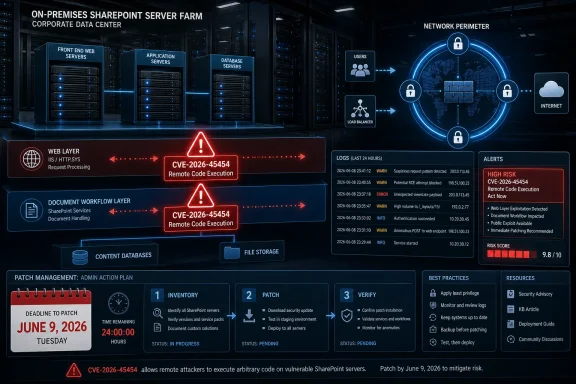 Microsoft’s Quiet Signal Is Louder Than the CVE Name
A SharePoint remote code execution bug does not need a theatrical disclosure to matter. In Microsoft’s ecosystem, an MSRC advisory is itself a form of escalation: the vendor is acknowledging that a defect exists, has been assigned a CVE, and is actionable enough to appear in the Security Update Guide. That moves the issue beyond rumor, proof-of-concept chatter, or third-party speculation.The metric described in the prompt is essentially about report confidence. It asks how sure defenders should be that the vulnerability is real and how much usable information is available to attackers. That distinction matters because security teams triage not only by theoretical severity but by certainty. A vague “possible issue” can wait behind verified exploit paths; a vendor-confirmed RCE in SharePoint generally cannot.
This is where Microsoft’s advisory format does some understated work. Even when MSRC withholds exploit details, a confirmed CVE title, impact category, affected product family, and update entry tell administrators that the flaw has crossed the threshold from suspected weakness to managed vulnerability. In practical terms, the organization no longer gets to treat the problem as speculative.
The absence of deep public technical detail should not be mistaken for safety. In the modern vulnerability economy, attackers often need less information than defenders wish they did. Patch diffing, endpoint exposure, historical SharePoint bug classes, and public hardening guidance can shrink the gap between advisory and exploit attempt.
SharePoint Is Still the Server Attack Surface Microsoft Cannot Wish Away
SharePoint occupies an awkward place in the Microsoft stack. Cloud-first messaging has pushed many organizations toward SharePoint Online, OneDrive, and Microsoft 365 governance, but on-premises SharePoint Server remains embedded in enterprises with regulatory constraints, custom workflows, intranet dependencies, air-gapped segments, and years of accumulated business logic.That installed base is exactly why RCE bugs in SharePoint draw attention. A vulnerable SharePoint server is not just another web application. It is often domain-integrated, permission-rich, document-heavy, and trusted by internal users who treat it as a central nervous system for business content.
Remote code execution against that kind of platform can have cascading consequences. Depending on the bug class and server configuration, successful exploitation may give an attacker a foothold on the SharePoint server itself, access to sensitive content, or a platform for credential theft and lateral movement. Even when exploitation is constrained, SharePoint’s position inside the enterprise makes it a valuable pivot point.
Microsoft has learned this lesson repeatedly. Recent years have shown that SharePoint flaws move quickly from advisory pages to emergency boardroom conversations when exposed servers are left unpatched. The product’s power is also its liability: extensibility, authentication complexity, and deep integration create a broad surface for subtle mistakes.
Report Confidence Changes the Triage Conversation
The user-supplied metric is easy to overlook because it sounds bureaucratic. It is not. It is a compressed way of asking whether defenders are dealing with a ghost story, a plausible weakness, a researcher-confirmed bug, or a vendor-confirmed vulnerability with enough detail to guide exploitation.For CVE-2026-45454, the Microsoft advisory context points toward the strongest end of that spectrum: the affected vendor has acknowledged the issue. That does not automatically mean exploit code is public, exploitation is active, or every SharePoint deployment is vulnerable. It does mean the existence of the flaw is no longer meaningfully in doubt.
That should alter prioritization. Security teams often waste time debating whether a vulnerability is “real” when a vendor-confirmed advisory has already answered the more important question. The better debate is about exposure, applicability, compensating controls, and how quickly the relevant SharePoint servers can be updated without breaking dependent workflows.
This is especially true for remote code execution issues. RCE is the category that collapses the distance between vulnerability management and incident response. If exploitation becomes reliable, defenders are no longer merely patching software; they are racing the possibility that untrusted input can become attacker-controlled execution.
The Technical Details Defenders Do Not Have Still Matter
Microsoft’s public advisories commonly avoid publishing exploit recipes. That restraint is sensible, but it creates an information imbalance. Administrators know enough to worry, not always enough to model the exact exploit path.That uncertainty is where report confidence becomes useful. If the vulnerability is confirmed but implementation details are sparse, defenders should assume attackers will work to fill in the missing pieces. The lack of public exploit detail is a temporary condition, not a control.
SharePoint is particularly vulnerable to patch-diff analysis because updates can reveal where Microsoft changed validation, serialization handling, request processing, authentication checks, or server-side logic. Attackers do not need Microsoft to publish a walkthrough if they can compare binaries, inspect changed components, and map the fix backward into a trigger.
Defenders should therefore avoid a comforting but false distinction between “known vulnerability” and “known exploit.” The window between the two has narrowed across enterprise software. For internet-facing collaboration servers, that window can be measured in days or hours once enough technical breadcrumbs exist.
Cloud Migration Reduced the Blast Radius, Not the Obligation
Microsoft 365 has changed the SharePoint risk picture, but it has not eliminated the on-premises problem. Organizations that have moved fully into SharePoint Online shift much of the patching burden to Microsoft. Organizations that keep SharePoint Server must still operate it like a high-risk application platform.The hybrid middle is messier. Many enterprises have some sites in the cloud, some legacy farms on-premises, and identity bridges between them. In that environment, the question “Do we still run SharePoint Server?” can produce several wrong answers before inventory catches up with reality.
That is why CVE-2026-45454 should trigger an asset-management exercise, not just a patch ticket. Security teams need to know which SharePoint versions exist, where they are exposed, which farms are supported, which service accounts they use, and whether old test environments are still reachable. The most dangerous SharePoint server is often the one everyone thought had been decommissioned.
Microsoft’s broader strategy gives customers every incentive to modernize, but enterprise reality moves slowly. Until the last on-premises farm is gone, SharePoint Server remains part of the Windows security perimeter. Treating it as legacy does not make it harmless; it may make it less watched.
Patch Tuesday Turns Risk Into Operations
The hardest part of SharePoint security is rarely recognizing that a patch matters. It is applying the patch in an environment where downtime is political, customizations are brittle, and business owners remember the last upgrade that broke a workflow from 2014.That operational friction is exactly what attackers count on. SharePoint farms can be complicated to update correctly, especially when administrators must sequence patches across multiple servers, validate databases, test custom web parts, and maintain user access. The result is a familiar enterprise pattern: everyone agrees the vulnerability is serious, and then remediation slips into a change window two weeks away.
For CVE-2026-45454, that is the wrong instinct. Vendor-confirmed RCE in a collaboration server should be treated as an accelerated change-management event. Not every organization can patch instantly, but every organization should be able to explain its exposure, its planned remediation date, and its interim controls.
Those interim controls are not a substitute for updating. Restricting access, tightening firewall rules, validating endpoint detection coverage, reviewing SharePoint logs, and ensuring antimalware integration can reduce risk while patches are tested. But they are bridges, not destinations.
The Real Threat Is the Farm You Forgot
The SharePoint deployments most likely to cause trouble are not always the flagship corporate portals. They are the old project servers, departmental document repositories, acquisition leftovers, extranet farms, and “temporary” collaboration platforms that became permanent through neglect.These systems often sit in a dangerous middle ground. They are important enough that someone would complain if they disappeared, but not important enough to receive first-class maintenance. They may run older SharePoint builds, have unusual authentication arrangements, or expose services to partners and contractors.
A confirmed RCE should force organizations to look beyond the neat diagram in the architecture repository. Vulnerability scanners, DNS records, certificate inventories, load balancer configurations, and firewall rules may tell a more honest story than the CMDB. If SharePoint is reachable from the internet, it belongs at the top of the queue.
The same applies internally. “Internal only” is not a magic phrase. Once an attacker has a foothold through phishing, VPN compromise, exposed RDP, or a vulnerable edge device, internal SharePoint servers become attractive targets for privilege expansion and data access.
The Defender’s Job Is to Convert Certainty Into Speed
The most useful way to read CVE-2026-45454 is not as a standalone trivia item. It is a test of whether an organization can translate vendor-confirmed risk into coordinated action. That means inventory, applicability checks, patch deployment, validation, and monitoring must happen as a single motion rather than five disconnected tickets.The report-confidence metric is the hinge. If the vulnerability were speculative, slower analysis might be defensible. If the vendor has confirmed it, the default posture should shift toward action unless there is clear evidence the environment is unaffected.
This is also where security and operations teams need a shared language. Security teams often say “critical” and mean “now.” Operations teams hear “critical” every month and ask which production system must be risked first. A confirmed SharePoint RCE gives both sides a more concrete basis for prioritization: exposed collaboration infrastructure with potential code execution impact is not routine background noise.
The best-run organizations will already have a SharePoint emergency path. They will know who owns the farm, who approves downtime, how patches are staged, where backups live, and what telemetry should be reviewed after update installation. Everyone else will discover those dependencies under pressure.
The SharePoint Lesson Microsoft Keeps Teaching
There is a broader story here than one CVE. Microsoft’s on-premises server products remain magnets for high-impact vulnerabilities because they combine complexity, legacy support, and privileged enterprise roles. Exchange has carried that burden. SharePoint carries it too.The uncomfortable truth is that defenders cannot rely on obscurity, low public detail, or the hope that attackers are busy elsewhere. A vendor-confirmed server-side RCE in a widely deployed Microsoft product is enough to draw attention. Even if CVE-2026-45454 never becomes the headline vulnerability of the month, it belongs in the same mental bucket as other enterprise-server flaws that punish slow patching.
Microsoft also has to keep walking a narrow line. It must publish enough information for defenders to act while avoiding unnecessary exploit enablement. That leaves customers responsible for reading between the lines without inventing facts the advisory does not state.
For WindowsForum readers, the practical interpretation is straightforward: do not wait for drama. A SharePoint RCE becomes most dangerous when organizations treat it as ordinary just because the advisory is terse.
The Patch Queue Has a SharePoint-Shaped Warning Label
The concrete response to CVE-2026-45454 should be disciplined rather than theatrical. The goal is not panic; it is compression of the time between confirmation and remediation.- Organizations should identify every supported and unsupported SharePoint Server deployment before assuming the vulnerability does or does not apply.
- Administrators should prioritize internet-facing and partner-facing SharePoint farms ahead of isolated systems with stronger compensating controls.
- Change owners should treat a vendor-confirmed SharePoint RCE as an accelerated maintenance event, not a routine monthly backlog item.
- Security teams should monitor SharePoint logs, endpoint alerts, web server activity, and authentication anomalies before and after patching.
- Legacy farms that cannot be patched promptly should be isolated, access-restricted, and placed on an explicit retirement or remediation plan.
- SharePoint Online customers should still verify that no forgotten on-premises SharePoint Server systems remain in hybrid, test, or departmental use.
References
- Primary source: MSRC
Published: 2026-06-09T07:00:00-07:00
Security Update Guide - Microsoft Security Response Center
 msrc.microsoft.com
- Related coverage: techradar.com
Microsoft releases urgent SharePoint security flaw patches - here's what you need to know, and how to update | TechRadar
Patches for a critical severity SharePoint bug are now availablewww.techradar.com - Related coverage: tomshardware.com
Microsoft says China-based hackers exploiting critical SharePoint vulnerabilities to deploy Warlock ransomware — three China-affiliated threat actors seen taking advantage | Tom's Hardware
The company has attributed these attacks to a group it calls Storm-2603.www.tomshardware.com - Related coverage: windowscentral.com
Microsoft issues emergency SharePoint patches for ToolShell | Windows Central
Microsoft has issued emergency patches for two zero-day vulnerabilities.www.windowscentral.com - Related coverage: sra.io
- Related coverage: pcgamer.com
Microsoft confirms SharePoint vulnerabilities have been exploited by suspected Chinese hackers, as reports indicate the US Nuclear Security Administration may have been among those compromised | PC Gamer
'Investigations into other actors also using these exploits are still ongoing.'www.pcgamer.com
- Related coverage: thecssc.com
NCSC Alert CVE-2019-0604 Microsoft SharePoint remote code vulnerability
Microsoft SharePoint remote code vulnerabilitywww.thecssc.com
- Related coverage: itpro.com
NCSC says ‘limited number’ of UK firms affected by SharePoint attack as global impact spreads | IT Pro
The SharePoint flaw has already had a wide impact according to reports from government security agencieswww.itpro.com - Official source: microsoft.com
MSRC - Microsoft Security Response Center
The Microsoft Security Response Center is part of the defender community and on the front line of security response evolution. For over twenty years, we have been engaged with security researchers working to protect customers and the broader ecosystem.www.microsoft.com
- Official source: learn.microsoft.com
Security Advisories and Bulletins | Microsoft Learn
learn.microsoft.com - Related coverage: hkcert.org
Microsoft Defender Multiple Vulnerabilities
Multiple vulnerabilities were identified in Microsoft Defender. Attacker could exploit some of these vulnerabilities to trigger remote code execution, denial of service condition and elevation of privilege on the targeted system. Note: CVE-2026-45498www.hkcert.org - Related coverage: datacomm.com
- Related coverage: stackoverflow.com
security - Python Error while Scraping Microsoft CVE Webpage - Stack Overflow
So, I read the question below. The answer provides some codes for further testing.
How can I scrape through the Microsoft CVE Webpage that assigns its content dynamically (preferably using Python)?...stackoverflow.com
