

SharePoint Spoofing Is Rarely Just Cosmetic
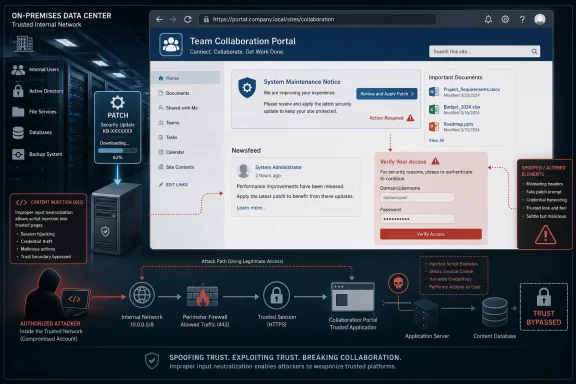
The word spoofing has always done too much work in Microsoft advisories. It can mean a misleading interface, a forged identity signal, a manipulated link, a cross-site scripting path, or a trust boundary bent just far enough that a user or system accepts the wrong thing as genuine. In CVE-2026-48562, the public description points to improper neutralization of input during web page generation, which places the bug in the broad family of cross-site scripting and content-injection issues.
That matters because SharePoint is not a random website. It is where organizations put project documents, HR workflows, policy portals, contract drafts, engineering notes, and internal announcements that users are trained to trust. A spoofing flaw in that environment can become more than a visual trick; it can become a way to make malicious content look like it belongs inside the company’s sanctioned collaboration layer.
Microsoft’s public phrasing says an authorized attacker can perform spoofing over a network. The “authorized” qualifier lowers the theoretical blast radius compared with a fully unauthenticated remote-code-execution bug, but it should not lull administrators into treating this as harmless. In enterprise environments, “authorized” often includes compromised low-privilege users, stale vendor accounts, overbroad guest access, and internal accounts phished months ago but never fully investigated.
The practical risk, then, is not that CVE-2026-48562 lets every stranger on the Internet instantly own a SharePoint farm. It is that SharePoint’s value comes from trust, and spoofing flaws attack trust at precisely the layer where users are most likely to click, approve, upload, or authenticate.
The Confidence Metric Is Doing Quietly Important Work
The user-supplied CVSS language about confidence in the existence of a vulnerability is more than scoring trivia. It describes a central problem in vulnerability management: defenders rarely receive perfect information at disclosure time. Sometimes a CVE arrives with a precise root cause, proof-of-concept exploit, affected builds, exploitability notes, and remediation guidance; other times it arrives as a title, a severity score, and a promise that the patch is the answer.
CVE-2026-48562 appears to sit closer to the confirmed-vendor-advisory end of that spectrum than the rumor mill. Microsoft has published the CVE in its Security Update Guide, attached it to SharePoint Server, and described both the weakness class and the security impact. That does not mean defenders know every implementation detail. It does mean the vulnerability’s existence is not speculative.
This is where the confidence metric changes the urgency calculus. A confirmed vulnerability with modest public detail can be more operationally important than a dramatic but unverified research claim. Attackers do not need Microsoft to publish a tutorial if patch diffing, affected component analysis, and prior SharePoint exploitation patterns can point them toward the interesting code paths.
The defensive mistake is to treat lack of technical detail as lack of danger. In modern vulnerability handling, thin advisories are often a temporary information asymmetry, not a protective fog. Vendors minimize exploit guidance for good reasons, but attackers are not limited to the prose in the advisory.
Microsoft’s Sparse Advisory Style Creates a Race
Microsoft’s Security Update Guide is built for structured disclosure, not narrative clarity. It gives administrators enough information to identify the product, classify the impact, locate the update, and prioritize remediation. It rarely gives defenders the full story of how a bug behaves in the messy reality of customized farms, third-party web parts, legacy authentication, and decades of SharePoint sprawl.
That sparseness creates a race between patch teams and exploit developers. Once a patch lands, researchers and attackers can compare binaries, inspect changed files, and infer where the defect lived. For a web-facing platform, the interval between “public CVE” and “useful exploit hypothesis” can be short, especially when the bug class is as familiar as input neutralization during page generation.
SharePoint has made this worse for years because its patching model is not as frictionless as cloud-first administrators would like. On-premises SharePoint updates can involve farm planning, schema considerations, service restarts, compatibility testing, and user-facing downtime. The result is an uncomfortable window in which the advisory is public, the fix exists, and the exposed estate is still catching up.
Microsoft 365 customers do not have the same operational burden for SharePoint Online, because Microsoft operates and updates the service. The risk described here is about SharePoint Server: the on-premises product that many organizations still keep because of customizations, regulatory constraints, data residency assumptions, or simple institutional inertia.
The Word “Authorized” Should Not Be Overread
Security teams often triage vulnerabilities by attacker position. Unauthenticated network bugs go to the top. Local privilege escalation waits for the workstation team. Authorized-user bugs fall into a gray middle category where everyone agrees they matter, but nobody wants to be the one to break a production farm during business hours.
That approach is understandable, but SharePoint punishes lazy threat modeling. If an attacker needs only a low-privilege account to stage convincing spoofed content, the vulnerability can pair neatly with phishing, token theft, password reuse, or contractor account compromise. Many real intrusions begin not with a glamorous zero-click exploit, but with an ordinary login that should have been less trusted than it was.
The word “authorized” also says nothing about how broadly organizations have granted SharePoint access. Some intranets allow all employees to read large portions of the site hierarchy. Some project spaces retain ex-employees in nested groups longer than anyone realizes. Some external collaboration setups accumulate guests because removing them is politically harder than adding them.
A vulnerability limited to authorized attackers can still be attractive when authorization is cheap. In that sense, CVE-2026-48562 belongs in the same mental bucket as many identity-adjacent enterprise flaws: it may not open the front door, but it can make the hallway signs lie once someone is inside.
Cross-Site Scripting Remains an Enterprise Problem, Not a Web 1.0 Relic
Improper neutralization of input during web page generation is the kind of phrase that makes veterans think of cross-site scripting, and cross-site scripting is the kind of bug class that many organizations wrongly consider solved. Modern frameworks reduced the easy cases, browser controls raised the floor, and security training made reflected script pop-ups seem almost quaint. But enterprise software is not a greenfield React demo.
SharePoint is a platform, a document system, a workflow host, a permissions maze, and a historical archive of customization decisions. It has pages, lists, templates, forms, web parts, search results, metadata views, and integration surfaces that can render user-influenced content in surprising ways. That is exactly the sort of environment where output encoding mistakes and trust-context confusion can survive longer than they should.
The danger in a SharePoint spoofing vulnerability is not limited to stealing cookies in the old textbook sense. Depending on where spoofed content appears and what privileges the victim has, attackers may be able to misdirect users, imitate trusted pages, influence workflow decisions, or create convincing lures inside a domain that security awareness programs have trained employees to trust.
This is why dismissing XSS-flavored vulnerabilities as “just spoofing” is bad security economics. The flaw may not be the final payload. It may be the delivery mechanism, the credibility layer, or the pivot that turns a compromised account into a broader campaign.
Patch Tuesday Has Become a Trust-Triage Exercise
For administrators, the hard part of Patch Tuesday is no longer knowing that patches exist. It is deciding which systems get emergency maintenance, which updates can ride the normal change window, and which advisories require compensating controls before the patch can be applied. CVE-2026-48562 lands in a category that deserves more attention than its label might first suggest.
The priority should be highest where SharePoint Server is Internet-facing, exposed to partner networks, used for external collaboration, or accessible through broad VPN and remote-access paths. A spoofing flaw in a lightly used internal archive is not the same operational risk as the same flaw in a heavily used portal for finance approvals or customer document exchange. Context is the difference between routine and urgent.
Administrators should also look at whether the affected SharePoint deployment has custom pages, legacy branding, unusual web parts, or old integrations that already stretch the platform’s rendering model. Microsoft’s patch fixes the product vulnerability, but local complexity can make testing slower and exploitation more persuasive. Attackers benefit when users cannot easily distinguish a legitimate customized SharePoint page from a maliciously altered one.
This is also a case where security teams should resist the false comfort of perimeter controls. Web application firewalls, conditional access, VPN segmentation, and endpoint detection can all help, but none of them reliably erase a server-side rendering flaw in a trusted collaboration platform. The patch remains the center of gravity.
SharePoint’s Recent History Makes Every New CVE Louder
SharePoint has not enjoyed a quiet security reputation in recent years. On-premises deployments have repeatedly drawn attention because they combine high-value data, complex server-side behavior, and patching friction. When SharePoint bugs are chained, the result can move from nuisance to incident with alarming speed.
That history changes how defenders read CVE-2026-48562. A single spoofing vulnerability is not the same thing as a critical unauthenticated remote-code-execution chain. But in a product with a record of meaningful server-side vulnerabilities, any weakness that affects trust, rendering, or identity presentation deserves disciplined handling.
The most serious SharePoint incidents have also shown that patching is sometimes only one part of remediation. In cases involving exploitation, organizations may need to look for persistence, stolen secrets, web shells, altered configuration, or abused machine keys. CVE-2026-48562 is not publicly described as that kind of compromise path, but the broader lesson remains: once SharePoint is in the blast radius, defenders should think beyond the installer.
That does not mean every SharePoint CVE should trigger panic. It means organizations should have a SharePoint-specific playbook instead of improvising each time Microsoft publishes another advisory. Inventory, exposure mapping, patch testing, backup validation, logging review, and owner identification should already be boring.
The Real Risk Is the Gap Between Ownership and Operation
One reason SharePoint vulnerabilities linger is that ownership is often blurry. Infrastructure teams maintain the servers, collaboration teams own the user experience, security teams monitor the alerts, business units own the content, and nobody wants to be accountable for downtime. This is the organizational design flaw that attackers exploit before they exploit code.
CVE-2026-48562 should force a simple inventory question: who can say, today, which SharePoint Server farms exist, which versions they run, which cumulative updates are installed, and which ones are reachable from outside the corporate network? If the answer requires a meeting series, the vulnerability has already found its first weakness. The attacker’s advantage is not always technical sophistication; sometimes it is just faster asset discovery.
The second question is whether SharePoint logs are actually useful. If a spoofing or XSS-style flaw is abused, defenders may need to reconstruct page access, suspicious requests, anomalous list activity, newly modified pages, or unexpected content changes. Logging that exists only in theory will not help during a real investigation.
The third question is whether users have a reliable path to report suspicious SharePoint behavior. Security awareness programs focus heavily on email, but internal portals can be equally persuasive. If a trusted SharePoint page suddenly asks users to reauthenticate, download a tool, approve a workflow, or open a document with macros, that should generate a report, not a shrug.
Cloud Migration Did Not Kill the On-Premises Problem
It is tempting to view SharePoint Server vulnerabilities as a shrinking legacy concern. Microsoft has spent years pushing customers toward Microsoft 365, where SharePoint Online receives platform-level security updates without customer-operated farm maintenance. For many organizations, that move reduces the operational burden dramatically.
But on-premises SharePoint persists for reasons that are not always irrational. Some deployments support custom workflows that were never rebuilt for the cloud. Some hold sensitive data under compliance regimes that administrators interpret conservatively. Some are tied to intranet applications that grew into business-critical systems without ever being designed as products.
This hybrid reality means Microsoft’s cloud security improvements do not automatically protect the whole SharePoint ecosystem. A company can run modern endpoint management, cloud identity, Defender telemetry, and Microsoft 365 while still keeping a forgotten SharePoint Server farm alive for one department’s ancient approval process. Attackers do not care that the architecture diagram calls it temporary.
CVE-2026-48562 is therefore another reminder that cloud migration is not a security control until the old system is actually retired. A patched cloud tenant sitting beside an unpatched on-premises collaboration server is not a completed modernization strategy. It is a split estate with split risk.
Defenders Need to Treat the Advisory as a Starting Gun
The correct response begins with the boring work. Identify affected SharePoint Server instances, confirm whether the relevant security update applies, test it against representative farms, and deploy it as quickly as business risk allows. Where SharePoint is exposed beyond a tightly controlled internal network, the tolerance for delay should be low.
Security teams should also review recent SharePoint activity for signs that would make spoofing or content injection more concerning. Newly created pages, unusual script-like content, unexpected edits by low-privilege users, anomalous access patterns, and reports of strange prompts inside SharePoint deserve attention. The public advisory may not confirm active exploitation, but absence of confirmation is not evidence of absence.
Administrators should revisit permissions while they are already touching the platform. If a vulnerability requires authorization, reducing unnecessary authorization is a practical mitigation. Removing stale users, tightening external sharing, auditing site collection administrators, and pruning broad contributor rights can reduce the number of accounts that could exploit or amplify the bug.
Finally, this is a useful moment to test incident response assumptions. If SharePoint is central enough to justify keeping on-premises, it is central enough to have a recovery and investigation plan. Backups, farm documentation, service account inventories, certificate and key handling, and update rollback procedures should not be reconstructed under pressure.
The Concrete Moves This SharePoint CVE Demands
CVE-2026-48562 is not a vulnerability that rewards theatrical panic, but it does reward disciplined urgency. Its most important lesson is that confirmed flaws in trusted collaboration systems should be handled according to business context, not advisory vocabulary alone.
- Organizations running on-premises SharePoint Server should verify exposure and patch status immediately rather than assuming cloud-managed SharePoint guidance applies to them.
- Administrators should treat “authorized attacker” as a meaningful constraint, not a guarantee of safety, because compromised low-privilege accounts are common in real intrusions.
- Security teams should review SharePoint permissions, stale accounts, guest access, and broad contributor rights as part of the remediation effort.
- Defenders should monitor for unusual page edits, suspicious rendered content, unexpected prompts, and abnormal access patterns around the disclosure window.
- Teams that cannot patch quickly should reduce network exposure and tighten access while they complete testing, but compensating controls should not become a substitute for the update.
- SharePoint owners should use this CVE as a trigger to confirm that farm inventory, logging, backups, and incident response procedures are current.
CVE-2026-48562 will probably not be remembered as the loudest Microsoft vulnerability of 2026, and that is precisely why it is useful. The industry has learned to sprint for critical remote-code-execution bugs, but enterprise security is often lost in the quieter flaws that bend trust, exploit messy ownership, and wait for patch friction to do the attacker’s work. For Windows administrators, the forward path is clear: make SharePoint boring again by knowing where it runs, narrowing who can influence it, and patching it before a sparse advisory becomes a detailed exploit chain.