

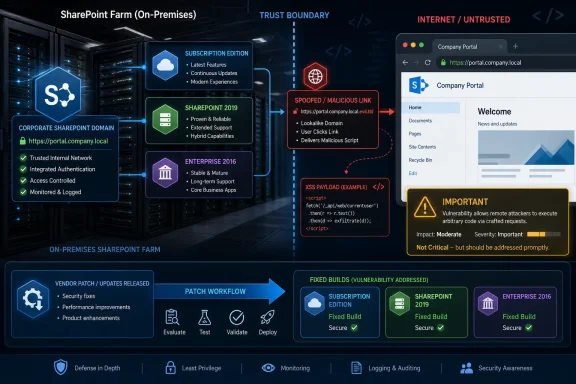
Microsoft disclosed CVE-2026-45468 on June 9, 2026, as an Important-rated Microsoft SharePoint Server spoofing vulnerability caused by cross-site scripting, affecting SharePoint Server Subscription Edition, SharePoint Server 2019, and SharePoint Enterprise Server 2016, with security updates available for all three supported server lines. The advisory is not a five-alarm SharePoint fire in the style of recent remote-code-execution scares, but it is still the kind of bug that earns attention in real enterprise environments. It sits in the awkward middle of modern vulnerability management: confirmed, patchable, remotely reachable, and user-assisted. That combination makes it less dramatic than a wormable server bug, but far more operationally relevant than its modest CVSS score might suggest.
CVE-2026-45468 lands with a CVSS 3.1 base score of 4.6 and a temporal score of 4.0, numbers that will not automatically vault it above every emergency change window. Microsoft rates the issue Important rather than Critical, and its exploitability assessment at publication says exploitation is less likely. In isolation, that sounds like a deferrable patch.
But SharePoint vulnerabilities rarely exist in isolation. SharePoint farms sit at the intersection of identity, document workflows, intranet publishing, records retention, legacy customization, and line-of-business integration. A spoofing flaw that requires a signed-in attacker and a convinced user may not be a perimeter catastrophe, but it can still become a foothold for phishing, session abuse, or trust erosion inside a tenant’s most document-heavy collaboration environment.
The flaw is described as improper neutralization of input during web page generation, the familiar family of cross-site scripting. In practical terms, Microsoft says an authorized attacker would need to send a malicious link and persuade a user to open it. Successful exploitation could allow the attacker to view some sensitive information and make limited changes to disclosed information, without affecting availability.
That last clause matters. This is not a denial-of-service bug, and it is not framed as unauthenticated remote code execution. It is a vulnerability in the trust boundary between SharePoint’s web rendering surface and the user who believes the page in front of them belongs to a safe corporate system.
That is why CVE-2026-45468 deserves more than a glance. The attack does not begin with a random anonymous packet hitting an exposed endpoint. It begins with an attacker who already has some level of access and can use SharePoint’s legitimacy as part of the lure.
The user-interaction requirement is equally easy to misread. “The user must click a malicious link” sounds like a training problem until one remembers that SharePoint is a link-driven product. Users are conditioned to open document links, workflow links, list links, approval links, and shared-site links all day. A malicious link that appears to route through a trusted SharePoint host is more believable than the average credential-theft email from an unknown domain.
That is the uncomfortable lesson of spoofing and XSS bugs in collaboration platforms. The vulnerability does not need to destroy the server to matter. It only needs to borrow the server’s reputation long enough to mislead a user.
The restraint is useful, but it is not the whole story. Low confidentiality impact may still mean exposure of sensitive data in a particular context, and SharePoint is a context machine. A seemingly minor leak from an HR workspace, legal matter site, M&A planning area, or engineering document library can carry more business consequence than the same technical impact in a generic web app.
Low integrity impact follows the same pattern. A limited modification of disclosed information is not the same thing as administrative control, but SharePoint often acts as a source of truth. If a user is tricked into trusting altered information in a list, page, file preview, or workflow-adjacent experience, the technical severity remains modest while the business effect depends on who sees it and what they do next.
This is why the CVSS score should inform prioritization rather than replace it. For a small lab farm with minimal external access and few users, the update can sit in the normal monthly rhythm. For an internet-reachable on-premises SharePoint deployment supporting sensitive workflows, “Important” should still mean “schedule deliberately and soon.”
That does not mean exploit code is public. Microsoft’s advisory says the vulnerability was not publicly disclosed and was not exploited at the time of publication. It also lists exploit code maturity as Unproven, meaning there was no known public exploit or the exploit was theoretical when the advisory shipped.
The distinction is important. “Confirmed” raises confidence that defenders are not chasing a phantom. “Unproven” lowers the immediate expectation of copy-and-paste exploitation. Together, they describe a vulnerability that is real but not yet broadly weaponized.
That is the sweet spot for competent patch management. The best time to fix a server-side web vulnerability is after the vendor has shipped tested updates and before adversaries have folded the details into phishing kits, scanners, or internal tradecraft. CVE-2026-45468 appears to be precisely that kind of window.
That sounds tidy until it meets a real SharePoint farm. Updating SharePoint is not like updating a disposable desktop app. Farms require sequencing, health checks, database upgrade awareness, search and service application validation, custom solution compatibility checks, and often a maintenance window negotiated with departments that insist their document libraries are mission-critical at all hours.
The 2016 line deserves particular attention because Microsoft’s advisory explicitly says the same KB applies to both SharePoint Server 2016 and SharePoint Enterprise Server 2016 for this vulnerability. That is a small clarification with practical value. Administrators running 2016 should not assume the Enterprise naming excludes them from the relevant security update.
The broader operational point is familiar: on-premises SharePoint patching remains a discipline, not a button. Organizations that still run SharePoint Server because of compliance, customization, latency, sovereignty, or legacy workflow requirements need a repeatable security update process. If each SharePoint CVE triggers a fresh internal debate about ownership and downtime, the farm is already riskier than the advisory score suggests.
That distinction matters for WindowsForum readers because many hybrid environments still straddle both models. A company may use SharePoint Online for broad collaboration while retaining on-premises SharePoint for regulated archives, custom workflows, legacy portals, or business units that never fully migrated. The presence of Microsoft 365 does not imply the absence of exposed SharePoint Server infrastructure.
The risk, then, is not merely technical debt. It is inventory ambiguity. Security teams may believe SharePoint has moved to the cloud while a server farm continues to exist for one application, one department, or one integration nobody wants to break. Those are the servers most likely to miss timely patch cycles.
CVE-2026-45468 should prompt a simple but uncomfortable check: do you know every SharePoint Server farm still running in your environment, and can you prove its patch level? If the answer requires a meeting rather than a query, the vulnerability has already done something useful by revealing a governance gap.
The link-click requirement does, however, shape defensive priorities. Mail filtering, safe-link rewriting, browser isolation, conditional access, and endpoint detection can all contribute friction. So can SharePoint governance that limits who can create content, share links, or place HTML-like payloads into areas where vulnerable rendering paths might be exercised.
The attacker’s need for low privileges also makes identity hygiene more relevant. Dormant accounts, overbroad guest access, and weakly monitored contractor identities are not just identity problems; they are potential staging points for authenticated application-layer attacks. A spoofing bug becomes easier to exploit when the attacker can blend into the population of ordinary users.
Administrators should also treat incident telemetry with the right level of suspicion. Since the advisory says exploitation was not known at release, there may be no obvious public indicators to hunt for. But organizations can still review unusual SharePoint link patterns, suspicious site-page activity, unexpected content edits, anomalous access from low-privilege accounts, and user reports of odd SharePoint-rendered pages.
CVE-2026-45468 sits inside that trust model. The spoofing label is not merely a taxonomy bucket; it points to an attack where the user’s perception of what they are seeing can be manipulated. Cross-site scripting flaws are especially dangerous in this regard because they can make malicious content appear to belong to the application itself.
This is why collaboration platforms are such attractive targets. They contain data, they broker access, they generate notifications, and they normalize link clicking. A successful attacker does not have to invent trust from scratch; the platform manufactures it every day as part of normal business.
Microsoft’s own advisory language keeps the impact bounded, and that is appropriate. But defenders should recognize the broader pattern. In a well-defended enterprise, attackers often move from pure exploitation to exploitation-assisted social engineering. Bugs like CVE-2026-45468 are useful because they make the social engineering more convincing.
Administrators should start with build verification. If the farm is Subscription Edition, the target fixed build is 16.0.19725.20384. If it is SharePoint Server 2019, the target is 16.0.10417.20153. If it is SharePoint Enterprise Server 2016, the target is 16.0.5556.1005.
Then comes the ordinary but essential SharePoint work: back up, test, patch, run the configuration wizard where required, validate services, and confirm farm health afterward. Organizations with custom web parts, third-party solutions, or heavily customized publishing portals should test rendering paths that users actually rely on, not just the central administration page.
The policy decision is equally important. A confirmed vulnerability with an official fix and no known exploitation is the scenario where disciplined maintenance can beat emergency response. If the update is delayed, that delay should be explicit, documented, and tied to compensating controls rather than hidden behind vague patch fatigue.
 Microsoft’s “Important” Label Should Not Lull SharePoint Administrators
CVE-2026-45468 lands with a CVSS 3.1 base score of 4.6 and a temporal score of 4.0, numbers that will not automatically vault it above every emergency change window. Microsoft rates the issue Important rather than Critical, and its exploitability assessment at publication says exploitation is less likely. In isolation, that sounds like a deferrable patch.But SharePoint vulnerabilities rarely exist in isolation. SharePoint farms sit at the intersection of identity, document workflows, intranet publishing, records retention, legacy customization, and line-of-business integration. A spoofing flaw that requires a signed-in attacker and a convinced user may not be a perimeter catastrophe, but it can still become a foothold for phishing, session abuse, or trust erosion inside a tenant’s most document-heavy collaboration environment.
The flaw is described as improper neutralization of input during web page generation, the familiar family of cross-site scripting. In practical terms, Microsoft says an authorized attacker would need to send a malicious link and persuade a user to open it. Successful exploitation could allow the attacker to view some sensitive information and make limited changes to disclosed information, without affecting availability.
That last clause matters. This is not a denial-of-service bug, and it is not framed as unauthenticated remote code execution. It is a vulnerability in the trust boundary between SharePoint’s web rendering surface and the user who believes the page in front of them belongs to a safe corporate system.
The Real Risk Lives in the Gap Between “Authenticated” and “Trusted”
Security advisories often use “privileges required: low” as though it were reassuring. In a SharePoint environment, low privilege may describe a very large population. Contractors, vendors, temporary staff, test accounts, and stale internal users can all sit inside the basic access tier that makes a user “authorized” without making that user trustworthy.That is why CVE-2026-45468 deserves more than a glance. The attack does not begin with a random anonymous packet hitting an exposed endpoint. It begins with an attacker who already has some level of access and can use SharePoint’s legitimacy as part of the lure.
The user-interaction requirement is equally easy to misread. “The user must click a malicious link” sounds like a training problem until one remembers that SharePoint is a link-driven product. Users are conditioned to open document links, workflow links, list links, approval links, and shared-site links all day. A malicious link that appears to route through a trusted SharePoint host is more believable than the average credential-theft email from an unknown domain.
That is the uncomfortable lesson of spoofing and XSS bugs in collaboration platforms. The vulnerability does not need to destroy the server to matter. It only needs to borrow the server’s reputation long enough to mislead a user.
CVSS Says “Low Impact,” but SharePoint Gives Low Impact Room to Travel
Microsoft’s CVSS vector for CVE-2026-45468 is specific: network attack vector, low attack complexity, low privileges required, user interaction required, unchanged scope, low confidentiality impact, low integrity impact, and no availability impact. That is a restrained profile. It tells defenders not to confuse the issue with a full server compromise.The restraint is useful, but it is not the whole story. Low confidentiality impact may still mean exposure of sensitive data in a particular context, and SharePoint is a context machine. A seemingly minor leak from an HR workspace, legal matter site, M&A planning area, or engineering document library can carry more business consequence than the same technical impact in a generic web app.
Low integrity impact follows the same pattern. A limited modification of disclosed information is not the same thing as administrative control, but SharePoint often acts as a source of truth. If a user is tricked into trusting altered information in a list, page, file preview, or workflow-adjacent experience, the technical severity remains modest while the business effect depends on who sees it and what they do next.
This is why the CVSS score should inform prioritization rather than replace it. For a small lab farm with minimal external access and few users, the update can sit in the normal monthly rhythm. For an internet-reachable on-premises SharePoint deployment supporting sensitive workflows, “Important” should still mean “schedule deliberately and soon.”
The Advisory’s Confidence Metric Is the Quiet Signal
The user-supplied MSRC text focuses on report confidence, and that is the right place to look. Microsoft marks the report confidence for CVE-2026-45468 as Confirmed. In CVSS terms, that means the vendor or author has confirmed the vulnerability’s existence, or enough detailed information exists to reproduce or verify the issue.That does not mean exploit code is public. Microsoft’s advisory says the vulnerability was not publicly disclosed and was not exploited at the time of publication. It also lists exploit code maturity as Unproven, meaning there was no known public exploit or the exploit was theoretical when the advisory shipped.
The distinction is important. “Confirmed” raises confidence that defenders are not chasing a phantom. “Unproven” lowers the immediate expectation of copy-and-paste exploitation. Together, they describe a vulnerability that is real but not yet broadly weaponized.
That is the sweet spot for competent patch management. The best time to fix a server-side web vulnerability is after the vendor has shipped tested updates and before adversaries have folded the details into phishing kits, scanners, or internal tradecraft. CVE-2026-45468 appears to be precisely that kind of window.
SharePoint’s Patch Surface Remains Stubbornly Operational
The affected product list is narrow but consequential. Microsoft provides updates for SharePoint Server Subscription Edition, SharePoint Server 2019, and SharePoint Enterprise Server 2016. The fixed build numbers listed by Microsoft are 16.0.19725.20384 for Subscription Edition, 16.0.10417.20153 for SharePoint Server 2019, and 16.0.5556.1005 for SharePoint Enterprise Server 2016.That sounds tidy until it meets a real SharePoint farm. Updating SharePoint is not like updating a disposable desktop app. Farms require sequencing, health checks, database upgrade awareness, search and service application validation, custom solution compatibility checks, and often a maintenance window negotiated with departments that insist their document libraries are mission-critical at all hours.
The 2016 line deserves particular attention because Microsoft’s advisory explicitly says the same KB applies to both SharePoint Server 2016 and SharePoint Enterprise Server 2016 for this vulnerability. That is a small clarification with practical value. Administrators running 2016 should not assume the Enterprise naming excludes them from the relevant security update.
The broader operational point is familiar: on-premises SharePoint patching remains a discipline, not a button. Organizations that still run SharePoint Server because of compliance, customization, latency, sovereignty, or legacy workflow requirements need a repeatable security update process. If each SharePoint CVE triggers a fresh internal debate about ownership and downtime, the farm is already riskier than the advisory score suggests.
The Cloud Escape Hatch Is Not the Same as a Patch Strategy
Modern Microsoft security stories often split into two worlds: Microsoft 365 services, where the vendor handles most platform updates, and on-premises servers, where customers carry the operational burden. CVE-2026-45468 is very much an on-premises SharePoint Server issue. The advisory is about SharePoint Server products, not SharePoint Online.That distinction matters for WindowsForum readers because many hybrid environments still straddle both models. A company may use SharePoint Online for broad collaboration while retaining on-premises SharePoint for regulated archives, custom workflows, legacy portals, or business units that never fully migrated. The presence of Microsoft 365 does not imply the absence of exposed SharePoint Server infrastructure.
The risk, then, is not merely technical debt. It is inventory ambiguity. Security teams may believe SharePoint has moved to the cloud while a server farm continues to exist for one application, one department, or one integration nobody wants to break. Those are the servers most likely to miss timely patch cycles.
CVE-2026-45468 should prompt a simple but uncomfortable check: do you know every SharePoint Server farm still running in your environment, and can you prove its patch level? If the answer requires a meeting rather than a query, the vulnerability has already done something useful by revealing a governance gap.
User Interaction Turns Awareness Training Into a Control, Not a Cure
Because exploitation requires persuading a user to open a malicious link, some organizations will be tempted to file CVE-2026-45468 under phishing awareness. That is too narrow. User education can reduce risk, but it cannot neutralize a rendering flaw in a trusted collaboration platform.The link-click requirement does, however, shape defensive priorities. Mail filtering, safe-link rewriting, browser isolation, conditional access, and endpoint detection can all contribute friction. So can SharePoint governance that limits who can create content, share links, or place HTML-like payloads into areas where vulnerable rendering paths might be exercised.
The attacker’s need for low privileges also makes identity hygiene more relevant. Dormant accounts, overbroad guest access, and weakly monitored contractor identities are not just identity problems; they are potential staging points for authenticated application-layer attacks. A spoofing bug becomes easier to exploit when the attacker can blend into the population of ordinary users.
Administrators should also treat incident telemetry with the right level of suspicion. Since the advisory says exploitation was not known at release, there may be no obvious public indicators to hunt for. But organizations can still review unusual SharePoint link patterns, suspicious site-page activity, unexpected content edits, anomalous access from low-privilege accounts, and user reports of odd SharePoint-rendered pages.
The Bigger SharePoint Story Is Trust Compression
SharePoint’s security challenge is not simply that it is old, complex, or widely deployed. It is that users trust it. A link hosted on a corporate SharePoint domain carries institutional credibility in a way that an arbitrary external site does not.CVE-2026-45468 sits inside that trust model. The spoofing label is not merely a taxonomy bucket; it points to an attack where the user’s perception of what they are seeing can be manipulated. Cross-site scripting flaws are especially dangerous in this regard because they can make malicious content appear to belong to the application itself.
This is why collaboration platforms are such attractive targets. They contain data, they broker access, they generate notifications, and they normalize link clicking. A successful attacker does not have to invent trust from scratch; the platform manufactures it every day as part of normal business.
Microsoft’s own advisory language keeps the impact bounded, and that is appropriate. But defenders should recognize the broader pattern. In a well-defended enterprise, attackers often move from pure exploitation to exploitation-assisted social engineering. Bugs like CVE-2026-45468 are useful because they make the social engineering more convincing.
Patch Priority Should Follow Exposure, Sensitivity, and Identity Reality
The right response to CVE-2026-45468 is not panic. It is ranking. A SharePoint farm exposed to the internet, used by external collaborators, or hosting sensitive business content should move faster than an isolated internal farm with tightly controlled access and limited usage.Administrators should start with build verification. If the farm is Subscription Edition, the target fixed build is 16.0.19725.20384. If it is SharePoint Server 2019, the target is 16.0.10417.20153. If it is SharePoint Enterprise Server 2016, the target is 16.0.5556.1005.
Then comes the ordinary but essential SharePoint work: back up, test, patch, run the configuration wizard where required, validate services, and confirm farm health afterward. Organizations with custom web parts, third-party solutions, or heavily customized publishing portals should test rendering paths that users actually rely on, not just the central administration page.
The policy decision is equally important. A confirmed vulnerability with an official fix and no known exploitation is the scenario where disciplined maintenance can beat emergency response. If the update is delayed, that delay should be explicit, documented, and tied to compensating controls rather than hidden behind vague patch fatigue.
The June SharePoint Fix Is a Governance Test in Disguise
CVE-2026-45468 offers a compact checklist for SharePoint owners, and the value of that checklist is that it reaches beyond one XSS issue. It asks whether the organization can find its farms, understand its exposure, move patches through change control, and reduce the social-engineering blast radius around trusted collaboration tools.- Organizations should verify whether they run SharePoint Server Subscription Edition, SharePoint Server 2019, or SharePoint Enterprise Server 2016 anywhere in the environment.
- Administrators should confirm that affected farms have been updated to Microsoft’s June 9, 2026 fixed builds for their respective product lines.
- Security teams should treat the lack of known exploitation at publication as a patching opportunity, not as evidence that the issue can be ignored.
- Identity teams should review low-privilege and guest access because the vulnerability requires an authorized attacker rather than anonymous access.
- User-facing defenses should focus on suspicious SharePoint links, unusual content rendering, and reports of pages that do not behave like normal corporate SharePoint experiences.
- Change managers should use this advisory to test whether SharePoint patching is a routine process or an improvised exception every time MSRC publishes a new CVE.
References
- Primary source: MSRC
Published: 2026-06-09T07:00:00-07:00
Security Update Guide - Microsoft Security Response Center
 msrc.microsoft.com
