

Microsoft has published CVE-2026-45483 as a Microsoft Office Project Server spoofing vulnerability in its Security Update Guide, with the public framing emphasizing confidence in the vulnerability’s existence and the credibility of available technical details rather than a fully narrated exploit chain. That distinction matters. For administrators, the useful question is not merely whether the word “spoofing” sounds less alarming than remote code execution, but whether Project Server sits in a trust path where forged identity, content, or workflow state could become operational leverage.
The uncomfortable lesson is that enterprise collaboration products rarely fail in isolation. Project Server is not a consumer app waiting for a user to open a funny attachment; it is a business coordination system tied to permissions, schedules, documents, reporting, and sometimes SharePoint-backed workflows. A spoofing bug in that environment is not automatically catastrophic, but it is exactly the kind of weakness that can become more serious when attackers already have a foothold, stolen credentials, or a convincing pretext.
The public language around CVE-2026-45483 is careful, and that care is doing work. Microsoft identifies the affected product family and the vulnerability class, but the most visible explanatory material points readers toward the confidence dimension of vulnerability scoring: how sure the ecosystem is that the bug exists, how credible the technical account is, and how much attackers can infer from what has been disclosed.
That is not the same as saying “nothing to see here.” It means the disclosure is operating in the familiar middle ground of modern enterprise security: enough information to justify patching, not enough information to hand defenders or attackers a clean diagram of the flaw. This is now the default posture for many vendor advisories, especially when the affected component is deployed in environments where a detailed proof path could accelerate opportunistic exploitation.
The problem for IT teams is that sparse disclosure transfers work downstream. A security team cannot simply read the advisory, map the exploit path, and decide whether the issue is irrelevant. Instead, it has to reason from product exposure, authentication boundaries, role design, and the business importance of the application.
That is where Project Server changes the calculus. A spoofing vulnerability in a lightly used internal tool may sit low in the queue. A spoofing vulnerability in a project and portfolio management system used to coordinate budget, delivery milestones, resource assignments, and executive reporting deserves more attention, even if the advisory itself reads dry.
That trust may involve a user identity, a request origin, a link target, a workflow state, a document context, or a user interface element that implies legitimacy. The exact mechanics of CVE-2026-45483 are not fully spelled out in the public text supplied here, and that uncertainty should be preserved rather than papered over. But the class itself belongs to a family of bugs that attackers like because it can bend user decisions and system assumptions without necessarily requiring noisy malware behavior.
In a Project Server environment, trust is the product. Users trust that the task they are assigned came from the right person. Managers trust that status, approvals, and project metadata reflect reality. Administrators trust that permissions and web surfaces are enforcing boundaries. If a spoofing flaw lets an attacker impersonate part of that trust fabric, even in a narrow way, the practical impact can exceed the sterile label.
The danger is not that every spoofing bug becomes a breach. The danger is that spoofing often supplies the connective tissue between other steps: phishing, session abuse, workflow manipulation, credential capture, lateral movement, or social engineering inside an already trusted portal. Security teams that treat spoofing as “not code execution, therefore later” have been burned before.
That makes the attack surface organizational as much as technical. A vulnerability in this space can touch people who do not think of themselves as high-risk users: project managers, finance reviewers, portfolio leads, contractors, and executives checking dashboards. These are not always the users with the best security reflexes, but they often have access to commercially sensitive information.
The server role also matters. Unlike a single workstation vulnerability, a Project Server flaw can sit on infrastructure that many users reach through a browser and that administrators may not patch with the same urgency as domain controllers, Exchange, or VPN appliances. In many organizations, project management systems fall into the category of “important but politically awkward to reboot.”
That is exactly the category where attackers benefit from inertia. Systems that are business-critical enough to be hard to patch, but not famous enough to be monitored like crown jewels, create a maintenance gap. CVE-2026-45483 should be read through that lens.
Report confidence does not measure business impact. It does not tell you whether your Project Server is internet-exposed, whether your authentication design reduces risk, or whether an attacker has a reliable exploit. What it does tell you is how much faith you should place in the claim that the vulnerability is real and that the available technical account is credible.
When the vendor is Microsoft and the entry appears in MSRC’s Security Update Guide, defenders should generally treat the existence of the vulnerability as settled enough for operational action. That does not mean panic. It means the “is this real?” phase should be short, and the “where do we run this product?” phase should begin quickly.
The more difficult question is how much technical knowledge attackers have. A sparse advisory with limited public mechanics may slow commodity exploitation, but it does not stop capable actors from diffing patches, probing behavior, or using adjacent knowledge of the platform. In 2026, patch diffing is not an exotic nation-state technique; it is part of the vulnerability economy.
That inventory problem is a security problem. A vulnerability cannot be prioritized if the asset is invisible. It cannot be patched if nobody knows which maintenance window governs it. It cannot be risk-rated if the team does not know whether it is reachable from the internet, limited to VPN users, or exposed through a reverse proxy.
Project Server also tends to have dependencies that make emergency changes uncomfortable. Administrators may need to consider SharePoint compatibility, custom workflows, reporting integrations, database maintenance, and add-ons. In theory, enterprise patching is a disciplined monthly process. In practice, business applications with customizations often end up on a slower track.
That slower track is where a spoofing vulnerability can become more dangerous over time. The first day after disclosure may bring limited public detail. The thirtieth day may bring more scans, more reverse engineering, more proof-of-concept chatter, and more attackers looking for organizations that deferred the update because “it was only spoofing.”
For Project Server, exposure should be the first dividing line. If the service is reachable from the public internet, directly or through a publishing layer, the organization should treat the issue with more urgency. If access is limited to authenticated internal users, the risk may be lower, but not gone; insider risk, compromised VPN accounts, and stolen credentials remain part of the modern threat model.
Authentication requirements also do not end the discussion. Many enterprise attacks now begin with valid credentials. A vulnerability that requires some level of access can still matter if it helps an attacker escalate influence, deceive other users, or manipulate trusted workflow content.
The security industry has spent years learning that “authenticated attacker” is not a synonym for “low risk.” In cloud and hybrid environments, valid sessions are often the battlefield. A spoofing bug inside an authenticated business application may be exactly the kind of tool an intruder wants after the first credential falls.
Project Server patching has historically demanded care because it may sit inside a SharePoint farm rather than as a simple standalone service. That means administrators should validate the farm state, back up relevant databases, review custom solutions, and test the update path where possible. The operational burden is real, but it is not a reason to ignore the issue.
The more mature response is to turn this into a small incident-style workflow. Identify assets, confirm ownership, check exposure, schedule updates, monitor logs, and document exceptions. If an exception is granted, it should have an expiration date and a compensating control, not a vague promise to revisit the issue after the quarter closes.
Security teams should also communicate the vulnerability in business terms. “Spoofing in Project Server” may not move an executive. “A flaw in a system used to coordinate project approvals and trusted internal information may allow deception or misrepresentation under certain conditions” is more likely to get the right maintenance window approved.
Administrators should review access patterns around Project Web App and related endpoints. They should confirm that privileged project and portfolio roles are limited to users who still need them. They should examine whether external collaborators have access that made sense two projects ago but no longer does.
Monitoring should focus on behavior that would look suspicious even without a public exploit recipe. Unexpected changes to project metadata, unusual access from new geographies, anomalous workflow actions, odd permission changes, and bursts of activity from dormant accounts deserve attention. Spoofing bugs often blend into normal application traffic, so defenders need baselines more than signatures.
This is also a good moment to revisit user-facing trust cues. If the organization trains users to accept approvals, links, or requests simply because they appear inside a familiar Microsoft-branded portal, it has created a soft target. Security awareness should not become paranoia, but users who handle approvals and budgets should know that internal-looking systems can still be abused.
That compression is frustrating, especially for defenders who need to justify downtime. But the absence of narrative detail should not be mistaken for the absence of risk. In many cases, the patch itself is the most detailed public explanation attackers will ever need, because binary and configuration changes can be compared against prior versions.
This is where the confidence metric becomes more than academic. A vendor-confirmed vulnerability with limited public exploit detail still deserves action because the vendor has acknowledged enough to ship guidance or a fix. The uncertainty is not about whether administrators should care; it is about exactly how attackers might operationalize the weakness and how quickly.
For WindowsForum readers, the practical lesson is familiar: do not let the advisory’s minimalism lull you into treating the issue as hypothetical. Minimal public detail is often a defensive choice, not a risk rating.
The long tail is where old assumptions live. A Project Server deployment may have been installed for a major transformation program, expanded for portfolio reporting, integrated with SharePoint, and then left running because shutting it down would break some reporting process nobody wants to own. That is not negligence so much as the normal sediment of enterprise IT.
Attackers do not need every organization to expose Project Server recklessly. They need enough organizations to have stale deployments, weak segmentation, delayed patch cycles, and users who trust internal portals. A spoofing vulnerability gives them a reason to look.
The defender’s answer is not to overreact to every CVE with a war room. It is to reduce the number of systems whose risk cannot be quickly understood. CVE-2026-45483 is a reminder that asset management remains the least glamorous control and one of the most decisive.
The right response is disciplined rather than dramatic. Find the product, identify the version, apply the relevant Microsoft update, and verify that the service behaves as expected afterward. Then use the moment to examine whether Project Server has more privilege, exposure, or business trust than its security monitoring reflects.
The uncomfortable lesson is that enterprise collaboration products rarely fail in isolation. Project Server is not a consumer app waiting for a user to open a funny attachment; it is a business coordination system tied to permissions, schedules, documents, reporting, and sometimes SharePoint-backed workflows. A spoofing bug in that environment is not automatically catastrophic, but it is exactly the kind of weakness that can become more serious when attackers already have a foothold, stolen credentials, or a convincing pretext.
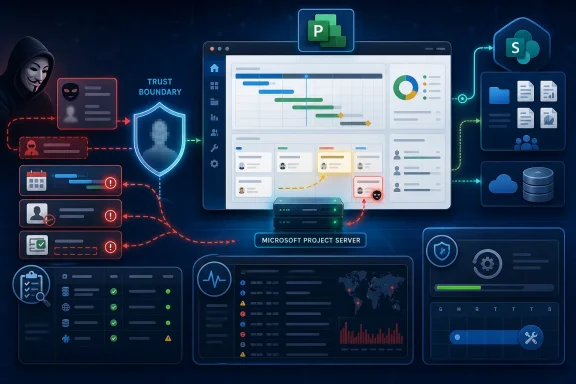 Microsoft’s Sparse Disclosure Is the Story, Not a Footnote
The public language around CVE-2026-45483 is careful, and that care is doing work. Microsoft identifies the affected product family and the vulnerability class, but the most visible explanatory material points readers toward the confidence dimension of vulnerability scoring: how sure the ecosystem is that the bug exists, how credible the technical account is, and how much attackers can infer from what has been disclosed.That is not the same as saying “nothing to see here.” It means the disclosure is operating in the familiar middle ground of modern enterprise security: enough information to justify patching, not enough information to hand defenders or attackers a clean diagram of the flaw. This is now the default posture for many vendor advisories, especially when the affected component is deployed in environments where a detailed proof path could accelerate opportunistic exploitation.
The problem for IT teams is that sparse disclosure transfers work downstream. A security team cannot simply read the advisory, map the exploit path, and decide whether the issue is irrelevant. Instead, it has to reason from product exposure, authentication boundaries, role design, and the business importance of the application.
That is where Project Server changes the calculus. A spoofing vulnerability in a lightly used internal tool may sit low in the queue. A spoofing vulnerability in a project and portfolio management system used to coordinate budget, delivery milestones, resource assignments, and executive reporting deserves more attention, even if the advisory itself reads dry.
Spoofing Bugs Are Often Underrated Until They Become Part of a Chain
“Spoofing” is one of those security labels that can make a vulnerability sound almost cosmetic. To non-specialists, it suggests a forged name, a misleading label, or a fake interface. In enterprise systems, however, spoofing often means a system can be made to trust something it should not trust.That trust may involve a user identity, a request origin, a link target, a workflow state, a document context, or a user interface element that implies legitimacy. The exact mechanics of CVE-2026-45483 are not fully spelled out in the public text supplied here, and that uncertainty should be preserved rather than papered over. But the class itself belongs to a family of bugs that attackers like because it can bend user decisions and system assumptions without necessarily requiring noisy malware behavior.
In a Project Server environment, trust is the product. Users trust that the task they are assigned came from the right person. Managers trust that status, approvals, and project metadata reflect reality. Administrators trust that permissions and web surfaces are enforcing boundaries. If a spoofing flaw lets an attacker impersonate part of that trust fabric, even in a narrow way, the practical impact can exceed the sterile label.
The danger is not that every spoofing bug becomes a breach. The danger is that spoofing often supplies the connective tissue between other steps: phishing, session abuse, workflow manipulation, credential capture, lateral movement, or social engineering inside an already trusted portal. Security teams that treat spoofing as “not code execution, therefore later” have been burned before.
Project Server Lives Where Identity, Workflow, and SharePoint Meet
Microsoft Project Server has always occupied an odd place in the Microsoft estate. It is business software, but not merely desktop productivity software. It is often deployed as part of a broader server-side collaboration stack, historically intertwined with SharePoint infrastructure, SQL Server back ends, Active Directory identity, and the operational habits of program management offices.That makes the attack surface organizational as much as technical. A vulnerability in this space can touch people who do not think of themselves as high-risk users: project managers, finance reviewers, portfolio leads, contractors, and executives checking dashboards. These are not always the users with the best security reflexes, but they often have access to commercially sensitive information.
The server role also matters. Unlike a single workstation vulnerability, a Project Server flaw can sit on infrastructure that many users reach through a browser and that administrators may not patch with the same urgency as domain controllers, Exchange, or VPN appliances. In many organizations, project management systems fall into the category of “important but politically awkward to reboot.”
That is exactly the category where attackers benefit from inertia. Systems that are business-critical enough to be hard to patch, but not famous enough to be monitored like crown jewels, create a maintenance gap. CVE-2026-45483 should be read through that lens.
Report Confidence Is a Quiet Signal for Prioritization
The user-supplied description of the metric is important because it highlights a reality many patch dashboards hide: vulnerability data has a confidence level. Sometimes a CVE is backed by a vendor-confirmed root cause, a patch, and enough technical detail to establish exploitability. Sometimes it is a thinner public record, with the existence of the issue acknowledged but the deeper mechanics withheld or still emerging.Report confidence does not measure business impact. It does not tell you whether your Project Server is internet-exposed, whether your authentication design reduces risk, or whether an attacker has a reliable exploit. What it does tell you is how much faith you should place in the claim that the vulnerability is real and that the available technical account is credible.
When the vendor is Microsoft and the entry appears in MSRC’s Security Update Guide, defenders should generally treat the existence of the vulnerability as settled enough for operational action. That does not mean panic. It means the “is this real?” phase should be short, and the “where do we run this product?” phase should begin quickly.
The more difficult question is how much technical knowledge attackers have. A sparse advisory with limited public mechanics may slow commodity exploitation, but it does not stop capable actors from diffing patches, probing behavior, or using adjacent knowledge of the platform. In 2026, patch diffing is not an exotic nation-state technique; it is part of the vulnerability economy.
The Patch Window Is Really an Inventory Test
For many administrators, the hardest part of responding to CVE-2026-45483 will not be installing an update. It will be answering whether Project Server is present at all, which version is deployed, who owns it, and whether it is still supported. The Microsoft stack in large organizations has a way of accumulating legacy collaboration services long after the teams that deployed them have reorganized.That inventory problem is a security problem. A vulnerability cannot be prioritized if the asset is invisible. It cannot be patched if nobody knows which maintenance window governs it. It cannot be risk-rated if the team does not know whether it is reachable from the internet, limited to VPN users, or exposed through a reverse proxy.
Project Server also tends to have dependencies that make emergency changes uncomfortable. Administrators may need to consider SharePoint compatibility, custom workflows, reporting integrations, database maintenance, and add-ons. In theory, enterprise patching is a disciplined monthly process. In practice, business applications with customizations often end up on a slower track.
That slower track is where a spoofing vulnerability can become more dangerous over time. The first day after disclosure may bring limited public detail. The thirtieth day may bring more scans, more reverse engineering, more proof-of-concept chatter, and more attackers looking for organizations that deferred the update because “it was only spoofing.”
Internet Exposure Changes the Moral Weight of “Medium” Bugs
Without a full public CVSS vector in the supplied material, it would be irresponsible to pretend certainty about severity mechanics. But severity labels have always been imperfect for server products. A vulnerability with moderate theoretical impact can become urgent if the affected system is exposed to untrusted networks and tied into sensitive identity flows.For Project Server, exposure should be the first dividing line. If the service is reachable from the public internet, directly or through a publishing layer, the organization should treat the issue with more urgency. If access is limited to authenticated internal users, the risk may be lower, but not gone; insider risk, compromised VPN accounts, and stolen credentials remain part of the modern threat model.
Authentication requirements also do not end the discussion. Many enterprise attacks now begin with valid credentials. A vulnerability that requires some level of access can still matter if it helps an attacker escalate influence, deceive other users, or manipulate trusted workflow content.
The security industry has spent years learning that “authenticated attacker” is not a synonym for “low risk.” In cloud and hybrid environments, valid sessions are often the battlefield. A spoofing bug inside an authenticated business application may be exactly the kind of tool an intruder wants after the first credential falls.
Administrators Need to Read Beyond the CVE Name
The name “Microsoft Office Project Server Spoofing Vulnerability” is useful, but it is not a remediation plan. Administrators should look for the affected product versions, the specific security update or cumulative update that addresses the flaw, and whether Microsoft lists any mitigations or workarounds. They should also check whether the update is bundled with other fixes that change the urgency of the maintenance window.Project Server patching has historically demanded care because it may sit inside a SharePoint farm rather than as a simple standalone service. That means administrators should validate the farm state, back up relevant databases, review custom solutions, and test the update path where possible. The operational burden is real, but it is not a reason to ignore the issue.
The more mature response is to turn this into a small incident-style workflow. Identify assets, confirm ownership, check exposure, schedule updates, monitor logs, and document exceptions. If an exception is granted, it should have an expiration date and a compensating control, not a vague promise to revisit the issue after the quarter closes.
Security teams should also communicate the vulnerability in business terms. “Spoofing in Project Server” may not move an executive. “A flaw in a system used to coordinate project approvals and trusted internal information may allow deception or misrepresentation under certain conditions” is more likely to get the right maintenance window approved.
Defenders Should Watch the Trust Boundary, Not Just the Patch Status
Patching is necessary, but it is not the only useful response. A spoofing vulnerability invites defenders to examine where Project Server makes trust decisions and where users may be induced to trust content, links, identities, or workflow states. Even if the patch closes CVE-2026-45483, the review can expose broader weaknesses.Administrators should review access patterns around Project Web App and related endpoints. They should confirm that privileged project and portfolio roles are limited to users who still need them. They should examine whether external collaborators have access that made sense two projects ago but no longer does.
Monitoring should focus on behavior that would look suspicious even without a public exploit recipe. Unexpected changes to project metadata, unusual access from new geographies, anomalous workflow actions, odd permission changes, and bursts of activity from dormant accounts deserve attention. Spoofing bugs often blend into normal application traffic, so defenders need baselines more than signatures.
This is also a good moment to revisit user-facing trust cues. If the organization trains users to accept approvals, links, or requests simply because they appear inside a familiar Microsoft-branded portal, it has created a soft target. Security awareness should not become paranoia, but users who handle approvals and budgets should know that internal-looking systems can still be abused.
The Vendor Knows More Than the Advisory Says
One of the recurring tensions in vulnerability disclosure is that vendors must say enough to protect customers while not saying so much that they arm attackers. Microsoft is no exception. MSRC advisories often compress complex engineering realities into a title, a severity score, affected products, and a few standardized fields.That compression is frustrating, especially for defenders who need to justify downtime. But the absence of narrative detail should not be mistaken for the absence of risk. In many cases, the patch itself is the most detailed public explanation attackers will ever need, because binary and configuration changes can be compared against prior versions.
This is where the confidence metric becomes more than academic. A vendor-confirmed vulnerability with limited public exploit detail still deserves action because the vendor has acknowledged enough to ship guidance or a fix. The uncertainty is not about whether administrators should care; it is about exactly how attackers might operationalize the weakness and how quickly.
For WindowsForum readers, the practical lesson is familiar: do not let the advisory’s minimalism lull you into treating the issue as hypothetical. Minimal public detail is often a defensive choice, not a risk rating.
The Real Risk Is the Long Tail of Forgotten Collaboration Servers
Microsoft’s biggest security stories tend to involve Exchange, Windows, Defender, Office, or SharePoint. Project Server is less glamorous, which is precisely why it deserves a sharper look when a CVE lands. Less glamorous systems are often less visible in patch dashboards, less represented in tabletop exercises, and less likely to have a named executive owner.The long tail is where old assumptions live. A Project Server deployment may have been installed for a major transformation program, expanded for portfolio reporting, integrated with SharePoint, and then left running because shutting it down would break some reporting process nobody wants to own. That is not negligence so much as the normal sediment of enterprise IT.
Attackers do not need every organization to expose Project Server recklessly. They need enough organizations to have stale deployments, weak segmentation, delayed patch cycles, and users who trust internal portals. A spoofing vulnerability gives them a reason to look.
The defender’s answer is not to overreact to every CVE with a war room. It is to reduce the number of systems whose risk cannot be quickly understood. CVE-2026-45483 is a reminder that asset management remains the least glamorous control and one of the most decisive.
The Practical Reading for Windows and Office Administrators
CVE-2026-45483 should be handled as a real Microsoft server-side vulnerability affecting Project Server, with risk shaped heavily by deployment context, exposure, and the sensitivity of the workflows hosted on the platform. It is not useful to inflate the advisory into an unverified catastrophe, but it is equally unwise to dismiss spoofing as a cosmetic class.The right response is disciplined rather than dramatic. Find the product, identify the version, apply the relevant Microsoft update, and verify that the service behaves as expected afterward. Then use the moment to examine whether Project Server has more privilege, exposure, or business trust than its security monitoring reflects.
- Organizations should first confirm whether Microsoft Project Server is deployed, who owns it, and whether it is still within a supported patching path.
- Internet-facing or broadly reachable Project Server instances should move higher in the patch queue than isolated systems with narrow, well-monitored access.
- Security teams should treat vendor-confirmed spoofing vulnerabilities as potential trust-boundary failures, not merely as cosmetic interface bugs.
- Administrators should review Project Server roles, external access, workflow permissions, and unusual recent activity as part of the response.
- Any decision to delay patching should be documented with a specific expiration date, a named owner, and compensating controls such as access restriction or enhanced monitoring.
References
- Primary source: MSRC
Published: 2026-06-09T07:00:00-07:00
Security Update Guide - Microsoft Security Response Center
 msrc.microsoft.com
- Official source: microsoft.com
Disrupting active exploitation of on-premises SharePoint vulnerabilities | Microsoft Security Blog
Microsoft has observed two named Chinese nation-state actors, Linen Typhoon and Violet Typhoon, exploiting vulnerabilities targeting internet-facing SharePoint servers. In addition, we have observed another China-based threat actor, tracked as Storm-2603, exploiting these vulnerabilities...www.microsoft.com - Related coverage: threats.kaspersky.com
Kaspersky Threats — KLA90842
threats.kaspersky.com
- Related coverage: techradar.com
Worrying Microsoft Office security flaw patched - update now or risk hackers accessing your files | TechRadar
Microsoft forced to issue an emergency patchwww.techradar.com - Related coverage: tomsguide.com
Do you use Microsoft Exchange? Hackers are actively exploiting a new zero-day flaw | Tom's Guide
Microsoft warns of a new zero-day vulnerability that leaves Exchange open to hackers.www.tomsguide.com - Related coverage: bleepingcomputer.com
Over 1,300 Microsoft SharePoint servers vulnerable to spoofing attacks
Over 1,300 Microsoft SharePoint servers exposed online remain unpatched against a spoofing vulnerability that was exploited as a zero-day and is still being abused in ongoing attacks.www.bleepingcomputer.com
- Official source: learn.microsoft.com
Security Advisories and Bulletins | Microsoft Learn
learn.microsoft.com - Related coverage: api.urlscan.io

api.msrc.microsoft.com - urlscan.io
urlscan.io - Website scanner for suspicious and malicious URLs
api.urlscan.io
- Related coverage: sra.io
- Related coverage: first.org
Complete CVSS v1 Guide
 www.first.org
- Related coverage: ibm.com
Common Vulnerability Scoring System (CVSS)
The Common Vulnerability Scoring System (CVSS) is used to rate the severity and risk of computer system security.www.ibm.com - Related coverage: techtarget.com
What is a Common Vulnerability Scoring System (CVSS)? | Definition from TechTarget
CVSS is a standardized framework for rating security vulnerabilities. Explore its applications, history and the mechanics behind CVSS scoring.www.techtarget.com - Related coverage: picussecurity.com
What is Common Vulnerability Scoring System (CVSS) ?
Discover CVSS (Common Vulnerability Scoring System) - a widely used framework for assessing cybersecurity risks. Learn how CVSS assigns scores to vulnerabilities, aiding in prioritizing and mitigating threatswww.picussecurity.com - Related coverage: orca.security
CVSS: Common Vulnerability Scoring System Guide | Orca Security
Learn how CVSS vulnerability scoring works, its limitations, and best practices for risk-based vulnerability management in cloud environments. orca.security
