

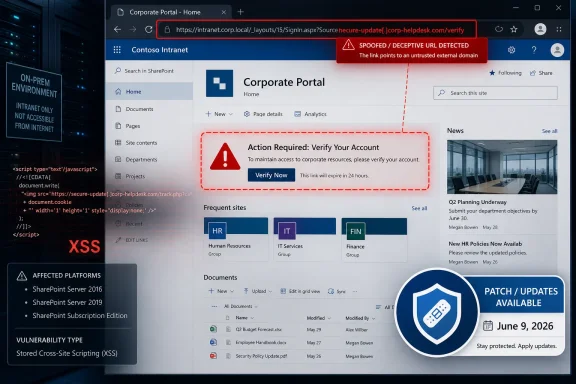
Microsoft disclosed CVE-2026-45464 on June 9, 2026, as an Important-rated spoofing vulnerability in SharePoint Server caused by cross-site scripting, affecting SharePoint Server Subscription Edition, SharePoint Server 2019, and SharePoint Enterprise Server 2016, with security updates now available for all three supported on-premises versions. The bug is not being described as a zero-day, and Microsoft’s own exploitability assessment says exploitation is less likely. But the interesting part is not the headline score. It is that SharePoint’s security story keeps returning to a familiar enterprise weakness: trusted portals are dangerous when they can be made to say or show something they should not.
CVE-2026-45464 is not the sort of vulnerability that should trigger the same panic as a wormable remote code execution flaw. Microsoft rates it Important, assigns it a CVSS 3.1 base score of 5.4, and says exploitation has not been publicly disclosed or observed in the wild at publication. On paper, this is a middle-lane Patch Tuesday item.
That framing is accurate, but it can also be misleading. SharePoint is rarely just another web app in the corner of the data center. In many organizations, it is a document repository, workflow hub, intranet front door, records system, and collaboration layer sitting near the soft underbelly of enterprise identity and business process.
The vulnerability is rooted in improper neutralization of input during web page generation — the familiar class better known as cross-site scripting, or XSS. Microsoft says an authorized attacker could perform spoofing over a network, and that successful exploitation requires a user to click a specially crafted URL. That means the attack chain needs persuasion, not just packets.
Still, persuasion is not much of a barrier in 2026. Enterprise users are trained to click SharePoint links because SharePoint is where work lives. A malicious link that appears to route through a trusted collaboration platform occupies a more dangerous psychological space than a random domain in a phishing email.
Microsoft’s advisory says exploitation could allow some loss of confidentiality and integrity, but no loss of availability. More plainly, a successful attacker could view some sensitive information and make changes to disclosed information, but not take the resource offline. That is not ransomware-grade destruction, but it is enough to matter in workflows where the wrong document, wrong link, or wrong instruction can move money, credentials, or approvals.
The CVSS vector tells the story in compressed form. The attack is network reachable, low complexity, and requires no privileges, but it does require user interaction. Scope is unchanged, availability is not affected, and the impact to confidentiality and integrity is low. The temporal score drops to 4.7 because Microsoft says exploit code maturity is unproven and an official fix exists.
That is the right place to be sober. This is not an unauthenticated server takeover. It is also not something administrators should wave away because the attacker needs a click. In the real world, “requires user interaction” often means “requires a convincing email, Teams message, ticket comment, or intranet post.”
But SharePoint is unusually fertile ground for that model. Unlike a consumer-facing website, an internal SharePoint portal already carries the authority of the company. Users expect it to host HR forms, IT notices, onboarding documents, policy acknowledgements, project trackers, legal templates, and finance workflows. A malicious SharePoint-flavored link does not need to invent trust from nothing; it can borrow trust already earned by the platform.
That matters because many organizations have invested heavily in identity controls while leaving collaboration-layer trust assumptions largely intact. Multifactor authentication can stop stolen-password reuse, but it does not prevent a signed-in user from clicking a malicious URL. Conditional access can reduce exposure, but it does not make rendered content safe.
This is why XSS remains such a persistent enterprise bug class. It is not merely about script execution in a browser. It is about confusing the user, the application, or both at the exact point where trust is being exercised.
Confirmed report confidence raises the urgency in one sense and lowers ambiguity in another. Administrators do not have to decide whether this is rumor, speculative research, or a placeholder CVE. It exists, it affects named SharePoint Server products, and Microsoft has shipped updates.
At the same time, confirmed does not mean exploited. Microsoft explicitly says the vulnerability was not publicly disclosed and not exploited at the time of original publication. Its exploitability assessment is “Exploitation Less Likely,” and exploit code maturity is listed as Unproven.
That combination is the sweet spot for mature patch management. There is enough certainty to act, but not enough observed abuse to justify emergency theater in every environment. The right response is disciplined prioritization: patch promptly, validate build levels, and keep an eye on telemetry for suspicious SharePoint-linked lures.
That lineup is a useful snapshot of Microsoft’s hybrid burden. SharePoint Online may dominate the marketing conversation around Microsoft 365, but on-premises SharePoint remains stubbornly present in regulated environments, legacy-heavy enterprises, government networks, and organizations with custom farm architectures that cannot be casually lifted into the cloud.
The inclusion of SharePoint Enterprise Server 2016 is especially notable because it reflects the long tail of enterprise platform dependency. Microsoft’s advisory also clarifies that the update for SharePoint Enterprise Server 2016 applies to customers running SharePoint Server 2016. That kind of wording matters in real patch operations, where product naming ambiguity can delay deployment or create false confidence.
For sysadmins, the practical job is less glamorous than the CVE discussion. Identify exposed farms, confirm installed build numbers, stage the relevant security update, and make sure SharePoint’s post-update configuration steps complete cleanly. SharePoint patching has never been a one-click ritual for careful administrators; it is a farm-aware process that rewards preparation.
That gap is where attackers tend to live. A vulnerability that looks less likely to be exploited on publication day can become more interesting once patches are released and researchers begin diffing changes. Even when exploit code is not public, adversaries can use vendor updates as a roadmap.
This does not mean every SharePoint administrator should break glass immediately for CVE-2026-45464. It does mean “Important” should enter the patch queue with a real date, not drift into the fog of the next maintenance window. The lower the score, the easier it is for a vulnerability to become invisible until it is chained with something else.
SharePoint also deserves special treatment because it is a user-facing enterprise platform. A spoofing bug in an obscure back-end component is one thing. A spoofing bug in a trusted collaboration system, reachable over the network and triggered by a crafted URL, sits closer to phishing, identity abuse, and business-process compromise.
CVE-2026-45464 is not those earlier bugs. Microsoft does not describe it as actively exploited, does not rate it Critical, and does not frame it as remote code execution. It is a separate vulnerability with a different impact profile.
But defenders remember patterns, not just CVE IDs. They remember that on-premises collaboration servers can become high-value targets because they combine external reachability, authenticated business content, and deep integration with Windows identity. They remember that initial vendor guidance can evolve as exploitation details mature.
That context is why a sober response is not the same as a relaxed response. The lesson from recent SharePoint incidents is not that every bug is catastrophic. It is that SharePoint belongs in the tier of infrastructure where even medium-severity issues deserve prompt validation and careful monitoring.
In some organizations, CVE-2026-45464 will be routine. A locked-down internal farm with limited exposure, mature email filtering, strong user training, and rapid patch windows faces a different risk than an externally reachable SharePoint deployment used for partner collaboration. The same CVE can carry different operational weight.
The confidentiality and integrity impacts are marked low, but “low” is not “none.” In a workflow system, limited data exposure can still be useful for reconnaissance, and limited data modification can still be damaging if it touches approvals, instructions, or user trust. Attackers rarely need perfect control when they can nudge a user toward the next step.
This is the part CVSS struggles to express. Spoofing in a trusted interface can be a bridge, not a destination. The direct technical impact may be modest, while the indirect impact depends on what the attacker persuades the user to do afterward.
The less obvious work is verification. SharePoint teams should confirm the post-update build number rather than assuming deployment succeeded. They should also check that all servers in a farm are consistently updated, because mixed or partially patched farms are a classic source of uncertainty.
Security teams should treat the click requirement as a detection opportunity. Look for suspicious SharePoint-themed links in email, collaboration tools, help desk tickets, and browser telemetry. If a campaign begins exploiting this vulnerability, the first signals may look less like server compromise and more like targeted phishing that leans on familiar SharePoint paths.
User education has a role, but it should not be oversold. Telling users not to click suspicious links is a weak compensating control for a trusted enterprise portal. Better controls include safe link rewriting, attachment and URL detonation, conditional access, least-privilege SharePoint permissions, and logging that makes suspicious navigation visible.
Next comes user population. A SharePoint farm used by a small technical group with narrow permissions is different from one used by every employee for HR, finance, and IT support. The more users who can be lured, the more opportunities an attacker has to convert a crafted URL into a meaningful foothold.
Finally, administrators should consider whether SharePoint is integrated into automated or semi-automated processes. If users make approvals, upload documents, follow workflow prompts, or trust SharePoint-hosted notices as authoritative, spoofing carries more weight. In those environments, the attack is not merely against a browser session; it is against the organization’s process layer.
That is the argument for not sleeping on this CVE. The patch may be straightforward, the score may be moderate, and exploitation may be less likely. But the platform’s role makes timely remediation prudent.
 SharePoint Gets Another Reminder That “Important” Does Not Mean Optional
CVE-2026-45464 is not the sort of vulnerability that should trigger the same panic as a wormable remote code execution flaw. Microsoft rates it Important, assigns it a CVSS 3.1 base score of 5.4, and says exploitation has not been publicly disclosed or observed in the wild at publication. On paper, this is a middle-lane Patch Tuesday item.That framing is accurate, but it can also be misleading. SharePoint is rarely just another web app in the corner of the data center. In many organizations, it is a document repository, workflow hub, intranet front door, records system, and collaboration layer sitting near the soft underbelly of enterprise identity and business process.
The vulnerability is rooted in improper neutralization of input during web page generation — the familiar class better known as cross-site scripting, or XSS. Microsoft says an authorized attacker could perform spoofing over a network, and that successful exploitation requires a user to click a specially crafted URL. That means the attack chain needs persuasion, not just packets.
Still, persuasion is not much of a barrier in 2026. Enterprise users are trained to click SharePoint links because SharePoint is where work lives. A malicious link that appears to route through a trusted collaboration platform occupies a more dangerous psychological space than a random domain in a phishing email.
The Bug Is Small; the Trust Boundary Is Not
The word “spoofing” sometimes undersells the practical risk. It sounds like cosmetic deception: a page that looks like another page, a link that appears more legitimate than it is, a bit of UI trickery. In a corporate SharePoint deployment, however, spoofing can become a trust-boundary problem.Microsoft’s advisory says exploitation could allow some loss of confidentiality and integrity, but no loss of availability. More plainly, a successful attacker could view some sensitive information and make changes to disclosed information, but not take the resource offline. That is not ransomware-grade destruction, but it is enough to matter in workflows where the wrong document, wrong link, or wrong instruction can move money, credentials, or approvals.
The CVSS vector tells the story in compressed form. The attack is network reachable, low complexity, and requires no privileges, but it does require user interaction. Scope is unchanged, availability is not affected, and the impact to confidentiality and integrity is low. The temporal score drops to 4.7 because Microsoft says exploit code maturity is unproven and an official fix exists.
That is the right place to be sober. This is not an unauthenticated server takeover. It is also not something administrators should wave away because the attacker needs a click. In the real world, “requires user interaction” often means “requires a convincing email, Teams message, ticket comment, or intranet post.”
The Click Requirement Is a Speed Bump, Not a Wall
The user-interaction requirement is the most important operational detail in Microsoft’s write-up. The victim must click a specially crafted URL. That makes CVE-2026-45464 more dependent on social engineering than on raw technical reach.But SharePoint is unusually fertile ground for that model. Unlike a consumer-facing website, an internal SharePoint portal already carries the authority of the company. Users expect it to host HR forms, IT notices, onboarding documents, policy acknowledgements, project trackers, legal templates, and finance workflows. A malicious SharePoint-flavored link does not need to invent trust from nothing; it can borrow trust already earned by the platform.
That matters because many organizations have invested heavily in identity controls while leaving collaboration-layer trust assumptions largely intact. Multifactor authentication can stop stolen-password reuse, but it does not prevent a signed-in user from clicking a malicious URL. Conditional access can reduce exposure, but it does not make rendered content safe.
This is why XSS remains such a persistent enterprise bug class. It is not merely about script execution in a browser. It is about confusing the user, the application, or both at the exact point where trust is being exercised.
Microsoft’s Confidence Metric Cuts Both Ways
The user-provided excerpt focuses on the CVSS Report Confidence metric, and for this vulnerability Microsoft marks that field as Confirmed. That is a meaningful detail. It means Microsoft is not merely repeating an unverified report or acknowledging a vague class of undesirable behavior; the vendor has confirmed the vulnerability’s existence or the technical basis is sufficiently reproducible.Confirmed report confidence raises the urgency in one sense and lowers ambiguity in another. Administrators do not have to decide whether this is rumor, speculative research, or a placeholder CVE. It exists, it affects named SharePoint Server products, and Microsoft has shipped updates.
At the same time, confirmed does not mean exploited. Microsoft explicitly says the vulnerability was not publicly disclosed and not exploited at the time of original publication. Its exploitability assessment is “Exploitation Less Likely,” and exploit code maturity is listed as Unproven.
That combination is the sweet spot for mature patch management. There is enough certainty to act, but not enough observed abuse to justify emergency theater in every environment. The right response is disciplined prioritization: patch promptly, validate build levels, and keep an eye on telemetry for suspicious SharePoint-linked lures.
The Affected Versions Map the On-Premises Reality Microsoft Still Has to Support
CVE-2026-45464 applies to three on-premises SharePoint lines: SharePoint Server Subscription Edition, SharePoint Server 2019, and SharePoint Enterprise Server 2016. Microsoft lists fixed builds for each: 16.0.19725.20384 for Subscription Edition, 16.0.10417.20153 for SharePoint Server 2019, and 16.0.5556.1005 for SharePoint Enterprise Server 2016.That lineup is a useful snapshot of Microsoft’s hybrid burden. SharePoint Online may dominate the marketing conversation around Microsoft 365, but on-premises SharePoint remains stubbornly present in regulated environments, legacy-heavy enterprises, government networks, and organizations with custom farm architectures that cannot be casually lifted into the cloud.
The inclusion of SharePoint Enterprise Server 2016 is especially notable because it reflects the long tail of enterprise platform dependency. Microsoft’s advisory also clarifies that the update for SharePoint Enterprise Server 2016 applies to customers running SharePoint Server 2016. That kind of wording matters in real patch operations, where product naming ambiguity can delay deployment or create false confidence.
For sysadmins, the practical job is less glamorous than the CVE discussion. Identify exposed farms, confirm installed build numbers, stage the relevant security update, and make sure SharePoint’s post-update configuration steps complete cleanly. SharePoint patching has never been a one-click ritual for careful administrators; it is a farm-aware process that rewards preparation.
SharePoint Patching Is Still a Change-Management Exercise
The existence of an official fix changes the risk equation, but it does not remove the operational friction. SharePoint farms often sit behind customizations, third-party components, search dependencies, service applications, and business-critical workflows that make administrators wary of fast patching. The result is a familiar enterprise gap: the fix is available before the organization is ready to absorb it.That gap is where attackers tend to live. A vulnerability that looks less likely to be exploited on publication day can become more interesting once patches are released and researchers begin diffing changes. Even when exploit code is not public, adversaries can use vendor updates as a roadmap.
This does not mean every SharePoint administrator should break glass immediately for CVE-2026-45464. It does mean “Important” should enter the patch queue with a real date, not drift into the fog of the next maintenance window. The lower the score, the easier it is for a vulnerability to become invisible until it is chained with something else.
SharePoint also deserves special treatment because it is a user-facing enterprise platform. A spoofing bug in an obscure back-end component is one thing. A spoofing bug in a trusted collaboration system, reachable over the network and triggered by a crafted URL, sits closer to phishing, identity abuse, and business-process compromise.
The 2025 SharePoint Hangover Still Shapes the Risk Conversation
Microsoft and its customers do not view SharePoint vulnerabilities in a vacuum anymore. The platform’s recent history includes high-profile on-premises SharePoint exploitation, including chained vulnerabilities that pushed many defenders into emergency patching and incident response. That history changes how even a more modest spoofing issue lands.CVE-2026-45464 is not those earlier bugs. Microsoft does not describe it as actively exploited, does not rate it Critical, and does not frame it as remote code execution. It is a separate vulnerability with a different impact profile.
But defenders remember patterns, not just CVE IDs. They remember that on-premises collaboration servers can become high-value targets because they combine external reachability, authenticated business content, and deep integration with Windows identity. They remember that initial vendor guidance can evolve as exploitation details mature.
That context is why a sober response is not the same as a relaxed response. The lesson from recent SharePoint incidents is not that every bug is catastrophic. It is that SharePoint belongs in the tier of infrastructure where even medium-severity issues deserve prompt validation and careful monitoring.
CVSS Says Medium; Enterprise Context Says Mind the Workflow
The CVSS base score of 5.4 is useful, but it is not destiny. Scoring systems intentionally abstract away local context. They do not know whether a SharePoint site hosts cafeteria menus or merger documents, whether a farm is internet-facing or intranet-only, or whether users regularly receive external collaboration links.In some organizations, CVE-2026-45464 will be routine. A locked-down internal farm with limited exposure, mature email filtering, strong user training, and rapid patch windows faces a different risk than an externally reachable SharePoint deployment used for partner collaboration. The same CVE can carry different operational weight.
The confidentiality and integrity impacts are marked low, but “low” is not “none.” In a workflow system, limited data exposure can still be useful for reconnaissance, and limited data modification can still be damaging if it touches approvals, instructions, or user trust. Attackers rarely need perfect control when they can nudge a user toward the next step.
This is the part CVSS struggles to express. Spoofing in a trusted interface can be a bridge, not a destination. The direct technical impact may be modest, while the indirect impact depends on what the attacker persuades the user to do afterward.
The Best Mitigation Is Boring, Which Is Why It Works
There is no mystery mitigation here. Microsoft has shipped official updates for all listed affected versions, and administrators should install the relevant update for their SharePoint line. The advisory’s temporal metrics explicitly reflect that an official fix is available.The less obvious work is verification. SharePoint teams should confirm the post-update build number rather than assuming deployment succeeded. They should also check that all servers in a farm are consistently updated, because mixed or partially patched farms are a classic source of uncertainty.
Security teams should treat the click requirement as a detection opportunity. Look for suspicious SharePoint-themed links in email, collaboration tools, help desk tickets, and browser telemetry. If a campaign begins exploiting this vulnerability, the first signals may look less like server compromise and more like targeted phishing that leans on familiar SharePoint paths.
User education has a role, but it should not be oversold. Telling users not to click suspicious links is a weak compensating control for a trusted enterprise portal. Better controls include safe link rewriting, attachment and URL detonation, conditional access, least-privilege SharePoint permissions, and logging that makes suspicious navigation visible.
The Real Patch Priority Is Exposure Plus Trust
A useful prioritization model starts with exposure. Internet-facing SharePoint farms should move faster than isolated internal deployments, particularly if they serve external partners or accept traffic from broad user populations. Systems hosting sensitive documents, regulated data, or executive workflows should also be near the front of the line.Next comes user population. A SharePoint farm used by a small technical group with narrow permissions is different from one used by every employee for HR, finance, and IT support. The more users who can be lured, the more opportunities an attacker has to convert a crafted URL into a meaningful foothold.
Finally, administrators should consider whether SharePoint is integrated into automated or semi-automated processes. If users make approvals, upload documents, follow workflow prompts, or trust SharePoint-hosted notices as authoritative, spoofing carries more weight. In those environments, the attack is not merely against a browser session; it is against the organization’s process layer.
That is the argument for not sleeping on this CVE. The patch may be straightforward, the score may be moderate, and exploitation may be less likely. But the platform’s role makes timely remediation prudent.
The June 9 SharePoint Fix Belongs on the Short List
The practical lesson from CVE-2026-45464 is not panic; it is prioritization. Microsoft has confirmed the vulnerability, published fixes, and provided enough scoring detail for administrators to make a grounded decision. The organizations that handle this well will be the ones that treat SharePoint as business infrastructure, not just another web server.- CVE-2026-45464 is an Important-rated SharePoint Server spoofing vulnerability released on June 9, 2026, with a CVSS 3.1 base score of 5.4.
- Microsoft attributes the flaw to cross-site scripting and says successful exploitation requires a user to click a specially crafted URL.
- Microsoft lists the vulnerability as not publicly disclosed and not exploited at publication, with exploitation assessed as less likely.
- Security updates are available for SharePoint Server Subscription Edition, SharePoint Server 2019, and SharePoint Enterprise Server 2016.
- Administrators should verify fixed build numbers after deployment rather than relying only on update installation status.
- The business risk depends heavily on SharePoint exposure, user population, hosted content, and the degree to which users trust SharePoint links in daily workflows.
References
- Primary source: MSRC
Published: 2026-06-09T07:00:00-07:00
Security Update Guide - Microsoft Security Response Center
 msrc.microsoft.com
