

Microsoft’s Confidence Metric Is the Quiet Signal in the Advisory
The text attached to CVE-2026-47641 describes a metric that measures confidence in the vulnerability’s existence and in the credibility of available technical detail. That language comes from the CVSS world, where security scoring is not only about impact but also about how much is actually known. A vulnerability with a confirmed vendor acknowledgement is different from a rumor, a proof-of-concept guess, or an observed behavior whose root cause remains murky.
That distinction matters because SharePoint vulnerabilities do not exist in a vacuum. An administrator reading a Microsoft advisory is not simply asking whether the bug is real; they are asking whether attackers can understand it, reproduce it, chain it, and weaponize it before the next maintenance window. The more certainty the ecosystem has, the less comfort there is in ambiguity.
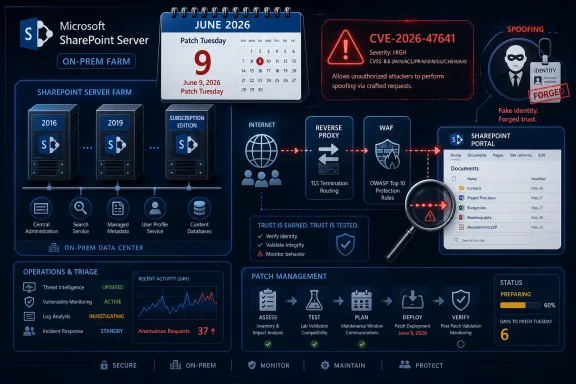
For CVE-2026-47641, Microsoft’s listing itself is the key baseline: this is not a speculative blog post or scanner vendor extrapolation. It is a vendor-tracked SharePoint Server spoofing vulnerability. That does not automatically mean public exploit code exists, nor does it mean every farm is equally exposed. But it does mean enterprise defenders should treat the issue as part of the supported patch stream, not as background noise.
Spoofing Sounds Mild Until SharePoint Is the Thing Being Spoofed
“Spoofing” is one of those security labels that can lull busy teams into underreaction. Remote code execution gets the emergency bridge call. Elevation of privilege gets the domain-admin nightmare scenario. Spoofing, by contrast, often sounds like trickery at the edges: a forged identity, a misleading link, a UI deception, or a server response that convinces a user or system of something untrue.
In SharePoint, that framing is too narrow. SharePoint is where organizations keep policy documents, business workflows, HR files, engineering notes, procurement records, legal material, and internal communications that were never meant to face the open web. A spoofing flaw in that context can undermine trust in the very surface employees use to decide what is legitimate.
The danger is not that every spoofing CVE becomes catastrophic. The danger is that defenders treat the category as inherently secondary. In a collaboration platform, trust is not a cosmetic layer; it is the product. If SharePoint can be made to present the wrong thing with the right authority, the security boundary may already be fraying.
The SharePoint Server Story Has Become a Story About Exposure
The modern SharePoint risk story is split between Microsoft 365 and the on-premises server product. SharePoint Online lives inside Microsoft’s cloud operations model, where Microsoft can apply service-side mitigations and patches centrally. SharePoint Server is different: it depends on customer-operated infrastructure, customer patch cadence, customer topology decisions, and customer exposure mistakes.
That difference has become more consequential with every public SharePoint incident. In 2025 and 2026, defenders watched on-premises SharePoint become a recurring target rather than a legacy afterthought. Several recent SharePoint flaws have affected SharePoint Server 2016, SharePoint Server 2019, and SharePoint Server Subscription Edition, keeping the same core population of self-managed farms in scope again and again.
This is why CVE-2026-47641 should be read less as an isolated entry and more as another data point in a pattern. Microsoft is still servicing SharePoint Server, but attackers are also still finding value in it. The platform remains strategically important because it often sits near sensitive internal data while being old enough, customized enough, and business-critical enough that patching is rarely instant.
End of Support Turns Patch Tuesday Into a Migration Clock
The calendar is unforgiving for SharePoint Server 2016 and SharePoint Server 2019. Both are approaching the end of extended support on July 14, 2026. That date is now close enough that every new CVE has two meanings: fix this month’s bug, and decide whether the platform should still be there next month.
This is where many organizations get trapped. They treat security updates as a recurring operational chore while postponing the architectural decision. But a SharePoint farm is not a browser or a desktop app that can simply be swapped out overnight. It often includes custom solutions, third-party components, InfoPath-era assumptions, legacy workflows, search dependencies, service accounts, and integrations nobody wants to rediscover during an outage.
For organizations still on 2016 or 2019, CVE-2026-47641 is therefore not just a vulnerability-management item. It is part of a closing support window. After the end of support, the question changes from “Have we installed the update?” to “Will there be an update at all?”
SharePoint Server Subscription Edition is Microsoft’s preferred on-premises answer, but it is not a magic erase button. It still requires governance, patching, monitoring, and attention to exposed endpoints. The move to a subscription-era server product improves lifecycle posture, but it does not turn a self-hosted collaboration platform into a cloud service.
The Real Risk Is the Farm Nobody Wants to Reboot
SharePoint administrators know the operational reality: patching a farm is easy to demand and hard to schedule. There are content databases to back up, service application dependencies to validate, cumulative update histories to inspect, and business owners who insist that their portal is too important to interrupt. In large environments, the “one SharePoint server” described in a risk register may actually be a multi-server farm whose patch plan requires coordination across SQL Server, Windows Server, load balancers, authentication providers, and monitoring tools.
That friction creates the attacker’s opportunity. The most exposed systems are often not the ones with the most dramatic vulnerabilities; they are the ones where the organization has normalized delay. A medium-severity SharePoint issue can become serious when the farm is internet-accessible, inconsistently patched, or loaded with custom code that complicates testing.
Spoofing vulnerabilities make this operational problem worse because they are easier to defer. A critical RCE can force an emergency. A spoofing advisory may be pushed into the next routine cycle, especially if no public exploit is known. That is a rationalization, not a risk model.
The lesson from recent SharePoint history is that incomplete or delayed remediation gives attackers time to study the patch, compare files, infer the vulnerable code path, and search for unpatched systems. Once a bug is acknowledged by the vendor, the clock starts for defenders and attackers alike.
Vendor Confirmation Does Not Equal Operational Clarity
Microsoft’s acknowledgement is valuable because it gives defenders a trusted source of truth. But a vendor advisory is rarely a full operational playbook. Security teams still need to answer which servers are affected, whether the farm is exposed externally, whether authentication reduces practical risk, whether compensating controls exist, and whether the update introduces compatibility issues.
That gap between advisory and implementation is where mature vulnerability management lives. The CVSS confidence language tells us how much faith to place in the vulnerability’s existence and known details. It does not tell an administrator whether a specific intranet portal is reachable through a reverse proxy, whether a forgotten web application still has anonymous access enabled, or whether a legacy customization breaks after the latest cumulative update.
This is why SharePoint patching should be tied to asset discovery, not just update deployment. If the security team cannot list every SharePoint farm, every web front end, every externally published URL, and every supported version, then the organization does not really know its exposure. It only knows what it hopes is true.
SharePoint’s Security Model Was Built for Trust, and Attackers Know It
SharePoint’s appeal has always been its integration with enterprise identity, permissions, workflows, and documents. That same integration creates rich attack surfaces. A successful attacker does not necessarily need to smash the entire farm if they can influence what users trust, what workflows process, or what content appears authoritative.
Spoofing vulnerabilities live in that uncomfortable space between technical and human trust. They can be used to make something appear to come from a trusted source, to misrepresent content, or to influence a victim’s decision in a system where context carries authority. In a platform used for internal approvals and document collaboration, that can be more than cosmetic.
The other complication is chaining. A spoofing flaw by itself may have limited impact. Combined with weak configuration, exposed endpoints, stolen credentials, phishing, or another server-side bug, it can become part of a broader intrusion path. Administrators should resist the temptation to evaluate each advisory only as a standalone event.
That does not mean panic is the correct response. It means classification should not replace analysis. “Spoofing” is a label, not a business-impact assessment.
The Patch Is Necessary, but It Is Not the Whole Defense
For supported SharePoint Server deployments, the first step is straightforward: identify the affected versions, read the Microsoft advisory, test the relevant update, and deploy it as quickly as the farm’s risk profile demands. Internet-facing farms and environments with sensitive data deserve a shorter timeline than isolated test systems. Unsupported or nearly unsupported farms deserve an even harsher review.
But patching alone is a thin defense if the same environment remains overexposed. SharePoint farms should not be casually reachable from the public internet unless there is a clear business requirement and a properly engineered access path. Authentication boundaries, reverse proxies, web application firewalls, endpoint protection, logging, and alerting all matter because SharePoint’s historical role as a trusted internal platform makes successful compromise especially valuable.
Microsoft’s AMSI integration for SharePoint is also part of the modern hardening story. It is not a substitute for updates, and it should not be sold internally as a silver bullet. But in environments where malicious payloads or suspicious request patterns may appear, having SharePoint participate in antimalware scanning gives defenders another layer they did not always have in older deployments.
The more strategic control is simplification. Old farms with sprawling customizations are harder to patch, harder to monitor, and harder to reason about. Every retained legacy dependency should have an owner and a retirement plan. Otherwise the organization is not preserving capability; it is accumulating attack surface.
The Cloud Escape Hatch Is Real, but It Has Trade-Offs
It is tempting to end every SharePoint Server security story with “move to SharePoint Online.” For many organizations, that is the correct long-term direction. Microsoft can patch cloud services centrally, absorb platform-level operational burden, and deliver security improvements without waiting for each customer to schedule downtime.
But that answer is not universal. Government, defense, regulated industry, disconnected environments, and organizations with strict data residency or integration constraints may still need on-premises SharePoint. Some have built business processes around server-side customizations that do not map cleanly to Microsoft 365. Others have legal or operational reasons to keep certain collaboration workloads inside their own network boundary.
The point is not that on-premises SharePoint is automatically reckless. The point is that it must now be treated as high-value infrastructure, not as a quiet document portal humming along in the corner. If an organization chooses to keep it, that choice requires funding, staffing, lifecycle planning, and rehearsed incident response.
The worst position is the accidental middle: too customized to migrate, too fragile to patch quickly, too exposed to ignore, and too old to remain supportable. CVE-2026-47641 is another reminder that this middle ground is where risk compounds.
The June Advisory Leaves Administrators With a Short List of Hard Answers
CVE-2026-47641 should push SharePoint owners toward concrete inventory and remediation work rather than abstract severity debates. The confidence language around the vulnerability reinforces that Microsoft is treating the issue as real, but local exposure depends on deployment choices. The useful response is disciplined, not theatrical.
- Administrators should confirm every SharePoint Server farm in the environment, including development, disaster-recovery, and forgotten departmental deployments.
- Teams should verify whether affected farms are running SharePoint Server 2016, SharePoint Server 2019, or SharePoint Server Subscription Edition, and map each one against its support lifecycle.
- Security owners should prioritize externally reachable SharePoint deployments, especially those published through reverse proxies, VPN alternatives, or legacy remote-access paths.
- Change managers should treat SharePoint updates as security maintenance with business risk attached, not as optional platform hygiene.
- Organizations still running SharePoint Server 2016 or 2019 should treat July 14, 2026, as a security deadline rather than a procurement footnote.
The broader lesson is that SharePoint Server’s risk is no longer episodic. Microsoft can keep issuing advisories and patches, but only customers can eliminate the fragile farms, unknown exposure, and maintenance delays that turn a single spoofing vulnerability into a meaningful breach path. CVE-2026-47641 may not be the loudest SharePoint advisory of the year, but it arrives at exactly the moment when administrators should be asking whether their on-prem collaboration stack is still a managed asset — or merely a trusted liability waiting for the next Patch Tuesday.