

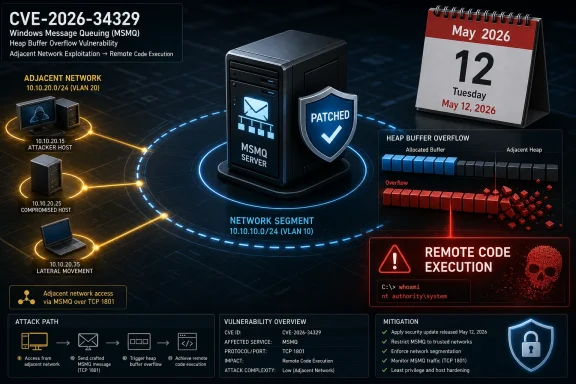
Microsoft’s “Important” Label Still Describes a Very Uncomfortable Bug
The first oddity in CVE-2026-34329 is that it sounds like the sort of vulnerability that usually earns a Critical badge. Remote code execution, no privileges required, no user interaction, high confidentiality impact, high integrity impact, high availability impact: that is the classic shape of a serious Windows service bug. Yet Microsoft rates this one Important because the attack vector is adjacent, not network-wide.
That distinction matters, but it should not be mistaken for comfort. Adjacent means the attacker must already be on the same network segment, virtual network, switch, or similarly bounded administrative zone. It does not mean the attacker needs credentials, a local account, or a cooperative user.
In modern enterprise networks, adjacency is often a weaker barrier than the word implies. A compromised workstation, a poorly isolated server VLAN, a VPN-connected foothold, or a cloud subnet with flat east-west access can all turn “adjacent” into “near enough.” The vulnerability is less internet-wormable than the worst MSMQ cases of the past, but it remains a post-compromise accelerator.
Microsoft’s own scoring tells the story. The CVSS base score is 8.8, with low attack complexity and no required privileges. The temporal score drops to 7.7 because Microsoft says exploit code maturity is unproven and an official fix exists, not because the underlying impact is modest.
The Old Queueing Service Keeps Reappearing in New Patch Tuesdays
MSMQ is one of those Windows components that many administrators know by reputation rather than by recent design choice. It provides asynchronous message delivery for applications that need to communicate even when endpoints are temporarily unavailable. It was useful in the era of classic Windows line-of-business software, distributed COM-era architecture, and server applications that preferred native Microsoft plumbing over third-party brokers.
That history is why MSMQ remains such an awkward security subject. It is not a fashionable platform. It is not the message broker that architects put into a greenfield cloud slide deck in 2026. But it is still present in Windows, still installable, still relied on by legacy applications, and still capable of exposing a network-facing service when enabled.
The problem for defenders is not that every Windows machine is automatically running MSMQ. The problem is that the machines that do run it are often the ones nobody wants to touch: application servers with brittle dependencies, industrial or healthcare systems, older middleware stacks, or departmental services that predate the current security team.
That makes every MSMQ RCE advisory a small excavation project. The first question is not simply “are we patched?” but “where is this service actually enabled, who owns the application that uses it, and why can anything outside its trust boundary reach it?” Those are inventory questions, and inventory questions are where tidy patch management dashboards go to die.
The Adjacent-Network Boundary Is a Speed Bump, Not a Wall
Microsoft says exploitation requires an attacker to send a specially crafted message over the network to a system running the MSMQ service. The service processes that message, triggers memory corruption, and could allow code execution on the affected system. That is a serious primitive even if the attacker must be close.
The adjacent-network constraint narrows the blast radius. It means this is not, based on Microsoft’s current description, a vulnerability that can be exploited directly across arbitrary routed networks or from the public internet in the general case. That is why the rating does not land in the highest severity bucket.
But network adjacency is not a fixed physical reality anymore. Virtual switches, overlay networks, site-to-site VPNs, remote access concentrators, container hosts, and hybrid cloud routing have stretched the meaning of “same network segment.” In poorly segmented environments, an attacker who compromises one endpoint may find that many “adjacent” services are effectively next door.
This is where the risk becomes operational rather than theoretical. A vulnerability with no user interaction and no required privileges is attractive because it reduces the need for phishing, credential theft, or social engineering once the attacker reaches the right place. If MSMQ is exposed inside a reachable subnet, the service itself becomes the interface.
Report Confidence Is the Quiet Metric That Should Get Admins’ Attention
The user-supplied context highlights one of the most useful but least discussed CVSS temporal metrics: report confidence. For CVE-2026-34329, Microsoft marks the vulnerability as confirmed. That matters.
A confirmed report does not mean public exploit code is available. Microsoft also says the vulnerability was not publicly disclosed and was not known to be exploited at original publication, with exploitation assessed as less likely. But confirmed means this is not rumor, inference, or a vague class of possible weakness. The vendor has acknowledged the vulnerability, published fixes, and described the root cause as a heap-based buffer overflow.
That combination changes how defenders should treat the advisory. “No exploitation observed” is reassuring only if it is paired with fast remediation. “No exploit code maturity” is a snapshot, not a warranty. Once a vendor publishes affected products, fixed builds, weakness class, attack vector, and exploitation conditions, researchers and attackers have a much clearer map than they had before Patch Tuesday.
This is especially true for memory corruption bugs in long-lived Windows services. The road from advisory to working exploit is not automatic, and modern mitigations may raise the bar. But the report-confidence metric tells defenders that the vulnerability is real enough to patch now, not something to watch until proof-of-concept code appears.
The Patch List Shows How Broad the Windows Footprint Still Is
The affected product table is a reminder that MSMQ is not just a relic on one old server SKU. Microsoft lists updates across supported Windows client and server releases, including Windows 10, Windows 11, Windows Server 2012 and 2012 R2 under extended servicing arrangements, Windows Server 2016, Windows Server 2019, Windows Server 2022, Windows Server 2025, and newer Windows 11 release lines.
That breadth does not mean every listed system is exploitable in every environment. MSMQ generally has to be installed and running for the service-specific attack path to matter. But Microsoft ships fixes broadly because the vulnerable component exists across the platform family.
For administrators, that means there are two parallel jobs. Patch the operating systems through the normal cumulative update process, and separately identify where MSMQ is enabled. The first job is routine. The second is where the real risk reduction happens.
The temptation is to assume cumulative updates solve the story. They do solve the vulnerability for machines that receive them. But a service that did not need to be enabled yesterday probably still does not need to be enabled tomorrow, patched or not. Removing unnecessary exposure is how an organization avoids having the next MSMQ bug become an emergency.
MSMQ’s Security Problem Is Really a Legacy Dependency Problem
MSMQ has become a recurring character in Windows security coverage because it sits at the intersection of three uncomfortable facts. It is network-facing when used. It supports old application patterns. And it often lives in environments where change control is slow.
That does not make MSMQ uniquely bad software. Plenty of older enterprise technologies have similar risk profiles. The issue is that queueing systems, by design, accept structured input from other machines and process it asynchronously. If the parser, memory management, or protocol handling is flawed, the security boundary is immediately interesting to an attacker.
The modern security model assumes least privilege, segmentation, authenticated service-to-service communication, and aggressive retirement of unused components. Legacy application estates often assume the opposite: trusted internal networks, broad reachability, service accounts nobody wants to rotate, and infrastructure dependencies documented in a wiki last edited during a datacenter migration.
CVE-2026-34329 is therefore not just a patch item. It is a test of whether an organization knows which parts of Windows it actually uses. If MSMQ is present because an application genuinely requires it, that dependency should be named, owned, monitored, and isolated. If it is present because a template, old install guide, or forgotten feature selection left it behind, it should be removed.
The Absence of Known Exploitation Should Not Set the Patch Clock
Microsoft’s exploitability assessment says exploitation is less likely, and the advisory states that the vulnerability was not publicly disclosed or exploited at the time of publication. That is useful information. It should influence triage, especially during a crowded Patch Tuesday when teams must decide what to patch first.
But it should not become a reason to defer indefinitely. The most dangerous misreading of exploitability guidance is treating “less likely” as “unlikely to matter.” Microsoft’s assessment is made at publication time, before broad reverse engineering of the released patches has played out.
Attackers routinely diff patches, inspect changed binaries, and look for reachable code paths. When the affected component is a Windows service and the impact is remote code execution, even an adjacent-only bug can be worth that effort. The payoff is not necessarily mass exploitation; it may be lateral movement inside selected networks.
That is why this vulnerability belongs in the “patch promptly and reduce exposure” category rather than the “drop everything worldwide” category. Internet-exposed edge bugs deserve emergency treatment. Adjacent MSMQ RCEs deserve disciplined, fast remediation, especially on servers and any subnet where untrusted endpoints coexist with application infrastructure.
Where Administrators Should Look First
The most important practical question is whether MSMQ is running where it does not need to be. On Windows systems, administrators can check installed optional features, service state, listening ports, and firewall exposure. In enterprise environments, endpoint management, configuration management databases, EDR telemetry, and network scans should all be able to help build the map.
The network angle matters because Microsoft’s advisory frames the attack as same-segment or same-virtual-network. If the service is reachable only from a tightly controlled application tier, the risk is materially different from a deployment where workstation VLANs, VPN clients, and server subnets can all reach MSMQ listeners.
Firewall policy is therefore not a cosmetic control. Blocking unnecessary access to MSMQ-related traffic between subnets can turn an adjacent-network vulnerability into a much harder operational problem for an attacker. If a legacy application needs MSMQ, the allowed peers should be explicit.
The same logic applies to monitoring. A service that accepts specially crafted messages as the exploitation path should not be a black box. Unexpected connections, unusual message volume, crashes in the MSMQ service process, or service restarts on patched or unpatched systems should be treated as useful signals.
The Memory Corruption Detail Explains the Severity
Microsoft identifies the weakness as a heap-based buffer overflow. That phrase is technical, but the security implication is straightforward: the service can mishandle data in memory in a way that may let attacker-controlled input corrupt execution state.
Not every buffer overflow becomes reliable code execution. Exploit reliability depends on the exact bug, mitigations, process architecture, memory layout, and available primitives. But the advisory’s impact rating is remote code execution, and the CVSS impacts are high across confidentiality, integrity, and availability, so defenders should not minimize it as a mere crash bug.
The no-user-interaction condition is particularly important. Many Windows RCEs require a user to open a file, preview a document, click a link, or otherwise participate in the compromise chain. This one is aimed at a service. If the vulnerable service is reachable, the user is irrelevant.
That changes the defensive posture. User awareness training does nothing here. Browser hardening does nothing here. The meaningful controls are patching, service reduction, segmentation, firewalling, and detection around the service boundary.
Coordinated Disclosure Gives Defenders a Head Start, If They Use It
Microsoft credits Azure Yang of Kunlun Lab in connection with the vulnerability, indicating that the bug came through a coordinated vulnerability disclosure path rather than arriving first as a public exploit. That is the best version of a bad day.
Coordinated disclosure gives vendors time to prepare fixes and gives defenders a cleaner starting point. There is no public proof-of-concept attached to the advisory, no known exploitation at publication, and no indication from Microsoft that customers are already under active attack. Those are meaningful advantages.
But coordinated disclosure also compresses the timeline after release. Once the patch is public, the patched binaries become a roadmap for those with the skill and motivation to reverse engineer the fix. Defenders get a head start only if they patch before that analysis matures into usable exploit logic.
This is where enterprise process can become either a shield or a liability. A mature patch program can move server updates through testing and deployment quickly. A brittle one can spend weeks debating maintenance windows while the technical details become progressively less private.
Hotpatching Changes the Maintenance Window, Not the Risk Equation
Some of the listed server and Windows 11 entries include both conventional security updates and hotpatch-style update paths. That is an important operational development for Microsoft’s platform strategy: reduce reboots, reduce disruption, and make security maintenance less painful.
But hotpatching should not change how teams judge the vulnerability itself. It changes the logistics of applying the fix. It does not make an unpatched MSMQ listener safer, and it does not eliminate the need to verify that the fixed build is actually present.
In practice, hotpatch availability may make this easier to remediate in environments that support it. Servers that previously waited for a reboot window may be able to receive protection faster. That is exactly the kind of operational friction reduction security teams have wanted from Microsoft for years.
The catch is that mixed estates remain mixed estates. Older Server versions, extended support systems, and legacy application hosts may not benefit from the newest servicing model. The environments most likely to have old MSMQ dependencies may also be the least likely to enjoy the smoothest patching path.
The Real Exposure Is East-West, Not North-South
Security teams have spent years learning to prioritize internet-facing exposure, and for good reason. But CVE-2026-34329 is a reminder that internal service exposure remains one of Windows’ most consequential risk zones.
North-south traffic is the traffic crossing the boundary between the organization and the outside world. East-west traffic is the movement inside the network, between machines, subnets, tiers, and services. Adjacent-network vulnerabilities live in that east-west world.
An attacker who lands on a user workstation may not care that MSMQ is not exposed to the internet. They care whether the workstation’s network position allows it to reach a vulnerable server. If the answer is yes, the boundary that mattered was not the firewall at the edge but the segmentation inside.
That is why the best response to this advisory is not only “install the May 2026 updates.” It is also “prove that ordinary clients cannot talk to infrastructure services they do not use.” The latter is harder, less glamorous, and more valuable over time.
The May 2026 MSMQ Fix Rewards Teams That Already Know Their Network
For Windows administrators, CVE-2026-34329 is a high-signal advisory even without public exploitation. It combines confirmed vendor acknowledgement, remote code execution impact, low attack complexity, and an old Windows component that may be enabled for reasons nobody has revisited in years.
- Microsoft released fixes for CVE-2026-34329 on May 12, 2026, and rates the issue Important with a CVSS 3.1 base score of 8.8.
- The vulnerability is a heap-based buffer overflow in Windows Message Queuing that can allow an unauthenticated attacker to execute code by sending a crafted network message to a system running MSMQ.
- The attack vector is adjacent, which limits exploitation to the same network segment or comparable virtual network boundary but does not require credentials or user interaction.
- Microsoft says the issue was not publicly disclosed and was not known to be exploited at publication, while also marking report confidence as confirmed and providing an official fix.
- Administrators should patch affected Windows systems, identify where MSMQ is enabled, restrict access to legitimate peers, and remove the component where it is not required.
- The biggest practical risk is lateral movement inside flat or poorly segmented networks, not direct exploitation from the public internet.
CVE-2026-34329 will probably not be remembered as the loudest Windows vulnerability of 2026, and that is precisely why it deserves attention. The loud bugs get emergency calls; the quieter service bugs test whether an organization has done the patient work of inventory, segmentation, and legacy retirement. MSMQ’s continued presence in the Windows estate is not automatically a failure, but unmanaged MSMQ exposure is. The next phase of Windows security will be won less by reacting to every advisory as a one-off crisis and more by making old internal services boring, visible, patched, and tightly fenced before the next confirmed bug arrives.