

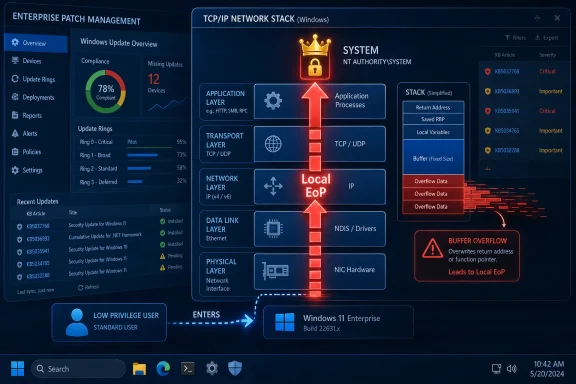
The TCP/IP Label Is Louder Than the Attack Path
There are few component names in Windows that raise blood pressure faster than TCP/IP. It is the plumbing every machine depends on, the stack that sits between the operating system and everything the network wants to throw at it. When Microsoft attaches a CVE to that surface, administrators immediately think of unauthenticated packets, exposed services, and long nights watching perimeter telemetry.
CVE-2026-40399 is not that kind of vulnerability, at least not according to Microsoft’s own published scoring. The CVSS vector marks the attack vector as local, with low attack complexity, low privileges required, and no user interaction required. In plain English, the attacker must already have some authorized access to the target system, but once there, the path to exploitation is not described as unusually complex.
That is the first tension in this bug. The affected component belongs to the network stack, but the exploit path is local. This is precisely the kind of vulnerability that can be misunderstood in both directions: overhyped by anyone reacting to “TCP/IP,” and underweighted by anyone who sees “local” and moves on.
Local privilege escalation is not a minor category in modern Windows intrusions. In many real-world attacks, initial access comes from stolen credentials, phishing, exposed remote access, a malicious document, a browser escape, or abuse of a legitimate management channel. The attacker’s next problem is almost always the same: how to move from “a user” to “the system.” CVE-2026-40399 sits in that second phase.
Microsoft’s Score Says “Important,” but the Impact Says “SYSTEM”
Microsoft rates the vulnerability as Important, with a CVSS 3.1 base score of 7.8 and a temporal score of 6.8. That is a familiar Microsoft Patch Tuesday shape: high technical impact, constrained exploit path, official fix available, and no evidence at publication that attackers are already using it. The base metrics are severe once exploitation succeeds: high confidentiality impact, high integrity impact, and high availability impact.
The FAQ detail is the line administrators should underline. Microsoft says a successful attacker could gain SYSTEM privileges. On Windows, SYSTEM is not merely “more permissions.” It is the local operating system’s most powerful built-in security context, the level used by core services and trusted components.
That does not make the bug remotely exploitable. It does make it strategically useful. A low-privileged account on a server, workstation, jump box, developer machine, or virtual desktop is often only the beginning of an incident; a reliable SYSTEM escalation can turn that beginning into persistence, credential theft, defense evasion, and lateral movement.
The stack-based buffer overflow classification is also meaningful. Microsoft maps the weakness to CWE-121, a category that has haunted C and C++ codebases for decades. Stack overflows are not automatically exploitable in the old-school, shellcode-on-the-stack sense — modern Windows has layers of mitigations — but the class still signals memory corruption in a sensitive path.
“Local” Does Not Mean “Harmless” in Enterprise Windows
The local attack vector often tempts organizations into relaxed prioritization. That instinct is understandable but outdated. In a tightly managed environment, many users, services, scripts, agents, and remote management paths can provide the “low privileges” necessary for an escalation attempt.
A local elevation-of-privilege vulnerability is especially important on shared systems. Remote Desktop Session Host deployments, multi-user workstations, lab machines, build servers, help-desk tools, and older line-of-business servers all create conditions where low-privileged local access may not be rare. In those environments, the difference between an ordinary account and SYSTEM is the difference between containment and full local compromise.
The vulnerability also matters on endpoints where the initial compromise is not expected to be privileged. Many modern defensive models assume that malware lands first in user space and then must fight its way upward. Application control, endpoint detection, browser sandboxing, and least privilege are all built around that assumption. A working EoP exploit attacks the assumption directly.
Microsoft’s “exploitation less likely” assessment is helpful, but it is not a promise. It is a snapshot at original publication, not a guarantee about what exploit developers will do after studying the patch. For memory corruption bugs in core Windows components, the real clock often starts when the update ships and attackers begin diffing changed binaries.
The Buffer Overflow Detail Narrows the Mystery
The user-facing MSRC description is brief: a stack-based buffer overflow in Windows TCP/IP allows an authorized attacker to elevate privileges locally. That sentence gives defenders more than a title, but less than an exploit narrative. It identifies the vulnerability class, the component, the access precondition, and the impact, while withholding the vulnerable code path.
That is the normal security-update bargain. Microsoft gives enough information for risk triage and patch validation, but not enough to hand attackers a recipe on release day. The tradeoff is that administrators must make decisions from metadata: CVSS vector, exploitability assessment, affected products, KB mappings, and whether any workaround exists.
Here, the metadata points in one direction. The attack requires local access and low privileges. It needs no user interaction. It has low attack complexity. It is confirmed by the vendor. It is not publicly disclosed and not known to be exploited at publication. The official fix is available.
That combination should put the vulnerability in the “patch promptly, do not panic” lane for most organizations. It should move higher for systems where low-privileged local access is common, where administrative credentials are cached, or where a compromised endpoint would provide a path into sensitive infrastructure.
Report Confidence Is the Quietly Important Metric
The text the user highlighted — the definition of report confidence — is one of the more overlooked parts of CVSS. It measures how certain the vulnerability report is and how credible the technical details are. In this case, Microsoft lists report confidence as Confirmed.
That does not mean exploit code is public. It means the vulnerability’s existence is not speculative. Microsoft, as the vendor and assigning CNA, has confirmed the presence of the flaw. The CVSS vector also marks exploit code maturity as Unproven, which indicates no publicly available exploit code or only theoretical exploitation at the time of publication.
Those two facts can coexist. A vulnerability can be confirmed without being actively exploited. In fact, that is the ideal patching window: the bug is real, the vendor has shipped a fix, and defenders have a chance to move before broad attacker adoption.
The “confirmed but unproven” pattern is where disciplined patch management earns its keep. Organizations that wait only for active exploitation are choosing to patch after the market has already moved. Organizations that treat every local EoP as a hair-on-fire emergency may burn credibility and operational capacity. The middle path is to prioritize based on where the bug changes the outcome of a likely intrusion.
The Affected Windows List Is Broad Enough to Touch Almost Everyone
Microsoft’s affected product table spans supported Windows client and server lines, including Windows 10, Windows 11, Windows Server 2016, Windows Server 2019, Windows Server 2022, Windows Server 2025, and Server Core variants. It also includes newer Windows 11 servicing branches, with separate entries for x64 and Arm64 systems where applicable.
That breadth is not surprising for a flaw in Windows TCP/IP. The component is foundational, and fixes land through cumulative updates or server security updates rather than through a niche application patch. For most managed environments, remediation will flow through the normal Windows Update, WSUS, Configuration Manager, Intune, Autopatch, or third-party patch orchestration pipeline.
The affected rows also show customer action required. That matters because this is not merely a documentation update or a mitigation-by-default notice. Administrators need to deploy the relevant monthly security update or hotpatch update where offered and applicable.
The presence of hotpatch entries for some server releases is notable but should not become a distraction. Hotpatching can reduce reboot pressure in supported configurations, especially on newer server platforms, but it does not eliminate the need to verify that the fixed build actually reached production machines. The operational question is not whether the update arrived elegantly; it is whether the vulnerable code path is gone.
Patch Tuesday’s Real Work Is Mapping KBs to Estates
For home users, the advice is simple: install the May 2026 Windows security updates. For administrators, the work is less glamorous. CVE-2026-40399 maps to different KB articles and build numbers across Windows versions, which means inventory accuracy is the first control.
A Windows 10 22H2 device is not remediated by the same build number as Windows 11 24H2, Windows Server 2022, or Windows Server 2025. Server Core systems are listed separately in Microsoft’s table, though they often share the same servicing package family as their desktop-experience counterparts. Older supported server versions also remain in scope, which is particularly relevant for enterprises still carrying legacy workloads.
This is where vulnerability management can get oddly brittle. A scanner may correctly identify the CVE, but remediation depends on servicing health, update deferrals, maintenance windows, reboot completion, supersedence logic, and whether a machine has drifted outside its expected support channel. A “missing KB” report is not the same as a verified exploit risk, but it is a strong signal that the endpoint is behind the intended security baseline.
Administrators should also remember that cumulative updates bundle many fixes. Delaying this update because CVE-2026-40399 is “only local” may also delay fixes for other vulnerabilities in the same monthly release. Patch triage rarely happens one CVE at a time, even when the incident ticket does.
The Exploitability Rating Buys Time, Not Immunity
Microsoft’s exploitability assessment says exploitation is less likely. That phrase has a specific operational value: it helps organizations sequence work when the monthly patch load is heavy. It does not mean exploitation is impossible, nor does it mean the vulnerability is irrelevant to attackers.
The distinction is especially important for privilege escalation flaws. Attackers do not always need the flashiest vulnerability in the batch. They need a reliable chain. A local EoP that works across many Windows builds can become valuable even if it lacks public exploit code on day one.
The absence of public disclosure is also temporary comfort. Once a security update is released, motivated researchers and adversaries can compare patched and unpatched binaries. This is not instant magic, but it is a well-established path from patch to proof-of-concept, particularly for memory corruption bugs where the changed code may reveal the vulnerable boundary check.
That does not mean every organization must emergency-patch every endpoint within hours. It does mean that “less likely” should be read as a scheduling input, not a reason to defer into the indefinite future. If the estate includes shared servers, developer workstations, privileged admin jump hosts, or exposed remote-access endpoints, the patch should move faster.
Why SYSTEM Still Changes the Defender’s Math
SYSTEM-level compromise gives attackers options that ordinary user-level compromise does not. They may tamper with local security tooling, access protected files, dump credentials from memory where other mitigations allow, install services, manipulate drivers, or establish persistence that survives ordinary user cleanup. Even when endpoint protection detects some of those moves, the attacker has more room to fight.
This is why local EoP bugs often appear in mature intrusion chains. Initial access is noisy and opportunistic; privilege escalation is the step that makes the foothold durable. A phishing payload running as a standard user is one problem. The same payload with SYSTEM privileges is a different incident.
Windows has invested heavily in hardening this terrain. Virtualization-based security, Credential Guard, driver signing, kernel-mode code integrity, LSASS protections, exploit mitigations, and tamper protection all raise the bar. But those defenses are not uniform across all Windows versions, hardware generations, enterprise baselines, or legacy server roles.
A vulnerability like CVE-2026-40399 should therefore be evaluated against the actual environment, not an ideal Windows security model. If users run without admin rights, that is good — but it also means attackers want local EoP vulnerabilities. If servers are heavily locked down, that is good — but shared operational access may still provide the low-privilege foothold needed to try an exploit.
The Network Stack Remains a Privileged Target Even When the Bug Is Local
It may seem odd that a TCP/IP bug is scored as local, but Windows’ networking implementation is not just a passive listener for packets. The stack interacts with drivers, sockets, filters, policies, offload features, virtualization layers, VPN clients, firewalls, and system services. Local processes can often exercise network-stack code paths without sending an attack from across the internet.
That is part of what makes the component attractive. Network code often runs in privileged contexts, handles complex state, and must process input from many layers. Bugs in such code do not need to be remotely reachable to matter; they only need to create a path from constrained execution to privileged execution.
The Windows ecosystem also complicates the picture. Third-party endpoint agents, VPN software, packet capture tools, firewall products, overlay networking, virtualization platforms, and container networking can all sit near the same terrain. Microsoft’s advisory does not say those products are involved in CVE-2026-40399, and defenders should not invent dependencies. But in practice, the more complex the local networking environment, the more important it is to test cumulative updates quickly rather than slowly.
For administrators, the key is not to guess the exploit path. It is to recognize that the component is central enough that the patch deserves standard security-update urgency, and the local requirement should shape prioritization rather than excuse delay.
The Practical Risk Is Highest Where Low Privilege Is Easy to Obtain
Not all Windows systems are equal here. A locked-down single-user workstation with current patches, no exposed management plane, and no local untrusted users has a different risk profile from a multi-user server, a developer workstation, or a remote-access host. The vulnerability’s preconditions make environment more important than brand-name severity.
Developer machines deserve particular attention. They often contain credentials, source code, signing material, cloud tokens, package-manager secrets, and local virtualization environments. They also run unusual tools that exercise operating-system internals in ways ordinary office endpoints do not. A local EoP on a developer workstation can become a supply-chain problem if the attacker reaches build systems or code repositories.
Jump servers and administrative workstations are another priority tier. If an attacker lands with low privileges on a machine used for privileged administration, SYSTEM-level control may expose cached credentials, session material, scripts, or management tooling. Even when privileged access management is in place, these systems are high-value because they mediate trust.
Shared Windows servers are the third obvious tier. Any place where multiple users or services can run code locally creates a more plausible path to exploitation. The same is true for virtual desktop infrastructure, lab environments, education settings, and contractor-access machines.
The Fix Is Straightforward; Verification Is the Hard Part
Microsoft has issued official fixes through the May 2026 security updates. That is the cleanest part of this story. There is no special mitigation published as the main answer, no registry key to toggle, and no vendor workaround being positioned as equivalent to patching.
The harder part is proving the update landed everywhere it should. Windows servicing is reliable at global scale, but individual estates accumulate exceptions: paused update rings, offline laptops, broken components, unsupported images, devices that never reboot, servers excluded from maintenance, and appliances running Windows under somebody else’s operational ownership.
Build-number verification matters for this CVE because Microsoft’s table lists fixed builds by product. A device that has downloaded an update but not completed installation is not remediated. A server that installed the cumulative update but awaits reboot may still be running old binaries. A scan that reports only “pending reboot” is not a bureaucratic nuisance; it is a live security state.
Security teams should also avoid treating hotpatch availability as a universal answer. Hotpatching is valuable where supported, especially for reducing downtime, but mixed estates still need conventional cumulative updates. The practical question is whether each product line reached its fixed build, not whether the organization used the newest servicing feature on part of the fleet.
The May 2026 Patch Queue Has a Familiar Lesson
CVE-2026-40399 is not the kind of vulnerability that should dominate headlines by itself. There is no public exploitation at publication, no public disclosure, no remote unauthenticated path, and no wormable description. But it is exactly the kind of vulnerability that mature defenders dislike leaving behind.
The reason is simple: privilege escalation bugs age poorly. When they are first published, they may look like routine monthly hygiene. Weeks later, after researchers have studied the patch and attackers have folded working primitives into toolchains, they can become the missing link in an intrusion sequence. The vulnerability did not become more real; the ecosystem around it matured.
That is why Microsoft’s temporal score matters. The official fix reduces the temporal score, and unproven exploit maturity keeps it below the base score. But report confidence is confirmed, and the impact is SYSTEM. The clock is therefore not an alarm bell, but it is ticking.
For WindowsForum readers, the best interpretation is sober urgency. This is not a reason to unplug networks or rewrite firewall rules. It is a reason to make sure the May 2026 Windows security updates move through rings on schedule, with accelerated handling for systems where local access is common or privilege boundaries matter most.
The Windows TCP/IP Bug That Rewards Boring Discipline
The concrete lesson from CVE-2026-40399 is that good patch management is not merely about chasing exploited zero-days. It is about closing the reliable stepping stones attackers hope will remain in place after initial access.
- CVE-2026-40399 is a confirmed Windows TCP/IP stack-based buffer overflow published by Microsoft on May 12, 2026.
- Microsoft rates the vulnerability Important, with a CVSS 3.1 base score of 7.8 and a temporal score of 6.8.
- The attack vector is local, requires low privileges, requires no user interaction, and can lead to SYSTEM privileges if exploited successfully.
- Microsoft says the vulnerability was not publicly disclosed and was not known to be exploited at original publication.
- The affected product list spans supported Windows client and server releases, including Windows 10, Windows 11, Windows Server 2016, Windows Server 2019, Windows Server 2022, Windows Server 2025, and Server Core installations.
- The right operational response is to deploy and verify the May 2026 security updates, prioritizing shared systems, admin workstations, developer machines, and servers where low-privileged local access is plausible.
CVE-2026-40399 is a reminder that Windows security is often decided after the first door has opened. Microsoft has provided the fix before public exploitation is known, which gives administrators the rare advantage of time; the organizations that use that time to close local escalation paths will be harder to turn from compromised into conquered.