
Target’s “Take a tour: Microsoft Copilot” video, published on Target’s corporate media site, showcases the retailer’s use of Microsoft’s AI assistant as part of a broader enterprise push to bring generative AI into store operations, employee workflows, and customer-facing retail experiences. The clip is less important as a demo than as a signal. Target is not merely experimenting with AI in a lab; it is presenting Copilot-style assistance as part of the operating fabric of a national retailer.
The most interesting thing about Target’s Copilot tour is not that a large company is using Microsoft’s AI stack. That has become almost routine. The interesting part is where Target places the technology: not in a glossy productivity keynote, but inside the everyday machinery of retail work.
Retail is an unforgiving test bed for enterprise AI because the work is repetitive, high-volume, and messy. A store associate does not have the luxury of spending five minutes prompt-engineering a perfect answer while a guest waits in aisle 12. If an AI assistant cannot answer quickly, respect policy boundaries, and reduce friction, it becomes another screen to tap through rather than a tool.
That is why Target’s framing matters. The company’s earlier rollout of its Store Companion chatbot to team members across nearly 2,000 U.S. stores positioned generative AI as a way to answer procedural questions, support new and seasonal workers, and help employees handle guest requests with more confidence. The Copilot tour sits naturally in that same arc: AI as an operational layer, not a novelty.
For Microsoft, this is exactly the kind of customer story Copilot needs. The company has spent years telling businesses that AI will become an everyday companion across Windows, Microsoft 365, Teams, Power Platform, and custom enterprise agents. Target gives that pitch a concrete retail setting, where the success metric is not a clever generated paragraph but a worker who can solve a problem faster.
That environment exposes the difference between generative capability and operational usefulness. A chatbot that can produce fluent prose is not automatically useful to a store associate. It has to know the organization’s policies, inventory language, return processes, loyalty-program rules, and escalation paths. It also has to admit when it does not know.
Target’s move suggests a more realistic model for workplace AI adoption. Instead of asking employees to become AI hobbyists, the company appears to be wrapping AI around narrow, high-frequency tasks. That is where Copilot and Copilot Studio-style systems have their best shot: converting internal knowledge into conversational assistance without requiring every employee to memorize a policy manual.
The risk is that “ask the AI” becomes a convenient substitute for fixing broken internal systems. If a worker needs an AI assistant because the underlying workflow is too complex, the assistant may mask the problem rather than solve it. But in a business as large as Target, where seasonal hiring and local store variation are unavoidable, even partial simplification can be valuable.
That matters for WindowsForum readers because the Copilot story is no longer confined to the Windows taskbar. The consumer-facing Copilot button and the enterprise-facing Copilot ecosystem share a name, but the business value is increasingly in the second category. Microsoft wants Copilot to be a governed, extensible assistant that companies can adapt to their own data and workflows.
Target’s video plays into that evolution. A retailer does not need a general AI companion that can write poetry and explain quantum mechanics. It needs a controlled assistant that can answer, “How do I handle this guest situation?” or “What is the correct process for this device, register, shipment, or store task?”
That is where Microsoft’s stack has an advantage over a standalone chatbot. Copilot can be tied to identity, permissions, admin controls, data loss prevention policies, audit logs, and the broader Microsoft 365 environment. For IT departments, those details are not footnotes. They are the difference between a pilot and a deployment.
That was a notable threshold. Many companies had announced AI pilots, but Target was talking about chainwide use among frontline retail workers. This was not a white-collar Copilot deployment for email and spreadsheets. It was AI moving into a labor environment where workers are measured by responsiveness, accuracy, and throughput.
The examples Target gave were deliberately practical. The assistant could help with questions about store processes, product locations, loyalty programs, and operational troubleshooting. That is not glamorous, but it is exactly the kind of work where a reliable internal assistant can have a compounding effect.
The word “reliable” is doing a lot of work. In retail, a confident wrong answer can create guest frustration, policy violations, or wasted time. So the question is not whether Target can put a chatbot on a handheld device. The question is whether it can keep the system grounded in approved knowledge and update it as store processes change.
A store worker needs short answers, not essays. The interface must be fast enough to use between tasks. It must understand internal terminology, but it cannot assume the user knows how to ask a perfect question. It must be secure, but not so cumbersome that workers avoid it.
This creates a product category that is closer to an intelligent operations manual than a creative assistant. The system succeeds when it disappears into the work. If the employee can resolve a guest issue without calling a supervisor or hunting through a knowledge base, the AI has done its job.
That also changes the economics. Microsoft’s office Copilot pitch is often about saving minutes across knowledge-work tasks. Target’s retail AI pitch is about scaling consistency across thousands of locations and hundreds of thousands of interactions. Those are different ROI stories, and the retail one may be easier to observe if the tooling is instrumented well.
Microsoft has been building Copilot Studio and related governance features around exactly those concerns. Organizations can define knowledge sources, restrict connectors, manage publishing, apply data policies, and use compliance tooling to monitor how agents behave. That is the unglamorous plumbing that makes enterprise AI deployable.
For a retailer, those controls are essential. A public-facing shopping assistant, a store-worker assistant, and an HR self-service bot should not have access to the same information. A seasonal team member should not be able to surface sensitive internal data simply because the prompt was phrased cleverly. A customer-support agent should not improvise policy beyond what the company permits.
This is where Microsoft’s enterprise story differs from consumer AI. The consumer product can be playful, broad, and personal. The enterprise product has to be boring in all the right ways: permissioned, logged, limited, monitored, and reversible.
That does not mean Windows is irrelevant. Quite the opposite. Windows remains the managed endpoint, the place where identity, device policy, browser access, security tooling, and productivity apps converge. But the Copilot that matters most to IT may not be the one pinned to the taskbar; it may be the one embedded in Teams, Power Platform, line-of-business apps, or a custom frontline device experience.
For administrators, this broadens the job. Copilot adoption is not just a Windows feature toggle. It is a governance project that crosses Entra ID, Microsoft 365 admin policies, Purview, Defender, Power Platform environments, data classification, and user training.
The more Copilot becomes an enterprise interface, the more Windows management becomes part of AI management. Device posture, app access, browser controls, and identity hygiene all shape what an AI assistant can safely do.
Those two sides are related, but they carry different risks. Internal AI can be governed within the company’s identity and policy framework. Consumer-facing AI has to handle brand presentation, product accuracy, fulfillment promises, personalization, privacy expectations, and the possibility that the shopping interface is no longer fully controlled by Target’s own app or website.
The ChatGPT shopping move is especially important because it points toward a future where retailers may have to compete inside AI interfaces they do not own. If a customer asks an assistant to plan a birthday party, build a back-to-school list, or find a same-day pickup option, the retailer wants to be present at the moment of intent. That is a different battle from search-engine optimization or app engagement.
Microsoft’s Copilot ecosystem and OpenAI’s ChatGPT commerce ambitions are not identical, but Target’s participation in both worlds shows how major retailers are hedging. They want AI inside the company to improve execution, and they want AI outside the company to become a new storefront.
Conversational shopping is more volatile. It asks customers to trust an AI intermediary with product discovery, basket building, and potentially purchase decisions. It also raises the question of who owns the customer relationship when the shopping journey begins in a third-party assistant.
Retailers have spent years trying to pull customers into their own apps because apps create data, loyalty, notifications, and repeat engagement. AI shopping assistants could invert that pattern. The retailer may become a fulfillment and inventory endpoint inside someone else’s conversational layer.
That does not mean Target is wrong to move early. It means the strategic stakes are higher than a holiday-shopping convenience feature. If AI assistants become a major shopping interface, retailers that wait too long may find themselves negotiating for visibility in a channel shaped by platform companies.
For example, does Store Companion reduce supervisor escalations? Does it shorten training time for seasonal workers? Does it improve guest satisfaction scores in departments where policy questions are frequent? Does it reduce time spent searching internal documentation? Does it create new support burdens when answers are unclear?
These are not hostile questions. They are the questions that separate successful software deployment from executive theater. AI systems can create value, but they also create new work: content curation, prompt testing, red-teaming, access reviews, feedback loops, and change management.
There is also a human factor. Workers may like a tool that helps them avoid embarrassment or uncertainty. They may resent a tool that feels like surveillance, automation pressure, or a way to reduce staffing. The same chatbot can be perceived as empowerment or management leverage depending on how it is introduced.
An AI assistant can also be outdated, overly cautious, too verbose, insensitive to context, or technically correct but practically useless. It can route users to the wrong workflow. It can expose inconsistencies in company policy. It can reduce the incentive to simplify the underlying process.
In retail, even small frictions matter. If the assistant takes too long to respond, workers stop using it. If it produces answers that need to be checked every time, it becomes a slower search engine. If it cannot distinguish between policy exceptions and standard procedures, it may push workers toward rigid behavior that frustrates customers.
The best enterprise AI systems will probably look less like magical general intelligence and more like carefully maintained, tightly scoped operational tools. That may disappoint futurists, but it is how useful technology usually enters large organizations.
This is why Microsoft keeps tying Copilot to agents. A basic chatbot answers. An agent can act, or at least coordinate a workflow. In enterprise terms, that means connecting conversational AI to tickets, inventory systems, HR processes, knowledge bases, reporting tools, and customer-service platforms.
The catch is that agentic AI raises the stakes. A wrong answer is one thing. A wrong action is another. Enterprises will need approval steps, audit trails, rollback options, and clear boundaries around which tasks can be automated and which require human review.
Target’s current retail-worker AI framing wisely emphasizes assistance rather than autonomy. That is the right place to start. The danger comes when the industry rushes from “help me understand the process” to “perform the process for me” before the governance model is mature.
This is a cultural shift. Traditional IT support can often treat applications as relatively fixed objects. AI assistants are more like living interfaces whose outputs depend on data, prompts, permissions, models, and user behavior. They require continuous evaluation.
For WindowsForum’s sysadmin audience, that should sound familiar and alarming in equal measure. Every new abstraction promises simplicity, but someone still has to manage the identity boundaries, data flows, endpoint policies, compliance requirements, and user expectations underneath.
The organizations that succeed with Copilot will not be the ones that merely buy licenses. They will be the ones that treat AI deployment as an operating model, with ownership, measurement, incident response, and a willingness to say no to use cases that are not ready.
That does not mean the technology is mature. It means the experiment has become operational. Store associates, managers, administrators, and customers are now part of the test environment. The results will be messier than the demos and more important than the keynote slides.
For Microsoft, Target is a useful proof point because retail is legible. Everyone understands the problem of needing a quick answer in a store. Everyone understands the cost of confusion at the point of service. If Copilot-style tools can help there, Microsoft’s enterprise AI pitch becomes easier to believe.
But the inverse is also true. If these systems become slow, inaccurate, over-governed, or distrusted by workers, the failure will be visible. Retail does not hide bad software well.
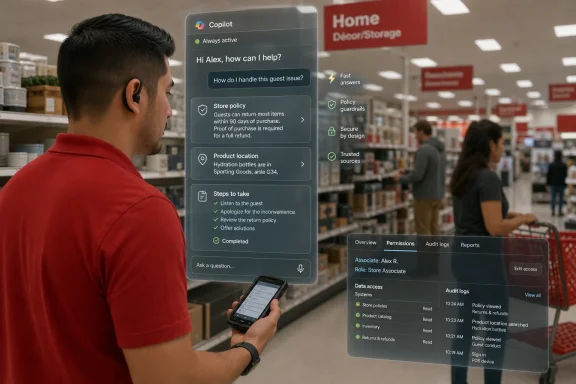 Target Turns the AI Demo Into a Store Operations Story
The most interesting thing about Target’s Copilot tour is not that a large company is using Microsoft’s AI stack. That has become almost routine. The interesting part is where Target places the technology: not in a glossy productivity keynote, but inside the everyday machinery of retail work.Retail is an unforgiving test bed for enterprise AI because the work is repetitive, high-volume, and messy. A store associate does not have the luxury of spending five minutes prompt-engineering a perfect answer while a guest waits in aisle 12. If an AI assistant cannot answer quickly, respect policy boundaries, and reduce friction, it becomes another screen to tap through rather than a tool.
That is why Target’s framing matters. The company’s earlier rollout of its Store Companion chatbot to team members across nearly 2,000 U.S. stores positioned generative AI as a way to answer procedural questions, support new and seasonal workers, and help employees handle guest requests with more confidence. The Copilot tour sits naturally in that same arc: AI as an operational layer, not a novelty.
For Microsoft, this is exactly the kind of customer story Copilot needs. The company has spent years telling businesses that AI will become an everyday companion across Windows, Microsoft 365, Teams, Power Platform, and custom enterprise agents. Target gives that pitch a concrete retail setting, where the success metric is not a clever generated paragraph but a worker who can solve a problem faster.
The Retail Floor Is Where AI Hype Meets Queue Length
Enterprise AI often looks more convincing in conference demos than in production. The model summarizes a document, drafts an email, or builds a presentation, and the audience applauds. In retail, the applause is replaced by a line of customers, a device with a cracked screen protector, spotty Wi-Fi, and a worker who may have joined the company last week.That environment exposes the difference between generative capability and operational usefulness. A chatbot that can produce fluent prose is not automatically useful to a store associate. It has to know the organization’s policies, inventory language, return processes, loyalty-program rules, and escalation paths. It also has to admit when it does not know.
Target’s move suggests a more realistic model for workplace AI adoption. Instead of asking employees to become AI hobbyists, the company appears to be wrapping AI around narrow, high-frequency tasks. That is where Copilot and Copilot Studio-style systems have their best shot: converting internal knowledge into conversational assistance without requiring every employee to memorize a policy manual.
The risk is that “ask the AI” becomes a convenient substitute for fixing broken internal systems. If a worker needs an AI assistant because the underlying workflow is too complex, the assistant may mask the problem rather than solve it. But in a business as large as Target, where seasonal hiring and local store variation are unavoidable, even partial simplification can be valuable.
Microsoft’s Bet Is That Copilot Becomes the Interface
Microsoft’s strategic aim is not hard to see. Copilot is not just a chatbot brand; it is Microsoft’s attempt to make natural-language interaction the connective tissue across its software estate. In one setting it summarizes Teams meetings. In another it drafts a Word document. In a retail scenario, it can become the front door to policies, procedures, forms, and operational knowledge.That matters for WindowsForum readers because the Copilot story is no longer confined to the Windows taskbar. The consumer-facing Copilot button and the enterprise-facing Copilot ecosystem share a name, but the business value is increasingly in the second category. Microsoft wants Copilot to be a governed, extensible assistant that companies can adapt to their own data and workflows.
Target’s video plays into that evolution. A retailer does not need a general AI companion that can write poetry and explain quantum mechanics. It needs a controlled assistant that can answer, “How do I handle this guest situation?” or “What is the correct process for this device, register, shipment, or store task?”
That is where Microsoft’s stack has an advantage over a standalone chatbot. Copilot can be tied to identity, permissions, admin controls, data loss prevention policies, audit logs, and the broader Microsoft 365 environment. For IT departments, those details are not footnotes. They are the difference between a pilot and a deployment.
Store Companion Was the First Serious Clue
Target’s 2024 Store Companion rollout was the more consequential announcement, even if the newer Copilot tour is the shinier artifact. At the time, Target said it planned to bring a generative AI tool to team members at all of its nearly 2,000 stores by August 2024. The tool was described as an app on handheld devices that could answer job-related questions in a conversational way.That was a notable threshold. Many companies had announced AI pilots, but Target was talking about chainwide use among frontline retail workers. This was not a white-collar Copilot deployment for email and spreadsheets. It was AI moving into a labor environment where workers are measured by responsiveness, accuracy, and throughput.
The examples Target gave were deliberately practical. The assistant could help with questions about store processes, product locations, loyalty programs, and operational troubleshooting. That is not glamorous, but it is exactly the kind of work where a reliable internal assistant can have a compounding effect.
The word “reliable” is doing a lot of work. In retail, a confident wrong answer can create guest frustration, policy violations, or wasted time. So the question is not whether Target can put a chatbot on a handheld device. The question is whether it can keep the system grounded in approved knowledge and update it as store processes change.
AI for Frontline Workers Is a Different Product Category
Most of the Copilot conversation has centered on office workers. Microsoft 365 Copilot is easiest to understand when attached to Outlook, Excel, PowerPoint, Word, and Teams. But frontline use changes the design requirements.A store worker needs short answers, not essays. The interface must be fast enough to use between tasks. It must understand internal terminology, but it cannot assume the user knows how to ask a perfect question. It must be secure, but not so cumbersome that workers avoid it.
This creates a product category that is closer to an intelligent operations manual than a creative assistant. The system succeeds when it disappears into the work. If the employee can resolve a guest issue without calling a supervisor or hunting through a knowledge base, the AI has done its job.
That also changes the economics. Microsoft’s office Copilot pitch is often about saving minutes across knowledge-work tasks. Target’s retail AI pitch is about scaling consistency across thousands of locations and hundreds of thousands of interactions. Those are different ROI stories, and the retail one may be easier to observe if the tooling is instrumented well.
The Governance Layer Is the Real Product
The public tends to judge AI by the model. IT departments judge it by the control plane. Target’s Copilot tour may look like another corporate AI video, but the deployment questions behind it are deeply administrative: who can ask what, which data can be used, what gets logged, what is retained, and who is accountable when the answer is wrong.Microsoft has been building Copilot Studio and related governance features around exactly those concerns. Organizations can define knowledge sources, restrict connectors, manage publishing, apply data policies, and use compliance tooling to monitor how agents behave. That is the unglamorous plumbing that makes enterprise AI deployable.
For a retailer, those controls are essential. A public-facing shopping assistant, a store-worker assistant, and an HR self-service bot should not have access to the same information. A seasonal team member should not be able to surface sensitive internal data simply because the prompt was phrased cleverly. A customer-support agent should not improvise policy beyond what the company permits.
This is where Microsoft’s enterprise story differs from consumer AI. The consumer product can be playful, broad, and personal. The enterprise product has to be boring in all the right ways: permissioned, logged, limited, monitored, and reversible.
The Windows Angle Is Bigger Than the Taskbar
Windows users have spent the past few years watching Microsoft place Copilot into the operating system with varying degrees of elegance. Sometimes it felt like an ambitious rethinking of PC interaction. Sometimes it felt like a web panel looking for a purpose. Target’s use case is a reminder that Microsoft’s AI center of gravity may be shifting away from the PC shell and toward the enterprise workflow.That does not mean Windows is irrelevant. Quite the opposite. Windows remains the managed endpoint, the place where identity, device policy, browser access, security tooling, and productivity apps converge. But the Copilot that matters most to IT may not be the one pinned to the taskbar; it may be the one embedded in Teams, Power Platform, line-of-business apps, or a custom frontline device experience.
For administrators, this broadens the job. Copilot adoption is not just a Windows feature toggle. It is a governance project that crosses Entra ID, Microsoft 365 admin policies, Purview, Defender, Power Platform environments, data classification, and user training.
The more Copilot becomes an enterprise interface, the more Windows management becomes part of AI management. Device posture, app access, browser controls, and identity hygiene all shape what an AI assistant can safely do.
Target’s AI Strategy Runs in Two Directions at Once
Target is not only thinking about employee assistance. The company has also moved toward conversational shopping, including plans to let consumers discover and shop Target through ChatGPT. That creates a two-sided AI strategy: one side helps workers operate the business, while the other tries to reshape how guests find and buy products.Those two sides are related, but they carry different risks. Internal AI can be governed within the company’s identity and policy framework. Consumer-facing AI has to handle brand presentation, product accuracy, fulfillment promises, personalization, privacy expectations, and the possibility that the shopping interface is no longer fully controlled by Target’s own app or website.
The ChatGPT shopping move is especially important because it points toward a future where retailers may have to compete inside AI interfaces they do not own. If a customer asks an assistant to plan a birthday party, build a back-to-school list, or find a same-day pickup option, the retailer wants to be present at the moment of intent. That is a different battle from search-engine optimization or app engagement.
Microsoft’s Copilot ecosystem and OpenAI’s ChatGPT commerce ambitions are not identical, but Target’s participation in both worlds shows how major retailers are hedging. They want AI inside the company to improve execution, and they want AI outside the company to become a new storefront.
The Employee Assistant Is Easier to Defend Than the Shopping Bot
From a business perspective, internal AI assistance may be the cleaner story. It can be measured against operational metrics, constrained by policy, and rolled out with training. A store associate using an AI assistant to answer a procedural question is still inside Target’s management structure.Conversational shopping is more volatile. It asks customers to trust an AI intermediary with product discovery, basket building, and potentially purchase decisions. It also raises the question of who owns the customer relationship when the shopping journey begins in a third-party assistant.
Retailers have spent years trying to pull customers into their own apps because apps create data, loyalty, notifications, and repeat engagement. AI shopping assistants could invert that pattern. The retailer may become a fulfillment and inventory endpoint inside someone else’s conversational layer.
That does not mean Target is wrong to move early. It means the strategic stakes are higher than a holiday-shopping convenience feature. If AI assistants become a major shopping interface, retailers that wait too long may find themselves negotiating for visibility in a channel shaped by platform companies.
The Productivity Pitch Needs Harder Numbers
The weakest part of nearly every enterprise AI announcement is measurement. Vendors and customers can describe time savings, improved confidence, smoother workflows, and better experiences, but the numbers are often selective or early. Target’s AI story would become much more persuasive if the company eventually discloses concrete operational outcomes.For example, does Store Companion reduce supervisor escalations? Does it shorten training time for seasonal workers? Does it improve guest satisfaction scores in departments where policy questions are frequent? Does it reduce time spent searching internal documentation? Does it create new support burdens when answers are unclear?
These are not hostile questions. They are the questions that separate successful software deployment from executive theater. AI systems can create value, but they also create new work: content curation, prompt testing, red-teaming, access reviews, feedback loops, and change management.
There is also a human factor. Workers may like a tool that helps them avoid embarrassment or uncertainty. They may resent a tool that feels like surveillance, automation pressure, or a way to reduce staffing. The same chatbot can be perceived as empowerment or management leverage depending on how it is introduced.
Hallucination Is Only One Failure Mode
Much of the public debate about generative AI focuses on hallucination, and for good reason. A system that invents facts is a dangerous source of operational guidance. But in enterprise deployments, hallucination is only one category of failure.An AI assistant can also be outdated, overly cautious, too verbose, insensitive to context, or technically correct but practically useless. It can route users to the wrong workflow. It can expose inconsistencies in company policy. It can reduce the incentive to simplify the underlying process.
In retail, even small frictions matter. If the assistant takes too long to respond, workers stop using it. If it produces answers that need to be checked every time, it becomes a slower search engine. If it cannot distinguish between policy exceptions and standard procedures, it may push workers toward rigid behavior that frustrates customers.
The best enterprise AI systems will probably look less like magical general intelligence and more like carefully maintained, tightly scoped operational tools. That may disappoint futurists, but it is how useful technology usually enters large organizations.
Microsoft Wins If Copilot Becomes Middleware
For Microsoft, the Target story reinforces a larger ambition: Copilot as middleware between human intent and enterprise systems. The user asks in natural language. The assistant retrieves knowledge, checks permissions, invokes tools, summarizes results, and guides the next action. That is the real platform play.This is why Microsoft keeps tying Copilot to agents. A basic chatbot answers. An agent can act, or at least coordinate a workflow. In enterprise terms, that means connecting conversational AI to tickets, inventory systems, HR processes, knowledge bases, reporting tools, and customer-service platforms.
The catch is that agentic AI raises the stakes. A wrong answer is one thing. A wrong action is another. Enterprises will need approval steps, audit trails, rollback options, and clear boundaries around which tasks can be automated and which require human review.
Target’s current retail-worker AI framing wisely emphasizes assistance rather than autonomy. That is the right place to start. The danger comes when the industry rushes from “help me understand the process” to “perform the process for me” before the governance model is mature.
IT Departments Become AI Product Managers
The Copilot era asks IT teams to do something more subtle than deploy software. They have to become stewards of AI behavior. That means deciding which knowledge sources are authoritative, which roles get access, how feedback is reviewed, and when an answer should be escalated rather than generated.This is a cultural shift. Traditional IT support can often treat applications as relatively fixed objects. AI assistants are more like living interfaces whose outputs depend on data, prompts, permissions, models, and user behavior. They require continuous evaluation.
For WindowsForum’s sysadmin audience, that should sound familiar and alarming in equal measure. Every new abstraction promises simplicity, but someone still has to manage the identity boundaries, data flows, endpoint policies, compliance requirements, and user expectations underneath.
The organizations that succeed with Copilot will not be the ones that merely buy licenses. They will be the ones that treat AI deployment as an operating model, with ownership, measurement, incident response, and a willingness to say no to use cases that are not ready.
Target’s Tour Shows the AI Rollout Has Left the Lab
Target’s Copilot video is a corporate media asset, but it captures a real shift in enterprise technology. AI is moving from abstract productivity claims into specific work settings where its usefulness can be tested by ordinary employees under ordinary pressure.That does not mean the technology is mature. It means the experiment has become operational. Store associates, managers, administrators, and customers are now part of the test environment. The results will be messier than the demos and more important than the keynote slides.
For Microsoft, Target is a useful proof point because retail is legible. Everyone understands the problem of needing a quick answer in a store. Everyone understands the cost of confusion at the point of service. If Copilot-style tools can help there, Microsoft’s enterprise AI pitch becomes easier to believe.
But the inverse is also true. If these systems become slow, inaccurate, over-governed, or distrusted by workers, the failure will be visible. Retail does not hide bad software well.
The Bullseye Lesson for Copilot Deployments
Target’s AI push offers a handful of concrete lessons for organizations watching from the sidelines. The details will differ by industry, but the deployment pattern is becoming clearer.- AI assistants work best when they are aimed at narrow, frequent, high-friction tasks that employees already struggle to complete quickly.
- Frontline deployments need shorter answers, stronger guardrails, and simpler interfaces than office-productivity deployments.
- Governance is not a compliance afterthought; it is the infrastructure that determines whether enterprise AI can safely scale.
- Internal AI assistance is easier to control and measure than consumer-facing conversational commerce, even if the latter gets more public attention.
- The most important Copilot work for IT may happen outside the Windows taskbar, inside identity systems, admin centers, data policies, and custom workflow integrations.
- Companies should measure AI adoption by operational outcomes, not by the number of employees who technically have access to a chatbot.
References
- Primary source: Target
Published: Thu, 18 Jun 2026 01:00:17 GMT
Video - Take a tour: Microsoft Copilot
corporate.target.com
- Related coverage: prnewswire.com
Target to Roll Out Transformative GenAI Technology to its Store Team Members Chainwide
/PRNewswire/ -- Target Corporation (NYSE: TGT) today announced plans to roll out a new generative artificial intelligence (GenAI) tool to team members at all... www.prnewswire.com
- Related coverage: pymnts.com
PYMNTS | Target Pilots GenAI-Powered Chatbot Designed for Store Staffers
Target is piloting a generative AI-powered chatbot that answers store staffers’ questions about on-the-job processes. www.pymnts.com
- Related coverage: iotm2mcouncil.org
- Related coverage: newsroom.workday.com
Workday Brings Sana Self-Service Agent for HR and Finance Into Microsoft 365 Copilot - May 13, 2026
See what’s new with Workday. Read more.newsroom.workday.com - Related coverage: thedrum.com
Target embraces generative AI with Store Companion | The Drum
 www.thedrum.com
- Related coverage: retail-insight-network.com
- Related coverage: retailrestaurantfb.com
Target to Roll Out GenAI Technology to its Store Team Members Chainwide - Retail & Restaurant Facility Business
Minneapolis — Target Corporation plans to roll out a new generative artificial intelligence (GenAI) tool to team members at all of its nearly 2,000 stores - News, Product Spotlight, retailers, software/technology, vendorsretailrestaurantfb.com - Related coverage: retailcustomerexperience.com
Target deploys GenAI tech to team members | Retail Customer Experience
Target has deployed a GenAI chatbot, called Store Companion, to its store team members. The GenAI tech is aimed at enhancing the shopping experience and making team members' jobs easier, according to a press release.www.retailcustomerexperience.com
- Related coverage: retailbrew.com
Target invests in generative AI tool for employees
The retailer will provide an AI-powered chatbot to employees at 2,000 stores by August. Other companies are getting similar ideas.www.retailbrew.com
- Related coverage: retailtechinnovationhub.squarespace.com
Target tap GenAI chatbot at US stores as technology plays outsized role in future of retail — Retail Technology Innovation Hub
Target has announced plans to roll-out a new generative artificial intelligence (GenAI) tool to team members at all of its nearly 2,000 stores by August. This makes it the first major retailer to share that it is bringing this technology to its store team members across the US.retailtechinnovationhub.squarespace.com
- Related coverage: axios.com
Target AI tool coming in August for store employees
Target is the latest retailer to announce its artificial intelligence plans and joins Apple, Amazon, Walmart and others.www.axios.com
- Related coverage: retailtouchpoints.com
Target Launches Gen-AI Chatbot for Store Associates Chainwide - Retail TouchPoints
Target plans to roll out a new gen AI-powered chatbot to aide store associates in nearly all of its 2,000 stores following a six-month pilot.www.retailtouchpoints.com - Official source: microsoft.com
Generative AI in Real-World Workplaces
Second Microsoft report on AI and productivity researchwww.microsoft.com
- Related coverage: newsroom.ibm.com
IBM Introduces New Microsoft Copilot Capabilities to Fuel AI-Powered Business Transformation
PDF documentnewsroom.ibm.com
- Official source: news.microsoft.com
- Official source: learn.microsoft.com
