

Microsoft Korea said on June 15, 2026, that Korean business leaders must redesign workflows, incentives, and management systems around AI agents rather than merely deploy tools, citing Microsoft’s 2026 Work Trend Index and Korea-specific survey results. The argument is not subtle: employees are already moving faster than the organizations that employ them. The risk for companies is no longer that workers will ignore AI. It is that workers will use it inside structures built to punish the very experimentation management claims to want.
Microsoft’s framing lands because it captures the strange mood of enterprise AI in 2026. Copilot licenses, agent pilots, and executive town halls are everywhere; durable operating-model change is not. Korea’s numbers sharpen the point: 78 percent of respondents said they felt at risk of falling behind in AI use, while only 16 percent said management’s AI strategy was clear. That is not an adoption gap. It is a leadership gap wearing a productivity dashboard.
For the first two years of the generative AI boom, the dominant corporate question was whether employees would use these systems at all. Microsoft, Google, OpenAI, Salesforce, and every consulting firm with a slide deck treated adoption as the first hill to take. Give workers a chatbot, wire it into documents and calendars, and wait for the productivity curve to bend upward.
The 2026 Work Trend Index marks a more mature, and more uncomfortable, phase of the story. Microsoft is now arguing that the tool layer is not enough. The company’s phrase for the problem, the “transformation paradox,” describes workers who feel urgency around AI but remain trapped in performance systems, approval chains, metrics, and cultural norms that reward pre-AI behavior.
That is a useful diagnosis even if it comes from a vendor with an obvious commercial interest in making AI feel inevitable. Microsoft sells Copilot, agents, cloud infrastructure, and the management tooling that surrounds them. But its self-interest does not make the observation wrong. In many organizations, AI has arrived as software procurement before it has arrived as management theory.
Cho Won-woo, Microsoft Korea’s head, put the issue in terms that should make executives slightly nervous: competitiveness depends not simply on adoption speed, but on whether organizations can turn workplace learning into shared routines. That is a stronger claim than “train your employees.” It says the firm itself has to learn, not just its staff.
That is a serious mismatch. A workforce that feels pressure to adapt without a clear management framework is likely to improvise. Some of that improvisation will be useful; some will be wasteful; some will create security, compliance, and quality problems that only appear after the demo phase has ended.
The reward structure looks even worse. Globally, 45 percent of respondents said it felt safer to maintain existing goals than to redesign work around AI. In Korea, 43 percent said the same. Only 13 percent globally said attempts at work redesign could be rewarded even if they did not immediately produce performance gains; in Korea, just 7 percent believed that.
Those numbers matter because they expose the hollowness of a familiar executive slogan: “Be innovative, but hit the old targets in the old way.” Employees hear that contradiction clearly. If experimentation is celebrated in speeches but ignored in compensation, promotion, and workload planning, the rational worker will use AI quietly at the edges and avoid challenging the process itself.
This is where AI transformation becomes politically difficult. Redesigning work means asking which meetings disappear, which approvals become automated, which documents no longer need to exist, and which teams lose control over familiar bottlenecks. The efficiency story is easy to sell in aggregate; it becomes more contested when it touches status, headcount, and authority.
Managers are also being asked to supervise work they may not fully understand. An employee using an AI agent to summarize customer tickets, draft a proposal, or test alternative market assumptions may produce output faster than the manager can evaluate the process behind it. That changes the manager’s role from task monitor to system designer and risk judge.
For WindowsForum readers, this is where the enterprise reality begins to diverge from the consumer AI fantasy. The issue is not whether Copilot can summarize a meeting or generate a draft. The issue is whether the organization knows when that summary becomes a record, when the draft becomes accountable work, and who owns the decision if the AI-assisted output is wrong.
The report’s four collaboration modes — delegation, collaboration, asking, and exploration — are a tidy way of describing what many workers are already doing informally. Sometimes the human sets direction and the agent executes a structured task. Sometimes the human and AI iterate together on a judgment-heavy artifact. Sometimes the AI is just a fast lookup tool. Sometimes the user is probing the system to discover what might be possible.
The danger is that companies treat all four modes as the same thing. They are not. Asking an AI to rewrite a sentence is a low-governance act; delegating research synthesis across internal documents is a higher-risk workflow; allowing an agent to act inside business systems raises still more questions about access, auditability, and rollback.
That is why “embedding AI in operations” is a more consequential phrase than it may first appear. Embedding means the work changes shape. It means prompts become procedures, exceptions become logs, and informal employee discoveries need a path into sanctioned practice. Without that path, every team becomes its own shadow IT department.
But “human in the loop” can become corporate theater if the loop is badly designed. A human asked to rubber-stamp AI output at speed is not exercising judgment; they are absorbing liability. A worker expected to validate machine-generated analysis without time, domain expertise, or access to source material is not empowered. They are the last soft target before the error reaches the customer.
The more serious interpretation is that human agency moves upstream. Humans decide which tasks are worth automating, which constraints matter, which trade-offs are acceptable, and when an AI-produced answer should be challenged. That is higher-value work, but it is also harder to measure than counting documents, tickets, or slide decks.
Microsoft’s data points in that direction. The company says analysis of more than 100,000 Microsoft 365 Copilot usage instances found that nearly half of conversations supported cognitive tasks such as information analysis, problem solving, alternative evaluation, and creative thinking. That suggests AI is not merely polishing emails. It is entering the terrain where organizations make judgments.
But higher-value work is not automatically better work. If AI compresses routine tasks but the organization simply fills the freed time with more meetings, more reporting, and more “alignment,” the productivity dividend evaporates. Worse, employees may experience AI not as liberation but as acceleration: the same job, more output, tighter deadlines.
This is where leadership has to make choices rather than admire adoption charts. If AI reduces the time required to create a first draft, does the saved time go into deeper analysis, customer contact, training, or simply another deliverable? If agents handle repetitive research, does the team redesign the research process or keep the old process and add agent output on top?
The report’s emphasis on learning systems is useful because it treats AI gains as something that must be captured and reinvested. A firm that learns from employee experiments can standardize effective patterns. A firm that does not will accumulate thousands of private shortcuts, many of them invisible to IT and unrewarded by management.
When workers feel pressure to use AI but lack clear guidance, they will find tools that solve immediate problems. That can mean consumer AI services, unsanctioned browser extensions, pasted customer data, or agents with more access than their tasks require. The “transformation paradox” therefore has a technical underside: urgency without governance produces risk.
Windows shops already know this pattern from every previous wave of workplace technology. Cloud storage, messaging apps, low-code tools, and browser-based SaaS all entered companies through a mix of official rollout and user improvisation. AI compresses that cycle because the perceived productivity payoff is immediate and the boundary between harmless assistance and sensitive processing is often blurry.
The answer is not to ban experimentation. That usually just pushes it underground. The answer is to give employees safe defaults, clear escalation paths, approved tools, data-handling rules, and a realistic account of what AI systems can and cannot be trusted to do. Governance that arrives only after a breach or embarrassment is not governance; it is cleanup.
That does not invalidate the work, but it does require adult reading. Microsoft benefits if executives conclude that AI must be embedded more deeply across workflows. It benefits if “frontier firms” become the aspirational model. It benefits if management teams decide that the next phase of AI investment is not fewer licenses, but more integration, more telemetry, more cloud services, and more organizational dependence on Microsoft’s stack.
Still, the report’s central argument has the ring of enterprise truth. Many companies have indeed treated AI as a feature rollout while leaving job design untouched. Many employees are using AI in ways their managers do not see. Many performance systems reward predictable delivery while leadership decks praise reinvention.
The skeptical position should not be that Microsoft is wrong because Microsoft has something to sell. The better critique is that Microsoft’s customers may underestimate the amount of organizational change required to make the software worth what they are paying for it.
This is the kind of institutional drag Microsoft is pointing to when it talks about metrics, incentives, and norms. The old measurements are not neutral. They tell employees what the organization truly values, regardless of what executives say about transformation.
AI makes this more urgent because it can produce plausible artifacts quickly. A slide deck, strategy memo, market scan, or code sample can now appear faster than the review culture around it can adapt. Organizations that confuse artifact velocity with business value will declare victory early and discover later that they automated the visible part of work, not the important part.
A redesigned metric system would ask different questions. Did the AI-assisted process improve the quality of the decision? Did it reduce rework? Did it expose assumptions earlier? Did it allow experts to spend more time on judgment and less time on formatting, retrieval, or routine synthesis? Those questions are harder than counting outputs, which is precisely why they matter.
No serious transformation happens without failed attempts. Process redesign involves false starts, awkward handoffs, bad prompts, incomplete data, and tools that work well in demos but fail in edge cases. If employees think those attempts will damage their evaluation, they will rationally avoid visible experimentation.
This is especially important in hierarchical organizations where alignment and performance discipline are culturally strong. AI experimentation can look messy. It may require junior employees to challenge established workflows, or managers to admit that a long-standing approval chain exists mainly because it has always existed.
Microsoft Korea’s message is therefore not just about technology adoption in Korea. It is about whether organizations with high execution discipline can create enough psychological and operational space to redesign work without interpreting every detour as underperformance.
The companies that benefit most from AI agents will probably not be the ones with the most enthusiastic prompt-sharing channels. They will be the ones that notice when a team has discovered a better workflow, validate it, secure it, document it, and propagate it. They will treat employee experimentation as raw material for operating-model change.
That has implications for IT departments. Admins will need to support sanctioned experimentation without losing control of identity, data boundaries, logging, retention, and compliance. Security teams will need policies that distinguish low-risk AI assistance from high-risk delegation. Business leaders will need to stop pretending that “AI strategy” is a quarterly announcement rather than a daily management practice.
The hard part is that this work is unglamorous. It involves permissions, templates, review gates, training, incentives, and postmortems. It is not as exciting as a keynote demo of autonomous agents completing a complex task. But it is where the difference between AI theater and AI transformation will be decided.
Microsoft’s 2026 Work Trend Index is, inevitably, a vendor document from a company with an enormous stake in the AI workplace. But the Korea findings point to a problem that cannot be solved by another license bundle or another inspirational memo. AI may elevate the human role, as Microsoft Korea argues, but only if leaders redesign the system around that role; otherwise, the future of work will look less like human agency expanded by agents and more like anxious employees racing ahead of institutions that still grade them by yesterday’s rules.
Microsoft’s framing lands because it captures the strange mood of enterprise AI in 2026. Copilot licenses, agent pilots, and executive town halls are everywhere; durable operating-model change is not. Korea’s numbers sharpen the point: 78 percent of respondents said they felt at risk of falling behind in AI use, while only 16 percent said management’s AI strategy was clear. That is not an adoption gap. It is a leadership gap wearing a productivity dashboard.
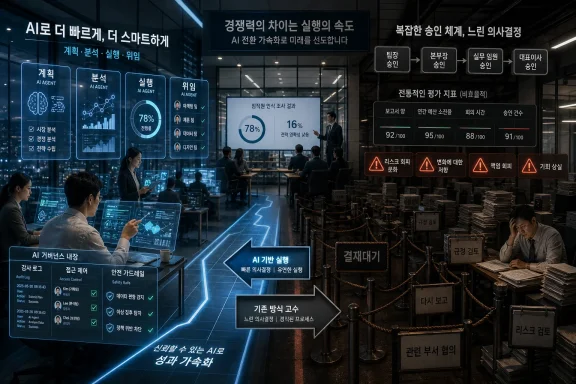 Microsoft’s AI Pitch Has Shifted From Tools to Operating Models
For the first two years of the generative AI boom, the dominant corporate question was whether employees would use these systems at all. Microsoft, Google, OpenAI, Salesforce, and every consulting firm with a slide deck treated adoption as the first hill to take. Give workers a chatbot, wire it into documents and calendars, and wait for the productivity curve to bend upward.The 2026 Work Trend Index marks a more mature, and more uncomfortable, phase of the story. Microsoft is now arguing that the tool layer is not enough. The company’s phrase for the problem, the “transformation paradox,” describes workers who feel urgency around AI but remain trapped in performance systems, approval chains, metrics, and cultural norms that reward pre-AI behavior.
That is a useful diagnosis even if it comes from a vendor with an obvious commercial interest in making AI feel inevitable. Microsoft sells Copilot, agents, cloud infrastructure, and the management tooling that surrounds them. But its self-interest does not make the observation wrong. In many organizations, AI has arrived as software procurement before it has arrived as management theory.
Cho Won-woo, Microsoft Korea’s head, put the issue in terms that should make executives slightly nervous: competitiveness depends not simply on adoption speed, but on whether organizations can turn workplace learning into shared routines. That is a stronger claim than “train your employees.” It says the firm itself has to learn, not just its staff.
Korea Shows the Paradox in High Contrast
The Korean findings are striking because they describe an especially sharp split between individual anxiety and institutional clarity. Globally, 65 percent of respondents said they feared falling behind if they did not adapt quickly to AI transformation. In Korea, that figure rose to 78 percent. Yet only 16 percent of Korean respondents said management’s AI direction was clear and consistent, compared with 26 percent globally.That is a serious mismatch. A workforce that feels pressure to adapt without a clear management framework is likely to improvise. Some of that improvisation will be useful; some will be wasteful; some will create security, compliance, and quality problems that only appear after the demo phase has ended.
The reward structure looks even worse. Globally, 45 percent of respondents said it felt safer to maintain existing goals than to redesign work around AI. In Korea, 43 percent said the same. Only 13 percent globally said attempts at work redesign could be rewarded even if they did not immediately produce performance gains; in Korea, just 7 percent believed that.
Those numbers matter because they expose the hollowness of a familiar executive slogan: “Be innovative, but hit the old targets in the old way.” Employees hear that contradiction clearly. If experimentation is celebrated in speeches but ignored in compensation, promotion, and workload planning, the rational worker will use AI quietly at the edges and avoid challenging the process itself.
The Middle Manager Becomes the Bottleneck and the Lever
Microsoft’s report says organizational factors such as culture, manager support, and talent practices account for 67 percent of AI’s tangible impact, more than twice the share attributed to individual mindsets and behaviors. That statistic should shift attention away from the heroic “AI power user” and toward the less glamorous terrain of management design. The person approving timelines, setting review criteria, and deciding what counts as good work may matter more than the prompt wizard in the corner.This is where AI transformation becomes politically difficult. Redesigning work means asking which meetings disappear, which approvals become automated, which documents no longer need to exist, and which teams lose control over familiar bottlenecks. The efficiency story is easy to sell in aggregate; it becomes more contested when it touches status, headcount, and authority.
Managers are also being asked to supervise work they may not fully understand. An employee using an AI agent to summarize customer tickets, draft a proposal, or test alternative market assumptions may produce output faster than the manager can evaluate the process behind it. That changes the manager’s role from task monitor to system designer and risk judge.
For WindowsForum readers, this is where the enterprise reality begins to diverge from the consumer AI fantasy. The issue is not whether Copilot can summarize a meeting or generate a draft. The issue is whether the organization knows when that summary becomes a record, when the draft becomes accountable work, and who owns the decision if the AI-assisted output is wrong.
Agents Raise the Stakes Beyond Chatbot Productivity
Microsoft’s 2026 report leans heavily into agents, and that emphasis is not accidental. A chatbot waits for a prompt; an agent is supposed to execute a task across tools, data, and workflow boundaries. That difference turns AI from a personal assistant into something closer to a junior operational actor.The report’s four collaboration modes — delegation, collaboration, asking, and exploration — are a tidy way of describing what many workers are already doing informally. Sometimes the human sets direction and the agent executes a structured task. Sometimes the human and AI iterate together on a judgment-heavy artifact. Sometimes the AI is just a fast lookup tool. Sometimes the user is probing the system to discover what might be possible.
The danger is that companies treat all four modes as the same thing. They are not. Asking an AI to rewrite a sentence is a low-governance act; delegating research synthesis across internal documents is a higher-risk workflow; allowing an agent to act inside business systems raises still more questions about access, auditability, and rollback.
That is why “embedding AI in operations” is a more consequential phrase than it may first appear. Embedding means the work changes shape. It means prompts become procedures, exceptions become logs, and informal employee discoveries need a path into sanctioned practice. Without that path, every team becomes its own shadow IT department.
Human Agency Is Not a Comforting Slogan
Microsoft’s headline claim is that as AI executes more work, the human role becomes more important. That sounds reassuring, and in some ways it is true. The report says 86 percent of global respondents view AI output as a starting point rather than a final answer, and many cite quality control and critical thinking as core competencies.But “human in the loop” can become corporate theater if the loop is badly designed. A human asked to rubber-stamp AI output at speed is not exercising judgment; they are absorbing liability. A worker expected to validate machine-generated analysis without time, domain expertise, or access to source material is not empowered. They are the last soft target before the error reaches the customer.
The more serious interpretation is that human agency moves upstream. Humans decide which tasks are worth automating, which constraints matter, which trade-offs are acceptable, and when an AI-produced answer should be challenged. That is higher-value work, but it is also harder to measure than counting documents, tickets, or slide decks.
Microsoft’s data points in that direction. The company says analysis of more than 100,000 Microsoft 365 Copilot usage instances found that nearly half of conversations supported cognitive tasks such as information analysis, problem solving, alternative evaluation, and creative thinking. That suggests AI is not merely polishing emails. It is entering the terrain where organizations make judgments.
The Productivity Dividend Will Not Distribute Itself
One of the most important claims in the report is that 66 percent of global AI users said they spend more time on higher value-added work thanks to AI. Another 58 percent said they are producing results that would have been difficult to create a year earlier. If those numbers hold up in practice, they represent a meaningful change in the texture of knowledge work.But higher-value work is not automatically better work. If AI compresses routine tasks but the organization simply fills the freed time with more meetings, more reporting, and more “alignment,” the productivity dividend evaporates. Worse, employees may experience AI not as liberation but as acceleration: the same job, more output, tighter deadlines.
This is where leadership has to make choices rather than admire adoption charts. If AI reduces the time required to create a first draft, does the saved time go into deeper analysis, customer contact, training, or simply another deliverable? If agents handle repetitive research, does the team redesign the research process or keep the old process and add agent output on top?
The report’s emphasis on learning systems is useful because it treats AI gains as something that must be captured and reinvested. A firm that learns from employee experiments can standardize effective patterns. A firm that does not will accumulate thousands of private shortcuts, many of them invisible to IT and unrewarded by management.
The Security and Compliance Story Is Hiding in the Management Story
For sysadmins and IT pros, the management rhetoric around AI can sometimes sound far removed from the operational grind. But the two are inseparable. Unclear strategy is not just a morale problem; it is a security architecture problem.When workers feel pressure to use AI but lack clear guidance, they will find tools that solve immediate problems. That can mean consumer AI services, unsanctioned browser extensions, pasted customer data, or agents with more access than their tasks require. The “transformation paradox” therefore has a technical underside: urgency without governance produces risk.
Windows shops already know this pattern from every previous wave of workplace technology. Cloud storage, messaging apps, low-code tools, and browser-based SaaS all entered companies through a mix of official rollout and user improvisation. AI compresses that cycle because the perceived productivity payoff is immediate and the boundary between harmless assistance and sensitive processing is often blurry.
The answer is not to ban experimentation. That usually just pushes it underground. The answer is to give employees safe defaults, clear escalation paths, approved tools, data-handling rules, and a realistic account of what AI systems can and cannot be trusted to do. Governance that arrives only after a breach or embarrassment is not governance; it is cleanup.
Microsoft Is Selling a Future It Also Has to Prove
There is an unavoidable tension in Microsoft’s message. The company is warning leaders that AI transformation requires more than buying tools, while also being one of the main companies selling those tools. Its report is research, but it is also market development for Copilot, Microsoft 365, Azure, and the broader agent ecosystem.That does not invalidate the work, but it does require adult reading. Microsoft benefits if executives conclude that AI must be embedded more deeply across workflows. It benefits if “frontier firms” become the aspirational model. It benefits if management teams decide that the next phase of AI investment is not fewer licenses, but more integration, more telemetry, more cloud services, and more organizational dependence on Microsoft’s stack.
Still, the report’s central argument has the ring of enterprise truth. Many companies have indeed treated AI as a feature rollout while leaving job design untouched. Many employees are using AI in ways their managers do not see. Many performance systems reward predictable delivery while leadership decks praise reinvention.
The skeptical position should not be that Microsoft is wrong because Microsoft has something to sell. The better critique is that Microsoft’s customers may underestimate the amount of organizational change required to make the software worth what they are paying for it.
The Old Metrics Are Starting to Lie
A recurring problem in AI adoption is that old measurements remain in place after the work changes. If a team is judged by volume of documents produced, AI can inflate output without improving decisions. If a support organization is judged by ticket closure speed, agents can help clear queues while masking whether customers actually received better answers.This is the kind of institutional drag Microsoft is pointing to when it talks about metrics, incentives, and norms. The old measurements are not neutral. They tell employees what the organization truly values, regardless of what executives say about transformation.
AI makes this more urgent because it can produce plausible artifacts quickly. A slide deck, strategy memo, market scan, or code sample can now appear faster than the review culture around it can adapt. Organizations that confuse artifact velocity with business value will declare victory early and discover later that they automated the visible part of work, not the important part.
A redesigned metric system would ask different questions. Did the AI-assisted process improve the quality of the decision? Did it reduce rework? Did it expose assumptions earlier? Did it allow experts to spend more time on judgment and less time on formatting, retrieval, or routine synthesis? Those questions are harder than counting outputs, which is precisely why they matter.
Korea’s 7 Percent Warning Should Travel
The most revealing Korea-specific number may be the 7 percent of respondents who believe AI-driven redesign attempts can be rewarded even without immediate performance gains. That is a brutally low figure. It says workers do not believe the organization has made room for learning.No serious transformation happens without failed attempts. Process redesign involves false starts, awkward handoffs, bad prompts, incomplete data, and tools that work well in demos but fail in edge cases. If employees think those attempts will damage their evaluation, they will rationally avoid visible experimentation.
This is especially important in hierarchical organizations where alignment and performance discipline are culturally strong. AI experimentation can look messy. It may require junior employees to challenge established workflows, or managers to admit that a long-standing approval chain exists mainly because it has always existed.
Microsoft Korea’s message is therefore not just about technology adoption in Korea. It is about whether organizations with high execution discipline can create enough psychological and operational space to redesign work without interpreting every detour as underperformance.
The Next AI Divide Is Between Firms That Learn and Firms That Merely License
The first enterprise AI divide was access: who had the tools and who did not. The next divide is institutional learning: who can convert scattered usage into better operating routines. That is a harder divide to close because it depends on management behavior, not procurement.The companies that benefit most from AI agents will probably not be the ones with the most enthusiastic prompt-sharing channels. They will be the ones that notice when a team has discovered a better workflow, validate it, secure it, document it, and propagate it. They will treat employee experimentation as raw material for operating-model change.
That has implications for IT departments. Admins will need to support sanctioned experimentation without losing control of identity, data boundaries, logging, retention, and compliance. Security teams will need policies that distinguish low-risk AI assistance from high-risk delegation. Business leaders will need to stop pretending that “AI strategy” is a quarterly announcement rather than a daily management practice.
The hard part is that this work is unglamorous. It involves permissions, templates, review gates, training, incentives, and postmortems. It is not as exciting as a keynote demo of autonomous agents completing a complex task. But it is where the difference between AI theater and AI transformation will be decided.
The Signal Korea Should Not Ignore
Microsoft Korea’s release is best read as a warning that the AI conversation has moved from access to accountability. The numbers are concrete enough to cut through the abstraction.- Korean workers reported more anxiety about falling behind in AI use than the global average.
- Korean respondents were less likely than global respondents to say management’s AI direction was clear and consistent.
- Workers in Korea and elsewhere still see existing goals as safer than redesigning work around AI.
- The reward system appears to lag the rhetoric of transformation, especially in Korea.
- Microsoft’s data suggests AI is already moving into cognitive work, not just administrative cleanup.
- The human role becomes more consequential when it shifts toward judgment, quality control, and responsibility for AI-assisted results.
Microsoft’s 2026 Work Trend Index is, inevitably, a vendor document from a company with an enormous stake in the AI workplace. But the Korea findings point to a problem that cannot be solved by another license bundle or another inspirational memo. AI may elevate the human role, as Microsoft Korea argues, but only if leaders redesign the system around that role; otherwise, the future of work will look less like human agency expanded by agents and more like anxious employees racing ahead of institutions that still grade them by yesterday’s rules.
References
- Primary source: Chosunbiz
Published: Mon, 15 Jun 2026 05:42:00 GMT
Microsoft Korea urges leaders to redesign work as AI elevates human role - CHOSUNBIZ
Microsoft Korea urges leaders to redesign work as AI elevates human role Leaders urged to rebuild workflows and incentives as AI agents spread, elevatbiz.chosun.com - Official source: microsoft.com
2026 Work Trend Index report: Agents, human agency, and opportunity
As AI and agents take on execution, our own agency expands. The question is whether organizations are built to capture it.www.microsoft.com - Official source: blogs.microsoft.com
How Frontier Firms are rebuilding the operating model for the age of AI - The Official Microsoft Blog
Updated May 11, 2026: The post was updated to reflect that third-party plugins will be available starting May 12, 2026. Spend time with any software engineering team right now and you’ll see something worth paying attention to. Over the last few years, the way software gets built has moved...blogs.microsoft.com - Official source: news.microsoft.com
AI, human agency, and the opportunity for every Canadian organization
 news.microsoft.com
- Related coverage: serversys.com
Microsoft 2026 Work Trend Index: Where AI Value Comes From
Microsoft's 2026 Work Trend Index shows AI's impact is decided by organisations, not individuals. Here's what it means for leaders.www.serversys.com - Related coverage: mer.vin
Microsoft 2026 Work Trend Index: How Frontier Firms Orchestrate Human-Agent Teams - Mervin Praison
Microsoft's 2026 Work Trend Index gives engineering leaders a vocabulary for human–agent collaboration and ships Copilot Cowork mobile, plugins, and Agent...mer.vin
- Related coverage: metaintro.com
Microsoft 2026 Work Trend Index: 67% Say... | Metaintro
Microsoft's 2026 Work Trend Index of 20,000 workers finds 67% rank organizational readiness — not tools — as the biggest factor in AI pilot success globally.www.metaintro.com - Related coverage: forbes.com
Microsoft Work Trend Index 2026 Shows AI Productivity Is Not Enough
The 2026 Work Trend Index shows that marginal AI productivity gains are outpacing organizational redesign that might harness AI for durable strategic advantage.www.forbes.com - Related coverage: tomshardware.com
Microsoft says 'Transformation Paradox' holding back AI adoption in the workplace — 45% of respondents say it's safer to focus on current goals, rather than AI innovation | Tom's Hardware
“Employees are ready to reinvent how they work, but the system around them continues to reinforce the old way.”www.tomshardware.com - Related coverage: assets-c4akfrf5b4d3f4b7.z01.azurefd.net
Microsoft 2026 Work Trend Index Annual Report
Agents, human agency, and the opportunity for every organizationassets-c4akfrf5b4d3f4b7.z01.azurefd.net
- Related coverage: techradar.com
'Every business leader knows the world is changing, but far fewer have a clear picture of what to do about it': Microsoft flags the changing world of AI at work, and why "Frontier Firms" are leading the way | TechRadar
Microsoft digs deep into how businesses are using AIwww.techradar.com
