
Rumble completed its acquisition of Northern Data AG on June 17, 2026, giving the video-platform company control of roughly 22,000 Nvidia H100 and H200 GPUs, a multi-site data-center footprint, and more than 200 megawatts of power capacity. That is not a routine media-company diversification story. It is Rumble trying to turn a culture-war video brand into an AI infrastructure company at the exact moment compute scarcity has become one of the defining constraints of the software industry. The bet is bold, expensive, and politically branded — but the hard part begins now.
Rumble’s Northern Data deal is best understood as a vertical move, not a vanity expansion. The company has spent years presenting itself as an alternative distribution platform for creators who distrust the moderation and monetization policies of larger incumbents. With Northern Data, it is extending that argument downward into the physical layer: chips, power, buildings, contracts, and cloud capacity.
That matters because AI infrastructure is no longer a back-office concern. Whoever controls large pools of high-end GPUs controls the pace, price, and availability of model training, inference, video generation, search, recommendation systems, and enterprise AI workloads. Rumble is not buying a generic data-center operator; it is buying scarce compute during a cycle in which scarce compute has become strategic leverage.
The acquisition gives Rumble approximately 85.2 percent of Northern Data AG, a German AI and high-performance computing infrastructure company. The headline number is the GPU estate: about 22,000 Nvidia H100 and H200 chips, the accelerators that powered much of the current generative AI buildout before Nvidia’s Blackwell generation began moving into the market. For a company whose public identity still revolves around video, speech, and creator monetization, that is a sharp turn toward the capital-intensive end of technology.
The more revealing asset may be power. Reports around the transaction describe more than 200 megawatts of unmonetized power capacity spread across nine data centers in Europe and the United States, while Rumble’s own post-closing positioning refers to up to roughly 250 megawatts of energized and contracted capacity. In 2026, that is not a footnote. Power, interconnection, and cooling are the new bottlenecks, and the market increasingly values data-center operators less like software companies and more like energy-adjacent infrastructure owners.
For investors, the immediate story was clear enough: Rumble acquired a revenue-producing AI infrastructure business with high utilization and a growing customer pipeline. Northern Data had already raised its 2026 revenue guidance to between 170 million and 190 million euros, up from a prior estimate of 130 million to 150 million euros. Utilization of the roughly 22,000 H100 and H200 GPUs reportedly reached about 85 percent in March 2026.
That utilization figure is the strongest argument against dismissing the deal as an “AI pivot” press-release stunt. A GPU fleet sitting idle is a depreciation machine with a marketing department. A GPU fleet that is largely contracted or in demand can become a high-margin infrastructure asset, assuming power costs, financing costs, customer concentration, and hardware refresh cycles are controlled.
But that assumption is doing a lot of work. Cloud infrastructure is brutally unforgiving. Hyperscalers have spent decades building procurement channels, network architectures, developer ecosystems, compliance regimes, reliability tooling, and sales organizations. Rumble has bought its way into the hardware layer, but it has not bought Amazon Web Services’ customer trust, Microsoft Azure’s enterprise sales motion, or Google Cloud’s machine-learning pedigree.
That is why the acquisition should be read as a race against time. H100s and H200s remain valuable, but the center of gravity is shifting toward Blackwell-class systems. A company that buys a large fleet of current-generation GPUs must monetize them aggressively before depreciation, competitive pricing, and newer hardware compress the advantage.
That thesis is that independent media, AI, and cloud services should not depend entirely on a handful of hyperscale platforms. Rumble CEO Chris Pavlovski has framed the combined entity as a “freedom-first” infrastructure play and, more ambitiously, as part of a sovereign, privacy-centric AI ecosystem. The language is politically charged by design. Rumble’s brand has always been inseparable from a critique of centralized platform power.
The more interesting question is whether that message translates into enterprise demand. A creator may choose Rumble because it feels ideologically aligned or less likely to demonetize controversial speech. An AI customer choosing GPU capacity has a different set of concerns: uptime, latency, price, compliance, data-handling guarantees, support quality, and whether the provider can keep delivering when Nvidia’s roadmap turns over.
The company’s challenge is to make Quake AI sound less like a slogan and more like infrastructure. Sovereignty is a powerful word in cloud marketing, especially in Europe, where data residency, regulatory exposure, and dependence on U.S. hyperscalers are live policy concerns. But the market will eventually ask very practical questions: where are the workloads running, who has access, how are failures handled, what certifications are in place, and how predictable is the pricing?
Together AI is a strategically useful customer because it operates in the developer-facing AI infrastructure market. Its needs are not theoretical. Companies building, fine-tuning, and serving models need dense GPU capacity, fast networking, predictable access, and a supplier that can deliver at scale. If Rumble can satisfy a customer in that category, it gains credibility that a press release alone cannot buy.
The contract also gives investors something concrete to measure. A $270 million commitment does not solve all the questions around margins, timing, delivery obligations, or concentration risk, but it provides near-term revenue visibility. It suggests Rumble has a path to monetizing infrastructure beyond simply saying the words “AI cloud” at the right point in a market cycle.
Still, a large anchor contract cuts both ways. It can validate a new infrastructure business, but it can also hide fragility if too much of the economics depends on a small number of customers. Cloud providers are judged not by one impressive deal, but by the depth, diversity, and renewability of their customer base.
That combination will appeal to some customers and alarm others. Tether’s backing gives Rumble access to a pool of capital and a network of strategic relationships outside the usual Silicon Valley cloud orbit. It also brings reputational and regulatory questions that mainstream enterprise buyers may not be eager to import into their AI supply chains.
The word “sovereign” is doing double duty here. In the European cloud context, sovereignty often means control over data jurisdiction, operational independence, and insulation from foreign legal demands. In Rumble’s political branding, it also gestures toward resistance to centralized content moderation and platform gatekeeping. In crypto circles, it can imply financial autonomy from traditional banking systems.
Those meanings overlap, but they are not identical. A European manufacturer seeking data-residency guarantees is not necessarily signing up for an ideological project. A developer needing GPU access may care more about availability and price than free-speech positioning. Rumble will have to decide whether sovereignty is a sales category, a compliance architecture, or a culture-war differentiator — because serious infrastructure customers will demand more than mood music.
In that environment, a company with 22,000 high-end GPUs can matter even if it is not a hyperscaler. Customers locked out of preferred cloud capacity, frustrated by queues, or seeking dedicated clusters may consider smaller providers if the economics and reliability work. The AI infrastructure market has room for specialists, brokers, regional providers, and vertically integrated operators.
But chip access is not the same thing as durable advantage. Nvidia’s ecosystem is powerful precisely because many providers can build around it. If supply loosens, prices fall, or Blackwell deployments accelerate faster than expected, H100 and H200 fleets will face pressure. The providers that win will be those that pair hardware with networking, orchestration, developer tools, service guarantees, and cost discipline.
That is the distinction between owning GPUs and operating a cloud. The first is a balance-sheet event. The second is a decade-long operational identity.
Microsoft has tied Windows, Microsoft 365, GitHub, Azure, and Copilot into a broad AI platform strategy. That makes Azure’s infrastructure position central to how many organizations will experience AI on the desktop. But it also makes alternative GPU clouds relevant, especially for developers and companies that want to train or host models outside the Microsoft, Amazon, and Google orbit.
A smaller provider like Rumble will not replace Azure for most Microsoft-centric enterprises. It does not need to. The market is already fragmenting into layers: hyperscale general-purpose cloud, specialized GPU cloud, sovereign infrastructure, on-premises AI appliances, and hybrid deployment models. In that world, Rumble’s Quake AI could become one more capacity source for organizations building AI features that still land on Windows PCs, Windows Server environments, or cross-platform enterprise applications.
The practical question for IT pros is not whether Rumble’s politics are agreeable. It is whether the provider can deliver compute with predictable security, support, compliance, and pricing. If Quake AI wants workloads beyond speculative AI labs and ideologically aligned customers, it will need to speak the language of enterprise procurement: auditability, identity integration, data-protection controls, contractual remedies, and operational transparency.
More than 200 megawatts of unmonetized power capacity is therefore not just spare room for servers. It is an option on future AI demand. If Rumble can convert that capacity into revenue-producing clusters, it gains room to grow without waiting years for entirely new sites. If it cannot, the capacity remains a promise wrapped in permitting, engineering, and capital expenditure.
This is where Northern Data’s operational experience matters. Rumble is not pretending to build a data-center business from scratch with a handful of executives and a dream. It is inheriting people, facilities, contracts, and systems from a company already operating in AI and high-performance computing. That reduces execution risk, though it does not eliminate it.
Power also changes how investors should think about the deal. A video platform’s valuation is often tied to users, engagement, advertising, subscriptions, and creator economics. A data-center infrastructure business is tied to utilization, power cost, capex efficiency, equipment depreciation, customer contracts, and financing. Rumble has effectively asked the market to evaluate both stories at once.
Short-term market reaction, however, is not proof of long-term infrastructure success. Investors have learned to reward AI capacity announcements quickly and punish execution delays just as quickly. The market will eventually want to know whether the acquired GPU fleet maintains high utilization, whether margins expand or compress, whether Blackwell deployment happens on schedule, and whether Rumble can keep financing growth without excessive dilution.
The all-stock nature of the deal also matters. Rumble preserved cash by paying with equity, but equity deals transfer risk to shareholders. If the combined company performs well, Northern Data sellers participate in the upside. If the strategic story weakens, existing shareholders absorb the consequences of a larger share base attached to a more complex company.
There is also a strategic distraction risk. Running a video platform is not simple. Running an AI infrastructure provider is not simple. Running both while presenting the combined company as a political, financial, and technological alternative to hyperscale power is significantly harder. The market may enjoy the ambition now, but it will demand operating proof soon.
Yet the AI compute market has created openings below and around them. Specialized GPU clouds can win customers by offering dedicated capacity, simpler pricing, or better availability for certain workloads. Regional providers can lean into sovereignty and data-location requirements. Infrastructure specialists can serve customers who do not want a full hyperscale platform, only the accelerators needed to train or run models.
That is probably the more realistic lane for Quake AI. It does not need to become a full AWS clone. It needs to become credible enough that customers looking for GPU capacity believe it can deliver clusters, support them, and keep them online. That is a narrower but still substantial opportunity.
The danger is that Rumble’s public framing may set expectations too high. “Competing with hyperscalers” sounds grand. Becoming a trusted specialized GPU infrastructure provider is more modest, more achievable, and arguably more valuable. The best version of this strategy is not Rumble beating Microsoft at Microsoft’s own game; it is Rumble finding profitable territory where hyperscale cloud is too expensive, too constrained, too centralized, or too slow.
A CIO may appreciate the argument for cloud diversity. A security team may like the idea of reducing dependence on a single hyperscaler. A European customer may want stronger regional control. But those same buyers will still ask for proof: certifications, incident history, service-level agreements, data-processing terms, financial stability, and clear escalation paths.
That is where Rumble’s “freedom-first” pitch must mature. Freedom from platform dependence is a credible enterprise theme. Freedom from accountability is not. The company needs to show that independence does not mean improvisation, and that privacy-centric infrastructure is implemented in architecture rather than merely asserted in speeches.
If it gets that right, Rumble could benefit from a broader backlash against overconcentration in cloud and AI. If it gets it wrong, Quake AI risks being pigeonholed as a niche provider for customers who choose vendors based on affiliation rather than operational merit. The former is a business. The latter is a brand extension with expensive GPUs.
For years, cloud computing trained companies to think of infrastructure as elastic, available, and someone else’s problem. AI broke that assumption. The most valuable workloads now require specialized chips, enormous power draw, dense networking, and long-range supply planning. That shifts advantage toward companies that can control capacity rather than merely consume it.
Rumble’s move is unusually visible because of its politics and because it comes from a company still best known for video. But the underlying logic is not strange. If AI is going to reshape content creation, recommendation engines, advertising, search, developer tools, and enterprise workflows, then a video platform with ambitions beyond hosting clips may reasonably conclude that compute access is existential.
The risk is that the infrastructure race rewards scale and punishes half-measures. Owning thousands of GPUs is meaningful, but it is not the endpoint. The winners will integrate chips, power, software, customers, and trust. Rumble has acquired several pieces of that puzzle. It still has to assemble them in public.
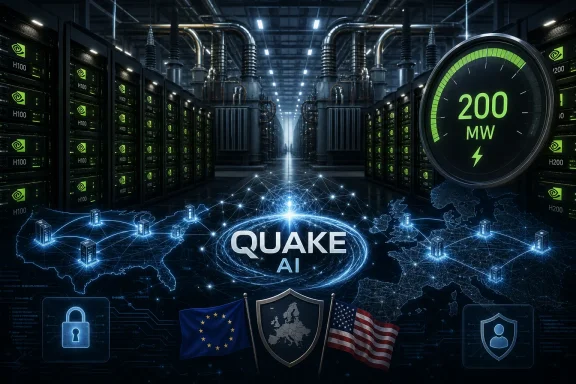 Rumble Is No Longer Just Buying Servers; It Is Buying a Position in the AI Stack
Rumble’s Northern Data deal is best understood as a vertical move, not a vanity expansion. The company has spent years presenting itself as an alternative distribution platform for creators who distrust the moderation and monetization policies of larger incumbents. With Northern Data, it is extending that argument downward into the physical layer: chips, power, buildings, contracts, and cloud capacity.That matters because AI infrastructure is no longer a back-office concern. Whoever controls large pools of high-end GPUs controls the pace, price, and availability of model training, inference, video generation, search, recommendation systems, and enterprise AI workloads. Rumble is not buying a generic data-center operator; it is buying scarce compute during a cycle in which scarce compute has become strategic leverage.
The acquisition gives Rumble approximately 85.2 percent of Northern Data AG, a German AI and high-performance computing infrastructure company. The headline number is the GPU estate: about 22,000 Nvidia H100 and H200 chips, the accelerators that powered much of the current generative AI buildout before Nvidia’s Blackwell generation began moving into the market. For a company whose public identity still revolves around video, speech, and creator monetization, that is a sharp turn toward the capital-intensive end of technology.
The more revealing asset may be power. Reports around the transaction describe more than 200 megawatts of unmonetized power capacity spread across nine data centers in Europe and the United States, while Rumble’s own post-closing positioning refers to up to roughly 250 megawatts of energized and contracted capacity. In 2026, that is not a footnote. Power, interconnection, and cooling are the new bottlenecks, and the market increasingly values data-center operators less like software companies and more like energy-adjacent infrastructure owners.
The Deal Makes Sense Only If Rumble Wants to Be Judged by Cloud Economics
The transaction was first announced on November 10, 2025, and completed on June 17, 2026, as an all-stock deal with estimates clustering around $767 million, though some reporting placed the value closer to $970 million depending on share-price assumptions. Those caveats matter. An all-stock acquisition can look cheap or expensive depending on what the market later decides the buyer is worth.For investors, the immediate story was clear enough: Rumble acquired a revenue-producing AI infrastructure business with high utilization and a growing customer pipeline. Northern Data had already raised its 2026 revenue guidance to between 170 million and 190 million euros, up from a prior estimate of 130 million to 150 million euros. Utilization of the roughly 22,000 H100 and H200 GPUs reportedly reached about 85 percent in March 2026.
That utilization figure is the strongest argument against dismissing the deal as an “AI pivot” press-release stunt. A GPU fleet sitting idle is a depreciation machine with a marketing department. A GPU fleet that is largely contracted or in demand can become a high-margin infrastructure asset, assuming power costs, financing costs, customer concentration, and hardware refresh cycles are controlled.
But that assumption is doing a lot of work. Cloud infrastructure is brutally unforgiving. Hyperscalers have spent decades building procurement channels, network architectures, developer ecosystems, compliance regimes, reliability tooling, and sales organizations. Rumble has bought its way into the hardware layer, but it has not bought Amazon Web Services’ customer trust, Microsoft Azure’s enterprise sales motion, or Google Cloud’s machine-learning pedigree.
That is why the acquisition should be read as a race against time. H100s and H200s remain valuable, but the center of gravity is shifting toward Blackwell-class systems. A company that buys a large fleet of current-generation GPUs must monetize them aggressively before depreciation, competitive pricing, and newer hardware compress the advantage.
Quake AI Is the Rebrand That Reveals the Real Strategy
Rumble’s post-closing realignment is telling. The company has moved to organize itself around two core units: the familiar Rumble video platform and a renamed cloud and AI infrastructure business called Quake AI. The branding may sound like it escaped from a late-1990s LAN party, but the structure is rational. It separates the attention economy from the compute economy while keeping both under the same corporate thesis.That thesis is that independent media, AI, and cloud services should not depend entirely on a handful of hyperscale platforms. Rumble CEO Chris Pavlovski has framed the combined entity as a “freedom-first” infrastructure play and, more ambitiously, as part of a sovereign, privacy-centric AI ecosystem. The language is politically charged by design. Rumble’s brand has always been inseparable from a critique of centralized platform power.
The more interesting question is whether that message translates into enterprise demand. A creator may choose Rumble because it feels ideologically aligned or less likely to demonetize controversial speech. An AI customer choosing GPU capacity has a different set of concerns: uptime, latency, price, compliance, data-handling guarantees, support quality, and whether the provider can keep delivering when Nvidia’s roadmap turns over.
The company’s challenge is to make Quake AI sound less like a slogan and more like infrastructure. Sovereignty is a powerful word in cloud marketing, especially in Europe, where data residency, regulatory exposure, and dependence on U.S. hyperscalers are live policy concerns. But the market will eventually ask very practical questions: where are the workloads running, who has access, how are failures handled, what certifications are in place, and how predictable is the pricing?
The Together AI Contract Gives the Story Its First Serious Customer
The most important companion announcement is not the acquisition itself but the multi-year Together AI contract worth $270 million. That deal commits Together AI to purchase dedicated GPU cloud capacity from Rumble powered by Nvidia HGX B300 systems, placing Rumble’s ambitions in the Blackwell era rather than only the H100/H200 era. In plain English, Rumble is not merely inheriting yesterday’s hot chips; it is trying to sell next-generation AI compute as a service.Together AI is a strategically useful customer because it operates in the developer-facing AI infrastructure market. Its needs are not theoretical. Companies building, fine-tuning, and serving models need dense GPU capacity, fast networking, predictable access, and a supplier that can deliver at scale. If Rumble can satisfy a customer in that category, it gains credibility that a press release alone cannot buy.
The contract also gives investors something concrete to measure. A $270 million commitment does not solve all the questions around margins, timing, delivery obligations, or concentration risk, but it provides near-term revenue visibility. It suggests Rumble has a path to monetizing infrastructure beyond simply saying the words “AI cloud” at the right point in a market cycle.
Still, a large anchor contract cuts both ways. It can validate a new infrastructure business, but it can also hide fragility if too much of the economics depends on a small number of customers. Cloud providers are judged not by one impressive deal, but by the depth, diversity, and renewability of their customer base.
Tether Turns the Deal Into a Sovereignty Story With Crypto Shadows
No serious reading of this deal can ignore Tether. The stablecoin issuer has been a key investor behind both Rumble and Northern Data, and its role gives the transaction a distinctive flavor. This is not merely a video platform buying a German infrastructure company. It is part of a broader alignment among alternative media, crypto capital, and AI compute.That combination will appeal to some customers and alarm others. Tether’s backing gives Rumble access to a pool of capital and a network of strategic relationships outside the usual Silicon Valley cloud orbit. It also brings reputational and regulatory questions that mainstream enterprise buyers may not be eager to import into their AI supply chains.
The word “sovereign” is doing double duty here. In the European cloud context, sovereignty often means control over data jurisdiction, operational independence, and insulation from foreign legal demands. In Rumble’s political branding, it also gestures toward resistance to centralized content moderation and platform gatekeeping. In crypto circles, it can imply financial autonomy from traditional banking systems.
Those meanings overlap, but they are not identical. A European manufacturer seeking data-residency guarantees is not necessarily signing up for an ideological project. A developer needing GPU access may care more about availability and price than free-speech positioning. Rumble will have to decide whether sovereignty is a sales category, a compliance architecture, or a culture-war differentiator — because serious infrastructure customers will demand more than mood music.
Nvidia Scarcity Has Created an Opening, but Not a Moat
The reason this acquisition is plausible at all is that AI compute demand has grown faster than conventional cloud capacity could comfortably absorb. Nvidia’s H100 became the emblem of the generative AI boom because it combined raw performance, software ecosystem support, and availability at scale for companies building large models. The H200 improved the memory side of the equation, and Blackwell-class systems are now positioned as the next major performance leap.In that environment, a company with 22,000 high-end GPUs can matter even if it is not a hyperscaler. Customers locked out of preferred cloud capacity, frustrated by queues, or seeking dedicated clusters may consider smaller providers if the economics and reliability work. The AI infrastructure market has room for specialists, brokers, regional providers, and vertically integrated operators.
But chip access is not the same thing as durable advantage. Nvidia’s ecosystem is powerful precisely because many providers can build around it. If supply loosens, prices fall, or Blackwell deployments accelerate faster than expected, H100 and H200 fleets will face pressure. The providers that win will be those that pair hardware with networking, orchestration, developer tools, service guarantees, and cost discipline.
That is the distinction between owning GPUs and operating a cloud. The first is a balance-sheet event. The second is a decade-long operational identity.
The Windows Angle Is Enterprise AI, Not Desktop Video
For WindowsForum readers, the temptation is to treat Rumble as a media story: another platform fight in the endless argument over speech, moderation, and creator monetization. But the more consequential angle is enterprise AI infrastructure. Windows users, developers, and administrators increasingly interact with AI through cloud services whose economics are shaped by exactly this kind of GPU buildout.Microsoft has tied Windows, Microsoft 365, GitHub, Azure, and Copilot into a broad AI platform strategy. That makes Azure’s infrastructure position central to how many organizations will experience AI on the desktop. But it also makes alternative GPU clouds relevant, especially for developers and companies that want to train or host models outside the Microsoft, Amazon, and Google orbit.
A smaller provider like Rumble will not replace Azure for most Microsoft-centric enterprises. It does not need to. The market is already fragmenting into layers: hyperscale general-purpose cloud, specialized GPU cloud, sovereign infrastructure, on-premises AI appliances, and hybrid deployment models. In that world, Rumble’s Quake AI could become one more capacity source for organizations building AI features that still land on Windows PCs, Windows Server environments, or cross-platform enterprise applications.
The practical question for IT pros is not whether Rumble’s politics are agreeable. It is whether the provider can deliver compute with predictable security, support, compliance, and pricing. If Quake AI wants workloads beyond speculative AI labs and ideologically aligned customers, it will need to speak the language of enterprise procurement: auditability, identity integration, data-protection controls, contractual remedies, and operational transparency.
Power Capacity Is the Asset Everyone Underestimates Until It Is Too Late
The GPU count makes headlines because Nvidia chips are easy to understand. Power capacity is less glamorous, but it may prove more important. The AI infrastructure race is increasingly constrained by electricity availability, grid interconnection delays, cooling requirements, and the physical limits of where data centers can be built.More than 200 megawatts of unmonetized power capacity is therefore not just spare room for servers. It is an option on future AI demand. If Rumble can convert that capacity into revenue-producing clusters, it gains room to grow without waiting years for entirely new sites. If it cannot, the capacity remains a promise wrapped in permitting, engineering, and capital expenditure.
This is where Northern Data’s operational experience matters. Rumble is not pretending to build a data-center business from scratch with a handful of executives and a dream. It is inheriting people, facilities, contracts, and systems from a company already operating in AI and high-performance computing. That reduces execution risk, though it does not eliminate it.
Power also changes how investors should think about the deal. A video platform’s valuation is often tied to users, engagement, advertising, subscriptions, and creator economics. A data-center infrastructure business is tied to utilization, power cost, capex efficiency, equipment depreciation, customer contracts, and financing. Rumble has effectively asked the market to evaluate both stories at once.
The Market Liked the Headline, but the Hard Metrics Come Later
Rumble’s stock reportedly rose around 8 percent in extended trading after the deal’s completion, which is not surprising. The announcement bundles together almost every term the market has rewarded during the AI boom: Nvidia GPUs, high utilization, data centers, power capacity, Blackwell systems, a large customer contract, and a sovereignty narrative. It is a potent cocktail.Short-term market reaction, however, is not proof of long-term infrastructure success. Investors have learned to reward AI capacity announcements quickly and punish execution delays just as quickly. The market will eventually want to know whether the acquired GPU fleet maintains high utilization, whether margins expand or compress, whether Blackwell deployment happens on schedule, and whether Rumble can keep financing growth without excessive dilution.
The all-stock nature of the deal also matters. Rumble preserved cash by paying with equity, but equity deals transfer risk to shareholders. If the combined company performs well, Northern Data sellers participate in the upside. If the strategic story weakens, existing shareholders absorb the consequences of a larger share base attached to a more complex company.
There is also a strategic distraction risk. Running a video platform is not simple. Running an AI infrastructure provider is not simple. Running both while presenting the combined company as a political, financial, and technological alternative to hyperscale power is significantly harder. The market may enjoy the ambition now, but it will demand operating proof soon.
The Hyperscalers Are the Target, but Not the Only Competition
Rumble’s rhetoric points upward at the hyperscalers, but its practical competition is broader. Amazon, Microsoft, and Google dominate enterprise cloud because they bundle infrastructure with identity, databases, developer tools, security services, managed AI, compliance programs, and global sales. Competing with them directly is a brutal proposition.Yet the AI compute market has created openings below and around them. Specialized GPU clouds can win customers by offering dedicated capacity, simpler pricing, or better availability for certain workloads. Regional providers can lean into sovereignty and data-location requirements. Infrastructure specialists can serve customers who do not want a full hyperscale platform, only the accelerators needed to train or run models.
That is probably the more realistic lane for Quake AI. It does not need to become a full AWS clone. It needs to become credible enough that customers looking for GPU capacity believe it can deliver clusters, support them, and keep them online. That is a narrower but still substantial opportunity.
The danger is that Rumble’s public framing may set expectations too high. “Competing with hyperscalers” sounds grand. Becoming a trusted specialized GPU infrastructure provider is more modest, more achievable, and arguably more valuable. The best version of this strategy is not Rumble beating Microsoft at Microsoft’s own game; it is Rumble finding profitable territory where hyperscale cloud is too expensive, too constrained, too centralized, or too slow.
The Real Test Is Whether Ideology Can Survive Procurement
Rumble’s brand is unusually ideological for an infrastructure company. That has helped it attract an audience and differentiate itself in media. In cloud, ideology can open doors, but procurement committees tend to be ruthless.A CIO may appreciate the argument for cloud diversity. A security team may like the idea of reducing dependence on a single hyperscaler. A European customer may want stronger regional control. But those same buyers will still ask for proof: certifications, incident history, service-level agreements, data-processing terms, financial stability, and clear escalation paths.
That is where Rumble’s “freedom-first” pitch must mature. Freedom from platform dependence is a credible enterprise theme. Freedom from accountability is not. The company needs to show that independence does not mean improvisation, and that privacy-centric infrastructure is implemented in architecture rather than merely asserted in speeches.
If it gets that right, Rumble could benefit from a broader backlash against overconcentration in cloud and AI. If it gets it wrong, Quake AI risks being pigeonholed as a niche provider for customers who choose vendors based on affiliation rather than operational merit. The former is a business. The latter is a brand extension with expensive GPUs.
The Rumble Deal Shows How the AI Boom Is Rewiring the Internet’s Power Map
The Northern Data acquisition is part of a larger pattern: companies that once lived at the application layer are trying to secure the infrastructure beneath them. Social platforms, model companies, enterprise software vendors, and even crypto-adjacent firms are all discovering that AI demand turns compute into strategy. The old internet abstraction — build the product, rent the cloud, scale as needed — is under pressure.For years, cloud computing trained companies to think of infrastructure as elastic, available, and someone else’s problem. AI broke that assumption. The most valuable workloads now require specialized chips, enormous power draw, dense networking, and long-range supply planning. That shifts advantage toward companies that can control capacity rather than merely consume it.
Rumble’s move is unusually visible because of its politics and because it comes from a company still best known for video. But the underlying logic is not strange. If AI is going to reshape content creation, recommendation engines, advertising, search, developer tools, and enterprise workflows, then a video platform with ambitions beyond hosting clips may reasonably conclude that compute access is existential.
The risk is that the infrastructure race rewards scale and punishes half-measures. Owning thousands of GPUs is meaningful, but it is not the endpoint. The winners will integrate chips, power, software, customers, and trust. Rumble has acquired several pieces of that puzzle. It still has to assemble them in public.
The Chip Count Is Impressive, but the Contract Stack Will Decide the Winner
The most concrete lesson from this deal is that AI infrastructure stories should be judged by monetization, not adjectives. Rumble now has assets that many companies would envy. The question is whether those assets can produce durable revenue faster than they depreciate.- Rumble completed the Northern Data acquisition on June 17, 2026, and gained control of roughly 22,000 Nvidia H100 and H200 GPUs.
- The acquired footprint includes nine data centers across Europe and the United States, along with more than 200 megawatts of unmonetized power capacity.
- Northern Data’s raised 2026 revenue guidance and reported 85 percent GPU utilization give the acquisition more substance than a typical AI rebranding exercise.
- The $270 million Together AI contract is the clearest early signal that Rumble can sell dedicated AI compute beyond its existing media business.
- Tether’s role strengthens the capital and sovereignty narrative while also introducing reputational and regulatory questions for mainstream enterprise buyers.
- Quake AI’s success will depend less on Rumble’s free-speech branding than on uptime, pricing, compliance, support, and the speed of Blackwell-era deployment.
References
- Primary source: Crypto Briefing
Published: 2026-06-18T01:01:32.860837
Rumble acquires 22,000 Nvidia chips for infrastructure expansion
Rumble finalized its acquisition of Northern Data AG, gaining control of 22,000 NVIDIA GPUs, over 200 MW of power capacity, and a $270M Together AIcryptobriefing.com - Related coverage: es.investing.com
Rumble completa la adquisición de Northern Data por entre 170 y 190 millones de euros en ingresos Por Investing.com
Rumble completa la adquisición de Northern Data por entre 170 y 190 millones de euros en ingresoses.investing.com - Related coverage: corp.rumble.com
Rumble Announces Final Results of Exchange Offer for Northern Data | Rumble
Longboat Key, FL – June 8, 2026 – Rumble Inc. (NASDAQ: RUM) (“Rumble”), the Freedom-First technology platform, today announced the final results for its exchange offer to acquire all outstanding shares... corp.rumble.com
- Related coverage: stocktitan.net
Rumble (NASDAQ: RUM) closes Northern Data acquisition, adds GPUs and 250 MW power
Rumble closes its Northern Data acquisition, issuing new shares and warrants while gaining roughly 250 MW power, about 22,000 NVIDIA GPUs, and access to Northern Data’s raised 2026 revenue outlook and a $270M Together AI GPU cloud contract.www.stocktitan.net - Related coverage: au.investing.com
Rumble completes Northern Data acquisition for $170-190M revenue By Investing.com
Rumble completes Northern Data acquisition for $170-190M revenueau.investing.com
