
Microsoft has not announced Windows 12 as of June 19, 2026, and the strongest evidence now points to Microsoft stretching Windows 11 into a longer AI-era platform while using Copilot+ PCs and Windows 11 26H1 to test the next hardware boundary. That does not mean Windows 12 is dead. It means the operating system brand is no longer the only place where Microsoft draws the line between old and new PCs. The next Windows break, if it comes, is increasingly likely to be about silicon, local AI, and servicing architecture rather than a Start menu redesign.
The Windows 12 rumor cycle has always been stranger than the Windows 11 one. Windows 11 arrived with leaked builds, visible design changes, a hardware cutoff, and then a formal announcement in June 2021. Windows 12, by contrast, has mostly existed as an inference: Microsoft is investing heavily in AI, PC silicon has changed, Windows 11 has awkward baggage, and therefore a new version must be coming.
That inference is not foolish. Microsoft has historically used major Windows releases to reset expectations, retire assumptions, and push the PC ecosystem toward new baselines. Windows Vista tried to do that with security and graphics, Windows 10 with servicing and cloud identity, and Windows 11 with TPMs, modern CPUs, and a more controlled shell. A hypothetical Windows 12 would fit that lineage neatly if it required an NPU and treated local AI as a first-class operating system capability.
But Microsoft has spent the last two years doing something more complicated. Instead of announcing a clean Windows 12 break, it created the Copilot+ PC category, moved headline AI features into Windows 11, and kept the familiar Windows 11 brand attached to hardware that is not really equivalent to the Windows 11 PCs most users already own. That is not a branding accident. It is a strategy.
The old model was simple: a new Windows version arrived, and the industry adjusted around it. The new model is messier: Windows remains Windows 11, but the feature line moves underneath it. Your PC may run Windows 11, but it may not run the same Windows 11 that Microsoft is really designing for.
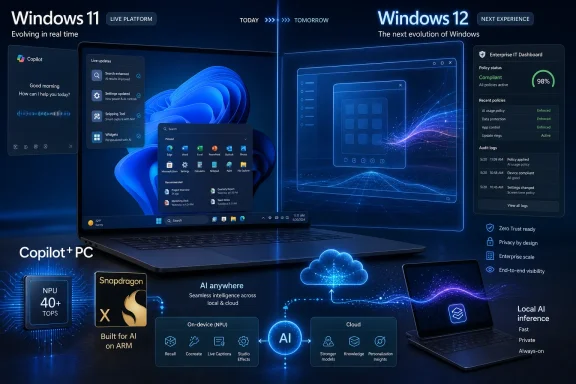
The key requirement was not cosmetic. Microsoft defined Copilot+ PCs around high-performance neural processing, with the first wave centered on chips capable of roughly 40-plus TOPS of NPU performance. That number mattered because it separated ordinary “AI PCs” from systems that could run Microsoft’s local AI experiences with acceptable latency, battery life, and privacy characteristics. It also gave retailers and OEMs a clean story: this is not merely a faster laptop; this is a laptop built for the next class of Windows features.
That move solved an immediate problem. If Microsoft had made those capabilities exclusive to Windows 12 in 2024, it would have forced a platform transition before the hardware ecosystem was ready. Intel and AMD were still catching up to Qualcomm’s early NPU lead, Recall had become a privacy controversy before it had become a product, and enterprise customers were already staring down the October 2025 end of Windows 10 support. Windows 12 would have turned all of that into a single, combustible migration story.
Copilot+ PCs instead let Microsoft decouple the platform shift from the version number. Windows 11 could remain the supported mainstream OS, while Copilot+ PCs became the premium lane for the features Microsoft wanted developers, OEMs, and reviewers to treat as the future. It was a clever compromise, but also a revealing one: the Windows brand no longer tells you enough.
That is why the Copilot rollout has felt both everywhere and oddly incomplete. Microsoft put Copilot into Windows 11, but much of the real action moved elsewhere: Microsoft 365 Copilot, GitHub Copilot, Edge, Bing, Windows Studio Effects, Recall, Click to Do, semantic search, and developer-facing local AI plumbing. Windows is the surface area, but the operating system is no longer the entire product.
This matters because Windows 12, as enthusiasts imagine it, would need to do more than add an AI sidebar. It would need to make the PC itself feel different. It would need agents that understand local context, APIs that let applications invoke local models cleanly, policy controls that enterprises can audit, and a scheduling model that decides when work should run on the NPU, GPU, CPU, or cloud. That is a deeper architectural project than putting a button on the taskbar.
Microsoft’s public language has gradually moved in that direction. The conversation has shifted from chatbots to agents, from assistants that answer questions to systems that can take action across apps and services. If Windows 12 becomes real in the next cycle, this is likely where the dividing line will be: not “this PC has Copilot,” but “this PC can orchestrate AI work locally and securely as part of the operating system.”
That sounds technical, and it is. But it is also political. Microsoft is willing to ship a Windows 11-branded release that is effectively bound to a specific silicon wave. That is a very different kind of Windows than the one most people grew up with, where the same version broadly spanned whatever x86 hardware could survive the installer.
The obvious interpretation is that 26H1 is a hardware-enablement release. New silicon arrives before the mainstream Windows train is ready, so Microsoft ships a branch to support it. That is plausible, and it may be the whole story. Windows has always had OEM timing problems, and Arm PCs have often required more bespoke platform work than x86 systems.
But the more provocative interpretation is that 26H1 is a preview of how Microsoft now thinks about Windows generations. The dividing line may not be a retail box, an ISO, or a splash screen. It may be a servicing branch tied to silicon capabilities, with the marketing name chosen later. If that sounds like Windows 12 hiding in Windows 11 clothing, that is because it might be exactly how a platform transition looks before the brand team gets involved.
That distinction matters. “Low-end” does not mean “old.” A future budget PC with a modern Intel, AMD, or Qualcomm chip may meet Windows 11 requirements comfortably while lacking the NPU performance needed for premium AI features. Conversely, an older high-end workstation may have plenty of CPU and GPU muscle but still fail to meet whatever local AI assumptions Microsoft wants to make.
This is where Copilot+ PC becomes a bridge and a trap. As a bridge, it lets Microsoft establish an AI-capable hardware class without cutting off every Windows 11 user. As a trap, it risks creating confusion in the market. Consumers already struggle to distinguish between “AI PC,” “Copilot PC,” and “Copilot+ PC.” If Windows 12 eventually arrives with requirements that match or exceed today’s Copilot+ PCs, Microsoft will need to explain why yesterday’s premium AI hardware is still on the right side of the line.
The company’s likely answer is gradualism. Windows 11 remains the mainstream compatibility platform. Copilot+ PCs remain the advanced experience tier. Windows 12, if it appears, becomes the point at which that tier hardens into the new default. The risk is that users experience this not as a roadmap but as fog.
That timing also fits the broader ecosystem. By 2027, the post-Windows 10 migration wave will have largely settled, Copilot+ hardware will be more common, x86 NPUs will be stronger, Arm compatibility will be less exotic, and enterprise IT will have had time to absorb Windows 11’s current servicing model. A 2027 Windows 12 would be less of a shock than a 2024 or 2025 one.
But an announcement could come before the release. Microsoft announced Windows 11 only months before general availability, but it could choose a longer runway if Windows 12 involves a meaningful developer platform change. AI agents, local model APIs, privacy controls, and enterprise governance would all benefit from early developer messaging. The company also has competitive reasons to show that Windows is not merely reacting to macOS, ChromeOS, Android, and Linux.
The counterargument is that Microsoft may not need Windows 12 at all in the near term. If Windows 11 can keep absorbing AI features, and if Copilot+ PC can carry the hardware story, a new version number may create more cost than benefit. Microsoft does not want another Windows 8-style moment where the brand change becomes the story and the platform work gets buried under user resistance.
If Microsoft says Windows 12 is the future too soon, users may reasonably ask whether Windows 11 was ever finished. This is especially sensitive because Windows 11 adoption was already driven in part by Windows 10’s support deadline. A new version announced too quickly after that migration would feed the suspicion that Microsoft is more interested in forcing hardware churn than improving the platform people already have.
The update-quality conversation makes this sharper. Every month seems to bring reports of a Windows update breaking something somewhere: BitLocker prompts, boot failures, Explorer regressions, VPN issues, gaming problems, printer weirdness, or OneDrive confusion. Many users never encounter these bugs, and the Windows hardware ecosystem is so vast that some level of breakage is inevitable. But perception matters, especially among administrators whose job is to assume that rare failures will become their failures.
Pavan Davuluri’s Windows organization has inherited a product with deep technical debt and a user base that has little patience for excuses. Foundational work is necessary, and foundational work can break things. But Microsoft cannot sell Windows 12 as the clean AI future if Windows 11 still feels like a house where the plumbing is being fixed while the kitchen is being remodeled.
That is why Microsoft’s two-tier approach has enterprise appeal. Companies can continue deploying Windows 11 on supported hardware while piloting Copilot+ PCs in roles where local AI makes sense. Developers, executives, analysts, creative workers, and field employees may justify premium devices earlier than the general fleet. The rest of the organization can wait until the hardware refresh cycle naturally catches up.
But that strategy only works if Microsoft is clear about what runs where. Enterprises can tolerate premium features being limited to premium hardware. They are much less tolerant of ambiguous requirements, surprise servicing branches, or features that appear in consumer builds before policy controls are ready. Recall taught Microsoft that lesson painfully: local AI features that touch user activity history must be explainable, controllable, and auditable from day one.
If Windows 12 becomes the agentic Windows release, governance will be the product. Admins will want to know what data agents can see, which apps they can act inside, where logs live, how prompts are retained, whether work leaves the device, and how these features interact with compliance regimes. The shiny demo will matter less than the Group Policy, Intune, and documentation story.
The command-line point is more important than it may seem. Windows has improved dramatically with Windows Terminal, PowerShell, WSL, winget, and developer tooling, but its culture remains GUI-first with command-line power bolted on. Linux comes from the opposite direction. For users who manage multiple machines, install lots of software, script repetitive tasks, or simply like a system that exposes itself honestly, Linux can feel less like a throwback than a relief.
Microsoft knows this, which is why it has embraced so many developer conveniences that once belonged more naturally to Linux and macOS. The company does not need every enthusiast to love the Windows shell. It does need developers and power users to feel that Windows is still a serious workstation platform rather than a consumer ad surface with enterprise controls stapled to it.
That is another reason Windows 12 cannot merely be Copilot with a new wallpaper. The users most likely to care about a major Windows release are also the users most sensitive to bloat, telemetry, forced cloud hooks, and half-finished shell experiments. If Microsoft wants Windows 12 to matter to them, it must make Windows feel more coherent, not just more intelligent.
That makes the next Windows break smaller than expected because many users may wake up one day to find that the future already shipped inside Windows 11. There may be no clean before-and-after moment. The taskbar changes, Settings gains new controls, apps expose actions to agents, search gets smarter, and more features quietly require hardware that last year’s PC does not have.
It also makes the break bigger than expected because the underlying platform may change more profoundly than the brand suggests. A Windows that can broker work between local models, cloud models, apps, files, and enterprise policy is not just Windows 11 with an assistant. It is an operating system trying to become an orchestration layer for machine intelligence.
That ambition is both exciting and dangerous. Windows succeeds when it fades into the background and lets people do work. AI agents, by design, do not fade into the background; they act, suggest, summarize, transform, and sometimes interrupt. The future of Windows depends on whether Microsoft can make that feel empowering rather than invasive.
 Windows 12 Has Become the Name for a Decision Microsoft Has Not Made Public
The Windows 12 rumor cycle has always been stranger than the Windows 11 one. Windows 11 arrived with leaked builds, visible design changes, a hardware cutoff, and then a formal announcement in June 2021. Windows 12, by contrast, has mostly existed as an inference: Microsoft is investing heavily in AI, PC silicon has changed, Windows 11 has awkward baggage, and therefore a new version must be coming.That inference is not foolish. Microsoft has historically used major Windows releases to reset expectations, retire assumptions, and push the PC ecosystem toward new baselines. Windows Vista tried to do that with security and graphics, Windows 10 with servicing and cloud identity, and Windows 11 with TPMs, modern CPUs, and a more controlled shell. A hypothetical Windows 12 would fit that lineage neatly if it required an NPU and treated local AI as a first-class operating system capability.
But Microsoft has spent the last two years doing something more complicated. Instead of announcing a clean Windows 12 break, it created the Copilot+ PC category, moved headline AI features into Windows 11, and kept the familiar Windows 11 brand attached to hardware that is not really equivalent to the Windows 11 PCs most users already own. That is not a branding accident. It is a strategy.
The old model was simple: a new Windows version arrived, and the industry adjusted around it. The new model is messier: Windows remains Windows 11, but the feature line moves underneath it. Your PC may run Windows 11, but it may not run the same Windows 11 that Microsoft is really designing for.
Copilot+ PCs Let Microsoft Ship the Future Without Naming It
Copilot+ PCs were the Windows 12 moment Microsoft could sell without saying “Windows 12.” Announced in May 2024 with availability starting in June 2024, the category gave OEMs a new premium badge, gave Qualcomm’s Snapdragon X chips a starring role, and gave Microsoft a way to say that on-device AI needed a serious NPU rather than a vague promise of future acceleration.The key requirement was not cosmetic. Microsoft defined Copilot+ PCs around high-performance neural processing, with the first wave centered on chips capable of roughly 40-plus TOPS of NPU performance. That number mattered because it separated ordinary “AI PCs” from systems that could run Microsoft’s local AI experiences with acceptable latency, battery life, and privacy characteristics. It also gave retailers and OEMs a clean story: this is not merely a faster laptop; this is a laptop built for the next class of Windows features.
That move solved an immediate problem. If Microsoft had made those capabilities exclusive to Windows 12 in 2024, it would have forced a platform transition before the hardware ecosystem was ready. Intel and AMD were still catching up to Qualcomm’s early NPU lead, Recall had become a privacy controversy before it had become a product, and enterprise customers were already staring down the October 2025 end of Windows 10 support. Windows 12 would have turned all of that into a single, combustible migration story.
Copilot+ PCs instead let Microsoft decouple the platform shift from the version number. Windows 11 could remain the supported mainstream OS, while Copilot+ PCs became the premium lane for the features Microsoft wanted developers, OEMs, and reviewers to treat as the future. It was a clever compromise, but also a revealing one: the Windows brand no longer tells you enough.
The AI Era Made the Version Number Less Useful
The industry keeps asking whether Windows 12 will be “the AI version of Windows,” but that assumes AI features arrive in the tidy way desktop features once did. They do not. Cloud Copilot features can appear as app updates, web components, Microsoft 365 integrations, Edge changes, or taskbar affordances. Local AI features depend on silicon, drivers, model delivery, privacy controls, and the Windows App SDK as much as they depend on the Windows shell.That is why the Copilot rollout has felt both everywhere and oddly incomplete. Microsoft put Copilot into Windows 11, but much of the real action moved elsewhere: Microsoft 365 Copilot, GitHub Copilot, Edge, Bing, Windows Studio Effects, Recall, Click to Do, semantic search, and developer-facing local AI plumbing. Windows is the surface area, but the operating system is no longer the entire product.
This matters because Windows 12, as enthusiasts imagine it, would need to do more than add an AI sidebar. It would need to make the PC itself feel different. It would need agents that understand local context, APIs that let applications invoke local models cleanly, policy controls that enterprises can audit, and a scheduling model that decides when work should run on the NPU, GPU, CPU, or cloud. That is a deeper architectural project than putting a button on the taskbar.
Microsoft’s public language has gradually moved in that direction. The conversation has shifted from chatbots to agents, from assistants that answer questions to systems that can take action across apps and services. If Windows 12 becomes real in the next cycle, this is likely where the dividing line will be: not “this PC has Copilot,” but “this PC can orchestrate AI work locally and securely as part of the operating system.”
Windows 11 26H1 Looks Like a Test Run for a Split Platform
Windows 11 version 26H1 is the most interesting clue in the current Windows roadmap because it is not behaving like a normal Windows 11 feature update. It is a targeted release for new Arm hardware, particularly Snapdragon X2-class devices, rather than an upgrade offered broadly to existing PCs. Reports around Microsoft’s support posture indicate that 26H1 devices are on a separate track and will not simply roll forward to Windows 11 26H2 in the ordinary way.That sounds technical, and it is. But it is also political. Microsoft is willing to ship a Windows 11-branded release that is effectively bound to a specific silicon wave. That is a very different kind of Windows than the one most people grew up with, where the same version broadly spanned whatever x86 hardware could survive the installer.
The obvious interpretation is that 26H1 is a hardware-enablement release. New silicon arrives before the mainstream Windows train is ready, so Microsoft ships a branch to support it. That is plausible, and it may be the whole story. Windows has always had OEM timing problems, and Arm PCs have often required more bespoke platform work than x86 systems.
But the more provocative interpretation is that 26H1 is a preview of how Microsoft now thinks about Windows generations. The dividing line may not be a retail box, an ISO, or a splash screen. It may be a servicing branch tied to silicon capabilities, with the marketing name chosen later. If that sounds like Windows 12 hiding in Windows 11 clothing, that is because it might be exactly how a platform transition looks before the brand team gets involved.
The Hardware Cutoff Is No Longer Just About Old PCs
The Windows 11 hardware debate is often framed around unsupported older PCs, especially Intel 7th-generation Core systems and similar machines that were left behind by the official requirements. That debate is not going away, but it is not the same debate as the Windows 12 one. Microsoft can maintain Windows 11’s baseline at 4 GB of RAM and 64 GB of storage while still creating a higher feature baseline for AI-era hardware.That distinction matters. “Low-end” does not mean “old.” A future budget PC with a modern Intel, AMD, or Qualcomm chip may meet Windows 11 requirements comfortably while lacking the NPU performance needed for premium AI features. Conversely, an older high-end workstation may have plenty of CPU and GPU muscle but still fail to meet whatever local AI assumptions Microsoft wants to make.
This is where Copilot+ PC becomes a bridge and a trap. As a bridge, it lets Microsoft establish an AI-capable hardware class without cutting off every Windows 11 user. As a trap, it risks creating confusion in the market. Consumers already struggle to distinguish between “AI PC,” “Copilot PC,” and “Copilot+ PC.” If Windows 12 eventually arrives with requirements that match or exceed today’s Copilot+ PCs, Microsoft will need to explain why yesterday’s premium AI hardware is still on the right side of the line.
The company’s likely answer is gradualism. Windows 11 remains the mainstream compatibility platform. Copilot+ PCs remain the advanced experience tier. Windows 12, if it appears, becomes the point at which that tier hardens into the new default. The risk is that users experience this not as a roadmap but as fog.
Microsoft’s Calendar Points to 2027, But the Brand Could Move Sooner
Windows history does not provide a prophecy, but it does provide a rhythm. Windows 10 shipped in 2015, Windows 11 was announced and shipped in 2021, and the gap between major releases lengthened compared with the Windows 7-to-8 and Windows 8-to-10 eras. If Microsoft mirrored the Windows 10-to-11 gap, a Windows 12 release in 2027 would make sense.That timing also fits the broader ecosystem. By 2027, the post-Windows 10 migration wave will have largely settled, Copilot+ hardware will be more common, x86 NPUs will be stronger, Arm compatibility will be less exotic, and enterprise IT will have had time to absorb Windows 11’s current servicing model. A 2027 Windows 12 would be less of a shock than a 2024 or 2025 one.
But an announcement could come before the release. Microsoft announced Windows 11 only months before general availability, but it could choose a longer runway if Windows 12 involves a meaningful developer platform change. AI agents, local model APIs, privacy controls, and enterprise governance would all benefit from early developer messaging. The company also has competitive reasons to show that Windows is not merely reacting to macOS, ChromeOS, Android, and Linux.
The counterargument is that Microsoft may not need Windows 12 at all in the near term. If Windows 11 can keep absorbing AI features, and if Copilot+ PC can carry the hardware story, a new version number may create more cost than benefit. Microsoft does not want another Windows 8-style moment where the brand change becomes the story and the platform work gets buried under user resistance.
The Windows 11 Repair Job Complicates the Windows 12 Sales Pitch
There is another reason Microsoft may be cautious: Windows 11 itself is under repair. The company has spent the last year talking more openly about fundamentals, reliability, performance, battery life, update behavior, and the everyday pain points that make Windows feel less polished than it should. That is welcome, but it also creates a messaging problem.If Microsoft says Windows 12 is the future too soon, users may reasonably ask whether Windows 11 was ever finished. This is especially sensitive because Windows 11 adoption was already driven in part by Windows 10’s support deadline. A new version announced too quickly after that migration would feed the suspicion that Microsoft is more interested in forcing hardware churn than improving the platform people already have.
The update-quality conversation makes this sharper. Every month seems to bring reports of a Windows update breaking something somewhere: BitLocker prompts, boot failures, Explorer regressions, VPN issues, gaming problems, printer weirdness, or OneDrive confusion. Many users never encounter these bugs, and the Windows hardware ecosystem is so vast that some level of breakage is inevitable. But perception matters, especially among administrators whose job is to assume that rare failures will become their failures.
Pavan Davuluri’s Windows organization has inherited a product with deep technical debt and a user base that has little patience for excuses. Foundational work is necessary, and foundational work can break things. But Microsoft cannot sell Windows 12 as the clean AI future if Windows 11 still feels like a house where the plumbing is being fixed while the kitchen is being remodeled.
Enterprise IT Will Treat Windows 12 as a Procurement Event
For consumers, Windows 12 is a curiosity. For enterprises, it is a budget line. A new Windows version with higher AI hardware requirements would immediately become a procurement, lifecycle, and security planning issue, especially for organizations still digesting the Windows 10-to-11 move.That is why Microsoft’s two-tier approach has enterprise appeal. Companies can continue deploying Windows 11 on supported hardware while piloting Copilot+ PCs in roles where local AI makes sense. Developers, executives, analysts, creative workers, and field employees may justify premium devices earlier than the general fleet. The rest of the organization can wait until the hardware refresh cycle naturally catches up.
But that strategy only works if Microsoft is clear about what runs where. Enterprises can tolerate premium features being limited to premium hardware. They are much less tolerant of ambiguous requirements, surprise servicing branches, or features that appear in consumer builds before policy controls are ready. Recall taught Microsoft that lesson painfully: local AI features that touch user activity history must be explainable, controllable, and auditable from day one.
If Windows 12 becomes the agentic Windows release, governance will be the product. Admins will want to know what data agents can see, which apps they can act inside, where logs live, how prompts are retained, whether work leaves the device, and how these features interact with compliance regimes. The shiny demo will matter less than the Group Policy, Intune, and documentation story.
Linux Is Benefiting From Windows’ Identity Crisis
One undercurrent in the Thurrott discussion is that Windows’ uncertainty is not happening in a vacuum. Linux desktop distributions have become more approachable, more polished, and more practical for users who once would have treated them as hobbyist projects. Zorin OS, Fedora Workstation, Linux Mint, Ubuntu, and others are not perfect Windows replacements, but they are increasingly credible alternatives for people whose workflows live in browsers, cross-platform apps, terminals, and cloud services.The command-line point is more important than it may seem. Windows has improved dramatically with Windows Terminal, PowerShell, WSL, winget, and developer tooling, but its culture remains GUI-first with command-line power bolted on. Linux comes from the opposite direction. For users who manage multiple machines, install lots of software, script repetitive tasks, or simply like a system that exposes itself honestly, Linux can feel less like a throwback than a relief.
Microsoft knows this, which is why it has embraced so many developer conveniences that once belonged more naturally to Linux and macOS. The company does not need every enthusiast to love the Windows shell. It does need developers and power users to feel that Windows is still a serious workstation platform rather than a consumer ad surface with enterprise controls stapled to it.
That is another reason Windows 12 cannot merely be Copilot with a new wallpaper. The users most likely to care about a major Windows release are also the users most sensitive to bloat, telemetry, forced cloud hooks, and half-finished shell experiments. If Microsoft wants Windows 12 to matter to them, it must make Windows feel more coherent, not just more intelligent.
The Next Windows Break Will Be Smaller and Bigger Than Expected
The mistake is to imagine Windows 12 as a single dramatic event. The more likely scenario is that it arrives in pieces before it arrives as a name. Copilot+ PCs were one piece. Windows 11 26H1 is another. Agent integration, local AI APIs, semantic indexing, new update plumbing, and stricter silicon assumptions may all be pieces of the same transition.That makes the next Windows break smaller than expected because many users may wake up one day to find that the future already shipped inside Windows 11. There may be no clean before-and-after moment. The taskbar changes, Settings gains new controls, apps expose actions to agents, search gets smarter, and more features quietly require hardware that last year’s PC does not have.
It also makes the break bigger than expected because the underlying platform may change more profoundly than the brand suggests. A Windows that can broker work between local models, cloud models, apps, files, and enterprise policy is not just Windows 11 with an assistant. It is an operating system trying to become an orchestration layer for machine intelligence.
That ambition is both exciting and dangerous. Windows succeeds when it fades into the background and lets people do work. AI agents, by design, do not fade into the background; they act, suggest, summarize, transform, and sometimes interrupt. The future of Windows depends on whether Microsoft can make that feel empowering rather than invasive.
The Windows 12 Waiting Game Is Really a Silicon Waiting Game
For now, the practical read is less dramatic than the rumor cycle. Windows 12 is not here, Windows 11 is still the mainstream platform, and Copilot+ PCs are the clearest expression of Microsoft’s near-term Windows future. The uncertainty is not whether Microsoft wants a more AI-native Windows. It is when the company decides that the hardware base, developer platform, and enterprise controls are strong enough to put a new name on it.- Microsoft has not publicly announced Windows 12, and any near-term prediction should be treated as informed speculation rather than roadmap fact.
- Copilot+ PCs have already taken over the role many expected Windows 12 to play by creating a higher hardware tier for local AI experiences.
- Windows 11 26H1 is significant because it shows Microsoft is willing to ship Windows 11 releases tied to specific new silicon rather than the whole installed base.
- A 2027 Windows 12 release would fit the historical gap between Windows 10 and Windows 11, but Microsoft could also keep extending Windows 11 while hardening Copilot+ as the real dividing line.
- Enterprise adoption will depend less on the Windows 12 name than on update reliability, AI governance, hardware clarity, and whether Microsoft can explain what runs locally, what runs in the cloud, and who controls it.
References
- Primary source: thurrott.com
Published: Fri, 19 Jun 2026 16:25:10 GMT
Ask Paul: June 19 ⭐ - Thurrott.com
Happy Friday! We're winding down after a week in Nashville, which has been fantastic despite the heat and humidity.www.thurrott.com
