

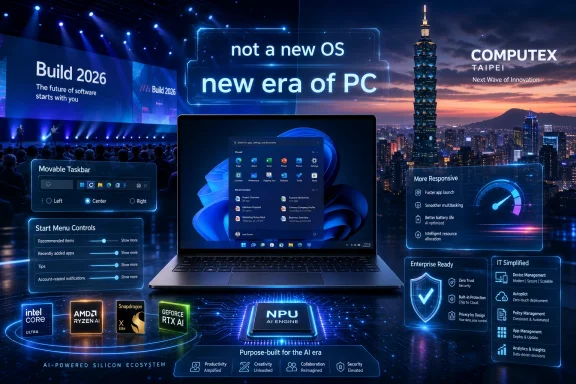
Microsoft said on May 29, 2026, that its Build 2026 announcements next week will not include Windows 12, while the Windows account separately teased “a new era of PC” tied to coordinates in Taipei ahead of Computex. That clarification matters because the Windows rumor cycle has become a product category of its own. The company is not merely tamping down a mistaken headline; it is trying to redirect attention from a fantasy operating system to a more consequential shift in PC hardware, AI-capable silicon, and the slow rehabilitation of Windows 11.
The most revealing part of Microsoft’s pre-Build messaging is not the teaser. It is the denial.
Pavan Davuluri, who leads Windows and Devices, posted that something new is coming for developers, then added that it is “not a new OS version.” That little clarification does a lot of work. It tells developers to show up, tells enthusiasts to calm down, and tells OEM partners that Microsoft does not want next week’s announcements consumed by a Windows 12 guessing game.
That is unusual only if we pretend Microsoft has not been burned by Windows expectations before. The company has spent years trying to make Windows feel like a continuously serviced platform while users still understand it as a sequence of big releases. Every visual tweak, leaked codename, or hardware requirement becomes evidence for the next numbered Windows.
This time, Microsoft is getting in front of the cycle. The company knows Build and Computex create the perfect rumor furnace: developers looking for platform signals, OEMs showing new machines, chip vendors selling roadmaps, and consumers trying to decide whether to buy now or wait. If Microsoft had stayed silent, “new era of PC” would have been read as “new Windows” by lunchtime.
The clarification is also a tacit admission that Windows branding has become fragile. Windows 11 still carries the memory of missing taskbar features, stricter hardware requirements, Microsoft account pressure, advertising complaints, and AI features that many users perceive as pushed rather than earned. A Windows 12 reveal would not automatically reset that ledger. It might simply move the argument to a new box.
That does not mean the rumor is baseless in the broader sense. Microsoft has explored modular Windows architectures before, has changed its servicing model repeatedly, and is plainly building more AI hooks into the operating system. But a collection of plausible ingredients is not the same thing as a shipping product.
The recent rumor cycle leaned heavily on ideas that sound real because they are adjacent to real Microsoft work: CorePC-style modularity, “Hudson Valley” references, Copilot integration, and NPU-driven local AI. Those concepts may describe experiments, abandoned paths, internal milestones, or components that eventually land inside Windows 11. They do not, by themselves, prove that a consumer-facing Windows 12 is about to appear.
Microsoft’s response is therefore narrower and more surgical than a grand denial of future Windows versions. The message is not “there will never be another Windows.” The message is that next week is not that moment. For IT pros, that distinction is the difference between roadmap noise and actual planning.
Windows has always been partly a product and partly an ecosystem coordination mechanism. When Microsoft says “new OS,” OEMs, enterprises, developers, app vendors, accessory makers, and security teams all hear work. If the company is not ready to impose that work, it has every reason to stop the rumor before it hardens into expectation.
That framing fits the state of the PC market in 2026. Microsoft’s biggest Windows story is no longer just the OS shell. It is the attempt to make the Windows PC feel like a coherent AI-era product across Intel, AMD, Qualcomm, and potentially Nvidia-powered machines.
Copilot+ PCs were Microsoft’s first major attempt to define that category around hardware capability, particularly NPUs capable of running local AI workloads. The first wave proved the concept but did not end the argument. Buyers still had to weigh Arm compatibility, feature availability, battery life, performance, price, and whether the AI features justified the branding.
The next wave is more interesting because it is less theoretical. Qualcomm’s Snapdragon X2 generation, Intel’s Core Ultra Series 3 systems, AMD’s AI PC lineup, and Nvidia’s rumored or emerging PC CPU ambitions all point toward a Windows ecosystem where the platform story is distributed across silicon vendors. Microsoft’s job is to make that fragmentation look like choice instead of chaos.
That is why “new era of PC” probably matters more than “Windows 12” would have. A new version number is a marketing event. A credible cross-vendor AI PC platform is an ecosystem bet.
If next week’s Windows news is developer-centered rather than OS-version-centered, the likely emphasis is on making apps work better across new hardware classes. That could mean deeper AI APIs, better local model support, Windows App SDK improvements, Copilot integration points, Arm optimization guidance, or tooling for hybrid local-cloud experiences. The exact announcements can wait; the strategic shape is already visible.
Microsoft has a hard problem here. Developers will not optimize for AI PCs simply because Microsoft invents a label. They need stable APIs, predictable hardware baselines, distribution opportunities, and evidence that users will own enough compatible machines to make the work worthwhile.
That is where the developer story and the hardware story meet. If OEMs flood Computex with machines carrying newer NPUs, better battery life, and improved Windows-on-Arm performance, Microsoft can tell developers that local AI is no longer a science project. If Build provides the software layer, Computex provides the installed-base argument.
The absence of Windows 12 may actually sharpen that pitch. Developers do not need another compatibility cliff. They need a believable runway. Microsoft appears to be saying: build for the Windows platform that exists, because the platform is changing under the same name.
The company has been moving toward a year of fixes and reversals that would have seemed almost embarrassing if they were not so necessary. The movable taskbar is coming back. Start menu customization is being expanded. Performance work is targeting shell latency and responsiveness. Windows Update changes and quality messaging are being positioned as trust-building measures rather than routine housekeeping.
These are not glamorous features. They are admissions.
Windows 11 launched with a cleaner visual identity, but it also removed behaviors that power users had built muscle memory around for years. The centered taskbar was never the problem by itself. The problem was that Microsoft treated long-standing customization as disposable while simultaneously asking users to accept stricter requirements and a more cloud-connected setup flow.
That bargain did not land equally across the Windows base. Casual users may have adapted. Enthusiasts complained loudly. Enterprises mostly cared about stability, manageability, and support timelines. But over time the missing pieces became symbols of a broader critique: Windows 11 felt less like an upgrade chosen by users and more like a direction imposed on them.
Restoring features does not erase that history, but it changes the posture. Microsoft is no longer pretending every Windows 11 design decision was inevitable. It is quietly unwinding some of the most criticized choices, and that is the sort of work that would be overshadowed by a Windows 12 reveal.
Because Windows users are not goldfish.
A new name would immediately raise the questions Microsoft has not fully answered under the current one. Would hardware requirements tighten again? Would more AI features become mandatory? Would local accounts become harder to use? Would enterprise admins face another wave of compatibility testing? Would more settings move, more defaults change, and more consumer cloud services appear in the shell?
Those questions are not anti-Microsoft paranoia. They are learned responses to the modern Windows experience. The more Microsoft treats Windows as the front end for subscriptions, identity, advertising, telemetry, and AI services, the less users interpret a new version as a neutral upgrade.
That is the deeper reason the Windows 12 rumor was combustible. It arrived in an environment where many users already suspect that the next Windows will be more locked down, more cloud-dependent, and more demanding of new hardware. Even if those fears outran the evidence, they were not created from nothing.
Microsoft’s best move, then, is not to ask for a blank slate. It is to make Windows 11 less annoying, more responsive, and more predictable. Trust is not restored by a version number. It is restored by defaults, performance, documentation, and restraint.
That is why local AI capability is both an opportunity and a trap for Microsoft. On paper, NPUs make sense. They can run certain workloads more efficiently, preserve battery life, reduce latency, and keep some processing on-device. For developers, they promise a new performance tier. For enterprises, they could enable private or semi-private AI workflows that do not send everything to the cloud.
But in the consumer imagination, “AI PC” is already tangled with Recall, Copilot prompts, screenshots, privacy debates, and the broader fatigue of every vendor labeling everything intelligent. Microsoft cannot assume users will greet another AI-branded PC era with gratitude. It has to show why the hardware makes the machine better without making the user feel watched, nudged, or upsold.
That makes Windows quality work strategically important. Faster shell interactions, better Start menu control, taskbar flexibility, and cleaner updates sound mundane. They are also the foundation that makes higher-level AI features tolerable. Nobody wants an agentic PC if the Start menu still feels like an argument.
A credible “new era of PC” begins with the PC behaving better.
Earlier this month, Microsoft announced new Surface for Business devices using Intel Core Ultra Series 3 chips and said Snapdragon X2 models would expand the portfolio later in the year. That sequencing is important. Microsoft is not choosing one silicon future. It is trying to make Windows credible across x86 and Arm while keeping enterprise manageability at the center.
For business buyers, the hardware story is not just TOPS and battery charts. It is deployment, driver stability, security baselines, docking, repairability, lifecycle management, and whether the machine behaves consistently under Intune, Autopilot, and existing app stacks. A new Surface device is only exciting if it does not create new help desk categories.
For consumers, Surface has a different job. It has to make the AI PC feel desirable rather than mandatory. The first Snapdragon X generation delivered impressive battery life and helped reset expectations around Windows on Arm, but compatibility concerns and uneven AI feature availability kept the story complicated. The next generation needs fewer caveats.
If Microsoft uses the Taipei tease to anchor new hardware, the company will be trying to tell both audiences the same thing in different dialects: Windows PCs are entering a hardware transition, but Microsoft wants that transition to feel managed rather than disruptive.
Qualcomm’s Snapdragon X push changed the Windows conversation by making Arm laptops feel viable beyond niche experiments. Intel responded by leaning hard into Core Ultra and the AI PC category. AMD has its own Ryzen AI roadmap. Nvidia, if its PC CPU ambitions materialize in the way the industry expects, brings GPU gravity and AI developer credibility to a market that has long treated Windows laptops as an x86 contest.
For Microsoft, this is both a dream and a governance problem. More silicon competition gives Windows OEMs fresh stories to tell against Apple’s tightly integrated Mac lineup. It also gives Microsoft a harder compatibility matrix, especially when AI features depend on specific NPU capabilities, drivers, model runtimes, and power envelopes.
The company’s platform challenge is to avoid recreating the old Windows problem in AI form. In the old model, two PCs running the same version of Windows could feel wildly different because of drivers, bloatware, firmware, storage quality, and vendor utilities. In the AI PC era, two machines with the same Windows branding could diverge based on NPU performance, supported models, privacy defaults, and whether features are enabled in a given region or build.
That is why a numbered Windows release is not the main event. The main event is whether Microsoft can define a hardware-and-software contract that users understand. If “Copilot+” or whatever comes next means “some things work on some machines at some point,” the category will drown in footnotes.
Apple’s advantage is not merely silicon performance. It is narrative compression. Microsoft has to achieve something similar across a messier ecosystem.
Windows 12 would have multiplied that anxiety. A new OS label triggers application compatibility testing, policy review, training materials, help desk scripts, procurement guidance, and board-level questions about upgrade timing. Even if the underlying changes were incremental, the name itself would create work.
By keeping the story inside Windows 11, Microsoft reduces the blast radius. Admins can evaluate new hardware and new features without immediately treating the entire desktop estate as an OS migration project. That matters at a time when many organizations are still digesting Windows 10’s end-of-support consequences, hardware refresh cycles, and AI governance policies.
The AI PC transition introduces its own enterprise complications. Local AI can be attractive for latency and privacy, but it also raises questions about data handling, model access, auditability, endpoint security, and whether employees can accidentally process sensitive material in unmanaged ways. A faster NPU does not answer those questions.
Microsoft’s opportunity is to make AI PC management feel like an extension of existing Windows administration rather than a parallel universe. If Intune, Group Policy, security baselines, and compliance tooling can expose clear controls for local AI features, enterprises may adopt with less friction. If controls lag behind features, IT will do what IT always does: delay, disable, or standardize on the least surprising option.
That is why Davuluri’s “something new for developers” line is interesting but not self-validating. Developers do not need more slogans. They need to know where Microsoft wants native Windows development to go, how AI capabilities will be exposed, and whether investments made in 2026 will still feel first-class in 2028.
If Microsoft wants local AI to matter on Windows, it has to make the developer path boring in the best sense. Tooling should detect hardware capability. APIs should degrade gracefully. Models should be deployable without licensing fog. Store distribution should not be the only viable path. Enterprise controls should not break apps unpredictably.
The Windows ecosystem is still enormous, but its size cuts both ways. Developers can reach a vast audience, yet that audience spans old desktops, managed laptops, gaming rigs, budget machines, Arm ultraportables, and future AI workstations. A successful Build message will not pretend those machines are the same. It will give developers a way to target the new without abandoning the old.
That is another reason Windows 12 would be a distraction. A new OS label would invite developers to ask who gets left behind. A Windows 11 evolution story lets Microsoft argue for continuity, even as the hardware underneath becomes more differentiated.
When the company does not clearly separate operating system releases, platform updates, silicon enablement, and feature drops, outsiders connect dots in whatever pattern generates the strongest headline. That is not merely a media problem. It is a communications problem.
Microsoft’s servicing model has also made version identity more confusing. Windows 11 can receive major features through cumulative updates, annual releases, staged rollouts, enablement packages, Store-delivered app updates, and hardware-specific builds. Users see features appear, disappear, or arrive on one machine but not another. Under those conditions, “Windows 12” becomes shorthand for “the big thing I assume Microsoft is hiding.”
The company’s May 29 clarification is therefore welcome precisely because it is plain. It does not require parsing a roadmap deck. It says the next thing is not a new OS version. That should be the standard, not the exception.
But Microsoft will need more than a tweet to keep expectations aligned. If next week’s announcements involve new Windows features limited to certain hardware, the company should say so clearly. If developer APIs require specific NPUs, say that. If consumer Surface devices are coming later rather than at Build, say that too. Ambiguity is rocket fuel for Windows rumors.
But modern Windows has blurred that signal. Windows 11 in 2026 is not the Windows 11 of launch. It has accumulated AI features, interface revisions, security changes, performance work, and hardware-specific branches. In practical terms, the Windows version number is now less informative than the combination of build, edition, hardware capability, region, account type, policy state, and rollout cohort.
That is bad for users, but it is also reality. The more Windows becomes a living platform, the less a name like Windows 12 tells us. What matters is the contract: supported hardware, upgrade paths, local account options, privacy defaults, management controls, app compatibility, and how long Microsoft will maintain a stable experience before changing the rules again.
A Windows 12 logo would not answer those questions. A well-managed Windows 11 evolution might.
For enthusiasts, that may feel unsatisfying. New versions are fun. They offer screenshots, leaks, speculation, wallpapers, and the hope that old annoyances will vanish in one decisive upgrade. But Windows is too large and too commercially embedded for catharsis to be a strategy.
The better outcome is less cinematic: Microsoft fixes what people use every day, makes the AI layer optional enough to earn trust, and coordinates the hardware transition without forcing everyone to care about the plumbing.
That does not make the AI PC illegitimate. It does mean buyers should be skeptical of vague promises. A new laptop with a capable NPU may be a smart purchase if it also delivers better battery life, thermals, display quality, camera processing, security, and performance. It is less compelling if the only visible difference is a Copilot key and a promise of future features.
Microsoft’s challenge is to make the new machines feel better even when the user never launches a flashy AI demo. Instant wake, efficient video effects, quieter fans, faster search, local transcription, better accessibility, improved gaming overlays, and responsive shell behavior may sell the category more effectively than grand agentic claims.
The coordinates to Taipei suggest Microsoft knows the upgrade cycle will be fought on hardware credibility. Computex is where the PC industry can show breadth: thin-and-light laptops, enterprise notebooks, gaming systems, creator machines, mini PCs, motherboards, and experimental designs. If Windows can make those devices feel unified without flattening their differences, Microsoft has a story.
If not, “new era” becomes another sticker.
For WindowsForum readers, the most important details will not be in the sizzle reel. They will be in support matrices, Insider build notes, processor lists, management documentation, and the parts of the keynote that explain what runs where.
 Microsoft Chooses the Anti-Climax Before the Keynote
The most revealing part of Microsoft’s pre-Build messaging is not the teaser. It is the denial.Pavan Davuluri, who leads Windows and Devices, posted that something new is coming for developers, then added that it is “not a new OS version.” That little clarification does a lot of work. It tells developers to show up, tells enthusiasts to calm down, and tells OEM partners that Microsoft does not want next week’s announcements consumed by a Windows 12 guessing game.
That is unusual only if we pretend Microsoft has not been burned by Windows expectations before. The company has spent years trying to make Windows feel like a continuously serviced platform while users still understand it as a sequence of big releases. Every visual tweak, leaked codename, or hardware requirement becomes evidence for the next numbered Windows.
This time, Microsoft is getting in front of the cycle. The company knows Build and Computex create the perfect rumor furnace: developers looking for platform signals, OEMs showing new machines, chip vendors selling roadmaps, and consumers trying to decide whether to buy now or wait. If Microsoft had stayed silent, “new era of PC” would have been read as “new Windows” by lunchtime.
The clarification is also a tacit admission that Windows branding has become fragile. Windows 11 still carries the memory of missing taskbar features, stricter hardware requirements, Microsoft account pressure, advertising complaints, and AI features that many users perceive as pushed rather than earned. A Windows 12 reveal would not automatically reset that ledger. It might simply move the argument to a new box.
The Windows 12 Rumor Was Always Bigger Than Windows 12
The Windows 12 rumor persists because it serves several audiences at once. Enthusiasts want a clean break from Windows 11. Hardware makers want a demand trigger. AI vendors want a platform story. Content mills want a headline that can be refreshed every quarter.That does not mean the rumor is baseless in the broader sense. Microsoft has explored modular Windows architectures before, has changed its servicing model repeatedly, and is plainly building more AI hooks into the operating system. But a collection of plausible ingredients is not the same thing as a shipping product.
The recent rumor cycle leaned heavily on ideas that sound real because they are adjacent to real Microsoft work: CorePC-style modularity, “Hudson Valley” references, Copilot integration, and NPU-driven local AI. Those concepts may describe experiments, abandoned paths, internal milestones, or components that eventually land inside Windows 11. They do not, by themselves, prove that a consumer-facing Windows 12 is about to appear.
Microsoft’s response is therefore narrower and more surgical than a grand denial of future Windows versions. The message is not “there will never be another Windows.” The message is that next week is not that moment. For IT pros, that distinction is the difference between roadmap noise and actual planning.
Windows has always been partly a product and partly an ecosystem coordination mechanism. When Microsoft says “new OS,” OEMs, enterprises, developers, app vendors, accessory makers, and security teams all hear work. If the company is not ready to impose that work, it has every reason to stop the rumor before it hardens into expectation.
The New Era Is Hardware, Not a Start Menu
The Windows account’s “new era of PC” teaser is not subtle, but the coordinates pointing to Taipei are the clue. Taipei during Computex means silicon, devices, thermals, form factors, motherboards, OEM showcases, and platform alliances. It does not naturally mean a consumer Windows version reveal.That framing fits the state of the PC market in 2026. Microsoft’s biggest Windows story is no longer just the OS shell. It is the attempt to make the Windows PC feel like a coherent AI-era product across Intel, AMD, Qualcomm, and potentially Nvidia-powered machines.
Copilot+ PCs were Microsoft’s first major attempt to define that category around hardware capability, particularly NPUs capable of running local AI workloads. The first wave proved the concept but did not end the argument. Buyers still had to weigh Arm compatibility, feature availability, battery life, performance, price, and whether the AI features justified the branding.
The next wave is more interesting because it is less theoretical. Qualcomm’s Snapdragon X2 generation, Intel’s Core Ultra Series 3 systems, AMD’s AI PC lineup, and Nvidia’s rumored or emerging PC CPU ambitions all point toward a Windows ecosystem where the platform story is distributed across silicon vendors. Microsoft’s job is to make that fragmentation look like choice instead of chaos.
That is why “new era of PC” probably matters more than “Windows 12” would have. A new version number is a marketing event. A credible cross-vendor AI PC platform is an ecosystem bet.
Build Gives Developers the Clue Microsoft Wants Them to See
Davuluri’s developer-focused tease is also telling. Build is not where Microsoft primarily sells laptops to consumers. It is where Microsoft tells developers which abstractions, APIs, runtimes, and services they should care about for the next several years.If next week’s Windows news is developer-centered rather than OS-version-centered, the likely emphasis is on making apps work better across new hardware classes. That could mean deeper AI APIs, better local model support, Windows App SDK improvements, Copilot integration points, Arm optimization guidance, or tooling for hybrid local-cloud experiences. The exact announcements can wait; the strategic shape is already visible.
Microsoft has a hard problem here. Developers will not optimize for AI PCs simply because Microsoft invents a label. They need stable APIs, predictable hardware baselines, distribution opportunities, and evidence that users will own enough compatible machines to make the work worthwhile.
That is where the developer story and the hardware story meet. If OEMs flood Computex with machines carrying newer NPUs, better battery life, and improved Windows-on-Arm performance, Microsoft can tell developers that local AI is no longer a science project. If Build provides the software layer, Computex provides the installed-base argument.
The absence of Windows 12 may actually sharpen that pitch. Developers do not need another compatibility cliff. They need a believable runway. Microsoft appears to be saying: build for the Windows platform that exists, because the platform is changing under the same name.
Windows 11 Is Getting the Repair Cycle It Should Have Had Earlier
The most practical reason not to announce Windows 12 is that Microsoft is still repairing Windows 11.The company has been moving toward a year of fixes and reversals that would have seemed almost embarrassing if they were not so necessary. The movable taskbar is coming back. Start menu customization is being expanded. Performance work is targeting shell latency and responsiveness. Windows Update changes and quality messaging are being positioned as trust-building measures rather than routine housekeeping.
These are not glamorous features. They are admissions.
Windows 11 launched with a cleaner visual identity, but it also removed behaviors that power users had built muscle memory around for years. The centered taskbar was never the problem by itself. The problem was that Microsoft treated long-standing customization as disposable while simultaneously asking users to accept stricter requirements and a more cloud-connected setup flow.
That bargain did not land equally across the Windows base. Casual users may have adapted. Enthusiasts complained loudly. Enterprises mostly cared about stability, manageability, and support timelines. But over time the missing pieces became symbols of a broader critique: Windows 11 felt less like an upgrade chosen by users and more like a direction imposed on them.
Restoring features does not erase that history, but it changes the posture. Microsoft is no longer pretending every Windows 11 design decision was inevitable. It is quietly unwinding some of the most criticized choices, and that is the sort of work that would be overshadowed by a Windows 12 reveal.
A New Name Would Not Magically Restore Trust
There is a tempting argument that Microsoft should just move on. Windows 11 is nearly five years old, Windows 10 support has receded into the rearview mirror, and the PC industry loves a fresh banner. Why not call the next thing Windows 12 and let the market reset?Because Windows users are not goldfish.
A new name would immediately raise the questions Microsoft has not fully answered under the current one. Would hardware requirements tighten again? Would more AI features become mandatory? Would local accounts become harder to use? Would enterprise admins face another wave of compatibility testing? Would more settings move, more defaults change, and more consumer cloud services appear in the shell?
Those questions are not anti-Microsoft paranoia. They are learned responses to the modern Windows experience. The more Microsoft treats Windows as the front end for subscriptions, identity, advertising, telemetry, and AI services, the less users interpret a new version as a neutral upgrade.
That is the deeper reason the Windows 12 rumor was combustible. It arrived in an environment where many users already suspect that the next Windows will be more locked down, more cloud-dependent, and more demanding of new hardware. Even if those fears outran the evidence, they were not created from nothing.
Microsoft’s best move, then, is not to ask for a blank slate. It is to make Windows 11 less annoying, more responsive, and more predictable. Trust is not restored by a version number. It is restored by defaults, performance, documentation, and restraint.
The AI PC Needs Windows to Become Boring Again
The irony of the AI PC push is that it depends on the operating system becoming less dramatic. Users may experiment with AI features, but they buy PCs to run apps, browse, create, manage files, join meetings, play games, and survive updates. If the basic platform feels unstable or manipulative, AI becomes another source of suspicion.That is why local AI capability is both an opportunity and a trap for Microsoft. On paper, NPUs make sense. They can run certain workloads more efficiently, preserve battery life, reduce latency, and keep some processing on-device. For developers, they promise a new performance tier. For enterprises, they could enable private or semi-private AI workflows that do not send everything to the cloud.
But in the consumer imagination, “AI PC” is already tangled with Recall, Copilot prompts, screenshots, privacy debates, and the broader fatigue of every vendor labeling everything intelligent. Microsoft cannot assume users will greet another AI-branded PC era with gratitude. It has to show why the hardware makes the machine better without making the user feel watched, nudged, or upsold.
That makes Windows quality work strategically important. Faster shell interactions, better Start menu control, taskbar flexibility, and cleaner updates sound mundane. They are also the foundation that makes higher-level AI features tolerable. Nobody wants an agentic PC if the Start menu still feels like an argument.
A credible “new era of PC” begins with the PC behaving better.
Surface Is No Longer Just a Device Line
The Surface angle matters because Microsoft’s hardware has become a reference design for Windows strategy. Surface is not the volume leader in PCs, but it signals what Microsoft believes the Windows ecosystem should look like. When Surface changes direction, OEMs and IT buyers pay attention.Earlier this month, Microsoft announced new Surface for Business devices using Intel Core Ultra Series 3 chips and said Snapdragon X2 models would expand the portfolio later in the year. That sequencing is important. Microsoft is not choosing one silicon future. It is trying to make Windows credible across x86 and Arm while keeping enterprise manageability at the center.
For business buyers, the hardware story is not just TOPS and battery charts. It is deployment, driver stability, security baselines, docking, repairability, lifecycle management, and whether the machine behaves consistently under Intune, Autopilot, and existing app stacks. A new Surface device is only exciting if it does not create new help desk categories.
For consumers, Surface has a different job. It has to make the AI PC feel desirable rather than mandatory. The first Snapdragon X generation delivered impressive battery life and helped reset expectations around Windows on Arm, but compatibility concerns and uneven AI feature availability kept the story complicated. The next generation needs fewer caveats.
If Microsoft uses the Taipei tease to anchor new hardware, the company will be trying to tell both audiences the same thing in different dialects: Windows PCs are entering a hardware transition, but Microsoft wants that transition to feel managed rather than disruptive.
Qualcomm, Intel, AMD, and Nvidia Are the Real Plot
The next phase of Windows is being written as much by chip vendors as by Microsoft.Qualcomm’s Snapdragon X push changed the Windows conversation by making Arm laptops feel viable beyond niche experiments. Intel responded by leaning hard into Core Ultra and the AI PC category. AMD has its own Ryzen AI roadmap. Nvidia, if its PC CPU ambitions materialize in the way the industry expects, brings GPU gravity and AI developer credibility to a market that has long treated Windows laptops as an x86 contest.
For Microsoft, this is both a dream and a governance problem. More silicon competition gives Windows OEMs fresh stories to tell against Apple’s tightly integrated Mac lineup. It also gives Microsoft a harder compatibility matrix, especially when AI features depend on specific NPU capabilities, drivers, model runtimes, and power envelopes.
The company’s platform challenge is to avoid recreating the old Windows problem in AI form. In the old model, two PCs running the same version of Windows could feel wildly different because of drivers, bloatware, firmware, storage quality, and vendor utilities. In the AI PC era, two machines with the same Windows branding could diverge based on NPU performance, supported models, privacy defaults, and whether features are enabled in a given region or build.
That is why a numbered Windows release is not the main event. The main event is whether Microsoft can define a hardware-and-software contract that users understand. If “Copilot+” or whatever comes next means “some things work on some machines at some point,” the category will drown in footnotes.
Apple’s advantage is not merely silicon performance. It is narrative compression. Microsoft has to achieve something similar across a messier ecosystem.
Enterprise IT Hears “New Era” and Starts Counting Risk
For sysadmins, “new era of PC” is not automatically good news. It often means new images, new drivers, new firmware, new security baselines, new procurement questions, and new executive expectations after a keynote demo. The best enterprise Windows announcement is one that arrives with fewer surprises than the marketing promised.Windows 12 would have multiplied that anxiety. A new OS label triggers application compatibility testing, policy review, training materials, help desk scripts, procurement guidance, and board-level questions about upgrade timing. Even if the underlying changes were incremental, the name itself would create work.
By keeping the story inside Windows 11, Microsoft reduces the blast radius. Admins can evaluate new hardware and new features without immediately treating the entire desktop estate as an OS migration project. That matters at a time when many organizations are still digesting Windows 10’s end-of-support consequences, hardware refresh cycles, and AI governance policies.
The AI PC transition introduces its own enterprise complications. Local AI can be attractive for latency and privacy, but it also raises questions about data handling, model access, auditability, endpoint security, and whether employees can accidentally process sensitive material in unmanaged ways. A faster NPU does not answer those questions.
Microsoft’s opportunity is to make AI PC management feel like an extension of existing Windows administration rather than a parallel universe. If Intune, Group Policy, security baselines, and compliance tooling can expose clear controls for local AI features, enterprises may adopt with less friction. If controls lag behind features, IT will do what IT always does: delay, disable, or standardize on the least surprising option.
Developers Need a Platform, Not Another Branding Exercise
The developer community has seen enough Microsoft pivots to be cautious. Win32, UWP, WinUI, PWA, Windows App SDK, .NET, WebView, Arm64, Copilot extensions, local AI runtimes — each may have a rational place in the stack, but the accumulated map can look like a city planned by committees that stopped speaking to each other.That is why Davuluri’s “something new for developers” line is interesting but not self-validating. Developers do not need more slogans. They need to know where Microsoft wants native Windows development to go, how AI capabilities will be exposed, and whether investments made in 2026 will still feel first-class in 2028.
If Microsoft wants local AI to matter on Windows, it has to make the developer path boring in the best sense. Tooling should detect hardware capability. APIs should degrade gracefully. Models should be deployable without licensing fog. Store distribution should not be the only viable path. Enterprise controls should not break apps unpredictably.
The Windows ecosystem is still enormous, but its size cuts both ways. Developers can reach a vast audience, yet that audience spans old desktops, managed laptops, gaming rigs, budget machines, Arm ultraportables, and future AI workstations. A successful Build message will not pretend those machines are the same. It will give developers a way to target the new without abandoning the old.
That is another reason Windows 12 would be a distraction. A new OS label would invite developers to ask who gets left behind. A Windows 11 evolution story lets Microsoft argue for continuity, even as the hardware underneath becomes more differentiated.
The Rumor Mill Filled a Vacuum Microsoft Created
It is easy to blame the internet for Windows 12 speculation, and the internet certainly deserves some blame. But Microsoft also helped create the conditions for the rumor cycle. The company often speaks in layered phrases: “the future of Windows,” “AI-powered experiences,” “new era,” “next generation,” “reimagined,” “modern,” “Copilot-first.” Those phrases are useful in marketing and slippery in reporting.When the company does not clearly separate operating system releases, platform updates, silicon enablement, and feature drops, outsiders connect dots in whatever pattern generates the strongest headline. That is not merely a media problem. It is a communications problem.
Microsoft’s servicing model has also made version identity more confusing. Windows 11 can receive major features through cumulative updates, annual releases, staged rollouts, enablement packages, Store-delivered app updates, and hardware-specific builds. Users see features appear, disappear, or arrive on one machine but not another. Under those conditions, “Windows 12” becomes shorthand for “the big thing I assume Microsoft is hiding.”
The company’s May 29 clarification is therefore welcome precisely because it is plain. It does not require parsing a roadmap deck. It says the next thing is not a new OS version. That should be the standard, not the exception.
But Microsoft will need more than a tweet to keep expectations aligned. If next week’s announcements involve new Windows features limited to certain hardware, the company should say so clearly. If developer APIs require specific NPUs, say that. If consumer Surface devices are coming later rather than at Build, say that too. Ambiguity is rocket fuel for Windows rumors.
The Version Number Matters Less Than the Contract
Windows users care about version numbers because version numbers historically changed the contract. Windows XP, Vista, 7, 8, 10, and 11 each carried a different understanding of hardware, support, interface, security, and Microsoft’s ambitions. A version number told people whether they were entering familiar territory or a fight.But modern Windows has blurred that signal. Windows 11 in 2026 is not the Windows 11 of launch. It has accumulated AI features, interface revisions, security changes, performance work, and hardware-specific branches. In practical terms, the Windows version number is now less informative than the combination of build, edition, hardware capability, region, account type, policy state, and rollout cohort.
That is bad for users, but it is also reality. The more Windows becomes a living platform, the less a name like Windows 12 tells us. What matters is the contract: supported hardware, upgrade paths, local account options, privacy defaults, management controls, app compatibility, and how long Microsoft will maintain a stable experience before changing the rules again.
A Windows 12 logo would not answer those questions. A well-managed Windows 11 evolution might.
For enthusiasts, that may feel unsatisfying. New versions are fun. They offer screenshots, leaks, speculation, wallpapers, and the hope that old annoyances will vanish in one decisive upgrade. But Windows is too large and too commercially embedded for catharsis to be a strategy.
The better outcome is less cinematic: Microsoft fixes what people use every day, makes the AI layer optional enough to earn trust, and coordinates the hardware transition without forcing everyone to care about the plumbing.
The Taipei Tease Points to a PC Industry Looking for Its Next Upgrade Cycle
The PC industry needs a reason for people to buy again. The pandemic boom pulled purchases forward. Windows 11’s hardware requirements pushed some refreshes, especially as Windows 10 support deadlines approached. AI PCs are now the next proposed reason.That does not make the AI PC illegitimate. It does mean buyers should be skeptical of vague promises. A new laptop with a capable NPU may be a smart purchase if it also delivers better battery life, thermals, display quality, camera processing, security, and performance. It is less compelling if the only visible difference is a Copilot key and a promise of future features.
Microsoft’s challenge is to make the new machines feel better even when the user never launches a flashy AI demo. Instant wake, efficient video effects, quieter fans, faster search, local transcription, better accessibility, improved gaming overlays, and responsive shell behavior may sell the category more effectively than grand agentic claims.
The coordinates to Taipei suggest Microsoft knows the upgrade cycle will be fought on hardware credibility. Computex is where the PC industry can show breadth: thin-and-light laptops, enterprise notebooks, gaming systems, creator machines, mini PCs, motherboards, and experimental designs. If Windows can make those devices feel unified without flattening their differences, Microsoft has a story.
If not, “new era” becomes another sticker.
The Windows Community Should Watch the Fine Print, Not the Fireworks
The practical reading of Microsoft’s message is straightforward: do not wait for Windows 12 next week, but do pay attention to what Microsoft says about developers, AI hardware, and the Windows 11 roadmap. That is where the real consequences will land.For WindowsForum readers, the most important details will not be in the sizzle reel. They will be in support matrices, Insider build notes, processor lists, management documentation, and the parts of the keynote that explain what runs where.
- Microsoft has explicitly cooled expectations for a Windows 12 reveal at Build 2026, so any report claiming an imminent launch should be treated skeptically unless Microsoft reverses itself on stage.
- The “new era of PC” teaser points more naturally toward Computex hardware and AI PC ecosystem announcements than toward a new consumer operating system.
- Windows 11 remains the platform Microsoft is actively repairing, with taskbar, Start menu, responsiveness, and update-quality work carrying more practical weight than a new brand name.
- New Surface and OEM devices are likely to matter because they will show how Microsoft plans to balance Intel, Qualcomm, AMD, and possibly Nvidia silicon in the AI PC era.
- Developers should watch for APIs, tooling, and hardware baselines rather than slogans, because the success of AI PCs depends on software that works predictably across a fragmented Windows fleet.
- Enterprise admins should focus on manageability, privacy controls, support timelines, and hardware qualification before treating any “new era” messaging as a procurement mandate.
References
- Primary source: Neowin
Published: Fri, 29 May 2026 17:16:00 GMT
Microsoft clarifies Windows 12 rumors, promises to unveil 'a new era of PC' next week - Neowin
With Computex and Build 2026 upon us, Microsoft clarifies things around "Windows 12" and promises "a new era of PC." www.neowin.net
- Related coverage: techradar.com
10 products that launched at Microsoft Build — and what happened to them | TechRadar
From Windows 8 to Copilot, here’s everything that was born at Buildwww.techradar.com - Related coverage: windowslatest.com
Microsoft isn’t launching a subscription-based Windows 12 AI OS in 2026. The rumors are just AI hallucinations.
Windows 12 rumors claim Microsoft will launch an AI-first, subscription OS in 2026. But the claims about Hudson Valley and CorePC are false. www.windowslatest.com
- Official source: news.microsoft.com
Microsoft Build 2026
 news.microsoft.com
- Related coverage: pcgamer.com
Rumor that Microsoft plans to launch a 'modular' Windows 12 this year retracted by its source, refuted by others [Updated] | PC Gamer
Microsoft does not plan to ship a Windows 12 this year, according to sources reacting to a now-retracted PCWorld article.www.pcgamer.com - Related coverage: windowscentral.com
No, an AI-focused "Windows 12" is not coming this year — false report gets the facts completely wrong | Windows Central
A new report has caught the internet's attention, claiming that Windows 12 is coming this year and will be a modular, AI-powered OS. Here's why that's wrong.www.windowscentral.com
- Related coverage: technerdo.com
Windows 12 in 2026: What's Real, What's Rumor, and Copilot+ Evolution — Technerdo | Technerdo
Is Windows 12 coming in 2026? The honest answer, plus everything real about Copilot+ PCs, Windows 11 26H2, NPU features, and Microsoft's actual AI strategy for Windows this year.www.technerdo.com - Related coverage: windowsforum.com
No Windows 12 in 2026: Microsoft Focuses on Windows 11 Evolution | Windows Forum
The viral claim that Microsoft is preparing a subscription‑only, AI‑first “Windows 12” for 2026 has been emphatically overstated: there is no public...windowsforum.com - Related coverage: bgr.com
New Windows 12 Rumors Were Immediately Debunked
A new report seemed to indicate that an AI-focused version of Windows was imminent, but those reports have been swiftly debunked by the original reporters.www.bgr.com - Official source: learn.microsoft.com
When is windows 12 coming out - Microsoft Q&A
ITS BEEN 5 YEARS SINCE WINDOWS 11 and windows has almst always had a 3 year streak but it been 5 years and still no windows 12. Microsoft is something wronglearn.microsoft.com - Related coverage: smartworld.it
Windows K2: niente Windows 12, Microsoft sistema Windows 11 | SmartWorld
Microsoft abbandona Windows 12 e punta su Windows K2: un piano per rendere Windows 11 più veloce, stabile e coerente entro il 2027.www.smartworld.it - Related coverage: abit.ee
Windows 12 in 2026: Viral Rumours Debunked, Microsoft Focuses on Windows 11
Rumours of a Windows 12 release in 2026 have been debunked. Microsoft is focused on improving Windows 11, with version 26H2 as the next major release in autumn 2026.abit.ee
- Official source: techcommunity.microsoft.com
What to know about Windows 11, version 26H1 - Windows IT Pro Blog
Explore this specialized Windows release designed to support the next generation of hardware innovation. techcommunity.microsoft.com
- Related coverage: tomshardware.com
Microsoft confirms Windows 11 26H1 will be for Arm devices only at launch — Snapdragon X2-powered devices officially shipping with 26H1 | Tom's Hardware
It's 24H2 all over again, but with the caveat that 26H1 will only support specific hardware for its entire lifecycle. Devices running 26H1 will not be able to upgrade to 26H2.www.tomshardware.com - Official source: blogs.windows.com
Introducing new Surface devices built for business and AI acceleration
Every IT leader and partner we work with is navigating the same challenges: AI is changing the demands of how teams work, security threats are growing more sophisticated and agents are changing investment decisions for the future. All under greater sblogs.windows.com - Related coverage: windowsreport.com
Windows 11 26H1 Targets Snapdragon X2 CPUs, Excludes Existing PCs
Microsoft confirms Windows 11 26H1 as a scoped Snapdragon X2 release, excluding 24H2 and 25H2 devices. windowsreport.com
- Related coverage: computerbase.de
Exklusiv für Snapdragon X2: Microsoft schafft Klarheit bei Windows 11 26H1 - ComputerBase
Microsoft erklärt offiziell Details zum Frühjahrs-Update Windows 11 26H1. Es erscheint ausschließlich auf Modellen mit Snapdragon-X2-Chip.www.computerbase.de
- Official source: support.microsoft.com
Windows 11版本 26H1 - Microsoft 支持
 support.microsoft.com
- Related coverage: techgenyz.com
Microsoft’s Bold Windows 11 Version 26H1 Launch Elevates Snapdragon X2 PCs
Microsoft announces Windows 11 Version 26H1 for new Snapdragon X2 PCs. Not available for existing users; regular updates continue until 26H2 in 2026.techgenyz.com - Related coverage: download.intel.com
Surface Book 3 with 10th Gen Intel Core processor
Surface Book 3 with 10th Gen Intel Core processors is a portable powerhouse that provides the performance you need to tackle any task. (Credit: Microsoft)download.intel.com
