

Microsoft’s next big Windows rumor — a modular, AI‑first successor widely referred to in press as “Windows 12” and internally tagged in some reports as Hudson Valley Next — has reignited a familiar mix of excitement and alarm across the PC ecosystem: promises of a leaner, more update‑friendly OS built around a system‑level Copilot, countered by fresh fears of hardware gating that could strand millions of existing machines. The basic outline that’s spreading through outlets and social feeds is straightforward: a modular architecture (often called CorePC), deeper integration of Copilot as a system service rather than an app, and a new class of on‑device AI hardware — NPUs meeting a threshold commonly reported as 40 TOPS — that would be required to unlock the platform’s full capabilities. But beneath that tidy narrative lies an incomplete mix of confirmed engineering moves, long‑running Microsoft experiments, and fast‑moving rumor that has already attracted a direct rebuttal from respected Windows reporters. The result is a story worth unpacking carefully for IT managers, device makers, and everyday users who must decide whether to refresh now or wait for clarity.
In the past 72 hours a wave of stories repackaged the same set of claims: Microsoft is preparing a major next‑generation Windows release (labelled Windows 12 by most outlets) that will emphasize modularity and AI integration; the OS’ architecture will be based on a CorePC concept that partitions Windows into updateable, isolated modules; Copilot will be embedded at the system level to provide natural‑language control, intelligent file management, and automation; and the new platform will rely on dedicated Neural Processing Units with performance measured in TOPS — in practice 40 TOPS is cited as the hardware gate for full functionality. Some reports also suggest Microsoft will deliver advanced AI features via subscription tiers layered on top of a baseline OS.
Those claims are consistent across multiple mainstream outlets and device‑industry coverage. At the same time, a prominent Windows watcher published a detailed pushback: sources inside Microsoft reportedly told him there is no plan to ship a full‑numbered Windows‑12 release this year, that much of the “CorePC” work referenced in the stories is older platform research, and that Microsoft’s near‑term roadmap emphasizes repairing and refining Windows 11 rather than fragmenting the market with a new flagship OS. In short: there are plausible technical fragments behind the rumor, but the timeline and many of the headline assertions remain unverified.
If Microsoft pursues a subscription overlay for premium on‑device or hybrid AI features, several consequences follow:
Two practical lessons follow:
For now, treat the reports as a heads‑up: expect modular packaging, expect AI to move deeper into the platform, and expect Copilot to play a bigger role. Do not assume the internet’s current conflation of Copilot+ hardware specs with an install‑blocking OS requirement is final — it may simply be a packaging and feature‑qualification story similar to the existing Copilot+ PC program. Until Microsoft issues formal guidance with developer documentation, product SKUs, and upgrade paths, IT leaders should prepare pragmatically, and consumers should avoid knee‑jerk upgrades.
If you manage devices, inventory now, budget refresh cycles realistically, and watch Microsoft’s official channels for policy and compatibility details. If you’re an OEM or ISV, start validating your roadmaps against modular update models and on‑device AI runtimes. And if you’re a user deciding whether a new Copilot+ machine is worth the investment, weigh real productivity benefits against the cost of upgrading an otherwise perfectly functional PC.
Windows is changing; the question is how deliberately Microsoft will orchestrate that change. The signals about CorePC, embedded Copilot, and NPU‑driven capabilities are loud — but the calendar and the final shape of the product remain uncertain. Until then, cautious preparation and measured skepticism are the best posture for the millions who will be affected by whichever path Microsoft chooses.
Source: International Business Times, Singapore Edition Windows 12 May Require AI Chips, Reportedly Coming With Modular Design And AI-First Features
 Background: what the recent reports say — and what they do not prove
In the past 72 hours a wave of stories repackaged the same set of claims: Microsoft is preparing a major next‑generation Windows release (labelled Windows 12 by most outlets) that will emphasize modularity and AI integration; the OS’ architecture will be based on a CorePC concept that partitions Windows into updateable, isolated modules; Copilot will be embedded at the system level to provide natural‑language control, intelligent file management, and automation; and the new platform will rely on dedicated Neural Processing Units with performance measured in TOPS — in practice 40 TOPS is cited as the hardware gate for full functionality. Some reports also suggest Microsoft will deliver advanced AI features via subscription tiers layered on top of a baseline OS.Those claims are consistent across multiple mainstream outlets and device‑industry coverage. At the same time, a prominent Windows watcher published a detailed pushback: sources inside Microsoft reportedly told him there is no plan to ship a full‑numbered Windows‑12 release this year, that much of the “CorePC” work referenced in the stories is older platform research, and that Microsoft’s near‑term roadmap emphasizes repairing and refining Windows 11 rather than fragmenting the market with a new flagship OS. In short: there are plausible technical fragments behind the rumor, but the timeline and many of the headline assertions remain unverified.
Overview: verified facts, solid signals, and the thin places
What we can verify now
- Copilot has moved beyond a single app. Microsoft has repeatedly pushed Copilot features into Windows and Microsoft 365, and it markets a classification called Copilot+ PC that denotes hardware designed to run on‑device AI workloads. The Copilot+ program and on‑device AI tooling are real, public initiatives from Microsoft and partner OEMs.
- Microsoft and OEMs have published minimum AI PC specs. The industry is using a practical hardware threshold for Copilot+ experiences: an on‑device NPU in the ballpark of 40 TOPS is a recognized benchmark for enabling richer, low‑latency experiences on consumer laptops marketed as AI PCs.
- Microsoft has long investigated modular Windows architectures. Projects such as Windows Core OS, Windows 10X, and internal proposals for “state separation” and partition‑based updates have appeared in public coverage for years. The CorePC description in the recent reports reflects a real, recurring idea inside Microsoft: a more partitioned OS that can be composed into lighter or fuller images.
What remains uncertain or disputed
- A labeled “Windows 12” release this year is not confirmed. While some outlets say a successor to Windows 11 is planned for 2026 and timed to overlap with Windows 10’s end of support window, other well‑connected reporting disputes that timeline and says Microsoft’s immediate priority is iterating Windows 11.
- Whether the OS will require an on‑device NPU to install or only to run advanced features. The distinction matters: Microsoft already uses hardware thresholds to define Copilot+ PC capabilities. That does not automatically mean the underlying OS will refuse to install on machines without an NPU; it could simply limit which features are available locally.
- Subscription plans for AI features are plausible but unconfirmed. Microsoft has experimented with subscription overlays across its portfolio; rumor about a subscription tier for premium AI on the OS is consistent with broader industry trends, but there’s no definitive plan in the public record.
CorePC and the modular OS idea: what it means technically
The concept: state separation and composable images
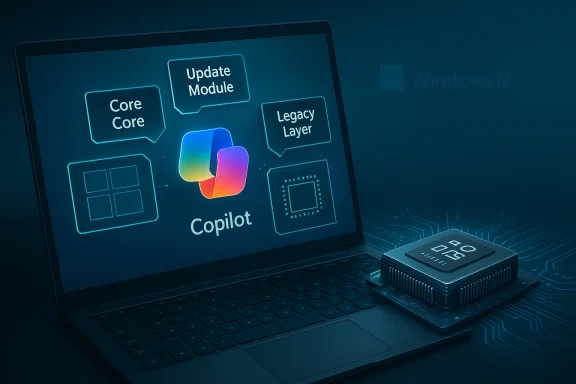
CorePC — as described in multiple reports and echoed in prior Microsoft work — aims to take the monolithic Windows image and break it into discrete, controlled partitions: a small, trusted core; optional feature modules; device‑type specific layers; and compatibility shims. That partitioning yields practical benefits:- Faster, smaller, and safer updates. Updating a single module is less disruptive than a monolithic image update: patches can be applied to inactive partitions and swapped atomically.
- Reduced attack surface. Read‑only or tightly controlled partitions can make it harder for malware and supply‑chain attacks to tamper with core system binaries.
- Tailored OS builds. OEMs could ship lightweight images for low‑end notebooks and richer images for gaming or workstation SKUs, while preserving a compatibility layer for legacy Win32 code.
Precedent: Windows Core OS and 10X
Microsoft has attempted similar approaches before: Windows Core OS and the shelved Windows 10X both explored a componentized Windows. Those projects produced ideas and code that Microsoft later reused; the current CorePC rumors sound like an evolution of these prior efforts rather than a wholly new invention. That makes the claim credible as a technical direction while still leaving open whether Microsoft will productize it as a full OS succession.Practical tradeoffs
- Developers will need to consider how feature partitioning affects API stability and compatibility.
- Enterprises that depend on legacy line‑of‑business apps will ask how compatibility layers are maintained and whether critical management tools remain supported across partitions.
- Faster updates reduce user friction but increase the operational tempo for IT teams tasked with validating patches.
AI as platform: Copilot moves from assistant to control plane
The rumor set insists Copilot becomes systemic — effectively the OS control plane for automation, semantic search, and natural‑language orchestration. That idea aligns with Microsoft’s public rhetoric and product moves:- Microsoft has integrated Copilot capabilities into Windows UI elements and productivity apps.
- Copilot+ PCs are already defined to enable local model execution for certain features, reducing latency and improving privacy for some workloads.
- System‑wide semantic search and Recall. Copilot indexing desktop activity to let users query “that document I edited last Tuesday” without manual search.
- Natural‑language automation. Asking the OS to “compile a project, run tests, and email the results” and letting Copilot orchestrate multiple applications.
- Contextual UI suggestions. Dynamic recommendations that adapt system settings, suggest shortcuts, or reconfigure windows based on observed workflows.
The hardware hinge: NPUs, 40 TOPS, and what that threshold really is
“40 TOPS” keeps appearing in reportage as the magic number. There’s solid evidence that Microsoft and industry partners used a 40 TOPS threshold when defining the early Copilot+ PC program and initial on‑device experiences. That threshold is already used to categorize which devices can run features like local model inference, image generation, and advanced Recall functionality without constant cloud reliance. In practice:- Qualcomm’s early Snapdragon X family claimed NPU figures in the 40–45 TOPS range and were singled out in early Copilot+ marketing.
- Intel and AMD have introduced AI accelerator blocks on their silicon roadmap and are positioning future parts to reach higher TOPS figures; existing chips in many 2023–2024 laptops remain below the 40 TOPS line.
What the rumored NPU gating would mean in practice
There are two related but distinct scenarios in the public discussion:- Microsoft requires a 40 TOPS NPU to upgrade or install the full new OS image. That would be a hard gate: many older PCs could be excluded from the successor OS entirely.
- Microsoft requires a 40 TOPS NPU only to run certain Copilot+ features locally. Systems without the NPU would still run the OS but rely more on cloud services or receive reduced functionality.
Business and market implications: OEMs, enterprises, and the channel
A move toward an AI‑centric Windows with hardware expectations would shift buying calculus across the PC ecosystem:- OEMs: Faster OS composition and modular builds could simplify SKUs and reduce time‑to‑market for form‑factor variations. Conversely, new silicon needs increase validation cost and narrow the list of chips qualifying for premium AI branding.
- Enterprises: IT shops will need to inventory devices, map which machines are capable of local AI workloads, and decide whether to standardize on Copilot+ hardware for a future‑proofed estate. Licensing costs escalate if advanced AI features are sold as subscription overlays.
- Channel partners: Migration services, device refresh financing, and Copilot+ validation are new revenue streams — but customers will seek transparent ROI calculations on whether on‑device AI materially improves business processes.
Privacy, security, and compliance: a triage
Embedding AI into the OS by default amplifies existing concerns:- Privacy: System‑level indexing and local model inference can be privacy‑positive if models run locally and data isn’t exfiltrated. But opaque telemetry or cloud fallbacks without clear consent would create serious trust issues. Enterprises regulated by sectoral rules must ask whether local AI processing meets compliance and audit requirements.
- Security: NPUs and new silicon introduce additional firmware and microcode attack surfaces. Conversely, modular CorePC partitioning could harden key system components and reduce risk from tampering.
- Forensics and eDiscovery: System‑wide Recall and activity indexing change the digital evidence landscape. Organizations must plan retention, access controls, and legal discovery policies around indexed content.
The subscription question: premium AI behind a paywall?
Reports that Microsoft may gate advanced AI experiences behind a subscription tier follow a pattern Microsoft has already adopted: base platforms remain buy‑once while cloud services and higher‑value features are monetized as subscriptions. That model is familiar across software vendors: base functionality remains available, while premium compute‑intensive features, larger context windows, or proprietary models are offered for a recurring fee.If Microsoft pursues a subscription overlay for premium on‑device or hybrid AI features, several consequences follow:
- It creates a two‑tier experience for users and enterprises.
- Enterprises will evaluate whether subscription features justify refresh budgets and licensing.
- The model accelerates cloud revenue for Microsoft while making advanced AI a recurring income stream.
What IT teams and consumers should do now
Until Microsoft issues formal plans, prudent preparation beats panic. Here’s a practical checklist:- Inventory your fleet. Record CPU family, NPU presence (if any), RAM, storage, and Current Windows build.
- Prioritize critical systems. For devices that must remain supported and compliant, build replacement or mitigation plans if they don’t meet modern security baselines.
- Watch for Copilot+ and Windows Insider guidance. Copilot+ hardware specs and Microsoft’s Insider channels will be early indicators of shift timelines and feature gating.
- Pilot hybrid models. Test Copilot features in a controlled group and evaluate whether local NPU processing materially improves workflows.
- Revisit application compatibility plans. Modular OS images are designed to preserve compatibility, but confirm that your line‑of‑business apps and management tooling work against new update models.
- Negotiate OEM and licensing terms. If subscriptions are introduced, lock in enterprise pricing or bundles where possible.
The skeptical read: why the timeline and branding remain doubtful
A respected Windows reporter with longstanding Microsoft contacts said the viral summary of leaks is wrong about a 2026 flagship Windows 12 launch and that Microsoft’s current focus is repairing Windows 11 rather than shipping a disruptive successor. That rebuttal matters because Microsoft has a history of long‑running exploratory projects that do not ship on a fixed timetable. CorePC‑style work could be quietly progressing while Microsoft focuses public product cadence on incremental improvements and feature flighting. The presence of code names and leaked artifacts is not proof of a near‑term, full‑numbered OS rollout.Two practical lessons follow:
- Treat early reports as strategic signal, not a guarantee of product dates.
- Distinguish between platform research and commercial product plans — the latter requires release dates, partner decks, and developer guidance that Microsoft typically publishes prior to broad shipping.
Risks and open questions
- Hardware lockout vs. feature gating. Which path Microsoft chooses has a massive downstream effect on upgrade cycles and e‑waste.
- Fragmentation. If CorePC spawns multiple, divergent Windows editions early, the developer and enterprise testing burden will spike.
- Regulatory scrutiny. Aggressive hardware gating or subscription shifts could attract antitrust and consumer protection attention in multiple jurisdictions.
- User trust. Privacy concerns around system‑wide indexing and the transparency of automated actions will determine user acceptance more than raw feature counts.
Final analysis: hype, signal, and how to judge Microsoft’s next move
The rumour wave around “Windows 12” stitches together three reliable truths: Microsoft is serious about embedding AI into Windows; the company and its partners have defined higher hardware thresholds for richer local AI experiences; and there is longstanding internal work exploring modular Windows architectures. Those elements create a plausible blueprint for a future OS iteration. What is not yet proven — and what matters the most — is how and when Microsoft intends to productize that blueprint.For now, treat the reports as a heads‑up: expect modular packaging, expect AI to move deeper into the platform, and expect Copilot to play a bigger role. Do not assume the internet’s current conflation of Copilot+ hardware specs with an install‑blocking OS requirement is final — it may simply be a packaging and feature‑qualification story similar to the existing Copilot+ PC program. Until Microsoft issues formal guidance with developer documentation, product SKUs, and upgrade paths, IT leaders should prepare pragmatically, and consumers should avoid knee‑jerk upgrades.
If you manage devices, inventory now, budget refresh cycles realistically, and watch Microsoft’s official channels for policy and compatibility details. If you’re an OEM or ISV, start validating your roadmaps against modular update models and on‑device AI runtimes. And if you’re a user deciding whether a new Copilot+ machine is worth the investment, weigh real productivity benefits against the cost of upgrading an otherwise perfectly functional PC.
Windows is changing; the question is how deliberately Microsoft will orchestrate that change. The signals about CorePC, embedded Copilot, and NPU‑driven capabilities are loud — but the calendar and the final shape of the product remain uncertain. Until then, cautious preparation and measured skepticism are the best posture for the millions who will be affected by whichever path Microsoft chooses.
Source: International Business Times, Singapore Edition Windows 12 May Require AI Chips, Reportedly Coming With Modular Design And AI-First Features
